

More news on this day
A year after a catastrophic midair collision over the Potomac River exposed critical blind spots in America’s crowded skies, lawmakers are betting that a new proposal, the ALERT Act, can usher in the most sweeping upgrade to collision-avoidance safeguards U.S. aviation has seen in decades.
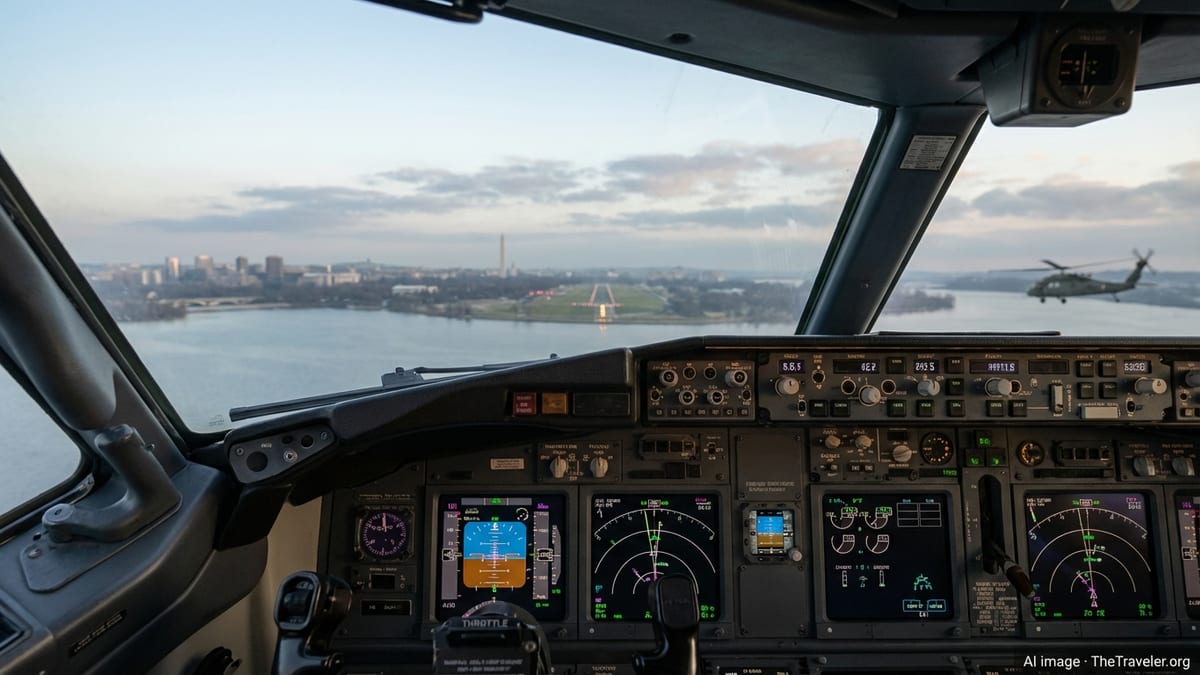
From Tragedy Over the Potomac to a Legislative Push
The ALERT Act, short for Airspace Location and Enhanced Risk Transparency, is the latest congressional response to the January 29, 2025 midair collision near Ronald Reagan Washington National Airport that killed all 67 people aboard a regional jet and a U.S. Army helicopter. The Potomac River crash, the deadliest U.S. air disaster in nearly a quarter-century, immediately refocused attention on how traffic is managed in some of the country’s most complex airspace and whether existing collision-avoidance systems are keeping pace with rapidly changing operations.
Preliminary findings from the National Transportation Safety Board highlighted a perfect storm of factors: high-density airspace, helicopter routes that brought low-flying aircraft within a few dozen feet of jetliners on final approach, and long-standing gaps in how military flights share their position and intent with civilian air traffic controllers. The investigation also documented monthly traffic collision avoidance system alerts in the Washington region going back years, a warning sign that systemic risk was building long before the fatal crash.
Into that context stepped a group of House committee leaders and frontline lawmakers from affected states, who in February 2026 rolled out the ALERT Act as a comprehensive blueprint for rebuilding the collision-avoidance architecture over major U.S. cities. Paired with a related bipartisan aviation safety package advancing in the Senate, the bill aims not only to address the specific failures seen over the Potomac but also to harden the entire national airspace system against similar midair threats.
What the ALERT Act Would Change in the Cockpit
At the heart of the ALERT Act is a mandate to modernize the tools pilots rely on to detect and avoid conflicting traffic. Many U.S. airliners and business jets still depend on older generations of traffic collision avoidance systems, which were designed for a different era of operations, before low-level helicopter corridors, proliferating drones, and new kinds of military training flights crowded into the same slices of sky.
The legislation directs the Federal Aviation Administration to evaluate and accelerate adoption of newer, software-driven systems that can provide earlier, more intuitive warnings and more precise resolution instructions when aircraft paths converge. These next-generation systems, rooted in the evolving ACAS X family of algorithms, are built to handle dense environments with mixed aircraft types, from fast jets to slow rotorcraft, and to interpret more complex patterns of closing speeds and altitudes.
Under timelines envisioned in the bill, commercial operators would face clear deadlines to retrofit fleets with upgraded avionics capable of ingesting richer surveillance data, including more detailed Automatic Dependent Surveillance Broadcast information, and turning that into predictive, rather than purely reactive, alerts. The intended result is a cockpit where traffic conflicts are detected sooner, displayed more clearly, and resolved with fewer ambiguous or contradictory instructions to pilots already under heavy workload on approach or departure.
Supporters argue that these changes would mark the biggest leap in airborne collision-avoidance capability since the United States first required modern TCAS equipment on airliners in the 1990s. For passengers, the shift would be largely invisible, but industry safety experts say it could be decisive in preventing the kind of last-second, low-altitude conflict that unfolded over the Potomac.
Pairing ADS-B With Next-Generation Collision Avoidance
The ALERT Act arrives alongside a parallel push in the Senate to tighten how aircraft broadcast and receive their position, speed, and altitude using ADS-B, the satellite-based tracking system that underpins much of modern air traffic management. A bipartisan aviation safety bill approved by the Senate Commerce Committee in late 2025 would, for the first time, require a wide range of operators to add ADS-B In technology in the cockpit, not just the ADS-B Out transmitters already mandated on most aircraft.
ADS-B Out allows aircraft to continuously send their position to ground stations and other aircraft, while ADS-B In lets pilots receive and display that same traffic picture in real time. Combined with enhanced collision-avoidance logic, ADS-B In can give crews a far more detailed view of nearby aircraft, including those operating just outside controlled airspace or in low-level corridors, and can support ground and runway traffic alerts that help prevent surface collisions.
For collision avoidance, the marriage of ADS-B and ACAS X-style systems is critical. With more accurate and frequent position updates, airborne algorithms can model trajectories more precisely and distinguish between benign and hazardous crossings. That, in turn, reduces nuisance alerts that can desensitize crews and increases confidence when a genuine resolution advisory is issued. Lawmakers backing the ALERT Act argue that codifying technology standards and timelines now will ensure that cockpit upgrades and ground infrastructure investments move in lockstep rather than creating fragmented, incompatible islands of capability.
Industry groups have pressed Congress and the FAA to manage costs and certification workloads carefully, especially for regional carriers and small operators with tight margins. But many also acknowledge that the Potomac collision underscored the limitations of relying on legacy systems in an era when aircraft density and diversity around major hubs continue to grow.
Closing the Civil–Military Visibility Gap
One of the most consequential shifts embedded in the ALERT Act and related proposals involves how military aircraft operate in civilian-controlled airspace, particularly around sensitive regions like the nation’s capital. The Potomac collision laid bare the risks of exemptions that allowed certain defense flights to operate with limited or no real-time position broadcasting, leaving civilian pilots and controllers with an incomplete picture of nearby traffic.
The House bill and the Senate’s broader safety package both move to sharply restrict those carve-outs. Training flights, routine proficiency sorties, and many missions involving federal officials would be required to transmit full ADS-B data when operating near major commercial airports, with only narrowly defined exceptions for truly sensitive operations. Oversight provisions would compel regular reporting to Congress on how often remaining exemptions are used and whether they correlate with elevated risk in particular corridors.
Aviation safety advocates say this shift could be transformative. For decades, civil and military airspace management has depended on a patchwork of memorandums, local agreements, and informal deconfliction practices. By hard-coding data-sharing expectations into statute and backing them with audits and inspector general reviews, the ALERT Act aims to make civil–military coordination more transparent and predictable, especially in crowded terminal areas.
The Defense Department has historically balanced safety concerns with operational security, arguing that constant public broadcasting of sensitive flights could expose national security vulnerabilities. The emerging compromise, shaped by both the Alert Act and the Senate’s ROTOR framework, leans toward default transparency in peacetime training and transportation missions while preserving limited tools for concealing the most sensitive operations, subject to after-the-fact scrutiny.
Reimagining High-Risk Urban Air Corridors
Beyond onboard technology and military policy, the ALERT Act seeks to tackle a more structural problem that the Potomac crash brought into sharp relief: the design of low-level routes for helicopters and other specialized operators in dense urban corridors. Investigators found that in the Washington area, certain helicopter paths could bring aircraft to within tens of feet vertically of airliners on final approach, leaving virtually no margin for error when either aircraft deviated, even slightly, from its intended path.
To address that, the bill directs the FAA to conduct comprehensive safety reviews of airspace designs around Ronald Reagan Washington National Airport and other major and mid-sized airports nationwide. Those studies are expected to examine how routes used by law enforcement helicopters, air ambulances, sightseeing operators, and, increasingly, drones intersect with fixed-wing traffic flows and instrument approach paths.
In practice, that could lead to redesigned helicopter corridors with clearer lateral boundaries, minimum distances from approach paths, and altitude buffers, along with more explicit procedures for how rotorcraft should transit in poor visibility or during peak arrival and departure banks. Lawmakers want the resulting assessments made public within weeks of completion, a transparency measure intended to keep pressure on regulators to follow through with concrete redesigns rather than letting the reviews gather dust.
Urban planners and local officials are watching closely, especially in regions where rivers, stadiums, hospitals, and restricted zones already funnel aerial activity into narrow strips of airspace. The ALERT Act could effectively trigger a nationwide rethink of how cities manage their three-dimensional traffic, with ripple effects for everything from emergency medical response times to sightseeing flights over iconic skylines.
Implications for Airlines, Pilots, and Travelers
If enacted, the ALERT Act and its Senate counterparts would trigger a multi-year implementation campaign stretching across airlines, regional carriers, business aviation, helicopter operators, and the military. For airlines, the most visible impact would likely be avionics retrofits, as carriers schedule aircraft into maintenance bays to install upgraded collision-avoidance computers, ADS-B In receivers, and new cockpit displays capable of presenting richer traffic data.
Pilot training would also shift. Flight crews would need to learn the behavior and logic of more sophisticated alerting systems, including how to respond to new types of advisories tailored to low-altitude environments or mixed fleets of aircraft. Training centers could incorporate more scenarios involving helicopter and drone traffic near major airports, as well as revised procedures for interactions with military flights now more consistently visible on cockpit displays.
For travelers, the benefits would largely take the form of risk reduction that never shows up in a headline. Lawmakers and regulators hope that more accurate warn-and-avoid systems, coupled with better-designed airspace and clearer rules for military flights, will prevent the kind of chain reaction that turned an ordinary approach over the Potomac into a national tragedy. Some airlines caution that equipment mandates, if not phased carefully, could place short-term pressure on fares or schedules, particularly for smaller regional fleets, but most acknowledge that the cost of inaction could be far higher.
Unions representing pilots and air traffic controllers, many of whom have long pressed for modernization of both cockpit equipment and ground systems, are expected to push for robust funding and realistic timelines to avoid overburdening front-line workers already strained by staffing shortages and pandemic-era disruptions.
How the ALERT Act Fits Into a Broader Safety Modernization Wave
The ALERT Act does not exist in isolation. It is part of a broader wave of safety-focused legislation and regulatory efforts that have gathered momentum over the past several years across the U.S. aviation system. Recent initiatives have targeted everything from the resilience of critical FAA computer systems to the expansion of cockpit voice recorder retention and the modernization of notice-to-air-missions alerts.
The Potomac collision, coming after a series of high-profile runway incursions and close calls at major airports, has amplified public and political appetite for deeper reforms. In Congress, that has translated into rare bipartisan alignment on many core principles: that surveillance data must be more comprehensive, that collision-avoidance algorithms must reflect current and emerging operations, and that civil–military boundaries in the sky must be clearer and more enforceable.
Safety experts see parallels with earlier inflection points in U.S. aviation, such as the adoption of radar control standards in the wake of midcentury midair collisions and the introduction of mandatory TCAS on airliners in the late twentieth century. Those changes were initially costly and complex but are widely credited with preventing countless accidents over subsequent decades. Proponents of the ALERT Act argue that today’s mix of commercial traffic, general aviation, helicopters, and drones represents a new era requiring a similarly decisive response.
As the House prepares to debate the bill and Senate leaders move their own safety package toward floor consideration, the central question is no longer whether collision-avoidance systems must evolve, but how quickly and comprehensively that evolution should occur. The stakes, lawmakers remind their colleagues, are not abstract: they are measured in lives lost or saved the next time two aircraft cross unseen paths in crowded American skies.