

More news on this day
As the Department of Homeland Security shutdown stretches into its fifth week, U.S. travelers are facing a shifting patchwork of security delays, staffing shortages and isolated airspace disruptions that are complicating spring and early summer travel plans.
Get the latest news straight to your inbox!
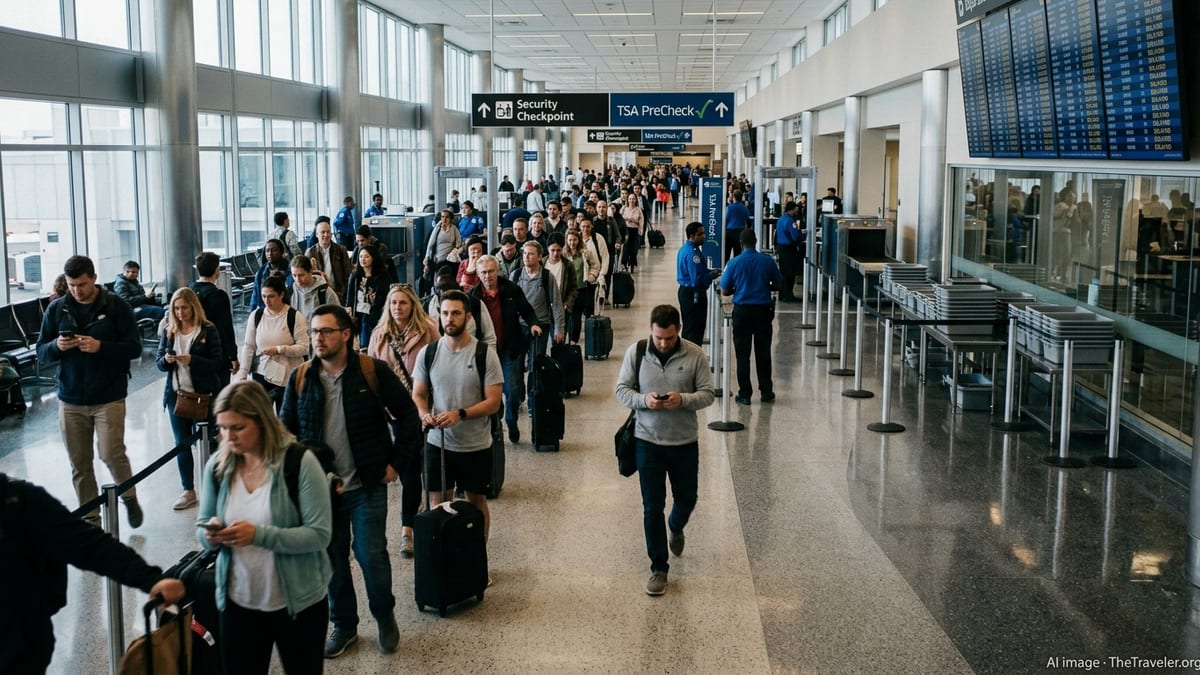
TSA Staffing Strains Translate Into Unpredictable Wait Times
Publicly available information indicates that most Transportation Security Administration operations remain formally open, with officers designated as essential and required to report even without pay. In practice, however, the shutdown is driving higher rates of unscheduled absences and resignations, which are translating into unpredictable security wait times across the country.
Recent coverage from national outlets and aviation data providers points to multi-hour security lines at several large and mid-sized airports, particularly at the height of early morning and late afternoon peaks. Reports from Houston’s Hobby Airport and Atlanta’s Hartsfield-Jackson International describe travelers waiting 90 minutes or more to clear checkpoints on some days, even outside of major holiday periods.
Travel industry analysis suggests that the pressure is particularly acute at airports with heavy leisure and spring break traffic, where family and student travelers are colliding with thinner staffing levels at checkpoint lanes. Unlike weather-related disruptions, these delays can be highly uneven, with some airports continuing to function relatively smoothly while others experience sudden bottlenecks from one day to the next.
Because TSA is not fully updating some public channels during the partial shutdown, travelers have fewer official tools to gauge day-of wait times. As a result, experts recommend assuming that lines may be longer than usual at any airport where federal staffing has been affected, especially during peak morning departures.
Airport and Airspace Closures: What “ATC Zero” Really Means
Separate from checkpoint bottlenecks, travelers are also contending with a different kind of disruption: temporary reductions or suspensions of air traffic control services when facilities cannot be staffed safely. Federal Aviation Administration directives describe these events using terms such as “ATC Limited” and “ATC Zero,” which signal that a tower, radar facility or control center has lost its ability to manage normal traffic.
Historical data from the 2018–2019 and 2025 shutdowns shows that staffing shortfalls at key FAA facilities have, on occasion, led to ground stops and reduced arrival or departure rates at major airports, including New York’s LaGuardia and Los Angeles International. More recent reports in 2025 noted a temporary ground stop for flights to Los Angeles due in part to staffing constraints at a Southern California control facility, illustrating how quickly conditions can change when critical posts go unfilled.
In most current cases, the result for travelers is not a dramatic airport closure but a cascade of delays as fewer controllers handle a reduced number of movements per hour. Flights may be spaced farther apart for safety, which can snarl schedules nationwide as aircraft and crews fall out of position. This dynamic has been visible again during the 2026 DHS shutdown, where weather systems have interacted with thinner staffing to produce outsized ripple effects in hubs such as Atlanta.
While complete airport shutdowns remain rare and are usually tied to safety or security incidents rather than staffing alone, recent airspace restrictions in parts of Texas and New Mexico and earlier shutdown-era tower slowdowns underscore that travelers cannot assume business as usual. Even when an airport remains open, the effective capacity of its runway and airspace system can be sharply curtailed.
Programs Like TSA PreCheck and Global Entry Are Not Immune
Travelers who rely on trusted traveler programs are encountering additional uncertainty. Publicly available DHS and Customs and Border Protection updates show that Global Entry enrollment and some processing activities were paused earlier in the current shutdown before being partially restarted in March. TSA PreCheck enrollment has also been the subject of shifting guidance, with initial suspension notices followed by clarifications that screening benefits for existing members would continue.
Industry coverage indicates that, while active PreCheck members can generally still access expedited lanes, staffing shortages may limit how many dedicated lanes are open at a given checkpoint and time of day. At some airports, only a subset of lanes is staffed, meaning that even PreCheck travelers can encounter longer lines than they are accustomed to, particularly when officers are reassigned to regular screening to manage volume.
For arriving international passengers, the earlier pause and subsequent reactivation of Global Entry processing has contributed to backlogs at passport control in some gateways. Travelers arriving without access to Global Entry or Mobile Passport options are more exposed to primary inspection delays, which can be amplified when CBP staffing is affected by the same budget impasse constraining TSA.
Travel advocacy groups and airport operators are using public statements to urge Congress to stabilize funding for these programs, arguing that frequent shutdown-related disruptions erode traveler confidence and diminish the time-saving value of expedited screening and entry services.
How US Travelers Can Plan Around Shutdown-Related Disruptions
With the DHS shutdown still unresolved as of mid-March 2026, travel advisors and industry associations are circulating practical guidance aimed at helping passengers reduce risk. Common recommendations include arriving earlier than usual for departures, particularly at large hubs and heavily impacted airports that have reported multi-hour lines in recent days.
Travel trade groups emphasize that smaller regional airports can be especially vulnerable because they have fewer redundant staff and limited flexibility to open additional lanes or adjust schedules. Guidance documents shared with member agencies suggest building in extra connection time when itineraries route through known bottlenecks and avoiding tight layovers that leave little margin for checkpoint delays or ground holds.
Technology can provide partial relief. Aviation data services, airline apps and some third-party tools allow travelers to monitor delay patterns and congestion trends, even if they do not track TSA wait times specifically. Publicly available coverage notes that, during the current shutdown, these tools have helped passengers spot trouble spots such as Houston Hobby and adjust departure times or routing when possible.
Travelers are also being encouraged to pack carry-on bags strategically to reduce secondary screening, verify that identification documents are current, and stay alert to changing conditions on the day of travel. Experts note that while shutdown-related disruptions can be significant, they are often uneven, making preparation and flexibility more important than any single prediction about where problems will appear next.
Longer-Term Concerns About TSA and FAA Workforce Stability
Beyond the immediate delays and sporadic ground stops, policymakers and labor organizations are raising broader concerns about the sustainability of the aviation security and air traffic control workforce. Public congressional testimony and union statements after the 2025 shutdown documented elevated resignation rates among TSA officers and ongoing challenges in recruiting and retaining controllers.
Analysts warn that repeated shutdowns, including the current 2026 impasse, may discourage prospective applicants and push experienced personnel to seek more stable employment, deepening existing staffing gaps. These trends can have lasting effects, since both TSA screening and air traffic control require significant training and certification before new hires can operate independently.
Travel and airline industry groups argue that the cumulative impact of multiple shutdowns is being felt by passengers in the form of chronic understaffing, aging infrastructure and less resilient operations. They point to the pattern of long wait times resurfacing quickly whenever pay or funding is disrupted as evidence that the system is already operating near its limits.
For U.S. travelers, the practical takeaway is that aviation disruptions tied to government funding disputes are no longer one-off anomalies but recurring risks. Until a longer-term funding solution is reached, experts expect that periods of political stalemate will continue to manifest as sudden spikes in wait times, scattered airport slowdowns and, in rare cases, temporary airspace closures that echo far beyond Washington.