

More news on this day
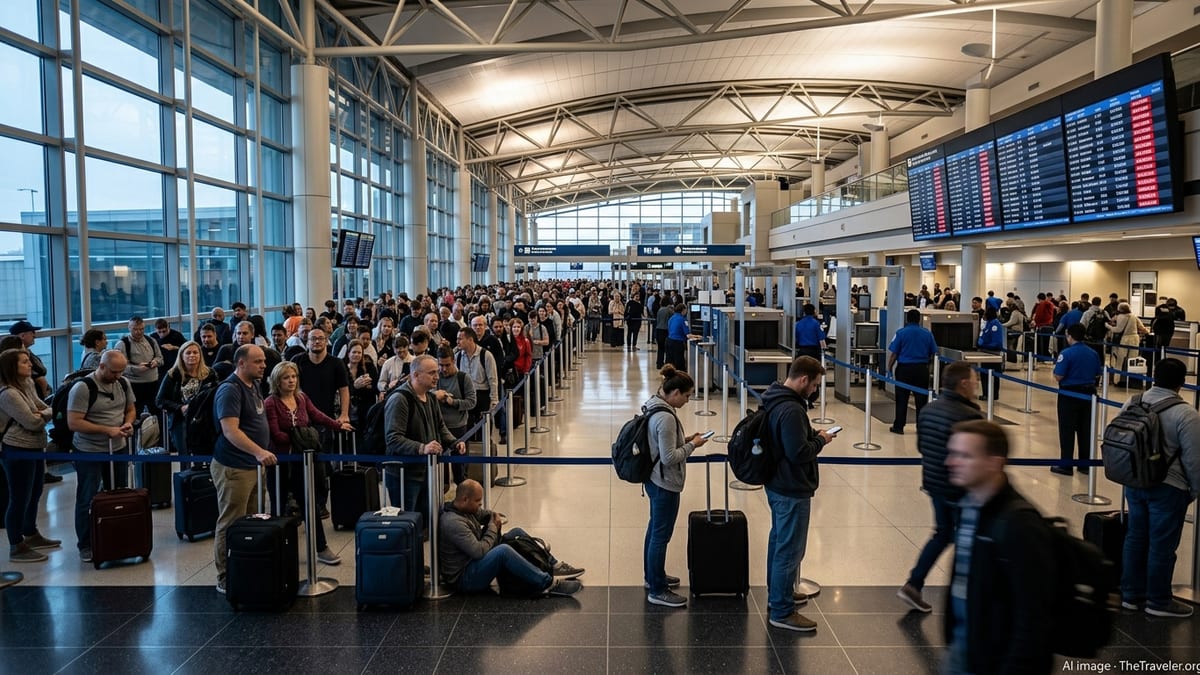
Weeks into a partial shutdown of the U.S. Department of Homeland Security, once-routine airport trips are turning into endurance tests, with mounting security lines, scattered flight cuts and rising anxiety about how long the system can hold.
Get the latest news straight to your inbox!
A Shutdown That Hits the Heart of Airport Operations
The current Department of Homeland Security funding lapse, which began on February 14, 2026, has left tens of thousands of Transportation Security Administration and other Homeland Security personnel working without pay while many administrative and support staff are furloughed. Publicly available information shows that this partial shutdown is narrowly focused on DHS, avoiding a broader federal closure but concentrating pressure on the agencies that keep airports running.
Core aviation safety functions, including air traffic control and front-line security screening, are classified as essential. That legal designation has kept flights operating, but it has not insulated the system from disruption. Reports indicate that unpaid workers are increasingly reshaping their schedules, seeking side jobs or leaving altogether, slowly eroding the staffing cushion that large airports depend on during busy travel periods.
Recent analyses of previous shutdowns suggest that the immediate risks to flight safety remain low, but operational resilience weakens as the days stretch into weeks. Patterns observed during the lengthy 2025 federal shutdown, when air traffic controllers and TSA officers also worked without pay, showed that rising sick calls and burnout translated directly into longer lines and localized flight delays at major hubs.
Security Lines Stretch as TSA Struggles to Staff Checkpoints
The most visible sign of strain for travelers has been at the security checkpoint. According to recent coverage, airports around the country have reported unusually long waits as TSA grapples with staffing shortages and overtime limits. At Houston’s George Bush Intercontinental Airport, security lines recently approached four hours at peak times, with only a fraction of normal checkpoints open for much of the day, despite additional personnel from other federal agencies being present on site.
TSA screening is designed with minimal slack, and the loss of even a small share of officers can have outsized effects. When a critical mass of staff members cannot or will not work extended unpaid shifts, queues build quickly and ripple through the rest of the travel day. Public statements from unions and industry groups emphasize that many officers are front-line workers living paycheck to paycheck, making it increasingly difficult to sustain full staffing through a prolonged funding lapse.
Programs that are normally pressure valves for the system have also faced uncertainty. Early in the shutdown, some reports suggested that popular expedited screening programs such as TSA PreCheck and Global Entry could be scaled back, prompting confusion among frequent travelers. Subsequent reporting indicated that fee-funded programs would largely continue, but enrollment and renewal services faced intermittent disruptions, adding another layer of frustration for travelers planning ahead.
Air Traffic Control Under Stress, But the Sky Stays Open
Behind the scenes, the shutdown is also bearing down on the air traffic control system. Federal aviation staffing was already tight heading into 2026 after years of hiring backlogs and retirements. During the 2025 federal government shutdown, public records show that controller hiring and training were halted, while existing controllers continued to work mandatory overtime without pay. As staffing thinned, major airports including Nashville, Dallas, Chicago and Newark reported surging delays tied to controller shortages.
In the current DHS-focused shutdown, the Federal Aviation Administration itself remains funded, limiting the risk of a full-scale collapse in flight operations. Even so, chronic staffing constraints coupled with mounting fatigue among essential personnel are beginning to show up in delay statistics and anecdotal accounts from frequent travelers. Online forums and social media posts in recent days describe repeated ground holds and rolling delays, with passengers uncertain whether the issues stem from weather, staffing, or both.
Industry observers note that the safety architecture of U.S. aviation is built with multiple redundancies, and there is no indication that basic separation standards between aircraft are being compromised. The larger concern is systemic: as controllers and security staff absorb week after week of unpaid labor, the risk grows that more may call in sick, transfer, or leave the profession, forcing traffic reductions and more aggressive schedule cuts at already busy airports.
Where Travelers Are Feeling the Worst of the Chaos
Travelers are not experiencing the shutdown’s impacts evenly. Large hub airports that process tens of thousands of passengers per day are bearing the brunt, particularly where staffing was already tight before the funding lapse. Publicly available reporting points to Houston, Atlanta, New York area airports and Washington’s Reagan National among the hardest hit during recent shutdown-related disruptions, as fewer open checkpoints and minimal spare staffing quickly snowball into multi-hour delays.
Some smaller airports have warned that they could be forced to temporarily suspend commercial operations if security staffing falls below minimum thresholds for sustained periods. In parallel, public discussions within the airline and aviation community have highlighted the possibility of targeted flight reductions at busy hubs if air traffic control staffing continues to deteriorate, echoing earlier warnings during the 2025 shutdown that deeper cuts might be needed to preserve safety.
Not every airport is in crisis. Facilities that rely on private security contractors instead of federal screeners have largely avoided the worst checkpoint delays, offering a patchwork of experiences for travelers depending on origin and destination. This uneven impact is adding to the perception of unpredictability: a passenger may clear security quickly departing from one city only to encounter severe bottlenecks on the return leg through a different airport.
For now, the practical advice emerging from airlines, travel insurers and industry groups is consistent. Travelers are being urged to arrive significantly earlier than they would during normal operations, monitor flight status closely and prepare for missed connections where tight layovers rely on swift passage through security. At the same time, some travel insurance policies explicitly exclude shutdown-related disruption announced in advance, leaving many passengers to absorb added costs on their own.
Is Your Next Flight at Risk?
Despite the unsettling headlines, most scheduled flights in the United States are still taking off and landing each day. The question for travelers is less about outright risk of cancellation and more about the likelihood of long queues, creeping delays and last-minute schedule changes as the shutdown continues. Data from previous funding lapses suggests that the longer a shutdown lasts, the more likely it becomes that staffing gaps will force airlines and regulators to pare back flight schedules in specific markets.
Industry associations have repeatedly warned that prolonged disruption at airport checkpoints and within the air traffic control system could ripple across the wider economy, discouraging travel and undermining confidence during key vacation and business travel periods. Estimates produced during the 2025 shutdown suggested that travel-related economic losses could quickly reach into the billions of dollars, and early commentary around the current DHS impasse points to similar concerns.
For individual travelers, the practical risk calculation is evolving day by day. Publicly available information shows that core safety functions remain intact and that there is no broad directive to halt flying. The greater hazard lies in travel plans that leave little margin for disruption. Tight connections, last flights of the day and complex itineraries involving multiple hubs are currently more vulnerable to the cascading effects of a strained system.
Until funding for the Department of Homeland Security is restored, travelers moving through U.S. airports face an environment defined less by outright shutdown of aviation and more by volatility and uncertainty. Each additional week of the impasse chips away at staffing, morale and schedule reliability, increasing the odds that the next wave of travel chaos could hit just as passengers arrive at the airport, boarding pass in hand.