

More news on this day
As a partial U.S. government shutdown drags into its second month, the effects are rippling through the nation’s aviation system, from hours-long security lines at major hubs to mounting questions over whether some smaller regional communities will soon lose their only commercial air links.
Get the latest news straight to your inbox!
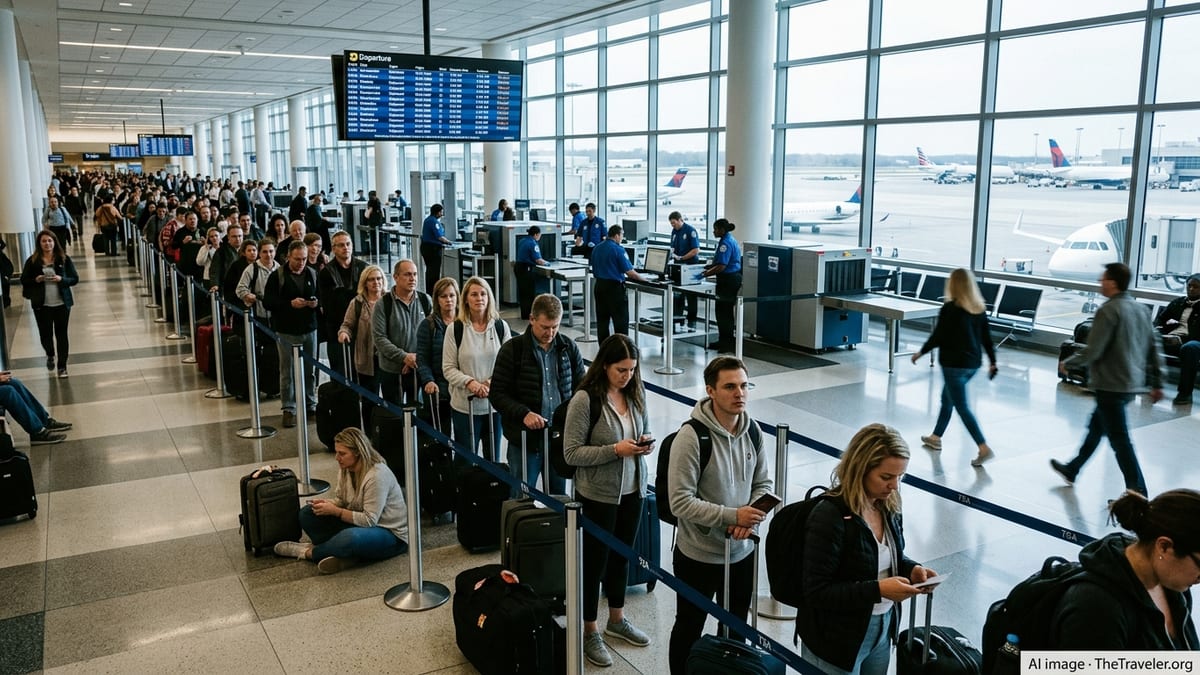
Airport Security Lines Stretch as TSA Works Without Pay
The current funding lapse has hit the Department of Homeland Security particularly hard, leaving Transportation Security Administration officers classified as essential and required to work without pay. Publicly available information shows that at several large airports, security wait times have already climbed well beyond typical spring levels, with some travelers reporting lines of more than three hours at peak periods.
Recent coverage points to Houston and New Orleans among the early flashpoints, where the combination of higher passenger volumes and unpaid staff has strained checkpoints. Travel advisories from industry groups are urging passengers across the country to arrive significantly earlier than usual, even for domestic flights, to avoid missing departures as screening backlogs grow.
Aviation analysts warn that the longer the shutdown lasts, the more likely it becomes that unpaid officers will begin calling in sick or seeking other work, compounding shortages in a system that was already under staffing pressure. Past shutdowns have followed a similar pattern, with an initial period of near-normal operations followed by sudden spikes in wait times once financial stress on federal workers deepens.
The result for travelers in the coming weeks could be a patchwork of conditions: some airports operating close to normal, while others periodically seize up as understaffed lanes fail to keep pace with demand. For families heading out on long‑planned vacations or students traveling over spring breaks, whether a trip begins smoothly may depend largely on the luck of the departure airport and time of day.
Flight Delays Mount as FAA Juggles Safety With Fewer Resources
While air traffic controllers generally remain on the job during shutdowns, the Federal Aviation Administration faces a different kind of squeeze. Hiring, training, and many non‑essential programs are paused, and thousands of support staff have been furloughed. Industry briefings describe a system in which controllers are working longer hours to keep core services running while back‑office functions, from inspections to technology upgrades, slow or stop.
Recent reporting has documented days with several thousand delays across the United States, attributing a growing share to staffing limitations at key air traffic control facilities rather than weather alone. In earlier shutdowns, the FAA responded by imposing ground delays and modest capacity cuts at congested hubs to avoid overloading controllers, a strategy analysts expect could return if current pressures continue.
Previous federal funding lapses offer a stark precedent. During the 2018–2019 shutdown, growing staffing gaps forced temporary restrictions on arrivals at New York’s LaGuardia and affected operations at major airports in New Jersey and Florida. Historical analyses show that, by the end of that 35‑day impasse, thousands of flights had been delayed or canceled as the system absorbed the strain.
What makes the present situation particularly fragile is that it comes on top of an already tight controller workforce and a post‑pandemic rebound in demand. Aviation consultants note that even a modest percentage reduction in available staff can ripple through schedules for days, creating rolling disruptions that travelers may feel long after any budget deal is signed.
Hidden Casualties: Regional Airports and Small‑City Routes
Behind the headlines about crowded hubs lies a quieter vulnerability: the network of small and mid‑sized airports that depend on just a handful of daily flights to connect their communities with the rest of the country. Many of these destinations rely on regional jets and smaller carriers that operate on thin margins and tight crew schedules.
When the system comes under stress, past shutdowns and recent industry commentary suggest that regional links are often the first to be trimmed. Airlines have strong incentives to preserve capacity on trunk routes linking major hubs, where larger aircraft and higher passenger volumes generate more revenue. By contrast, a lightly used flight to a small city is an easier target for temporary suspension or consolidation if air traffic capacity is capped or ground operations are disrupted.
Business aviation groups and local airport authorities have raised concerns that prolonged furloughs of FAA inspectors and certification staff could delay aircraft approvals, crew training checks, and infrastructure projects that are especially important outside the big coastal gateways. Testimony submitted to Congress in recent months describes backlogs in simulator checks and safety inspections following earlier shutdowns, which took months to unwind even after agencies were fully funded again.
For travelers, the impact may be felt as suddenly higher fares, fewer departure times, or the disappearance of non‑stop options from smaller hometown airports. In extreme cases, communities that currently see only one or two daily flights could find themselves temporarily cut off from the commercial air network if a carrier decides that maintaining service during a prolonged budget standoff is no longer viable.
Traveler Strategies as the Shutdown Drags On
Consumer advocates and travel experts are advising passengers to treat the current shutdown as a live operational risk rather than a distant political dispute. One recurring recommendation is to build extra time into every stage of a journey, from arriving earlier at security to allowing longer layovers between connecting flights, especially at busy hubs that are more vulnerable to bottlenecks.
Another theme emerging from published guidance is the value of flexibility. Travelers who can shift departure times to earlier in the day, when schedules are less backed up, may have better odds of avoiding cascading delays. Rebooking onto non‑stop flights, where available, can reduce exposure to disruptions in the broader network, even if it means paying slightly more upfront.
Insurance products that cover delays and missed connections are drawing renewed attention, although policy details vary widely. Experts emphasize that travelers should read the fine print carefully to understand what constitutes a covered event and whether government shutdown‑related disruptions are included. At the same time, major airlines are under pressure from regulators and industry groups to maintain clear, consistent rebooking policies as the situation evolves.
For now, publicly available data and recent coverage suggest that flying in the United States remains fundamentally safe, but also increasingly unpredictable. With no clear timeline for a funding compromise on Capitol Hill, travelers booking spring and early summer trips face a moving target in terms of how much disruption they may encounter, both at big‑city hubs and at the smaller regional gateways that keep much of the country connected.