

Quartier Petit Champlain is one of Quebec City’s most atmospheric corners, a riverside warren of stone facades, hanging signs and cobblestone lanes often described as a real-life postcard.
Exploring it properly is not about racing through the sights, but slowing down and following the neighborhood’s natural rhythm. This step-by-step guide walks you through a thoughtful route, helping you experience Petit Champlain’s history, views, food and local boutiques in an easy, logical order.
Start Above the Quarter: Orient Yourself in Upper Town
The best way to understand Quartier Petit Champlain is to begin above it. Start your visit on Dufferin Terrace, the long wooden promenade that wraps around the Fairmont Le Château Frontenac and looks down toward the St. Lawrence River. From here you can see just how the Lower Town is tucked beneath the cliffs of Cap Diamant, with Petit Champlain lying directly below. Take a few minutes to scan the panorama so you can later recognize the streets and rooftops you will be walking through.
Use this moment to get your bearings. To one side lies the Upper Town’s fortified core, with its stone walls and steep streets; straight ahead is the river, often busy with ships, cruise boats or the Quebec–Lévis ferry; below the terrace, clustered along the base of the cliff, is the compact area that forms Quartier Petit Champlain. It helps to picture your visit as a loop: you will descend to the quarter, walk through its lanes, reach the riverfront, possibly ride the ferry, then return to Upper Town by funicular or stairs.
Before heading down, note two key access points. The Funiculaire du Vieux-Québec has its upper entrance directly on Dufferin Terrace near the Château front lawn, providing an easy glide down to Rue du Petit-Champlain. A little farther along, the top of the Breakneck Stairs drops steeply toward the Lower Town. Deciding between them now sets the tone of your visit: one is effortless and scenic, the other is more physical and immersive.
If you have time, walk the length of Dufferin Terrace to appreciate the changing angles over the river and Lower Town. In the morning, the light tends to be soft and slanting across the rooftops; late afternoon brings warm tones on the stone buildings; evenings are all about twinkling lights below. These shifting moods will shape how Petit Champlain feels when you finally enter it.
Choose Your Descent: Funiculaire or Breakneck Stairs
Most travelers reach Quartier Petit Champlain either via the Old Quebec funicular or down the famous Breakneck Stairs. Each option offers a different style of arrival, and if you have time in your schedule, you may want to try both at different moments in the day.
The Funiculaire du Vieux-Québec is the most relaxed route. Open year-round, it links Dufferin Terrace directly with Rue du Petit-Champlain, descending at a steep angle alongside the cliff face. The ride takes little more than a minute, but the glass cabin offers a striking view over the Lower Town and river. It is especially convenient if you have luggage, limited mobility or are visiting in winter when the steps may be slippery. The lower station emerges almost at the heart of the quarter, so you step straight into the action.
The Breakneck Stairs, by contrast, provide an old-world, slightly dramatic approach. This set of wooden and stone steps descends from Côte de la Montagne toward Rue du Petit-Champlain, with small landings that act as impromptu viewing platforms. As you walk down, look up occasionally at the cliff, the closely stacked buildings and the backs of the Upper Town structures rising above you. This route can be quite photogenic, especially when snow coats the roofs or summer plants spill from balconies, but you need to be comfortable on stairs and prepared for the climb back up later if you decide not to use the funicular.
Whichever way you choose, pause halfway down and remember that you are following in centuries of footsteps. Merchants, sailors and residents have been moving between Upper and Lower Town since the early days of New France, hauling goods and supplies along these same slopes. Keeping that in mind adds a layer of meaning to what otherwise might feel like a simple practical choice of route.
Enter the Heart of Rue du Petit-Champlain
Once you reach the bottom of the cliff, you are ready for the main act: Rue du Petit-Champlain itself. This pedestrian lane, only a few hundred meters long, forms the spine of the quarter. Flanked by two- and three-story stone houses with sloping roofs, painted shutters and old-fashioned shop signs, it is often cited as one of the oldest commercial streets in North America. The street’s compact scale and consistent architecture make it feel cohesive, like a preserved village that happens to sit inside a modern city.
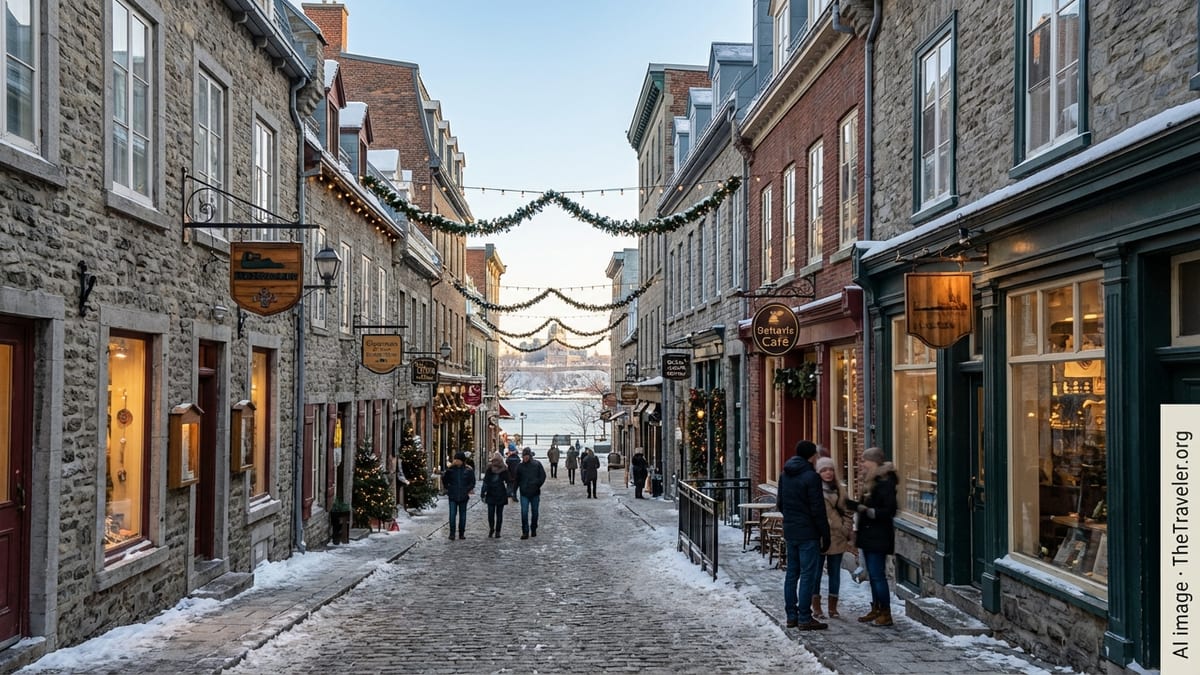
Begin at whichever end you arrive, but walk slowly. The visual details are what make this district memorable: carved wooden storefronts, iron brackets supporting lanterns, tiny balconies filled with flowers in summer, and seasonal decorations that change with the calendar. In winter and over the holidays, evergreen boughs, wreaths and strings of warm white lights are draped across the street, creating a tunnel of glow that can feel almost storybook, especially when snow muffles the sound of footsteps.
As you move along the lane, resist the urge to dart into every shop right away. First, take a full pass of the street to understand its rhythm. Notice where it widens into small pockets of public space and where narrow passages run off toward Place-Royale or the riverside. Listen for the mix of languages as visitors and locals intersect. You may even spot delivery carts or staff preparing terraces and displays, reminders that this is a working neighborhood, not a film set.
When you complete a first slow walk, consider turning back and repeating the route in the opposite direction, this time ducking into whichever places piqued your curiosity. The street looks surprisingly different just by reversing your orientation, and it ensures you do not miss a particular courtyard or side alley because you were focused on something else the first time through.
Explore Shops, Cafés and the Theater Step by Step
With your overview complete, it is time to explore the district’s businesses in more detail. The cooperative that manages Quartier Petit Champlain brings together dozens of merchants, many of them local artisans and independent retailers. This structure helps maintain a certain character: while there are souvenirs, the emphasis typically leans toward Quebec-made products, from clothing and jewelry to gourmet foods and artwork.
Move methodically so your visit feels intentional rather than rushed. You might start at one end of Rue du Petit-Champlain and work your way door by door. Step into a clothing boutique that highlights Quebec designers, noting the different cuts and fabrics that are practical for the region’s climate. Next, wander into a gallery showing paintings or photography of Old Quebec, giving you new ways of seeing the very streets you are walking. Gourmet and specialty food stores are ideal for picking up maple products, local chocolates, preserves or spice blends that travel well and make meaningful gifts.
Plan a pause in a café or small bistro partway through your circuit. A morning coffee on a terrace in summer, or a hot chocolate in winter, gives you an excuse to simply sit and watch how the neighborhood moves. You will notice how groups of day-trippers flow in waves, how residents cut quickly along certain side streets, and how tour guides cluster near particular corners to give historical explanations. This observational break can be as rewarding as any attraction.
Do not overlook the cultural dimension of the area. The Théâtre Petit Champlain, a well-known performance venue, sits right in the quarter and often hosts concerts, comedy and theater in an intimate setting. If your visit coincides with an evening show, you can easily turn your day of wandering into a full night out. Even if you do not attend a performance, walking past the theater adds another layer to your sense of the neighborhood as a lived-in cultural space rather than solely a backdrop for photos.
Link Petit Champlain With Place-Royale and the Riverfront
Quartier Petit Champlain is not isolated; it flows naturally into nearby Place-Royale and the Old Port. To deepen your sense of place, build these neighboring areas into your step-by-step route instead of treating them as separate excursions. From Rue du Petit-Champlain, follow the cobbled lanes that slope gently toward the small plaza of Place-Royale, where stone buildings and a church frame one of the city’s most historic squares.
Spend some time here absorbing the atmosphere. Interpretive panels and subtle plaques tell fragments of Quebec’s early colonial story, while the surrounding architecture illustrates how the Lower Town grew as a trading and administrative hub. In winter, a tall Christmas tree and festive lighting usually anchor the square, making it a favorite backdrop for seasonal photographs. From this vantage point, when you look back toward the lanes of Petit Champlain, you see how closely woven the two areas are.
From Place-Royale, continue toward the river, descending by short streets that lead to the Old Port and the Quebec–Lévis ferry terminal. This short walk takes you through a slightly different layer of the city, where warehouse-style buildings and port infrastructure mix with galleries and restaurants. Reaching the riverfront gives you a chance to stand at the water’s edge and glance back at the cliff. You will recognize the silhouette of Château Frontenac high above and, below it, the cluster of roofs that form the neighborhood you have just explored.
If your schedule allows, consider incorporating a ferry crossing into your exploration. The Quebec–Lévis ferry runs year-round, typically with crossings roughly every 20 to 30 minutes during busy periods, and the ride itself takes about 10 to 15 minutes. Even if you simply cross to Lévis, admire the view and immediately return, the perspective over Old Quebec is remarkable. Watching Quartier Petit Champlain recede and then grow again as you approach helps fix its location firmly in your mental map of the city.
Time Your Visit for Different Seasons and Crowds
One of the most striking things about Quartier Petit Champlain is how different it feels depending on when you visit. The physical architecture remains the same, but the mood shifts with light, weather and crowds. Planning your visit with those variations in mind can dramatically change your experience and your photographs.
In high summer, the street can be very busy in the middle of the day, especially when cruise ships are in port. If you enjoy a lively ambiance, this can be part of the charm: terraces are full, buskers sometimes perform nearby, and shop doors are flung open. However, if you prefer a quieter stroll, consider visiting early in the morning or later in the evening, when day-trippers have thinned and the lane regains a more relaxed village feel. Warm evenings often bring a soft golden hue to the stone, and the lights strung overhead create an inviting canopy once the sun sets.
Autumn brings cooler air and, often, vivid foliage on the slopes above the neighborhood. The quarter tends to feel calmer after the peak of summer, yet still lively on weekends. A sweater and light jacket are usually enough for lingering on terraces, and the lower sun angle makes for beautifully textured photographs where every stone joint and wooden beam catches the light.
Winter and the holiday season transform Petit Champlain in a distinctive way. Starting around mid-November, decorations and overhead garlands are added, and by December the entire area often looks like a traditional Christmas village. Choir performances and acrobatic shows sometimes animate the streets on selected days, while shops emphasize seasonal displays and warm drinks. Although temperatures can be very cold, the visual impact is striking: snow spilling from rooftops, lanterns glowing through the early dusk and the crunch of snow on the cobblestones. Good footwear with grip and warm layers are essential, but the reward is an atmosphere few other urban districts can match.
Capture the Best Views and Photo Angles
Photographers, whether serious or casual, will find that Quartier Petit Champlain offers rewarding angles at every turn if you know where to look. Start with the classic perspective from the top of the Breakneck Stairs, looking down onto Rue du Petit-Champlain. From here, the receding line of shops, strung lights and people moving along the cobbles conveys the scale and intimacy of the street. Try a few variations: portrait orientation to emphasize the height of the buildings and the cliff, or landscape orientation to include more of the shopfronts and signage.
Once you are on the lane itself, look for compositions that combine architectural texture with small human details. For example, a close-up of a carved hanging sign with blurred pedestrians behind it, or a café table against a stone wall with the street receding in soft focus, can capture the mood better than a wide, empty shot. In winter, frame clusters of snow-draped evergreens against colored window shutters or glowing windows; in summer, use flowering window boxes and shaded corners as foreground elements.
Do not forget to look up and out as well as straight ahead. From near the funicular lower station, you can photograph the cliff and Château Frontenac towering above the rooftops, creating a sense of the vertical structure that defines Old Quebec. Down at the riverfront and from the ferry, aim your camera back toward the Lower Town to capture the layered effect of buildings stepping up the slope. Sunset crossings often combine warm light on the stone facades with cooler tones on the river.
Most importantly, remember that this is a lived-in neighborhood. Be respectful when photographing, particularly in front of residential windows or people seated at café tables. Candid street photographs that show the natural flow of life, rather than posed scenes, will feel truer to the spirit of the quarter and more satisfying when you look back at them later.
Practical Tips: Timing, Comfort and Accessibility
Even in such a compact area, a bit of logistical planning makes your exploration smoother. Start by choosing your time of day with intention. Morning visits are often quieter and cooler in summer, ideal for photos without dense crowds. Midday brings the highest concentration of visitors and the fullest shop hours, while evenings are best for atmospheric lighting, dinners and impromptu strolls when many day-trippers have departed.
Wear comfortable footwear with good grip. The district’s cobblestones and sloping lanes can be hard on the feet after a few hours, and in rain or snow they become slippery. In winter, insulated boots and traction-friendly soles are highly recommended. Layers are wise any time of year: the Lower Town can feel a bit cooler and windier than Upper Town in shoulder seasons, especially near the river.
From an accessibility standpoint, the funicular is the friendliest way to move between Upper and Lower Town for visitors with limited mobility. The cabin is designed to accommodate wheelchairs and strollers, and the ride removes the strain of steep stairs. Once you are in Petit Champlain, most of the main street is level, though some side lanes and older building entrances have steps. If you or a travel companion have mobility considerations, it can be helpful to preview the area during a quieter time of day to identify the smoothest routes.
Finally, leave some flexibility in your schedule. While it is tempting to assign strict times to each phase of your step-by-step visit, the most rewarding moments in Quartier Petit Champlain often come unscripted: a conversation with a shop owner, an unexpected street performance, or a sudden shift in weather that changes the light. A loose framework combined with space for detours generally delivers the most satisfying experience.
The Takeaway
Exploring Quartier Petit Champlain step by step is less about ticking off sights and more about layering impressions. By starting in Upper Town, choosing an intentional descent, walking the length of Rue du Petit-Champlain, then extending your route to Place-Royale and the riverfront, you experience how geography, history and daily life intersect in this small corner of Quebec City.
Give yourself time to move slowly, to sit in a café and watch the street, to browse shops that highlight local creativity, and to return at a different hour or season if your stay allows. The quarter rewards repeat passes, each revealing new details: a carved lintel you missed, a different reflection in a window, or the way snow or summer light reshapes the same stone facades.
In the end, what makes Petit Champlain memorable is not just that it is picturesque, but that it still functions as a living commercial district at the base of a historic cliff. Approached thoughtfully and at human speed, it becomes one of the most compelling ways to understand Quebec City itself.
FAQ
Q1. How much time should I plan to explore Quartier Petit Champlain?
Most visitors are happy with two to three hours for a relaxed walk, some shopping and a café stop, but you can easily spend half a day if you include Place-Royale, the riverfront and a ferry ride.
Q2. Is Quartier Petit Champlain open year-round?
Yes, the district is active in all seasons. Shops and restaurants may adjust hours slightly in winter or shoulder seasons, but you can visit any time of year, including in very cold weather.
Q3. What is the easiest way to reach Petit Champlain from Upper Town?
The Old Quebec funicular provides the smoothest route, linking Dufferin Terrace directly with Rue du Petit-Champlain in about a minute, and avoiding steep stairs.
Q4. Are the Breakneck Stairs safe to use in winter?
The stairs are maintained, but in snow or ice they can be slippery. Use the handrails, wear good winter footwear, and consider taking the funicular if conditions seem challenging.
Q5. Can I visit with limited mobility or a stroller?
Yes, with some planning. The funicular is more accessible than the stairs, and the main street is mostly level, though a few side lanes and older doorways have steps or uneven surfaces.
Q6. When is the most atmospheric time to visit for photos?
Early morning and late afternoon into evening offer the best light. In December and early January, holiday decorations and snow often create particularly photogenic scenes.
Q7. Is Quartier Petit Champlain very crowded?
It can be busy on summer afternoons and during major holidays. To avoid the thickest crowds, visit on weekday mornings, later in the evening, or outside peak summer weeks.
Q8. Are there public restrooms in the area?
Restroom access is usually through cafés, restaurants and some attractions for customers. It is a good idea to plan short breaks around food or drink stops.
Q9. Can I combine Petit Champlain with other nearby sights in one day?
Yes. Many visitors pair the quarter with Dufferin Terrace, Château Frontenac viewpoints, Place-Royale, the Old Port and a short ferry trip across the river.
Q10. Do I need to book anything in advance?
You do not need reservations to walk the quarter or ride the funicular, but consider advance bookings for popular restaurants or evening performances at Théâtre Petit Champlain, especially in peak season.