

Germany is one of Europe’s easiest countries to navigate, with dense rail networks, well-maintained motorways and efficient local public transport in even medium-sized towns. Whether you are planning a whirlwind tour of major cities or a slower journey through wine regions and alpine valleys, understanding how trains, cars and local transport fit together will help you travel smoothly and avoid surprises.
Understanding Germany’s Transport Landscape
Germany combines a national rail network, extensive regional and local transport systems, and a modern road network that includes the famous Autobahn. For visitors, this means you can usually choose between high-speed trains, slower regional services, buses, trams, metro systems and rental cars for almost any route you have in mind. The challenge is less about availability and more about choosing the mode that fits your time, budget and comfort level.
Most long-distance rail services are operated by Deutsche Bahn, the partly state-owned rail company, while hundreds of smaller public transport authorities run local buses, trams, S-Bahn and U-Bahn systems. Tickets are increasingly integrated: in many regions a single ticket or pass covers multiple modes, and nationwide offers such as the Deutschlandticket provide simple flat-rate access to local and regional transport.
Germany’s roads are also visitor-friendly. Motorways connect the main cities and border crossings, while well-signed secondary roads reach smaller towns, castles and hiking areas that are not always convenient by rail. Strict enforcement of driving and parking rules, however, means you should be well-informed before you set off in a rental car, especially in large cities with environmental zones and tight parking.
For most itineraries that focus on major cities and popular regions, travelling primarily by train and local public transport is the most relaxed and sustainable choice. A car becomes more useful when your plans involve small villages, rural accommodation or flexible road trips through wine country, the Alps, or remote parts of the former East Germany.
Long-Distance Trains: Fast Links Between Major Cities
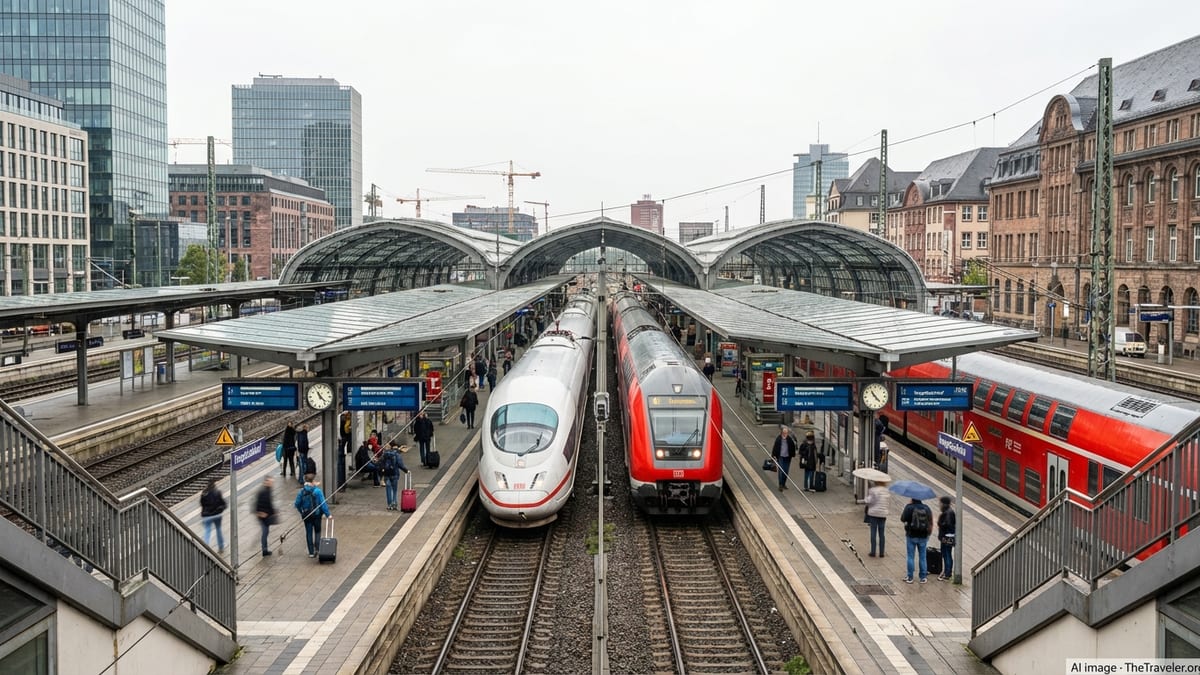
Germany’s long-distance trains are the backbone of cross-country travel. Intercity Express (ICE) trains connect major cities such as Berlin, Munich, Frankfurt, Hamburg, Cologne and Stuttgart at speeds of up to roughly 300 kilometers per hour. Intercity (IC) and EuroCity (EC) trains supplement this network, often serving key routes at slightly lower speeds but with similar levels of comfort. For many visitors, these services are the quickest and most convenient alternative to domestic flights.
Tickets for long-distance trains are sold in several fare types, ranging from flexible tickets that allow you to take any train on a given day to cheaper advance-purchase fares tied to specific departures. Advance fares are usually much lower but come with restrictions on exchanges and refunds, so they work best when your plans are firm. Flexible fares cost more but give you the peace of mind to change your schedule on the day if your flight is late or you decide to linger longer in a city.
Seat reservations on most domestic ICE, IC and EC trains in Germany are optional rather than mandatory. You can simply board with a valid ticket and look for any unreserved seat, but at busy times such as Friday afternoons, Sunday evenings, holidays and major events, trains can fill up and standing is not unusual. Reserving a seat for a modest fee is recommended on popular routes and peak travel times, and it is increasingly expected on some international ICE services in high season.
On board, you can expect air conditioning, power sockets at most seats, luggage racks and usually at least one bistro or restaurant car on ICE services. First class offers wider seats and quieter carriages, but second class is perfectly adequate for most travelers. Larger stations typically provide lifts or ramps as well as clearly marked platforms, making long-distance trains accessible for travelers with baggage, children or mobility issues.
Regional Trains and the Deutschlandticket
Beyond the high-speed network, Germany’s regional trains connect cities with smaller towns and rural areas. Regional-Express (RE) and Regionalbahn (RB) trains are slower and stop more often than ICE or IC services, but they form a dense web that reaches wine valleys, lakes, coastal resorts and smaller cultural destinations. For many scenic routes, such as along the Rhine or through the Bavarian Alps, regional trains are actually more rewarding than the fastest options.
A central feature of regional and local travel since 2023 has been the Deutschlandticket, often called the Germany Ticket. Introduced as a nationwide monthly subscription, it offers unlimited travel on local and regional public transport, including most regional trains, S-Bahn networks, U-Bahn, trams and buses. The ticket is not valid on standard long-distance services such as ICE, IC and EC, but it makes almost all other public transport remarkably simple for frequent travelers and longer stays.
The ticket was launched at 49 euros per month and has since risen in price as transport authorities adjust to higher operating costs and ongoing funding debates between federal and state governments. At the time of writing in early 2026, the advertised standard price stands in the low 60 euro range per month, with some cities and federal states offering discounts or special versions for students, apprentices, seniors or low-income residents. Discussions about future price adjustments and an index-based mechanism from 2027 are ongoing, so visitors should always check the current price and conditions before purchase.
For short stays of a few days, a regional day ticket or local city pass may be better value than a full month Deutschlandticket. Many federal states offer regional day tickets valid on all regional and local services within their borders, and sometimes in neighboring states, for a fixed price. These state tickets are particularly useful for day trips by regional train, such as exploring Franconian towns from Nuremberg, lake districts around Berlin, or the Rhine Valley from Cologne or Frankfurt.
Urban Transport: S-Bahn, U-Bahn, Trams and Buses
Germany’s major cities and many mid-sized towns have layered public transport systems that combine S-Bahn commuter trains, U-Bahn or metro lines, trams and buses. Networks in Berlin, Munich, Hamburg, Frankfurt, Cologne, Stuttgart and other urban centers are designed for quick transfers, with clearly signed platforms and coordinated timetables. For most visitors staying in cities, these systems will be your primary way to get around.
Ticketing is usually organized by local transport associations that set fares across multiple modes. Depending on the city, you may encounter zones, rings or fixed city areas that determine the price. Single tickets, short-trip tickets, 24-hour passes and multi-day city cards are common. Many visitors appreciate that the Deutschlandticket, where valid, simply acts as a pass for almost all local services without worrying about zones or individual fares.
Stations and stops are generally well signposted, with route maps and timetables posted in German and often English. Ticket machines typically offer English language menus and accept major bank cards and contactless payments, though it is still wise to carry some cash for backup. In many cities you can also use smartphone apps to plan journeys, buy tickets and see real-time departure information, which is especially helpful during disruptions or track works.
Urban networks run at high frequencies during the day, especially on core routes, and reduced frequencies at night. Large cities often supplement regular services with night buses or night S-Bahn and U-Bahn lines on weekends, but coverage and safety perceptions vary by district and time. As with any large urban area, it is sensible to stay aware of your surroundings at night, keep valuables concealed and favor well-lit stations and carriages.
Driving in Germany: When a Car Makes Sense
Germany’s road network is famous for its Autobahn sections without a general speed limit, though in practice many stretches now have posted limits, and traffic density often keeps speeds moderate. Motorways and main roads are generally in good condition, and signage follows standard European conventions, making self-driving relatively straightforward for those comfortable on busy highways and in dense traffic near major cities.
For itineraries centered on historic city centers, a car can be more of a burden than a benefit. Many old towns have pedestrian zones, limited access areas and strict parking controls. Hotels in central areas often charge for parking, and public car parks can be expensive. In addition, environmental zones in many cities restrict access for older vehicles that do not meet emissions standards. Rental cars from major agencies usually comply, but visitors should still pay attention to signage when entering city centers.
A car becomes truly useful when your plans involve small villages, rural guesthouses, hiking areas or wine regions where public transport is less frequent. The Romantic Road, the Moselle Valley, parts of the Black Forest and some alpine valleys are classic examples where having a car provides flexibility and access to viewpoints, trailheads and scattered attractions. Even in these regions, however, many key towns have rail connections, so a mixed approach combining trains with short rental periods can work well.
Driving regulations are strictly enforced. Seat belts are compulsory for all passengers, mobile phone use while driving is prohibited without a hands-free system, and drink-driving limits are lower than in some other countries. Parking rules are detailed and local; ignoring them risks fines or towing. Speeds are limited in urban areas and through villages, with frequent speed cameras. Visitors should also be aware that winter tires are effectively mandatory in winter conditions, so if you plan to drive between roughly November and March, book a rental equipped accordingly.
Car Rental, Fuel Costs and Practicalities
Car rental is widely available at airports, major railway stations and in city centers, with both international chains and local providers represented. Booking in advance is advisable, especially in peak seasons such as summer holidays and major trade fairs, when demand pushes prices up. Automatic transmissions are less common than in some countries and often more expensive, so travelers who can drive manual vehicles will have a wider choice.
Rental rates in Germany are influenced by season, vehicle category, pickup location and insurance coverage. While base prices can appear low in online searches, comprehensive insurance with manageable deductibles often adds significantly to the total. Cross-border travel to neighboring countries is usually allowed but can be subject to restrictions for certain vehicle categories or destinations, so always confirm your plans with the rental company before booking.
Fuel prices in Germany are generally higher than in North America and fluctuate with global energy markets and national taxes. Many travelers find that, despite rental and fuel costs, a car shared by several people can still be cost-effective, particularly in rural areas where public transport is infrequent. Diesel and petrol are widely available at service stations, and electric vehicle charging infrastructure is expanding rapidly along major routes and in many towns, though drivers should still plan charging stops carefully on long journeys.
Tolls are relatively limited compared with some neighboring countries, and there is no general toll for private passenger cars on the Autobahn at the time of writing. However, parking fees in cities, tunnel or bridge charges on specific routes, and vignette or toll requirements in neighboring countries can affect cross-border road trips. It is wise to research each border crossing and route segment so you do not miss any local permit or toll rules.
Tickets, Apps and Paying for Your Journey
Buying tickets has become easier in recent years as transport operators have invested in digital platforms. Deutsche Bahn’s official app and website allow you to search timetables, compare prices and purchase tickets for long-distance and many regional services. Local transport associations typically offer their own apps for city and regional tickets, and in some areas integrated platforms now sell tickets across multiple regions in a single interface.
For long-distance rail, buying in advance can yield significant savings, especially on popular city pairs such as Berlin to Munich or Frankfurt to Hamburg. However, deep-discount advance fares are often tied to specific trains and times and can be restrictive. Travelers who value spontaneity may prefer slightly more expensive flexible tickets, sometimes combined with saver offers or rail cards that provide percentage discounts for a fee.
Tickets for local and regional transport are usually straightforward. Single rides, day passes and short-trip tickets can be bought from machines at stations, on buses in some regions and via apps. Validation rules vary: in some systems you must stamp a ticket in a machine before boarding or immediately after boarding, while digital tickets are usually validated automatically via QR code and timestamp. Inspectors carry out spot checks, and traveling without a valid, correctly validated ticket can result in an on-the-spot fine significantly higher than the original fare.
Contactless payment is increasingly standard at ticket machines, on some buses and within mobile apps. Major international credit and debit cards are commonly accepted, but acceptance is not universal, especially in smaller towns or on board rural buses. Keeping a small amount of cash in euros remains useful for occasional cash-only situations or for topping up local transport cards where required.
The Takeaway
Getting around Germany is remarkably straightforward once you understand how the main pieces fit together. High-speed and long-distance trains efficiently connect the big cities, regional services and S-Bahn lines reach smaller towns and suburbs, and local buses, trams and U-Bahn networks fill in the gaps. For many visitors, these options make it entirely feasible to explore the country without ever renting a car.
A car still has its place, particularly for trips focused on rural landscapes, smaller villages or flexible road journeys across multiple regions. However, it comes with the responsibilities of navigating unfamiliar rules, parking restrictions and environmental zones. Evaluating whether you truly need a car for each segment of your itinerary can save you money and stress.
Staying informed is crucial. Ticket products such as the Deutschlandticket, regional day passes and advance-purchase rail fares continue to evolve as operators and governments adjust to financial and environmental pressures. Checking current prices and conditions shortly before your trip, and downloading the relevant apps, will help you take advantage of the best offers available when you travel.
With a bit of planning and an openness to using trains and public transport, you will likely find that getting around Germany becomes part of the pleasure of the journey. Watching landscapes roll past on a regional train, stepping from a city tram directly into a historic square or driving a winding road through wine-covered hills can be as memorable as the destinations themselves.
FAQ
Q1. Do I need to reserve a seat on German long-distance trains?
Seat reservations are usually optional on domestic ICE, IC and EC services, but they are strongly recommended at busy times and may be required on some international routes in peak seasons.
Q2. Is the Deutschlandticket worth it for short trips?
The Deutschlandticket is best value if you stay at least several days and make frequent journeys on local and regional transport. For a brief city break or one or two day trips, local day tickets or city passes may be cheaper.
Q3. Can I use the Deutschlandticket on ICE or IC trains?
No. The Deutschlandticket is generally valid only on local and regional services, including most regional trains, S-Bahn, U-Bahn, trams and buses, but not on standard long-distance ICE, IC or EC trains.
Q4. Is it easy to get around German cities without a car?
Yes. Major German cities have dense public transport networks that combine S-Bahn, U-Bahn, trams and buses, making it simple to move between districts and attractions without driving.
Q5. Do I need a car to visit rural areas and small towns?
Many small towns are accessible by regional trains and buses, but a car offers more flexibility in sparsely served regions, especially for reaching remote villages, trailheads and scattered sights.
Q6. Are there speed limits on the German Autobahn?
Some sections of the Autobahn still have no general speed limit, but many stretches do have posted limits, and traffic or weather conditions often keep speeds moderate even where no limit is signed.
Q7. How do I pay for public transport tickets?
You can usually buy tickets at station machines, via official apps and sometimes from bus drivers. Contactless card payments are common, but carrying some cash is still practical, especially in smaller towns.
Q8. Are German trains reliable and punctual?
Punctuality has fluctuated in recent years, with occasional delays due to infrastructure works and high traffic. Building some buffer time into connections is wise, especially when catching flights or important appointments.
Q9. Is public transport in Germany accessible for travelers with limited mobility?
Accessibility is improving and many stations and vehicles now have lifts, ramps and dedicated spaces, but not every smaller station is fully accessible. Checking accessibility information for key routes in advance is advisable.
Q10. Do I need to validate my ticket before travel?
In many regions, paper tickets must be validated in a machine before boarding or immediately after boarding, while app-based tickets are usually time-stamped automatically. Always check local instructions to avoid fines.