

Iowa may be known for open skies, rolling fields, and relaxed small towns, but it is also a state where your choice of transportation can dramatically shape your trip. Distances between cities are longer than they first appear on a map, public transit is strong in some hubs but sparse in rural areas, and winter weather can quickly change driving plans. Whether you are flying into Des Moines, road-tripping across the Mississippi bluffs, or visiting a college town for a weekend, understanding how to get around will help you travel Iowa comfortably and with fewer surprises.
Understanding Distance, Seasons, and Travel Realities in Iowa
Iowa looks compact on the map, but travel times can surprise visitors. Des Moines to Iowa City is roughly two hours by car, while cross-state drives from the Mississippi River to the Missouri River can easily run four to five hours. Interstates and major highways are generally in good condition, yet once you leave those corridors you may find two-lane rural roads, slower speeds through small towns, and stretches with limited services. Building extra time into your schedule is smart, especially if you are connecting to flights, events, or reservations.
Seasonality is another major factor. Winters can bring snow, ice, and reduced visibility from December through March, and conditions can become challenging quickly on open rural highways. Spring and early summer storms occasionally bring heavy rain and strong winds. While major cities like Des Moines and Cedar Rapids are used to dealing with winter weather, visitors unused to snow driving may want to prioritize daylight travel, choose all-wheel-drive rentals when possible, and remain flexible in case of advisories.
In contrast, late spring through fall is generally pleasant for driving and exploring on foot or by bike. During these months, road construction becomes more common, particularly on interstates and bridges. Expect occasional detours or slower segments and pay attention to work zone postings. Large summer events such as the Iowa State Fair in Des Moines or college football games in Iowa City and Ames can also crowd roads and parking garages, making it worthwhile to plan routes and parking in advance.
Iowa is largely car-oriented outside its core urban areas, yet it does offer a patchwork of options that can work well together: rental cars for flexibility, rideshare in and around cities, regional public transit, and limited intercity bus and train connections. Knowing where each mode works best will help you mix and match instead of relying on just one solution.
Renting a Car in Iowa: Airports, Requirements, and Costs
For most visitors, renting a car remains the most efficient way to get around Iowa, especially if you plan to visit smaller towns, state parks, or several cities on one trip. Major national rental brands operate at Des Moines International Airport and the Eastern Iowa Airport near Cedar Rapids, as well as at some smaller regional airports and neighborhood locations in larger cities. Airport counters typically have longer operating hours and a wider vehicle selection, from compact cars to SUVs and minivans.
Drivers usually need a valid driver’s license, a major credit card in the primary driver’s name, and to meet minimum age requirements, which are often 21 or 25 depending on the company. Renters under 25 should expect a young-driver surcharge and may have more limited vehicle categories available. Some companies allow debit cards, but may require additional identification or proof of travel, and often place a higher security hold. It is wise to confirm policies with the rental company in advance, particularly if you have an international license or are planning a one-way rental.
Rental costs vary by season, location, and demand. Prices are generally higher at Des Moines International Airport than at some off-airport or smaller-city locations, especially during major events or holidays. Extra fees can apply for additional drivers, underage drivers, GPS units, toll transponders, child seats, and one-way drop-offs. Collision damage waivers and supplemental liability coverage are optional but can significantly raise the total, so review what coverage your own auto insurance or credit card may already provide before you arrive at the counter.
Fuel is usually easy to find along major corridors, with many stations clustered near interstate exits. However, in more remote areas it is sensible to refuel when your tank reaches the halfway mark rather than waiting until it is nearly empty. Many rural gas stations close earlier in the evening, particularly on Sundays, and not all accept every form of payment. Checking fuel levels before heading onto lesser-traveled county roads will spare you nervous stretches between small towns.
Driving in Iowa: Roads, Etiquette, and Rural Realities
Driving in Iowa is generally straightforward, but a few local realities are worth understanding before you take the wheel. Interstates such as I-80 and I-35 form the backbone of cross-state travel, while four-lane divided highways and well-marked two-lane state routes connect smaller cities and towns. Outside the main routes you will encounter county roads and gravel roads. Rental companies often discourage or prohibit driving on unpaved roads, so review your contract and consider staying on paved routes when possible, especially in wet or winter conditions.
Rural traffic patterns can be very different from those in larger metro areas. You are likely to share the road with farm equipment, especially during planting and harvest seasons. Tractors, combines, and other slow-moving machinery may travel well below the speed limit, and passing should be done cautiously and only where legal and with clear sightlines. Wildlife, particularly deer, can be present near dusk and dawn on rural and wooded stretches, so scanning the shoulders and moderating speed can reduce collision risk.
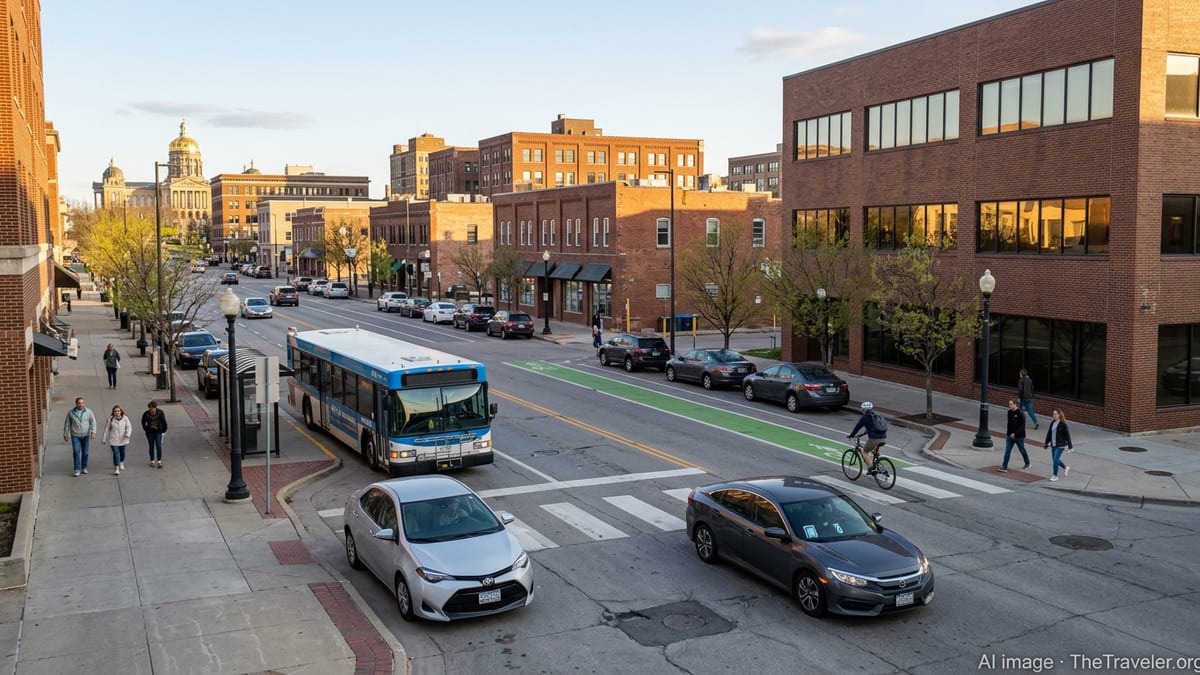
In cities like Des Moines, Cedar Rapids, and Iowa City, traffic is heavier at typical commute times but rarely reaches the sustained congestion levels of major coastal metros. Many downtown cores mix cars with buses, cyclists, and pedestrians. Pay attention to lane markings around bus-only lanes, bike lanes, and turn lanes near university campuses or medical centers. In winter, give snowplows and sand trucks plenty of room to operate, and remember that shaded bridges and overpasses can remain icy even when the rest of the road looks clear.
Parking rules and availability vary widely. Downtown Des Moines has a mix of parking ramps, metered street parking, and event-specific lots, with rates higher near major venues and offices. College towns such as Iowa City and Ames strictly enforce neighborhood permit rules and signed restrictions around campus, especially on game days. In small towns, street parking is often unmetered and plentiful, but time limits sometimes apply near main squares or courthouses. Watch local signs, as overnight parking or snow emergency rules may affect where you can leave a rental car.
Rideshare, Taxis, and Local Ride Options
App-based rideshare services such as Uber and Lyft are available in Iowa’s larger urban areas, with the most consistent coverage in Des Moines and significant but more limited availability in cities like Cedar Rapids, Iowa City, Waterloo, Sioux City, and the Quad Cities region. In these places, using rideshare can be an easy way to reach restaurants, events, and hotels without worrying about parking, particularly in dense downtown areas or during nightlife hours. Wait times are typically reasonable near city centers but can lengthen late at night, during bad weather, or on the outskirts of town.
Rideshare coverage drops off quickly in smaller towns and rural areas, where only a handful of drivers may occasionally run the apps or none at all. If you are staying outside a major city and hoping to rely on rideshare, do not assume it will be a viable primary mode of transportation. In some cases, it may be available to get you into a city but difficult or expensive to get back. For visits that include wineries, rural attractions, or state parks, a rental car, pre-booked shuttle, or designated driver is usually a safer plan.
Traditional taxi services still operate in some Iowa cities, though fleets tend to be smaller than in large metropolitan areas. Taxis can often be found at airports, larger hotels, and downtown hubs, but are not always readily available on the street. Many companies encourage advance bookings by phone, especially for early morning airport runs or trips from outlying neighborhoods. Airport shuttles and independent shuttle operators also serve certain routes, such as between the Eastern Iowa Airport and nearby cities, sometimes on a scheduled or pre-arranged basis.
The state also supports Iowa Rideshare, a statewide system that helps residents and visitors find potential carpool partners, vanpools, and transit routes. While this platform is more commonly used by commuters than short-term visitors, it illustrates the broader mix of shared transportation options beyond the familiar rideshare apps. If you are staying in one spot for an extended period, particularly for work or study, exploring these local carpool and vanpool programs can reduce dependence on a personal vehicle.
City Transit: Buses in Des Moines and Other Urban Areas
Public transit in Iowa is strongest in its urban centers, where local bus networks serve residents, students, and visitors. Des Moines Area Regional Transit, often referred to simply as DART, is the state’s largest public transit agency and operates fixed-route buses, express services, and on-demand options across the metro. Routes focus on connecting downtown, residential neighborhoods, major employers, shopping centers, and park-and-ride lots. Schedules are more frequent on core lines and during weekdays, with somewhat reduced service in evenings and on weekends.
Several mid-sized cities run their own municipal or regional bus systems. Cedar Rapids, Iowa City and Coralville, Dubuque, Ames, Waterloo, Sioux City, Bettendorf, Davenport, and Fort Dodge are among the communities with established transit services, though coverage and operating hours vary. Some systems operate university-oriented routes that can be particularly useful for visitors staying near campuses, while others focus on core corridors that connect downtowns with hospitals, retail centers, and residential districts.
Fares are typically modest, and many systems offer day passes and discounted or free rides for students, older adults, or individuals with disabilities. In university towns, campus circulator buses are often free to ride and can be an efficient way to reach museums, libraries, sports venues, and nearby districts without a car. However, visitors should expect less frequent service during academic breaks and holidays. Digital tools differ by system; some offer route planners and live bus tracking via mobile apps, while others rely more on static maps and timetables, so it is worth checking schedules before heading to the stop.
For travelers who prefer not to drive, combining local buses with walkable downtowns can make car-free stays realistic in select cities, especially Des Moines, Iowa City, and some parts of the Quad Cities. Yet local transit rarely extends deep into rural counties, so relying solely on city buses works best for trips focused on a single metro area rather than statewide exploration.
Rural and Regional Transit: Reaching Smaller Towns
Beyond the main cities, Iowa maintains a web of regional transit systems that primarily serve residents but are technically available to visitors as well. The Iowa Department of Transportation recognizes dozens of public transit systems, including multiple rural providers that cover multi-county areas. These agencies often operate demand-response or dial-a-ride services rather than fixed bus routes, particularly in low-density areas where regular bus lines would be difficult to sustain.
In practice, this means that in many rural regions you can request trips in advance, often a day or more before you need to travel. Vehicles may be small buses or accessible vans that pick up and drop off riders along shared routes. Fares are usually modest but depend on distance and the specific agency. Hours can be limited, sometimes focusing on daytime weekday travel, with little or no service in the evenings or on weekends. These services are designed to connect people to shopping, medical appointments, work, and social services in nearby towns and hubs.
Visitors who are planning a stay in smaller communities should contact the local regional transit provider early to understand eligibility, booking rules, and service areas. Some agencies prioritize certain trip purposes or passenger groups, though many will carry any rider on a space-available basis. Because these systems do not usually accommodate last-minute, spontaneous trips, they are best viewed as a backup or supplemental option rather than a substitute for having a car.
In addition to publicly supported transit, a few communities have volunteer driver programs affiliated with non-profits, senior centers, or health systems. These programs focus on residents with specific needs and are less appropriate for general tourism use, but they underscore the point that mobility outside Iowa’s cities relies heavily on planning ahead. If you hope to visit out-of-the-way sites without driving yourself, asking local tourism offices, hotels, or chambers of commerce about ride options well in advance can reveal solutions that are not immediately obvious online.
Intercity Travel: Buses, Trains, and Flights
Intercity bus service bridges some of the gaps between Iowa’s major communities. Private carriers operate routes that connect cities such as Des Moines, Iowa City, Cedar Rapids, Davenport, Burlington, and others with each other and with destinations in neighboring states. Over the past few years, service patterns have evolved as companies have adjusted routes, with some longtime operators reducing or discontinuing certain lines and others stepping in to maintain critical corridors. For travelers, the practical takeaway is that it remains possible to move between key Iowa cities by bus, though schedules may be limited and often require advance planning.
Amtrak provides rail service to Iowa along routes that run roughly east to west across the southern part of the state and along the Mississippi corridor in the east. Stations in communities such as Burlington, Mount Pleasant, Ottumwa, Osceola, and Creston connect to the broader national rail network, while nearby stations across the river in Illinois serve Quad Cities riders. Train frequencies are relatively modest, and stations can be some distance from downtown cores, so integrating rail into an Iowa trip usually works best for travelers who are comfortable pairing train segments with local buses, taxis, or rental cars at each end.
Air travelers will find that Des Moines International Airport functions as the primary aviation gateway to Iowa, offering a range of nonstop flights to major hubs and regional cities. The Eastern Iowa Airport near Cedar Rapids and other regional airports such as those in Sioux City and Dubuque provide additional commercial service, though with fewer destinations and frequencies. Flying into Des Moines or Cedar Rapids and then renting a car is a common strategy for exploring multiple regions, including the Driftless Area in the northeast, the Loess Hills in the west, and river towns along the Mississippi.
Because intercity buses and trains may operate only once or twice a day on certain routes, connections between modes can be fragile. Weather delays, road construction, or unforeseen schedule changes can disrupt same-day transfers. Whenever possible, allow generous layover times or consider overnight stays in connection cities such as Des Moines or Iowa City. Checking operating calendars around major holidays and during winter can also help you avoid days with especially constrained or reduced service.
Active and Micro-Mobility: Biking, Walking, and Scooters
Iowa is well regarded for its bicycling culture, thanks in part to high-profile events and an extensive network of trails and low-traffic rural roads. Many communities maintain paved multi-use paths along rivers, through parks, and between neighborhoods. In cities such as Des Moines, Iowa City, and Cedar Falls, visitors can often link these trails with calm side streets to reach downtowns, university campuses, and local attractions. Helmets are strongly encouraged, night riding requires proper lights and reflectors, and cyclists are generally expected to follow the same traffic rules as motorists when on the road.
Local ordinances differ on where bikes may ride, particularly on sidewalks in commercial districts and pedestrian zones. Some downtown cores ban cycling on certain sidewalks, while others allow it with the condition that riders yield to pedestrians and give an audible signal when passing. Because rules vary by city and even by street, looking for posted signage and checking local guidance can help you avoid fines or conflicts. In all settings, courteous behavior and clear communication with drivers and pedestrians go a long way toward ensuring safe shared use of the streets.
Bike-share and scooter-share services are present in a few Iowa cities, often concentrated near downtowns and university areas. Availability and operators can change from year to year as contracts and pilot programs evolve, so do not assume that a particular brand or device will be present when you arrive. Where such services are available, they can be a convenient way to cover short distances without a car, but require attention to local parking rules and geofenced operating zones. Leaving devices blocking sidewalks, curb ramps, or doorways can result in penalties and inconvenience to others.
For walkers, many Iowa downtowns and college districts are compact and pleasant to explore on foot, with sidewalks, crosswalks, and increasingly visible traffic-calming measures. However, distances between districts can quickly lengthen once you move beyond the core, and pedestrian infrastructure may become patchier along arterial roads built primarily for car traffic. When planning a car-free itinerary, study local maps to understand where continuous sidewalks and trails exist, and be prepared for weather extremes, particularly winter cold and summer humidity.
Planning Your Iowa Itinerary Around Transportation
Because transportation options vary so much between Iowa’s urban centers, small towns, and rural landscapes, planning your itinerary with mobility in mind can greatly improve your experience. If you prefer not to drive, consider basing yourself in a transit-rich city such as Des Moines, Iowa City, or parts of the Quad Cities, where you can rely on a combination of buses, rideshare, walking, and biking. Choose accommodations near downtown or campus areas to shorten walking distances and maximize your options after dark.
Travelers who want to see state parks, wineries, scenic byways, or multiple regions in one trip will generally find a rental car indispensable. In that case, you can still reduce stress by minimizing the time you spend driving in unfamiliar conditions. Plan longer rural legs for daylight hours, schedule city stops so you are not searching for parking during peak commuter periods, and factor in time for weather or construction-related delays. Reserving cars, intercity bus seats, and accommodations well in advance is especially important around major events such as the Iowa State Fair, large university events, and popular summer festivals.
Combining modes can unlock more ambitious itineraries. For example, you might arrive by air in Des Moines, spend a car-free day exploring downtown and nearby neighborhoods by bus and on foot, then pick up a rental car for a loop through smaller towns before returning on an intercity bus or train from a different city. Similarly, staying car-free in a university town and joining organized tours or renting a car just for specific days can balance convenience with cost and comfort.
While Iowa’s transportation network is not as heavily transit-oriented as that of some coastal states, it offers enough flexibility for thoughtful travelers to tailor mobility to their comfort level. A clear-eyed understanding of distances, schedules, and seasonal conditions, paired with realistic expectations about where buses, rideshare, and walking can substitute for driving, will help you create an itinerary that feels relaxed rather than rushed.
The Takeaway
Getting around Iowa successfully comes down to aligning your transportation choices with the realities of a largely rural, weather-sensitive state that also contains a growing network of urban transit and shared mobility options. Rental cars remain the most practical tool for exploring widely, connecting small towns, and reaching parks and countryside vistas on your own schedule. At the same time, cities like Des Moines, Iowa City, and Cedar Rapids offer enough buses, rideshare coverage, bike infrastructure, and walkable neighborhoods to support car-light or even car-free stays, especially for short visits focused on one metro area.
Public transit, regional demand-response services, and intercity buses and trains provide important links, but they generally require planning and flexibility, with limited frequencies and service windows. Active travelers can take advantage of Iowa’s robust trail systems and bike-friendly culture, while always respecting local rules and seasonal conditions. The key is to research your specific destinations, sketch out how you will move between them, and build in time for the unexpected, whether that is a snow squall in February or a detour around summer roadwork.
By approaching transportation as an integral part of your Iowa travel plan rather than an afterthought, you will be better equipped to choose the right mix of rental cars, rideshare, transit, and active modes. That, in turn, will free you to focus less on logistics and more on what brought you to the Hawkeye State in the first place: friendly communities, wide-open landscapes, and a slower pace that rewards those who take the time to explore.
FAQ
Q1. Do I really need a car to visit Iowa?
In most cases a car makes travel much easier, especially if you want to visit multiple cities, small towns, or state parks. Car-free trips can work in select cities with good local transit and rideshare, but they limit how far you can roam.
Q2. Is rideshare available everywhere in Iowa?
Rideshare services are common in larger metros like Des Moines and present, though less reliably, in mid-sized cities. Coverage drops quickly in smaller towns and rural areas, so you should not rely on rideshare as your only option outside major cities.
Q3. How bad are Iowa roads in winter?
Major highways and city streets are generally cleared fairly quickly after storms, but snow and ice can still make driving challenging, especially on rural roads. If you are not used to winter driving, travel during daylight, allow extra time, and consider delaying trips during active storms.
Q4. Can I rely on buses to travel between Iowa cities?
Intercity buses do connect key cities, but routes and schedules are limited. They can work well if you plan carefully and are flexible, yet they rarely match the convenience of driving, especially for multi-stop itineraries or rural destinations.
Q5. Are there age restrictions for renting a car in Iowa?
Most rental companies will rent to drivers 21 and older, though some require renters to be 25. Drivers under 25 usually pay a young-driver surcharge and may be restricted to certain vehicle types.
Q6. Is biking a realistic way to get around Iowa?
Biking is a great way to explore cities, trails, and nearby countryside, particularly in warmer months. However, distances between towns and variable road conditions mean it is better suited for local trips and planned cycling routes than as a primary statewide transportation method.
Q7. What are the best cities in Iowa for car-free travel?
Des Moines, Iowa City, and some parts of the Quad Cities are the most promising for car-free stays, thanks to local bus networks, rideshare, walkable downtowns, and, in university towns, free or low-cost campus circulator buses.
Q8. How far in advance should I book transit or shuttles?
For intercity buses and regional demand-response transit, booking at least a day or two in advance is wise and sometimes required. Airport shuttles and taxi rides from outlying areas also benefit from advance reservations, especially for early morning or late-night trips.
Q9. Is it safe to drive on rural gravel roads in Iowa?
Many locals use gravel roads daily, but conditions can be dusty, muddy, or slick depending on the weather. Visitors should slow down, be cautious on hills and curves, and check rental agreements, since some companies discourage or prohibit driving on unpaved roads.
Q10. Are there any special traffic rules I should know about?
Iowa’s traffic laws are broadly similar to those in other Midwestern states. Pay particular attention to speed limits that change when passing through towns, yield to farm equipment and school buses, and remember that cyclists generally have the same rights and responsibilities as other vehicles on the road.