

Understanding Your Main Options
Heathrow is about 15 to 20 miles west of central London, depending on where you are heading. Most visitors are going somewhere in Zone 1, such as Paddington, Kensington, Westminster, Soho, Covent Garden, London Bridge, or King’s Cross. From Heathrow, the main ways to reach these areas are the Heathrow Express train to Paddington, the Elizabeth line, the Piccadilly line on the London Underground, express coaches, and taxis or ride hailing services. There are also private car transfers and, for a few people, car rentals, but those are less common for city stays.
In broad terms, the Heathrow Express is usually the fastest rail option into central London, with a non stop journey to London Paddington in about 15 minutes from Terminals 2 and 3 and a couple of minutes more from Terminal 5. The Elizabeth line is slower by comparison but still quick, with trains taking roughly 30 to 40 minutes into key central stations like Tottenham Court Road and Liverpool Street and serving more destinations directly. The Piccadilly line is the budget champion, with off peak fares that are a fraction of premium rail prices, though you should allow around 45 to 60 minutes to reach central stops like Piccadilly Circus or Leicester Square.
On the road, you can choose between black cabs from the official taxi ranks, pre booked private minicabs, and ride hailing apps such as Uber and Bolt. These usually take 45 to 90 minutes into central London depending on traffic, and fares from Heathrow to Zone 1 typically range from around £60 at the low end with a pre booked car in light traffic to over £110 for a black cab in heavy traffic or at night. Long distance and airport coaches such as National Express connect Heathrow to Victoria Coach Station and other points in London and beyond, which can be useful if your hotel is near Victoria or you are changing to another long distance coach or tour.
When you compare options, think about your personal situation. A solo traveller with a backpack staying near a Tube station in Bloomsbury might head straight for the Piccadilly line to Russell Square and pay only a few pounds. A family of four with several large suitcases arriving late at night and staying near Paddington may decide the Heathrow Express plus a short walk or taxi is worth paying more for speed and simplicity. Someone heading to Canary Wharf on a weekday afternoon might prefer the Elizabeth line, which runs directly there from Heathrow without a change.
Using the Heathrow Express
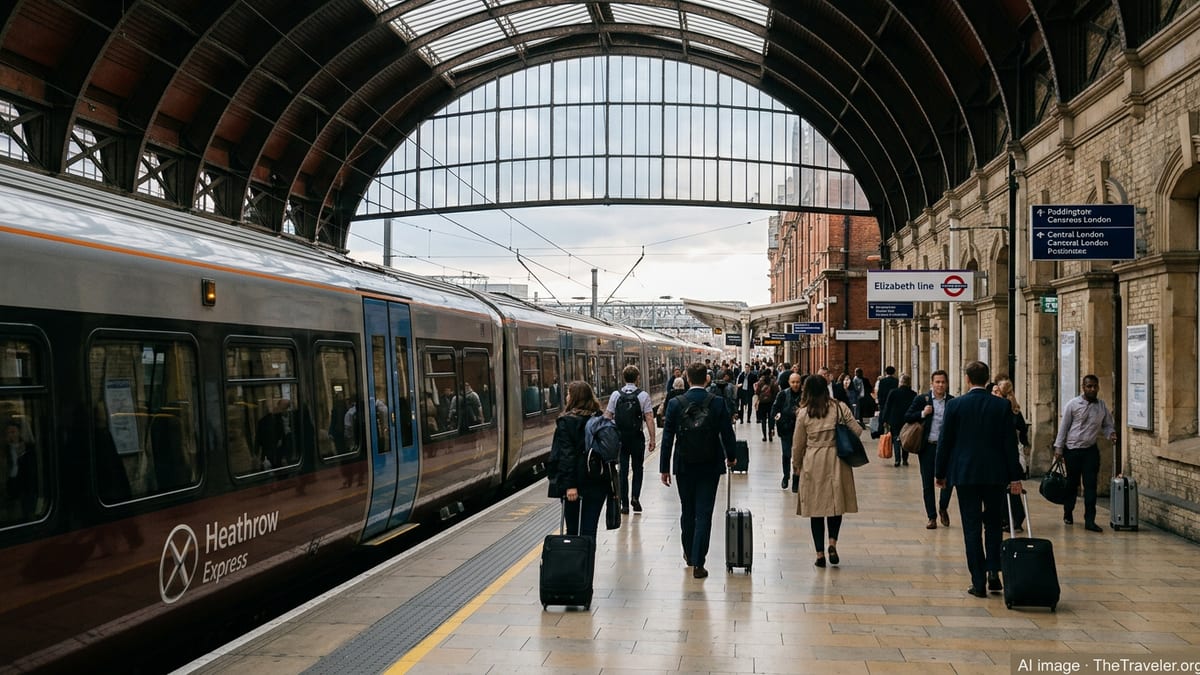
The Heathrow Express is the flagship airport train and exists for one purpose: to move people quickly between Heathrow and London Paddington. Trains usually run every 15 minutes throughout most of the day. From Heathrow Terminals 2 and 3, the ride to Paddington takes about 15 minutes. From Terminal 5 it is closer to 20 minutes, and passengers from Terminal 4 typically use the free shuttle train to Terminals 2 and 3 and then board the Heathrow Express there. The service is non stop, so you do not have to worry about intermediate stops or complex route maps.
Tickets for the Heathrow Express are significantly more expensive than other rail options, and prices vary by how far in advance you buy them and which channel you use. Advance purchase “online only” fares can sometimes be found under £20 for a one way trip if you book well ahead, whereas walk up tickets at the station or via the on platform machines can be well above that. Some recent price comparisons suggest that walk up standard class tickets can easily reach around £25 to £37 per adult depending on time, class, and flexibility. Children can often travel free with paying adults, which softens the cost for families, but for a solo traveller it is a noticeable expense.
In practical terms, using the Heathrow Express works like this. After collecting your luggage, follow the signs to “Trains to central London” or “Heathrow Express.” At Terminals 2 and 3, the station is reached via an underground walkway. At Terminal 5 it is below the arrivals level. You can buy a ticket at the machines using a credit or debit card, purchase via a mobile app ahead of time, or, depending on current arrangements, tap in with a contactless bank card or mobile wallet. Once on board, there are generous luggage racks near the doors and above seat storage for smaller bags. On a typical weekday morning, you might board at 08:15 at Terminal 5 and be stepping off at Paddington before 08:40, which suits business travellers heading nearby or changing to the Underground.
The main drawback is that Heathrow Express only goes to Paddington. If your hotel is in another part of London, you will need to connect, usually by taxi, bus, or the Underground. For example, if you are staying near Covent Garden, you might take the Heathrow Express to Paddington and then transfer to the Bakerloo line to Piccadilly Circus and walk or change to the Piccadilly line. Travel time door to door could still be under an hour, but the connection adds complexity compared with a direct Tube or Elizabeth line train if those serve your final stop.
Taking the Elizabeth Line
The Elizabeth line has quickly become a favorite for many Heathrow passengers because it balances cost, comfort, and convenience. Trains run from Heathrow Terminals 2 and 3 and Terminal 5 into central London, stopping at key stations including Paddington, Bond Street, Tottenham Court Road, Farringdon, and Liverpool Street. If you are staying in areas such as Soho, Fitzrovia, the City, or near major rail hubs like Liverpool Street or Farringdon, this can be a near direct service. Travel time from Heathrow to Tottenham Court Road is usually around 35 to 40 minutes, and to Liverpool Street about 45 minutes, depending on the specific train and stopping pattern.
Fares on the Elizabeth line are higher than the standard Underground fares from Heathrow but significantly lower than Heathrow Express. Exact prices change periodically, but a single adult fare paid with contactless or Oyster is usually somewhere in the low to mid teens in pounds from Heathrow to Zone 1, while the Underground Piccadilly line fare for the same journey is generally less than half that. Unlike the Heathrow Express, Elizabeth line journeys to and from Heathrow are typically charged at peak rates all day when you tap in or out, so you should not expect a substantial off peak discount from the airport itself.
For example, imagine arriving at Heathrow Terminal 3 at 10:00 on a weekday and needing to get to Farringdon with one large suitcase and a carry on. You could follow the signs to the Elizabeth line platforms, tap in with your contactless card, and board a through train. With a journey time of around 40 minutes, you would emerge at Farringdon between 10:40 and 10:50, already in the heart of central London and with step free access at many stations. If you were going to Canary Wharf, you could simply remain on the train as it continues east, reaching the financial district in roughly an hour from Heathrow, which is very convenient for business travellers.
A key advantage of the Elizabeth line is that it uses modern, spacious trains with wide doors, open through carriages, and ample standing room. This makes it easier to manage luggage compared with some older Tube lines, especially during busy times. The line is also well integrated with other transport: at Paddington you can change to multiple Underground lines, at Farringdon you can swap to the Thameslink network, and at Liverpool Street there are connections to the Central, Circle, Hammersmith & City, and Metropolitan lines. For many visitors, this means fewer changes compared with using Heathrow Express plus the Underground.
Riding the Piccadilly Line (London Underground)
The Piccadilly line is almost always the cheapest rail option into central London from Heathrow. Trains serve Heathrow Terminals 2 and 3 and Terminal 5 directly, and most services also run to Terminal 4 via a branch loop. The main Piccadilly line route heads into central London via stations such as Hammersmith, Earl’s Court, South Kensington, Knightsbridge, Hyde Park Corner, Green Park, Piccadilly Circus, Leicester Square, and Covent Garden. This makes it particularly useful if you are staying in West End neighborhoods, South Kensington, or along the line toward King’s Cross and Russell Square.
Travel time on the Piccadilly line from Heathrow to central stops is longer than the Elizabeth line or Heathrow Express. You should allow about 45 to 50 minutes to reach stations such as Green Park or Piccadilly Circus and around an hour for King’s Cross St Pancras if services are running smoothly. However, the cost is substantially lower. While exact fares change periodically, a single adult journey from Heathrow to Zone 1 paid by Oyster or contactless is typically a standard Zone 6 to Zone 1 Underground fare, which in recent years has been in the range of only a few pounds rather than double digits.
To put this into context, consider a budget minded traveller arriving at Heathrow Terminal 5 around 13:00 on a Saturday and heading to Covent Garden with one mid size suitcase. Instead of paying a premium for Heathrow Express, they could follow signs to the Piccadilly line, board a direct Tube train, and stay on until Leicester Square or Covent Garden. Door to door, the journey might take around an hour, but their transport cost to central London would likely be less than what a single coffee and pastry costs in a central London cafe. For visitors staying several days who intend to use the Tube frequently, this savings can quickly add up.
There are trade offs. Piccadilly line trains are older and can become very crowded at peak times, especially between Earl’s Court and Holborn on weekday mornings and late afternoons. If you are arriving with large suitcases during rush hour, you might find it challenging to find space. The line also stops frequently, and some stations involve stairs or long walks between platforms and exits. That said, for many travellers with moderate luggage arriving outside of the busiest commuter windows, the Piccadilly line remains one of the most practical and cost effective ways to go straight from Heathrow to central hotel areas such as South Kensington, Gloucester Road, or Russell Square.
Paying with Oyster, Contactless and Travelcards
For most visitors, the simplest way to pay for the Tube, Elizabeth line, and many rail services in London is by tapping in and out with a contactless bank card or mobile wallet such as Apple Pay or Google Pay. Heathrow’s ticket halls and information desks also sell Oyster cards, which are reusable smartcards that can be loaded with credit. In general, Oyster and contactless cards are charged the same pay as you go fares and enjoy daily and weekly fare caps, so your charges automatically stop once you reach a certain spending limit within specified zones.
The details of fare caps change periodically, but the idea is straightforward. If you are making several journeys in one day within Zones 1 to 6, including your Heathrow transfer and a few additional trips on the Tube or buses, there is a maximum amount you will be charged for that day. Once you reach that cap, further eligible journeys are effectively free for the rest of the day. For many leisure travellers staying 3 to 5 days, this makes pay as you go often better value and more flexible than buying paper Travelcards in advance.
There are a few important wrinkles. Journeys involving Heathrow on the Elizabeth line and Heathrow Express are often charged differently from standard Tube fares, and Heathrow journeys tend to be treated as peak priced even outside commuter rush hours, so you should not assume they will be as cheap as trips between other Zone 6 stations and central London. Also, contactless caps for longer distance journeys can be set relatively high, so a single ride from an outer zone through central London to Heathrow can in some cases come close to or exceed the daily caps. Because fare structures are regularly updated, it is sensible to check a current fare finder or station information board when you arrive for up to date figures.
If you arrive with children, note that under a certain age children usually travel free on buses and trams, and older children and teenagers can benefit from discounted or free fares when using specific cards or products, which you can set up at a station ticket office. Many families take advantage of this by loading an adult’s contactless card for the grown ups and obtaining a discounted card or pass for their teenager. A common real world pattern is a family of four landing at Heathrow on a Friday, tapping in with the parents’ bank cards and an Oyster card loaded for their teenager, and then using tap in tap out across the weekend without ever needing paper tickets.
Coaches, Buses, Taxis and Ride Hailing
Not everyone wants to use the train from Heathrow. For some visitors, especially those with heavy luggage who prefer not to navigate escalators and station corridors, road based options are attractive. The main choices are long distance coaches, local buses, traditional London black cabs, pre booked minicabs, and ride hailing apps. Each has its own balance of cost, comfort, and convenience.
National Express operates frequent coaches from Heathrow to London Victoria Coach Station, with some services continuing to stops like Earl’s Court. Recent schedules show departures day and night from Heathrow Central Bus Station and directly from terminal forecourts, with advertised one way fares starting from around £9 to £10 when booked in advance. Travel time to Victoria is typically 45 minutes to 1 hour in light traffic, though at busy times it can take longer. These coaches are particularly useful if your hotel is within walking distance of Victoria or if you are catching another long distance coach or tour from there.
Black cabs are licensed taxis that wait at official ranks outside all Heathrow terminals. They are metered and regulated, and drivers are required to know London’s streets in detail, which can be reassuring after a long flight. As of recent price guides, a typical metered fare from Heathrow to central London often falls in the region of about £90 to £110 depending on the exact destination, traffic conditions, time of day, and any applicable surcharges such as airport charges or holiday supplements. Journey times vary widely. A late evening ride to a hotel in Kensington might take only 35 to 40 minutes, while a weekday rush hour trip to the City could easily exceed an hour.
Private hire minicabs and ride hailing apps such as Uber, Bolt, and others usually need to be booked via apps or websites rather than hailed from the kerb. These services often quote fixed or estimated fares in advance. A pre booked car service picked up from the terminal arrivals area might quote around £65 to £80 for a standard saloon car into central London in 2026, while surge pricing on a ride hailing app during a busy arrival wave can push similar journeys well above that. Some companies advertise fixed price transfers such as £66 from central London to Heathrow, which gives you a ballpark idea of what non metered services might charge in the opposite direction.
For a concrete scenario, imagine a couple arriving at Terminal 3 at 21:30 on a winter evening with two large suitcases and staying in a small hotel near Trafalgar Square. They might open a ride hailing app and see quotes around £70 for a private hire car, while the taxi rank offers a black cab that could end up near £100 depending on traffic. In this case, the couple may decide that the extra £30 for a black cab is not worth it and opt for the fixed price ride. Another traveller arriving midday with mobility challenges might feel that a door to door black cab is well worth the added cost compared with managing luggage through Tube stations and escalators.
Choosing the Best Option by Traveller Type
Not every route from Heathrow to central London will suit every traveller. Thinking about your profile helps narrow choices quickly. If time is your top priority and you are staying near Paddington or will connect to another main line train from there, Heathrow Express remains very attractive. Business travellers arriving early morning for a meeting near Paddington or Marylebone often justify the premium fare as a cost of doing business, especially when they can charge it to a corporate account.
For most leisure visitors, the Elizabeth line or the Piccadilly line provide better value. If your final destination is close to an Elizabeth line station such as Tottenham Court Road, Farringdon, or Liverpool Street, the ability to ride directly from Heathrow without changing trains is extremely convenient. This is especially true if you have a medium amount of luggage and arrive outside the most crowded commuter peaks. Travellers heading to the West End, South Kensington, or King’s Cross with tighter budgets often gravitate to the Piccadilly line, trading a longer journey for significant savings.
Families and groups of three or more people sometimes find that the cost per person of a taxi or pre booked car becomes competitive compared with multiple rail tickets, particularly if they are travelling outside the busiest times. For instance, a family of four paying around £15 per person on the Elizabeth line is already close to £60 in total, at which point a pre booked private transfer for £70 to £80 to a central London apartment door might feel like good value, especially late at night or with small children in tow. On the other hand, a solo backpacker or couple visiting on a tight budget might gladly spend an hour on the Piccadilly line to save the same amount.
Finally, consider the time of day and your energy level. After an overnight flight that lands at Heathrow at 06:00, some people simply want the most straightforward, low stress option. That might mean walking to the Heathrow Express, taking the short ride to Paddington, and then a short taxi hop to their hotel, even if it costs more. Others, particularly frequent visitors who know the system, might head straight for the Piccadilly line even at that early hour, confident they can manage the luggage and navigate the stations. There is no single best answer, but understanding the trade offs helps you choose the option that feels right for your own trip.
The Takeaway
Getting from Heathrow Airport to London city center is no longer a one size fits all decision. The combination of the Heathrow Express, the Elizabeth line, and the long established Piccadilly line gives you a spectrum of choices between speed and budget, while coaches, black cabs, private cars, and ride hailing apps add further flexibility. What has changed in recent years is how competitive the Elizabeth line has become, offering a strong middle ground for many visitors by providing direct trains to multiple central locations at a moderate price.
Before you travel, spend a few minutes looking at where your accommodation sits on the Tube and rail map and what your arrival time will be. If you are near Paddington and in a hurry, Heathrow Express may suit you. If you are close to an Elizabeth line or Piccadilly line station and happy to roll a suitcase for a few minutes, one of those lines will often be the simplest and best value. For those with mobility issues, very heavy luggage, or late night arrivals, budgeting for a taxi or private transfer can make your first hour in London far more comfortable.
Whatever you choose, Heathrow is well connected to central London at nearly all hours of the day and night. By matching your transport method to your budget, luggage, and energy level, you can start your London visit smoothly, avoid unnecessary stress at the airport, and arrive at your hotel ready to explore the city rather than recover from the journey in.
FAQ
Q1. What is the fastest way to get from Heathrow to central London?
The fastest option for most travellers is the Heathrow Express train to London Paddington, with a non stop journey of around 15 minutes from Terminals 2 and 3 and a couple of minutes longer from Terminal 5.
Q2. What is the cheapest way to travel from Heathrow into central London?
The Piccadilly line on the London Underground is usually the cheapest rail option, with standard Zone 6 to Zone 1 fares that are significantly lower than the Elizabeth line or Heathrow Express.
Q3. Is the Elizabeth line better than the Piccadilly line for most visitors?
The Elizabeth line is faster and more comfortable and serves key stations like Tottenham Court Road and Liverpool Street directly, but it is more expensive than the Piccadilly line. Which is better depends on your budget and where you are staying.
Q4. Can I use my contactless bank card instead of buying an Oyster card at Heathrow?
Yes. Most visitors can simply tap in and out with a contactless bank card or mobile wallet, which charges the same pay as you go fares and benefits from daily and weekly fare caps similar to Oyster.
Q5. How much does a taxi from Heathrow to central London usually cost?
A licensed black cab to central London often costs around £90 to £110 depending on your exact destination, traffic, time of day, and any surcharges, while pre booked private cars and ride hailing services can sometimes be cheaper.
Q6. Is taking the Tube from Heathrow safe and manageable with luggage?
The Tube is generally safe and widely used by locals and visitors. Travellers with one or two medium sized bags usually manage well, though it can be crowded at peak times and some stations require using stairs or escalators.
Q7. Do Heathrow trains and Tubes run late at night and early in the morning?
Both the Piccadilly line and Elizabeth line run from very early morning until late at night, though frequencies reduce outside peak hours. Night services can vary, so it is wise to check your planned travel time in advance.
Q8. Which option is best for a family with children and lots of luggage?
Families with multiple large suitcases often prefer either the Elizabeth line, which offers spacious modern trains, or a pre booked private car or taxi for direct door to door travel without navigating stairs and busy platforms.
Q9. Is there a direct service from Heathrow to Canary Wharf?
Yes. The Elizabeth line runs directly from Heathrow to Canary Wharf without a change, usually in around one hour, which is convenient for visitors staying or working in that area.
Q10. Should I buy a Travelcard in advance for my Heathrow transfer and London stay?
Most short stay visitors find that pay as you go with contactless or Oyster, using the built in daily and weekly caps, is more flexible and often better value than buying a paper Travelcard in advance, especially when starting from Heathrow.