

Relocating to Mexico is legally feasible for many foreign nationals, but the process requires a clear understanding of immigration categories, consular procedures, and in-country formalities. This briefing outlines, step by step, the legal pathways and procedural sequence a foreigner must follow to move to Mexico, focusing on visitor status and residency routes without entering into broader lifestyle or cost-of-living analysis.
1. Understanding Legal Entry Categories for Moving to Mexico
Any lawful move to Mexico begins with choosing an immigration category that matches the intended length and purpose of stay. Mexico’s framework is built around three principal statuses for foreigners: visitor (typically up to 180 days), temporary resident (generally up to four years), and permanent resident (indefinite stay). A foreigner considering relocation must decide whether an initial exploratory stay on a visitor permit is sufficient or whether a direct application for residency is more appropriate.
Visitor status is suitable for those planning short-term stays, remote work not tied to a Mexican employer, or preliminary scouting trips. It does not confer the right to remain beyond the authorized period nor to work for a Mexican entity, and overstaying can lead to fines or future entry problems. For an actual move involving long-term residence, leasing or buying property, and integrating into local systems, a temporary or permanent resident pathway is usually required.
Temporary residency is designed for stays longer than 180 days and up to four years, with a renewable card typically issued in one to four year increments. Permanent residency provides an open-ended right to live in Mexico and is available either directly through certain consular processes or as a progression from temporary status after several years. Financial, family, or investment criteria usually underpin these residency routes, and the exact quantitative thresholds are recalculated periodically using Mexico’s Unidad de Medida y Actualización (UMA) benchmark.
In practice, a foreigner planning to move should first map out time horizon, employment situation, and eligibility: whether they qualify through income or savings, through family ties to Mexicans or residents, or through investment. This assessment determines whether the move starts with a visitor entry followed by in-country processes, or with a residency visa obtained at a Mexican consulate before arrival.
2. Pre‑Move Planning: Checking Nationality Rules and Visitor Options
A foreigner must determine whether a visa is required before entering Mexico, based on nationality and current status in other countries. Many nationals, including most from the United States, Canada, the European Union, the United Kingdom, Japan, and several others, may enter Mexico without a pre-arranged visa for short visits as long as they hold a valid passport and satisfy standard immigration controls. Others must obtain a visitor visa in advance from a Mexican consulate, even for short stays.
Upon arrival with or without a pre-arranged visitor visa, travelers ordinarily receive an entry registration, commonly associated with the Forma Migratoria Múltiple (FMM) mechanism. Officers have discretion to grant up to 180 days but can authorize shorter periods, especially if the ticketed departure or stated purpose suggests a brief trip. This entry stamp or document defines the legal maximum stay; it is not automatically 180 days. A person who intends to explore future relocation options should make sure entry is properly recorded and that the authorized stay period is clearly understood.
Many foreigners use visitor status for an initial reconnaissance trip to assess cities, services, and personal fit before committing to a relocation process. However, visitor status is not a legitimate substitute for residency when the intention is to live in Mexico long-term. Repeated back-to-back entries may attract scrutiny at the border, and entry can be refused if immigration authorities conclude that a person is using visitor status to reside in the country without proper authorization.
From a compliance standpoint, the key is aligning immigration status with actual behavior. If the foreigner’s plan evolves from exploratory visits to a more definitive move, the planning phase should transition toward securing a temporary or permanent resident visa, usually via a Mexican consulate abroad, before attempting to establish long-term residence in Mexico.
3. Choosing a Legal Residency Pathway: Temporary vs Permanent
A foreigner moving to Mexico must select between temporary and permanent residency as the primary legal pathway. Temporary residency is the default for individuals who wish to live in Mexico for more than six months but less than four years, and who may not yet qualify for permanent status. It is commonly used by retirees with modest pensions, remote workers with foreign income, and individuals who want flexibility before committing to an indefinite stay.
Permanent residency is suitable for foreigners intending to live in Mexico indefinitely or who meet stronger eligibility criteria. In many cases, this includes retirees with higher income or savings, individuals with close Mexican family ties, or those who have completed four consecutive years as temporary residents and now wish to regularize their stay on a permanent basis. Some consulates allow qualified applicants to bypass temporary status and obtain permanent residency directly if they meet high financial thresholds or specified family categories.
Both pathways rely heavily on financial solvency metrics calculated using Mexico’s UMA unit. For temporary residency, broad guidance from recent analyses suggests monthly income requirements often around the equivalent of several hundred times the daily UMA or substantial savings on the order of several thousand times the daily UMA, which in practice has translated into approximate income thresholds in the low to mid four-figure range in US dollars per month and six-figure equivalents in savings, although exact amounts vary by consulate and year. Permanent residency typically requires higher monthly income or significantly larger savings, reflecting its indefinite nature.
Aside from financial criteria, there are specific routes based on family unification, marriage to a Mexican citizen or resident, and investment. For example, some foreigners qualify as spouses or dependent children of Mexican nationals or existing resident card holders, in which case financial proofs may be partially shifted to the sponsoring family member. Those planning a move should carefully document their qualifying basis and choose the category most aligned with their situation, as this will determine which documents must be prepared and how the consular interview will be structured.
4. Consular Stage: Obtaining a Mexican Residency Visa Before Arrival
For most foreigners who intend to move to Mexico, the legal process starts at a Mexican consulate outside the country. The consulate interview is where the residency category is requested and where eligibility is assessed. The core outcome at this stage is a temporary or permanent resident visa sticker placed in the passport, which later must be exchanged for a resident card in Mexico.
The typical consular sequence includes: selecting an appropriate consulate, booking an appointment (often online), completing the national visa application form, and compiling supporting documentation. This documentation usually includes a valid passport, recent photographs, a completed form, and evidence related to the chosen route, such as bank and investment statements for the last 6 to 12 months, pension letters, proof of ownership of Mexican real estate, or marriage and birth certificates for family-based cases. Some consulates require that all financial statements be original or certified, and that they be translated or apostilled depending on the issuing country.
At the appointment, consular staff review the documents and conduct an interview to confirm purpose of stay, income sources, and consistency between declared intentions and evidence. Approved applicants have a residency visa sticker affixed to their passport, normally valid for 180 days to enter Mexico. The visa itself is not yet a residence card and does not complete the process; it only authorizes entry for the purpose of finalizing residency within Mexico.
Foreigners planning a move must factor in consular processing times, which can range from a few days to several weeks depending on consular workload and completeness of documents. It is important not to book irreversible travel arrangements before the visa decision, since approval is not automatic and the consulate has discretion to deny the application if requirements are not fully met or if the interview is unsatisfactory.
5. Arrival in Mexico: Entry Procedures and 30‑Day Canje Deadline
Once a residency visa has been issued and the move date is set, the next critical step occurs at the port of entry in Mexico. The traveler must present the passport with the residency visa to the immigration officer and clearly indicate that the purpose of entry is residency, not tourism. The officer should register the entry accordingly, usually marking the passport and entry record to reflect that the person has 30 calendar days to complete the canje, or exchange, process at the National Migration Institute (Instituto Nacional de Migración, INM).
This 30-day period is central to maintaining legal status. The residency visa sticker is a single-entry document; if the foreigner leaves Mexico without completing the canje and receiving a resident card, the visa typically becomes void and the process must be restarted from the consulate stage. Therefore, travel plans should allow sufficient time in Mexico immediately after arrival to attend INM appointments and resolve any documentation queries.
During this 30-day window, the person remains in a transitional legal status: no resident card yet, but authorized to be in Mexico for the purpose of finalizing residency. It is advisable to retain boarding passes, proof of entry date, and copies of the consular visa approval, as these may be requested by INM. Establishing a local address in Mexico is also necessary at this stage, as proof of address (such as a lease, utility bill, or host’s registration) is usually required for INM filings.
If logistical or administrative issues arise that make it difficult to complete the canje within 30 days, an individual should seek qualified local guidance, as failure to adhere to this timeframe can compromise the entire relocation process and may require new consular applications or regularization mechanisms, which can be more complex and costly.
6. INM Process: Exchanging the Visa for a Resident Card
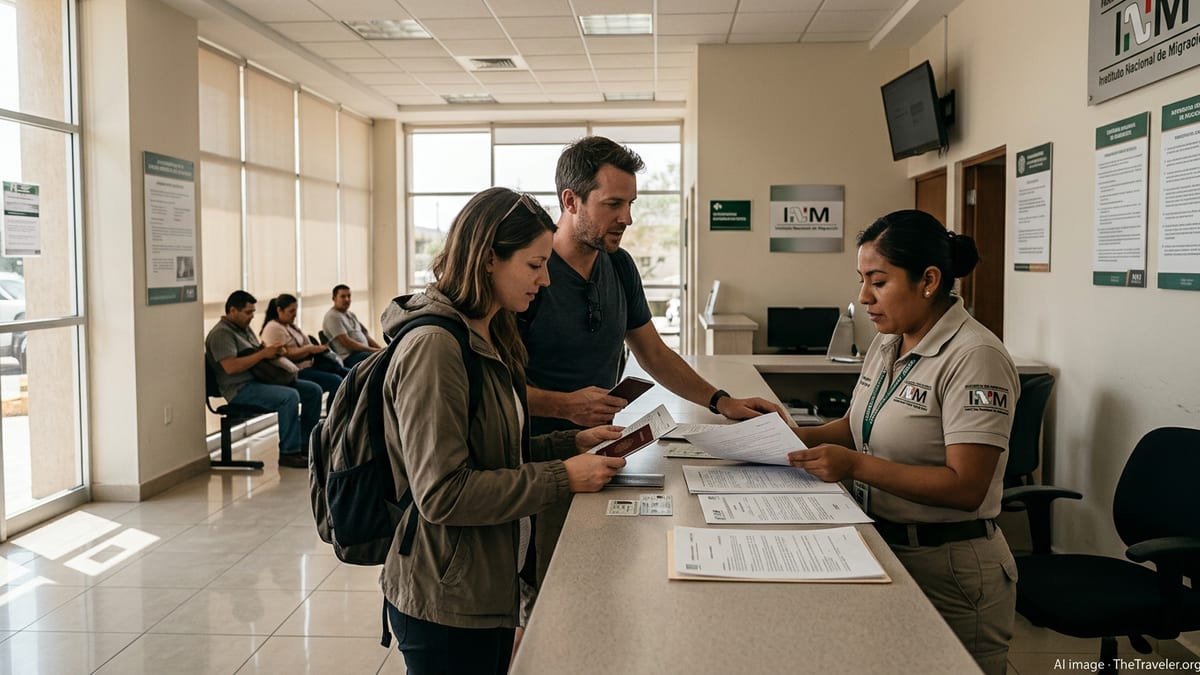
The in-country component of moving legally to Mexico culminates at the INM office corresponding to the foreigner’s place of residence. This is where the residency visa is exchanged for a plastic resident card that proves legal status. The overall process involves completing an official online form, paying government fees at a bank or electronically, submitting supporting documents, and attending biometrics and photo capture.
Typical documentation for the canje process includes: the original passport with the residency visa, entry record showing the recent arrival, the completed residency application form printed and signed, proof of payment of government fees, proof of address in Mexico, photographs that meet INM specifications, and in some cases a brief written statement or additional forms describing the intended stay. Some INM offices require appointments booked through an online system, while others accept walk-in applicants depending on local capacity and policy.
Processing times vary by office and workload. In some locations, applicants may complete biometrics and collect the resident card the same day or within a few days, while in others the interval can be several weeks. During processing, the applicant may receive a printed document or electronic folio confirming that the application is in progress, which serves as proof of pending legal status if requested by authorities.
Once the resident card is issued, the foreigner has formal legal authorization to reside in Mexico under the conditions stated on the card. For temporary residents, the first card is typically valid for one year, with the option to renew in one, two, or three year increments up to a total of four years before transitioning to permanent residency. Permanent resident cards do not usually require annual renewal, although they may need periodic replacement for administrative reasons such as changes in format or loss.
7. Post‑Arrival Legal Obligations and Status Maintenance
After obtaining a resident card, maintaining legal status in Mexico requires adherence to several obligations. Temporary residents who wish to continue living in Mexico must renew their card before its expiry date at the same or another competent INM office. Late renewals can result in fines or loss of status, so calendar tracking is essential. Permanent residents, while not on an annual renewal cycle, still need to maintain accurate personal data with INM when major circumstances change.
Foreigners must notify INM of specific events within statutory deadlines. These commonly include changes of address within Mexico, changes in civil status such as marriage or divorce, modifications in employer or type of authorized economic activity if the resident holds work authorization, and changes in nationality if an additional passport is acquired. Failure to update these details can lead to administrative penalties or complications during renewals or reentry.
In terms of travel, resident card holders can usually leave and reenter Mexico freely as long as the card remains valid and they meet standard border controls. However, being absent from Mexico for extended periods without maintaining genuine ties may raise questions in certain procedures, especially when transitioning from temporary to permanent residency through continuous residence. Individuals should verify any minimum or continuity requirements that apply to their specific route before adopting a pattern of frequent or long absences.
In the event of card loss or theft, the resident must report the incident and apply for a replacement at the appropriate INM office, and if outside Mexico, follow consular procedures to obtain the documentation needed to reenter and regularize the card. Treating the resident card as a critical identity and status document, similar to a national ID in other countries, is an important part of maintaining uninterrupted legal residence.
8. The Takeaway
Moving to Mexico legally as a foreigner involves a layered but navigable series of steps, starting with selecting the correct immigration category, continuing through consular processing, and concluding with in-country formalities at INM. The key to a compliant relocation is matching the chosen pathway to the individual’s real intentions and capabilities, including income, savings, family relationships, and investment plans.
Most long-term movers will rely on temporary or permanent residency rather than extended use of visitor status. The consular stage is where eligibility is examined and where financial or family evidence must be presented in a structured way. The subsequent 30-day window after entry is operationally crucial, because timely completion of the canje process is what transforms a visa in the passport into a durable resident card.
Once established as a resident, the foreigner’s primary responsibilities are to renew temporary cards on time, to report changes in key personal or professional circumstances, and to preserve documentary evidence of lawful status for everyday transactions. While administrative details and financial thresholds continue to evolve, the overall architecture of Mexico’s relocation regime remains stable: an initial decision at the consulate, a technical in-country exchange procedure, and ongoing compliance to maintain the right to live in Mexico legally and securely.
FAQ
Q1. Can I move to Mexico long term using only a tourist entry or visitor permit?
It is possible to enter Mexico repeatedly as a visitor, but using visitor status as a de facto long-term residence is risky and not compliant with the intended rules. Immigration officers can shorten stays, deny entry, or question repeated visits if they suspect that a person is residing in Mexico without an appropriate resident status.
Q2. Do I have to apply for Mexican residency in my home country, or can I do it inside Mexico?
The standard route requires initiating residency at a Mexican consulate outside Mexico, obtaining a residency visa in the passport, and then completing the exchange at INM in Mexico. Certain family-based and special regularization mechanisms can begin in-country, but for most foreigners planning a move, the process starts abroad.
Q3. How long do I have after arriving in Mexico to finalize my resident card?
After entering Mexico with a residency visa, there is generally a 30 calendar day deadline to initiate the canje process at the relevant INM office. Missing this window can invalidate the visa and may require restarting the process from the consulate.
Q4. Is it possible to obtain permanent residency directly without first being a temporary resident?
Some foreigners can obtain permanent residency directly from a consulate if they meet higher financial thresholds or qualify through specific family categories such as being a parent of a Mexican citizen. However, many people first become temporary residents and later convert to permanent status after several years.
Q5. What role do income and savings play in qualifying for residency in Mexico?
Income and savings are central eligibility criteria in most economic solvency-based residency routes. Mexico calculates these thresholds using the UMA unit, and consulates apply them in local currency, resulting in approximate monthly income and savings amounts that are reviewed annually and can differ slightly by consulate.
Q6. Can I work in Mexico with a temporary or permanent resident card?
Some temporary and permanent resident statuses authorize work, while others do not. If work is intended, the application must use a category that allows employment, or the resident must obtain specific authorization from INM. Working in Mexico without the correct authorization can jeopardize legal status.
Q7. What happens if my resident card expires while I am outside Mexico?
Allowing a resident card to expire while abroad can complicate reentry and may result in the loss of residency. In such cases, individuals often need to contact a Mexican consulate or legal advisor to explore potential mechanisms to regularize status or reapply.
Q8. Do I need to stay in Mexico a minimum number of days each year to keep my residency?
Mexico’s formal minimum stay rules are relatively flexible compared to some countries, but extended absences can affect certain processes, especially the transition from temporary to permanent residency based on continuous residence. It is prudent to keep records of time spent in Mexico and verify how absences may affect long-term plans.
Q9. Are the financial requirements for residency the same at every Mexican consulate?
No. While all consulates follow national guidelines based on UMA, practical thresholds and documentation expectations can differ between consulates and are adjusted periodically. Applicants should check the current published requirements of the specific consulate where they plan to apply.
Q10. Can my spouse or children obtain residency in Mexico through my status?
Yes, family members such as spouses, minor children, and in some cases dependent parents can often obtain residency under family unity provisions based on the primary applicant’s status. The principal resident usually must prove sufficient economic capacity to support dependents, and each family member must complete the appropriate consular and INM steps.