

Planning a trip to Kenya is as much about choosing the right routes and seasons as it is about deciding how you want to experience the country: big game safaris, Indian Ocean beaches, highland culture, or all of the above.
With a new electronic travel authorization system replacing traditional visas, steadily improving transport infrastructure, and a year-round tourism calendar anchored by the Masai Mara’s famed wildebeest migration, Kenya is increasingly straightforward to navigate.
The key is to align your itinerary with the climate, wildlife patterns, and logistics on the ground so that your days flow smoothly from game drive to sundowner, coastal dhow cruise to urban café.
Understanding Kenya’s Regions and Classic Routes
Most first-time itineraries in Kenya revolve around three broad areas: Nairobi and the central highlands, the Rift Valley and classic safari plains, and the Indian Ocean coast. Nairobi, the capital, is both a logistical hub and a destination in its own right, with a major international airport, a growing restaurant scene, and easy access to nearby wildlife areas. The central highlands surrounding Mount Kenya, including areas such as Laikipia, offer cooler climates, ranch conservancies, and more exclusive safari experiences.
To the southwest lies the Masai Mara National Reserve and its neighboring conservancies, arguably the country’s most famous wildlife destination. This is where many visitors plan to witness the Great Migration between July and October, but the Mara also offers strong predator sightings throughout the year. North of Nairobi, Samburu and surrounding reserves in semi-arid country provide a contrasting scenery of red soil, rugged hills, and riverine forests, as well as “northern special” species not found in the south, such as reticulated giraffe and Grevy’s zebra.
Kenya’s coast stretches from Lamu in the north to Diani in the south, with Mombasa roughly in the middle. Powdery beaches, coral reefs, Swahili culture, and historic towns provide a softer, slower complement to the intensity of a safari. Many travelers structure trips to start with a few nights in or near Nairobi, move into a circuit of one or two safari regions, then end with several days on the coast before flying home.
Several classic routes have emerged from these building blocks. A popular ten to twelve day journey might link Nairobi, the Masai Mara, and the Diani or Watamu coast. Longer itineraries of two weeks or more might add Laikipia or Samburu in the north, or include a circuit through Lake Nakuru or Lake Naivasha for Rift Valley lakes and birdlife. Internal flights make these hops feasible without spending long hours on the road, though road safaris remain possible for those with more time and tighter budgets.
When to Go: Seasons, Migration, and Weather
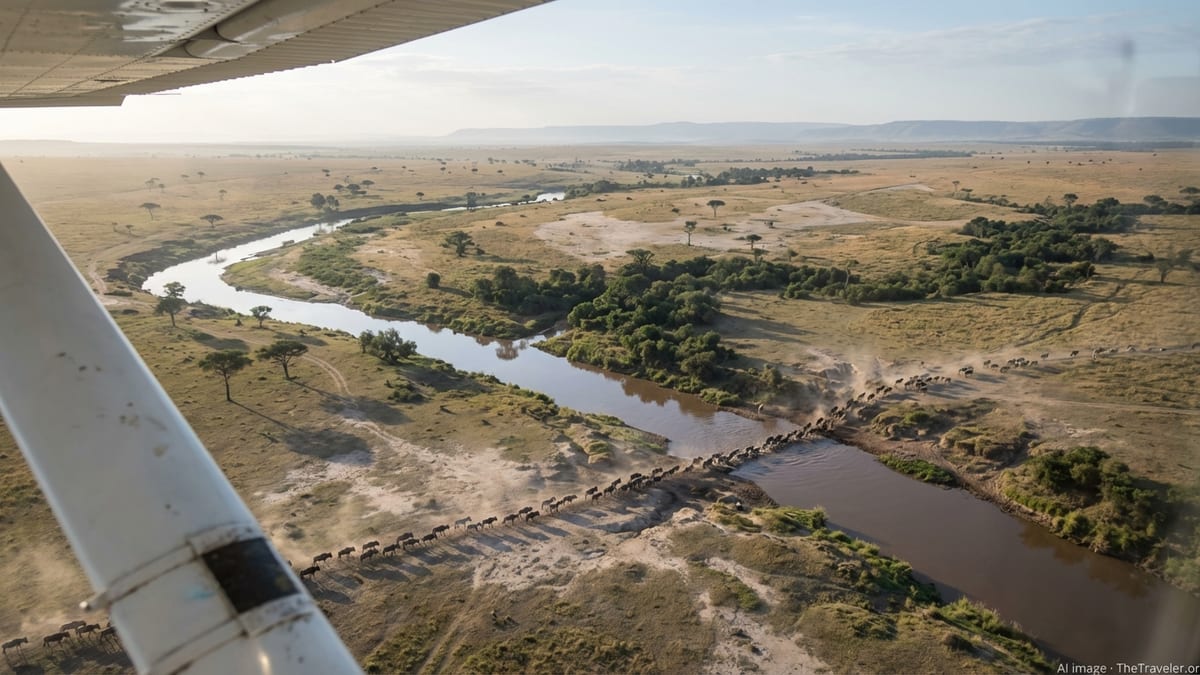
Kenya is very much a year-round destination, but your experience will shift with the seasons. Broadly, conditions fall into dry and rainy periods. The main dry season usually runs from late June through October and often delivers the most reliable wildlife viewing, particularly in the Masai Mara, where vegetation is lower and animals are drawn to permanent water sources. This period coincides with the arrival of vast herds of wildebeest and zebra crossing into the Mara from Tanzania, with river crossings typically most intense from July through September.
The short rains often arrive around November and can extend into early December, greening the plains without necessarily disrupting travel. The long rains generally occur from March through May, with April tending to be the wettest. During this time some remote roads may become muddy or temporarily impassable, certain smaller camps may close, and photographic conditions can be more challenging. However, the wet season brings dramatic skies, lush landscapes, fewer crowds, and often lower rates, appealing to photographers and repeat visitors comfortable with a bit of unpredictability.
In terms of wildlife spectacles, the Great Migration in the Masai Mara is the main seasonal draw. While exact dates change from year to year depending on rainfall, the herds are most reliably present in the Mara between July and October, with peak river crossings often occurring in August and early September. Outside this window, Kenya’s resident wildlife, including the “Big Five” and a wealth of plains game and birdlife, remains excellent in many parks and conservancies, from Amboseli’s elephant herds beneath Mount Kilimanjaro to Laikipia’s rhinos and Samburu’s arid-adapted species.
Climate also varies by altitude. Nairobi and the central highlands are generally mild and spring-like, with cooler evenings, particularly from June through August. Coastal regions are warm and humid year-round, with the most pleasant beach conditions often found from December to March and again from late June into October. If your trip combines highland safaris and coastal relaxation, you are likely to experience a range of temperatures and should pack accordingly, from a warm layer for early morning game drives to lightweight, breathable clothing for the coast.
Entry Requirements, Health, and Safety Basics
Kenya has overhauled its entry system, replacing traditional visas with an electronic travel authorization, or eTA, for almost all foreign nationals. Travelers must apply online before departure, supplying passport details, travel dates, and basic itinerary information, and then receive electronic approval, which airlines and immigration officials will verify on arrival. Although processing times are often relatively quick, it is prudent to apply at least several days before departure to avoid last-minute complications. Children and infants also require authorization, so families should complete all applications in advance.
Passport validity rules are strictly enforced, so plan ahead. Visitors are typically required to hold a passport valid for at least six months beyond their date of entry and to have at least one or two blank pages available for entry stamps. Return or onward tickets and proof of accommodation may be requested at immigration. Those planning overland travel to neighboring countries should confirm current border and health requirements for each destination well before departure, as these can change.
On the health front, standard advice for East Africa applies. Many travelers speak with a travel medicine clinic six to eight weeks before departure to review recommended vaccinations and malaria prevention. Requirements for yellow fever certificates may depend on your country of origin or recent travel history, particularly if you are arriving from or transiting through a yellow fever risk country. Insect bite protection, careful food and water hygiene, and comprehensive travel insurance that includes medical evacuation coverage remain sensible precautions wherever you are headed in Kenya.
Safety perceptions of Nairobi and other Kenyan cities vary widely, but with basic urban precautions, most visitors move through the country without incident. As in many large cities, opportunistic crime can target distracted tourists in busy areas, so it is wise to use registered taxis or reputable ride-hailing services, avoid displaying expensive electronics or jewelry, and be cautious after dark. In safari areas and coastal resorts, security standards are generally high, and lodges and camps provide extensive guidance about safe movement, especially at night. Political demonstrations sometimes occur in urban centers; staying informed through local news and your accommodation, and avoiding protest areas, helps keep your travels smooth.
Choosing Your Itinerary: Safari Circuits and Coastal Add-Ons
Designing a Kenya itinerary begins with deciding how much time you have and what balance you want between safari, city, and coast. With seven to ten days, a focused route that pairs Nairobi with a single main wildlife area, such as the Masai Mara or Amboseli, can deliver a concentrated safari experience without feeling rushed. With ten to fourteen days, you can reasonably link two or three safari regions, such as combining the Mara with Laikipia or Samburu, then fly onward to the coast for several days on the beach.
The classic “southern circuit” uses Nairobi as a gateway to Amboseli, the Tsavo parks, and coastal areas. Travelers might spend two or three nights beneath the snow-dusted peak of Kilimanjaro in Amboseli, famed for its large tusker elephants, before driving or flying to the vast landscapes of Tsavo East or Tsavo West. From there it is a straightforward onward hop to the beaches around Mombasa, Diani, or further north to Watamu and Malindi, creating a natural overland or fly-in arc from inland plains to the Indian Ocean.
Alternatively, the “Mara plus north” route focuses on the southwest and central highlands. After a night or two in Nairobi, travelers fly to a camp in the Masai Mara or neighboring conservancies for intensive big cat and migration-focused game viewing, then connect to Laikipia or Samburu. Laikipia’s private conservancies offer walking safaris, night drives, and a mix of traditional tented camps and chic lodges, while Samburu showcases dramatic arid scenery and distinctive wildlife assemblies along the Ewaso Nyiro River. A coastal extension can still be added by flying back via Nairobi and onward to the beach.
Independent travelers with more time, particularly those comfortable with overland journeys, may also weave in Rift Valley lakes such as Nakuru and Naivasha. Lake Nakuru National Park is renowned for rhino populations and varied birdlife, while Naivasha offers boating, hiking on nearby Mount Longonot, and cycling among wildlife at Hell’s Gate National Park. These lakes can function as intriguing stopovers between Nairobi and the Mara, breaking up road journeys and adding ecological variety to a safari-focused trip.
Getting Around: Flights, Roads, and Rail
Internal transport choices in Kenya often determine how relaxed or tiring your trip feels. Domestic flights, operated by several regional carriers on light aircraft, have made it easy to hop between Nairobi, safari airstrips, and coastal airports. Most routes connect through Nairobi’s Wilson Airport, the city’s domestic aviation hub, with scheduled services into popular areas such as the Masai Mara, Amboseli, Laikipia, Samburu, and the main coastal gateways. These flights significantly cut travel time compared to long overland drives, though they come at a premium, and baggage allowances are usually limited to soft bags in the 15 to 20 kilogram range.
For those traveling by road, conditions vary. Major highways linking Nairobi with cities such as Mombasa, Nakuru, and Kisumu continue to improve, and the drive between Nairobi and the central Rift Valley is relatively straightforward. Access roads to national parks and more remote conservancies, however, can be rough, especially after heavy rain. Many travelers in these areas move with a driver-guide in a safari 4x4 or minibus arranged through a tour operator or lodge, rather than attempting self-drive. If you do intend to drive, careful preparation, familiarity with local traffic etiquette, and a realistic sense of daily distances are essential.
The Nairobi–Mombasa standard-gauge railway has become an increasingly popular option for connecting the capital and the coast. Trains run between the two cities, with the journey typically taking about five to six hours. From Mombasa, onward road transfers to Diani, Watamu, or Malindi can be arranged. The railway offers an alternative to flying for travelers who prefer not to take domestic flights or who are looking to experience a different perspective on the Kenyan landscape during their journey.
Within cities, ride-hailing apps and registered taxis are widely used in Nairobi and Mombasa. In smaller towns and coastal resorts, tuk-tuks and local taxis are common for short hops. When moving between accommodations in safari regions, transfers are usually coordinated by lodges and camps as part of a package, with game drives effectively forming your primary mode of transport once you are in the bush. Planning your itinerary so that long journeys are broken up with activities and overnight stops helps ensure that travel days do not overshadow your time on the ground.
Booking Safaris, Lodges, and Experiences
Securing the right combination of camps, lodges, and guiding can define the quality of a Kenya trip. Peak periods, especially the heart of the migration season in the Masai Mara from July through September, see high demand for well-located camps near favored river crossing points. For these months it is common advice to book six to twelve months in advance to secure preferred properties and room types, particularly if you are planning a special occasion or traveling as part of a larger family group.
Travelers with more flexibility on timing can often find wider availability and more favorable rates in shoulder seasons such as early June, late October, or January and February. These periods can deliver strong wildlife viewing with fewer vehicles on sightings and more personal service in camp. When comparing options, look beyond room decor to factors such as guiding quality, access to private conservancies that allow activities like night drives and bush walks, and camp philosophies on community partnerships and conservation.
Many visitors choose to work with experienced safari tour operators who package internal flights, accommodation, park fees, and guiding into a single itinerary. This approach simplifies logistics, particularly for multi-stop journeys across remote areas, and provides 24-hour support if schedules shift because of weather or operational issues. More independent travelers may book international flights and then secure arrangements directly with a handful of lodges and camps, leaving room for spontaneous adjustments, although this still requires careful alignment of flights, transfers, and park regulations.
Beyond standard game drives, Kenya offers a growing menu of specialized experiences. Hot air balloon flights over the Masai Mara, usually scheduled at dawn, provide sweeping views of the plains and herds below. Walking safaris in conservancies, horseback safaris on certain highland ranches, birding excursions around Rift Valley lakes, and cultural visits to Maasai or Samburu communities can all be woven into an itinerary. On the coast, dhow cruises, snorkeling, diving, kitesurfing, and historical walks through old Swahili towns enrich days between hours spent on the beach.
Budgeting, Payments, and Practical Details
Kenya trips range from relatively modest overland safaris to ultra-luxury fly-in experiences, so early clarity on budget helps narrow choices. Safari-level costs are driven mainly by the caliber and location of lodges and camps, the ratio of guests to guides and vehicles, whether you are in a national park or a private conservancy, and whether internal flights are included. Beach stays and time in Nairobi tend to be more flexible in price, with a wider range of hotels and guesthouses. Peak season rates from July through October and during holiday periods are significantly higher than low or shoulder season prices.
Most midrange and higher-end properties allow payment by credit card, especially in cities and established safari camps, though surcharges may apply. Nonetheless, it is sensible to carry some local currency for tips, small purchases at local markets, and incidental expenses during road transfers. Cash machines are available at major banks and in shopping centers in cities and larger towns, but are sparse in rural regions and absent in parks themselves. Inform your bank of your travel dates to minimize the risk of cards being blocked for suspected fraud when used in East Africa.
Gratuities and service charges are a significant part of staff income in many tourism operations. While tipping practices vary by property, a common pattern is to leave a pooled tip for camp or lodge staff, plus a separate amount for your guide and, where applicable, tracker. Many accommodations provide guidance in guest information folders or at reception. Spreading tipping across key staff and aligning with local norms respects the teams who make your experience possible.
Connectivity is improving, with 4G mobile coverage increasingly available along major routes and in towns, and Wi-Fi present in many hotels, lodges, and camps. However, in remote safari areas, coverage can be intermittent or deliberately limited to preserve a sense of immersion. Travelers who need consistent access for work may wish to purchase a local SIM card in Nairobi and download offline maps and key documents in advance. Power in camps may be supplied by generators or solar systems; charging schedules are usually clear, but packing a small power bank ensures cameras and phones remain ready for early morning game drives.
The Takeaway
Planning a trip to Kenya is, at its heart, an exercise in aligning your expectations with the realities of climate, wildlife rhythms, and infrastructure, then letting the country’s energy fill in the details. Deciding when to go, choosing which combination of regions best fits your interests, and piecing together the most sensible transport options between them are the foundational steps. What follows, whether it is the thrum of hooves during a Mara river crossing, the stillness of elephants at dawn under Kilimanjaro, or the call to prayer drifting over a Swahili harbor at sunset, is what transforms an itinerary into a memory.
With electronic travel authorization smoothing entry, domestic flights and rail lines shortening internal journeys, and a mature safari industry spanning every style from rustic tented camps to polished resorts, Kenya is well-equipped for both first-time visitors and seasoned African travelers. The key is to start planning early enough, particularly for peak seasons, to secure the experiences most important to you. From there, building in a little flexibility, leaving some afternoons open, and trusting the expertise of local guides and hosts will allow the country’s landscapes, wildlife, and cultures to reveal themselves at their own pace.
FAQ
Q1. How far in advance should I plan and book a Kenya trip?
For peak periods such as July to October in the Masai Mara or major holiday seasons, aim to start planning and booking six to twelve months in advance, especially if you want specific camps or family rooms. For shoulder and low seasons, three to six months often suffices, though last-minute deals may be limited in more remote or exclusive areas.
Q2. Do I still need a visa, or is the electronic travel authorization enough?
Kenya now uses an electronic travel authorization system for most foreign visitors instead of traditional visas. You apply online before travel, receive approval electronically, and present this along with your passport on arrival. Check the latest official guidance for your nationality before booking flights, and complete applications several days before departure.
Q3. What is the best month to see the Great Migration in the Masai Mara?
The migration herds are most reliably in the Masai Mara from July through October, with many travelers targeting August and early September for the highest chance of dramatic river crossings. Exact timing can vary year by year with rainfall patterns, so think in terms of a window rather than exact dates, and allow a few days in the Mara to improve your chances of witnessing major movements.
Q4. Is it safe to travel independently in Kenya, or do I need a guided tour?
Many visitors travel independently through cities and to the coast using domestic flights, trains, or road transfers, then join guided activities once in safari areas. For multi-park safaris in remote regions, working with a reputable operator or booking packages directly with established camps simplifies logistics and enhances safety. In cities, basic precautions such as using licensed taxis or ride-hailing services and avoiding poorly lit areas at night are generally sufficient for most travelers.
Q5. How many days should I spend on safari versus at the beach or in Nairobi?
For a balanced first trip, many travelers allocate four to six nights on safari, split between one or two locations, then three to five nights on the coast, plus one or two nights in Nairobi at the beginning or end. Those with a strong wildlife focus may devote most of their time to multiple parks, while others prefer a shorter, intense safari followed by a longer beach stay for rest and water-based activities.
Q6. What should I pack for Kenya’s varied climates?
Pack lightweight, breathable clothing in neutral colors for daytime game drives, a warm layer and perhaps a light hat and gloves for cool early mornings and evenings in the highlands, and swimwear plus light beachwear for the coast. Comfortable closed shoes, a wide-brimmed sun hat, sunglasses, insect repellent, sunscreen, and a compact rain jacket are useful across seasons. Soft-sided luggage is best for small aircraft, where weight limits are strict.
Q7. Can I self-drive in national parks and reserves?
Self-drive is possible in some Kenyan parks, but most international visitors choose to explore with a driver-guide arranged through a tour operator or lodge. Guides understand local road conditions, wildlife behavior, and park rules, and handle navigation and permits. If you decide to self-drive, you must research regulations for each park, ensure you have a suitable 4x4, and be comfortable with sometimes challenging road conditions and long distances.
Q8. How much will a Kenya safari and beach trip typically cost?
Costs vary widely, but a midrange safari with shared game drives and standard lodges, plus a few days at the beach, often falls into the moderate to upper travel budget bracket per person, excluding international flights. Luxury fly-in safaris with high-end camps, private vehicles, and scenic extras such as hot air ballooning can be significantly more expensive. Traveling in shoulder seasons, choosing a mix of lodge categories, and limiting the number of internal flights can help manage costs.
Q9. Is Kenya suitable for families with children?
Kenya can be an exceptional family destination, with many lodges offering family tents or adjoining rooms, child-friendly menus, and tailored activities. Some camps have minimum age requirements for game drives or walking safaris, so families should carefully select properties that welcome younger guests and offer flexible schedules. Combining shorter game drives, downtime by the pool, and hands-on experiences such as cultural visits or gentle boat trips can help keep children engaged.
Q10. Do I need to worry about connectivity and power when on safari?
Most established lodges and camps have at least some Wi-Fi access in public areas, although speeds can be limited and coverage may be switched off at night. Power is typically available for charging cameras and phones, even when properties rely on generators or solar systems, but you may find restricted hours in very remote camps. Bringing a small power bank, downloading entertainment or work materials in advance, and preparing for intermittent connectivity will help you adapt to conditions on the ground.