

Fringed by sheltered harbours and coastal mountains, Nanaimo is one of Vancouver Island’s most accessible gateways, yet planning the journey can feel surprisingly complex.
Ferries, seaplanes, helicopters, local buses and taxis all intersect here, and schedules and procedures have changed in recent years.
This guide walks you through the practical details of getting to Nanaimo and moving around once you arrive, so you can focus on exploring the waterfront, trails and nearby islands instead of worrying about logistics.
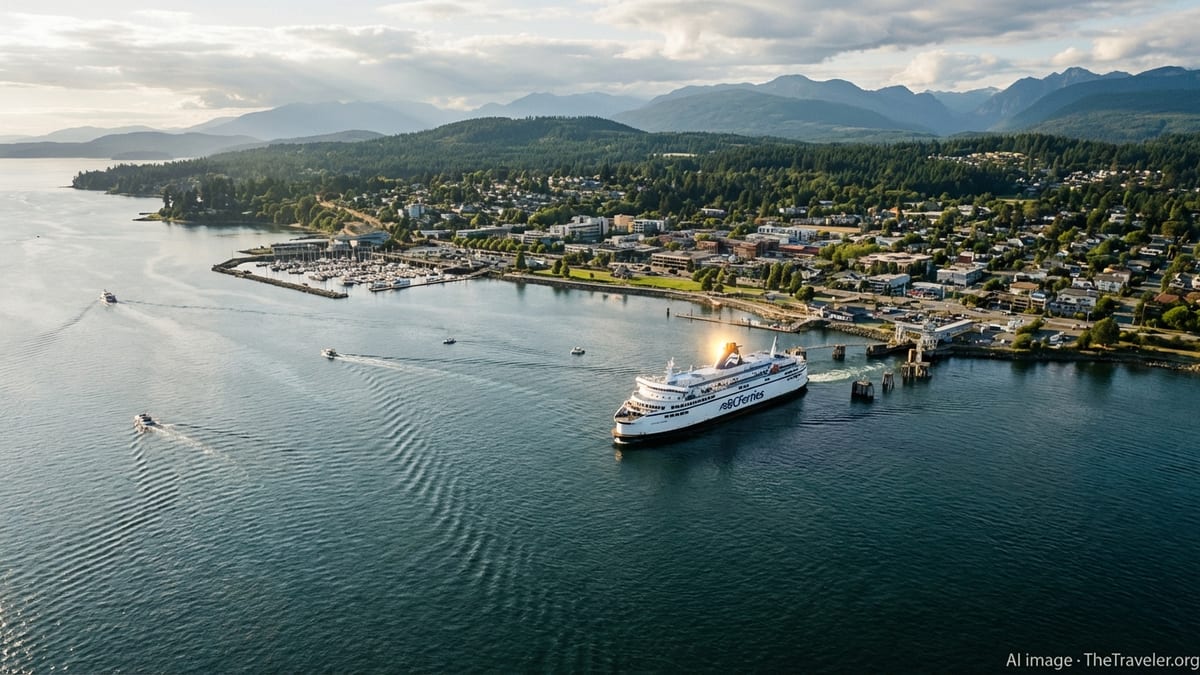
Understanding Nanaimo’s Geography and Terminals
Nanaimo stretches along the east coast of Vancouver Island, with transportation services fanning out along its shoreline rather than through a single central hub. As a visitor you are most likely to encounter four main arrival points: Departure Bay ferry terminal near established residential neighbourhoods north of downtown, Duke Point ferry terminal in a more industrial area south of the city, the downtown harbour seaplane and fast ferry area, and Nanaimo Airport located inland at Cassidy, roughly a 15 to 20 minute drive south of the city. Knowing which terminal you are using is essential because it shapes how you connect to accommodation, transit and onward travel.
Departure Bay is the scenic gateway linked with Horseshoe Bay in West Vancouver. It sits a short drive from central Nanaimo and is relatively convenient for most hotels and guesthouses. Duke Point, by contrast, handles the Tsawwassen route that connects directly to the highway network toward Vancouver and the United States border; it is practical for drivers continuing by road but less convenient for foot passengers, who will usually need a taxi or pre arranged pick up.
In the heart of the city, Nanaimo’s inner harbour concentrates seaplanes, helicopter services and the fast passenger ferries that connect to downtown Vancouver. This cluster of docks is within walking distance of many downtown hotels, restaurants and the harbourfront walkway, making it particularly attractive if you prefer to arrive directly into the city core without needing a vehicle. Finally, Nanaimo Airport, south of town, serves regional flights that link to major Canadian hubs. Shuttles, taxis and rental cars connect the airport with both downtown Nanaimo and nearby communities, so you can tailor your arrival to your itinerary.
Because these terminals are spread out, it is worth confirming the exact name of your arrival point when you book, then checking how far it is from your accommodation and what local transport options operate at your time of arrival. This simple step prevents last minute surprises and helps you choose the route that best fits your priorities, whether that is cost, scenery, or arriving as close as possible to your hotel.
Arriving by BC Ferries from Metro Vancouver
BC Ferries remains the classic way to reach Nanaimo from the Vancouver area, and it offers two main routes. The Horseshoe Bay to Departure Bay route is shorter and more scenic, crossing part of Howe Sound before traversing the Strait of Georgia. Typical sailing time is around an hour and forty minutes, and in most seasons there are frequent daily departures in both directions. The Tsawwassen to Duke Point route generally takes about two hours and is popular with drivers heading toward Victoria or south to the United States because it connects directly to major highways.
Recent changes are particularly important if you plan to travel by vehicle from Horseshoe Bay to Departure Bay. BC Ferries now requires that all vehicles on this route be booked and prepaid in advance, rather than relying on traditional drive up fares. This applies to standard cars, motorcycles, commercial vehicles and tour operators. The booking cutoff has been tightened to around 30 minutes before departure during current construction at Horseshoe Bay, making last minute changes easier in some cases but also removing the option to simply arrive and hope for space. For the reverse direction, from Departure Bay back to Horseshoe Bay, advance reservations are still strongly recommended but not strictly mandatory in the same way.
Foot passengers continue to have more flexibility. On both Nanaimo routes you can generally buy a walk on ticket at the terminal, although sailings on long weekends, school holidays and summer afternoons can be busy. Arriving at least an hour before your preferred sailing is a sensible buffer in peak periods, and earlier if you are travelling with a group. For vehicles, BC Ferries advises arriving 30 to 60 minutes before your booked departure to clear check in and lane assignments, and you risk losing your reservation if you miss this window.
When choosing between the two routes, think about where you are starting and where you need to end up. Horseshoe Bay is on the North Shore of Metro Vancouver and works well if you are coming from downtown Vancouver or the Sea to Sky corridor. Tsawwassen lies south of the city, closer to the border and Richmond. On the Nanaimo side, Departure Bay is more convenient for central hotels and transit, while Duke Point is useful for road trips continuing down island. Both crossings can occasionally face delays or cancellations due to weather or mechanical issues, so on the day of travel it is wise to check current conditions and service notices before setting out for the terminal.
Fast Passenger Ferries and Harbour Services
In addition to the large car ferries, Nanaimo has emerged as one of the key hubs for fast passenger services along the BC coast. Private operators now connect downtown Nanaimo directly with downtown Vancouver across the Strait of Georgia, using high speed catamarans that carry foot passengers only. These sailings bypass the need for vehicle decks and large terminals, so boarding generally feels more like a small regional ferry or coastal commuter service.
Travel times on these fast ferries are typically under 90 minutes, depending on the operator and routing, and the experience is quite different from the larger BC Ferries vessels. On board you can expect assigned or open seating, snack service, Wi Fi on some boats, and large windows that frame views of the Gulf Islands and coastal mountains when the weather cooperates. Because capacity is smaller than the big ferries, advance booking is highly advisable, especially for weekend departures and peak travel seasons when sailings can fill quickly.
Most of these fast ferries use terminals at or near the Nanaimo Port Authority facilities along the downtown waterfront. That places you within a relatively short walk of harbourfront hotels, restaurants and the Harbourfront Walkway, or a quick taxi ride to neighbourhoods farther afield. On the Vancouver side, fast ferry terminals are typically located close to downtown transit hubs, which makes them attractive if you are travelling without a car or aiming to minimize transfers.
At the same harbourfront area you will also find seaplane docks and helicopter pads, which can be confusing if you arrive without having checked the exact operator and location. When booking, pay careful attention to whether your ticket lists the cruise terminal, the seaplane base, a floatplane dock, or a passenger ferry terminal. These facilities sit close together but are not identical, and signage on site is designed around individual companies, so double checking the name of your carrier and terminal before you arrive will streamline your boarding experience.
Flying into Nanaimo: Airport, Seaplanes and Helicopters
For many visitors, especially those coming from farther afield, flying into Nanaimo is the most efficient option. Nanaimo Airport, designated YCD, sits south of the city near the community of Cassidy. It is a compact regional airport with a modern terminal that connects primarily to larger Canadian hubs such as Vancouver, Calgary, Edmonton and, on a seasonal basis, other cities like Kelowna or Toronto. These hub connections allow you to fly into Nanaimo from international origins with just one domestic connection.
From the airport to downtown Nanaimo, you can choose between rental cars, taxis, ride hail services where available, or shuttle operators which run between the terminal and key locations in the city. Driving time is usually in the range of 15 to 20 minutes in light traffic. If you plan to rely on transit alone, check current schedules carefully, as bus services in the immediate airport area may be limited in early mornings or late evenings. Most travellers who plan to explore Vancouver Island beyond Nanaimo find that collecting a rental car at the airport offers the greatest flexibility.
Another distinctive option is to arrive right in the heart of Nanaimo by seaplane. Harbour Air, Seair and other floatplane operators run frequent flights linking Nanaimo’s harbour with downtown Vancouver and the Vancouver International Airport south terminal. Typical flight times are around 20 minutes, and flying low over the Gulf Islands can be a highlight of the trip. Seaplanes usually operate during daylight hours and are more vulnerable than large jets to weather related delays, particularly during winter storm systems or periods of low visibility, so it is prudent to allow some buffer time if you need to make tight connections.
Helicopter services also link Nanaimo’s cruise terminal area with downtown Vancouver’s heliport. These flights appeal to business travellers and anyone looking to minimize total travel time door to door. Flight durations are comparable to seaplanes, and the downtown to downtown convenience is hard to match. However, capacity is limited and fares are generally higher than standard ferry tickets, so advance booking is important, and this mode is best viewed as a premium or time saving option rather than a budget choice.
Local Transit, Taxis and Car Rentals
Once you have arrived in Nanaimo, getting around the city involves a choice between public transit, taxis or ride hail, car rentals, and in some cases cycling or walking. Public buses are operated by the Regional District of Nanaimo under the RDN Transit banner. The network focuses on connecting major neighbourhoods, shopping areas, Vancouver Island University and key transportation hubs, including shuttle style service that links ferry terminals and the downtown harbour area. Routes and schedules can change periodically, so always consult the current rider guide or trip planner when mapping connections.
Of particular interest to visitors is the ferry shuttle route that serves Departure Bay and the downtown area. Recent adjustments have increased the number of trips to and from the BC Ferries terminal and added service to the Nanaimo Port Authority facilities used by fast ferries and air services. These buses are timed where possible to meet arriving sailings, though they may no longer wait for delayed ships in order to protect connections elsewhere in the system. If you are relying on a specific bus after a late evening arrival, it is wise to have a fallback option such as a taxi in case your sailing is significantly delayed.
Taxis queue at major terminals and in the downtown core, and they remain the most straightforward way to travel between scattered terminals, hotels and residential neighbourhoods, particularly if you are carrying luggage. During busier evenings and on holiday weekends there can be lineups, so pre booking a cab where possible may save time. Ride hail services operate within Nanaimo subject to provincial licensing, but availability can fluctuate and may be limited outside peak hours. If you know you will arrive very late at night, check in advance whether taxis or ride hail will be operating when your ship or flight is scheduled to arrive.
Car rental agencies are present both at Nanaimo Airport and at locations closer to the downtown area. Renting a vehicle gives you maximum flexibility for exploring nearby attractions such as Newcastle Island, Nanoose Bay, Parksville and Qualicum Beach, or for continuing your journey down island toward Victoria or north toward Campbell River. Parking in downtown Nanaimo is a mix of street parking and lots; check whether your accommodation includes guest parking, particularly if you are staying in the historic core where space can be tight. Driving in and around Nanaimo is generally straightforward, but visitors should remain alert for changing speed limits as highways shift into urban zones and watch for pedestrians and cyclists near the waterfront.
Walking, Cycling and Neighbourhood Mobility
Nanaimo’s linear coastal layout makes certain areas highly walkable while others are more car dependent. Downtown Nanaimo, the Old City Quarter and the waterfront districts around the harbour form a compact area where you can reasonably explore on foot, provided you are comfortable with some hills. The Harbourfront Walkway stretches along the shoreline, linking marinas, small parks and viewpoints; it is ideal for leisurely strolls or as a practical walking route between some hotels and the floatplane or fast ferry terminals.
Outside the immediate downtown core, distances increase quickly and the terrain can be a mix of residential slopes and commercial arterials. Sidewalk coverage is good in most built up areas but can be patchier on the fringes. If you enjoy walking and want to rely less on vehicles, choosing accommodation in or close to the downtown or within established neighbourhoods along major transit corridors will make this easier. For late night returns, remember that bus frequencies drop and some areas may feel quiet, so you may prefer to use a taxi instead of walking long distances after dark.
Cycling in Nanaimo is gradually becoming more common, with a growing network of bike lanes and multi use paths, although infrastructure is still evolving. Confident cyclists can use local streets and designated lanes to travel between the downtown area, the university and commercial districts. If you are considering cycling between ferry terminals, be prepared for significant hills and highway style roads in some sections, especially on the approach to Duke Point. For many visitors, cycling is best enjoyed on local trails and waterfront routes rather than as a primary mode of inter terminal travel.
For mobility challenged travellers, it is useful to know that BC Ferries vessels and terminals are outfitted with elevators and accessible washrooms, and crews are accustomed to assisting passengers who use wheelchairs or mobility aids. In Nanaimo itself, curb cuts and ramps are common in the core, though slopes can still be challenging in some streets that climb away from the harbour. If accessibility is a key concern, check with your accommodation about elevator access, step free entrances and the steepness of nearby streets, and consider booking taxis in advance that can accommodate mobility devices.
Seasonal Considerations and Travel Timing
Nanaimo’s transportation network functions year round, but your experience will vary considerably with the season. Summer, particularly from July into early September, is peak travel time, with holidaymakers, tour groups and day trippers all converging on the region. Ferry sailings can sell out for vehicles, terminals may feel busy, and traffic leading to Horseshoe Bay and Tsawwassen can back up during long weekends. In these months booking well ahead, choosing off peak sailing times where possible, and arriving early at terminals reduces stress.
Spring and autumn bring milder crowds and can be ideal for visitors who prefer a more relaxed pace. Sailing frequencies remain robust on the major Nanaimo routes, but there is often more flexibility to choose your departure time, and fares on certain products may be lower outside holiday periods. Shoulder seasons do, however, coincide with more changeable weather, including rain and occasional strong winds, which can lead to slower crossings or, in rarer cases, sailing adjustments. Building a bit of slack into your itinerary on travel days is helpful in case conditions cause minor delays.
Winter on the Strait of Georgia can bring powerful Pacific storm systems, lower visibility and rougher seas. BC Ferries is experienced at operating in these conditions and does so whenever it is safe, but heavy weather can sometimes prompt cancellations or schedule changes, especially on smaller or less sheltered routes. Seaplanes and helicopters are more likely than large ferries to be affected by low cloud or strong winds, so in midwinter it is particularly important to monitor your operator’s alerts and have a back up plan, such as a later flight or a ferry crossing, if a departure is cancelled.
Regardless of the season, try to avoid planning extremely tight connections between a Nanaimo arrival and long onward journeys by air or road. While most sailings and flights operate close to schedule, occasional disruptions due to mechanical issues or marine traffic are a reality. Allowing a few hours of cushion between a ferry and a long haul flight, for example, can turn an otherwise stressful day into a manageable one. If you are transferring between different Nanaimo terminals, build in extra time for the taxi or bus ride and for any potential traffic along local roads.
The Takeaway
Reaching Nanaimo and moving around once you arrive is easier when you understand how its ferries, flights and local transport all fit together. With two major BC Ferries routes, fast passenger ferries, harbour based seaplanes and helicopters, and a regional airport, the city offers an unusual wealth of options for a community of its size. The trade off is a patchwork of terminals spread along the shoreline and south toward Cassidy, which can surprise visitors who expect a single central hub.
By confirming which terminal or airport you will use, booking ferries and flights in advance where required, and checking the latest schedules and service notices, you can turn that complexity into flexibility. Public buses, taxis and rental cars then provide the final links between docks, airport and accommodation, while walking and cycling open up the compact downtown waterfront. Whether you choose the classic BC Ferries crossing, the speed of a seaplane hop, or the convenience of a direct downtown to downtown fast ferry, a bit of preparation will ensure that your journey to Nanaimo is as memorable as the city itself.
FAQ
Q1. What is the easiest way to get to Nanaimo from Vancouver without a car?
The most straightforward car free options are to take BC Ferries as a walk on passenger from Horseshoe Bay to Departure Bay with a bus or taxi connection into town, or to book a fast passenger ferry or seaplane that runs directly between downtown Vancouver and Nanaimo’s harbour.
Q2. Do I need a reservation to take BC Ferries with my vehicle to Nanaimo?
For vehicles travelling from Horseshoe Bay to Departure Bay you now need to book and prepay in advance, since traditional drive up fares are no longer offered on that direction. On other routes, including the return from Nanaimo to Horseshoe Bay and the Tsawwassen to Duke Point sailings, reservations are strongly recommended, especially in peak seasons, but limited drive up space may still be available.
Q3. How long is the ferry ride between Vancouver and Nanaimo?
The Horseshoe Bay to Departure Bay crossing usually takes around 95 to 100 minutes under normal conditions, while the Tsawwassen to Duke Point route is closer to two hours. You should plan extra time on either end for check in, boarding and disembarkation.
Q4. Which Nanaimo ferry terminal is best for downtown hotels?
Departure Bay and the downtown harbour terminals are generally the most convenient for central hotels. Departure Bay is a short taxi or bus ride from downtown, while fast ferries and seaplanes arrive directly at or near the harbourfront, within walking distance of many accommodations.
Q5. How do I get from Nanaimo Airport to downtown?
From Nanaimo Airport you can take a taxi, pre arranged shuttle, rental car, or, at certain times, a regional transit bus. Travel time by road is typically around 15 to 20 minutes depending on traffic and your exact destination in the city.
Q6. Are there direct flights from Vancouver to Nanaimo’s harbour?
Yes. Seaplane operators run frequent flights between downtown Vancouver’s harbour and Nanaimo’s harbour, as well as between Vancouver International Airport’s south terminal and Nanaimo’s floatplane docks. These flights are short, generally around 20 minutes, and land directly on the water beside downtown.
Q7. Is public transit in Nanaimo practical for visitors without a car?
Public transit works reasonably well for trips between major hubs, such as ferry terminals, the downtown area, shopping centres and Vancouver Island University. Buses are less frequent in the evenings and some outlying areas, so many visitors combine transit with walking and taxis rather than relying on buses alone for every journey.
Q8. Can I walk from Departure Bay ferry terminal to downtown Nanaimo?
It is technically possible to walk from Departure Bay to downtown, and some fit travellers do so using local streets and pathways. However, the distance, hills and luggage make it challenging for many visitors, so most people prefer to use a bus or taxi instead.
Q9. How weather dependent are seaplane and helicopter services to Nanaimo?
Seaplanes and helicopters are more sensitive to weather than large ferries or jet aircraft. Low visibility, high winds or strong storms can cause delays or cancellations, especially in winter. If you choose these services, allow some flexibility in your schedule on travel days.
Q10. Is it worth bringing a car to Nanaimo if I plan to stay mostly in the city?
If your plans focus on downtown Nanaimo, nearby waterfront areas and short excursions, you can manage comfortably without a car by using ferries, transit, taxis and walking. If you intend to explore beaches and towns up and down Vancouver Island, however, having a car or renting one locally will give you much more freedom and save time on longer day trips.