

Victoria, British Columbia is one of Canada’s most appealing small cities, perched on the southern tip of Vancouver Island and framed by busy harbour traffic and distant mountains. Getting there does take a little planning, whether you arrive by BC Ferries, floatplane, or through Victoria International Airport.
Once you land on the island, a mix of buses, taxis, and scenic water taxis make it fairly easy to explore. This guide walks you through the key options step by step so you can choose the route, timing, and local transport that fit your trip and budget.
Understanding Victoria’s Geography and Transport Hubs
Before you plan your route into Victoria, it helps to understand where the main transport hubs actually sit in relation to downtown. Victoria’s compact city centre hugs the Inner Harbour, home to floatplane docks, the main cruise ship berths a short walk away in James Bay, and the colourful Fisherman’s Wharf community. However, neither the primary ferry terminal nor the airport are in the city centre; both are located on the Saanich Peninsula, roughly 30 to 35 kilometres to the north.
Swartz Bay, the main BC Ferries terminal serving the Vancouver to Victoria route and the Southern Gulf Islands, is about 32 kilometres north of downtown Victoria by road. Travel time by car or taxi, depending on traffic, is usually 35 to 45 minutes. Victoria International Airport (YYJ) is slightly closer, roughly 25 kilometres north of downtown in the municipality of North Saanich. Typical drive times from downtown to the airport fall in the 30 to 40 minute range in normal conditions.
Most visitors start or end their journey in one of three locations: Swartz Bay terminal, Victoria International Airport, or downtown Victoria itself. A smaller but important group uses the Inner Harbour seaplane terminals operated by carriers that connect directly with downtown Vancouver and other coastal communities. Knowing which hub you will arrive at is crucial for timing your connection, especially if you are coordinating a ferry, a flight, and a hotel check in on the same day.
Public transit, taxis and ride-hailing, rental cars, and seasonal water taxis all connect these hubs in different ways. There is currently no direct rail service, and intercity buses play a much smaller role than in some regions. As a result, visitors often combine a scenic ferry ride or short flight with local transport by road or harbour to complete the final leg of their journey.
Reaching Victoria by BC Ferries via Swartz Bay
For many travellers, the most memorable way to reach Victoria is aboard a BC Ferries sailing between Tsawwassen on the mainland and Swartz Bay on Vancouver Island. The route is relatively short, at about 24 nautical miles, and the sailing time is typically around 1 hour and 35 minutes. Sailings operate year round, with more frequent departures in summer and on holiday weekends. On peak days there can be well over a dozen sailings in each direction, while winter schedules are more modest. It is wise to check current departure times and any advisories close to your travel date, since schedules can change seasonally and occasionally shift for maintenance or weather.
BC Ferries carries both foot passengers and vehicles. If you are driving onto the vessel, reservations are strongly recommended, particularly in the busier travel seasons and on Friday afternoons, weekends, and long weekends. A reservation guarantees you space on a specific sailing as long as you arrive at the terminal within the stated check in window, which closes prior to departure. Walk on passengers cannot reserve but generally have a smooth experience, though popular departures can still be busy.
Vehicle fares are charged per car, plus additional fares for each passenger. Recent published fares suggest that a standard vehicle up to about 6 metres pays a base amount in addition to passenger fares, and BC Ferries also offers discounted “Saver” fares on selected off peak sailings that combine a reduced vehicle rate with an included reservation. Exact figures change periodically, so consider any price ranges you see as approximate and verify close to your travel date. Foot passenger fares tend to be more stable and represent good value relative to the length and scenery of the crossing.
The voyage itself threads between the Gulf Islands, passing forested shorelines, small communities, and occasional marine wildlife. On clear days the outdoor decks provide panoramic views of distant mountain ranges. Facilities aboard typically include cafeterias, coffee bars, comfortable indoor seating, and children’s play areas. If you are connecting to a flight or other onward transport, keep in mind that weather, marine traffic, and operational issues can occasionally delay sailings, so build some flexibility into tight same day itineraries.
Connecting from Swartz Bay to Downtown Victoria
Once you disembark at Swartz Bay, you still have roughly 30 or more kilometres to travel before you reach downtown Victoria. Most visitors choose between driving, taxis, ride hailing where available, and the regional bus system operated by BC Transit. The road route from Swartz Bay into the city follows Highway 17, also known as the Patricia Bay Highway, which is a fast divided highway for most of its length.
If you arrive with your own vehicle or a rental car, following the highway south is straightforward, and navigation apps provide live traffic updates and turn by turn directions. Allow around 40 minutes to reach central hotels in normal traffic, and longer during weekday peak hours or summer holiday weekends when ferry traffic can be heavy. Numerous gas stations and services sit along the corridor, so you do not need to refuel immediately at the terminal.
Travellers arriving on foot have a choice between taxis and BC Transit buses that serve the terminal. Taxis wait outside arrivals and are convenient for direct trips to downtown hotels or neighbourhoods not well served by a single bus route. Local taxi companies quote approximate fares from Swartz Bay to central Victoria in the range of about 60 to 70 Canadian dollars, depending on traffic and exact destination. It is reasonable to confirm the estimated fare with the driver before leaving the terminal, particularly at night or during busy periods.
BC Transit routes connect Swartz Bay with the nearby town of Sidney, the Saanich Peninsula, and downtown Victoria. Express routes generally provide the fastest link into the city, while local routes serve more intermediate stops. Cash fares are modest, and it is common to pay the regular Greater Victoria adult fare for a trip into downtown. Buses are comfortable but can be crowded when sailings unload large numbers of walk on passengers. Keep your luggage compact and be prepared to stand if seats are limited. Travel time by bus is often between 50 and 70 minutes depending on the route and time of day.
Flying into Victoria International Airport (YYJ)
Victoria International Airport serves the capital region with domestic and limited international flights. Located near the tip of the Saanich Peninsula, YYJ is a relatively small and efficient airport by North American standards, which many travellers find easy to navigate. Facilities include a single main terminal building, car rental desks in the arrivals area, food and beverage outlets, and staffed information services.
Flight options change from season to season, but the airport typically maintains frequent daily service to Vancouver International Airport and Seattle, plus several other Canadian cities. There can also be seasonal routes to sun destinations or other regional centres. Because many passengers connect through Vancouver for onward travel, flight schedules are designed to link reasonably well with major domestic and international banks of arrivals and departures.
Unlike larger hubs, YYJ does not currently have a dedicated airport rail line or a large network of competing shuttle bus operators. A long running privately operated shuttle service ceased operations in 2022, leaving taxis, private transfers, rental cars, and regular regional buses as the primary options. On the positive side, the small size of the airport means that walking distances are short, security lines are usually manageable, and baggage claim times are often relatively quick.
When planning departures, airlines and the airport authority generally advise arriving at least 90 minutes before a domestic flight and longer for international journeys. Security and check in times can lengthen at peak hours, particularly on early morning flights. If you are connecting from downtown Victoria by bus or taxi, build in a buffer for traffic and any disruption on Highway 17, especially during winter weather or major events in the region.
Getting from Victoria International Airport to Downtown
With the closure of the main private airport shuttle service, travellers heading between YYJ and downtown Victoria now rely primarily on taxis, rental cars, and BC Transit buses. Fortunately, distances are modest and road connections are straightforward, so journeys are still relatively simple to manage even without a dedicated shuttle.
Taxis queue outside the arrivals area and typically operate on a metered basis with fixed starting charges and per kilometre rates. Local operators indicate that a typical fare between downtown Victoria and the airport falls in the approximate range of 50 to 60 Canadian dollars, depending on traffic. The ride usually takes around 30 to 40 minutes. If you are travelling with a larger group or substantial luggage, asking the dispatcher for a larger vehicle can make the trip more comfortable and often more economical when the fare is shared.
BC Transit offers scheduled service between the airport and the McTavish Transit Exchange, where passengers can transfer to routes heading south toward Sidney and downtown Victoria. Some routes stop directly at or near the airport, while others require a short walk. The airport authority notes that there can be up to several dozen departures to and from the terminal and exchange on a typical day, using route numbers such as 70, 72, 87, and 88. Exact timetables and routings do change periodically, so always consult the most recent trip planner before relying on a specific bus connection, especially for early morning flights or late night arrivals.
Renting a car can be practical for travellers planning to explore Vancouver Island beyond Victoria, such as the Cowichan Valley, the Pacific Rim region near Tofino and Ucluelet, or the northern island communities. YYJ hosts counters for several major rental companies directly in the arrivals hall, with vehicles parked a short walk from the terminal. Advance bookings are highly advisable in summer and around long weekends, when fleets can sell out. Outside the airport, some off airport rental agencies serve customers through prearranged pick ups at designated curbside zones.
Harbour Arrivals: Floatplanes, Passenger Ferries, and Cruise Ships
In addition to Swartz Bay and YYJ, Victoria’s Inner Harbour functions as a vibrant transport hub in its own right. Several floatplane companies operate scheduled and charter services that land on the harbour’s calm waters, linking downtown Victoria directly with downtown Vancouver, the Lower Mainland, the Gulf Islands, and selected coastal communities. For business travellers and visitors with tight schedules, these short flights can be time efficient and scenic, providing aerial views of the Gulf Islands and the city’s waterfront landmarks.
Passenger ferries also use the harbour, connecting Victoria with nearby islands and, on some routes, with destinations in Washington State. The mix of services has shifted in recent years as operators adjust to changing travel patterns, fuel costs, and border regulations. When considering any cross border or seasonal passenger ferry to or from Victoria’s harbour, pay close attention to operating dates, passport and visa requirements, and any current health or customs guidelines.
During the cruise season, which typically runs from spring into autumn, large cruise ships call at Ogden Point on the outer harbour, a short drive or a walk of around 20 to 30 minutes from the Inner Harbour and downtown hotels. The arrival of multiple ships can temporarily increase traffic on downtown streets and along the waterfront, and may also make popular attractions busier. On the other hand, extended port calls sometimes allow cruise passengers to use local transport such as harbour ferries and buses to explore neighbourhoods beyond the standard excursion routes.
For travellers arriving by harbour, onward connections into the city are relatively straightforward. The floatplane terminals and passenger ferry docks are within walking distance of many central hotels, as are major bus stops on Douglas Street and Government Street. Taxis are easy to find at marked stands or can be requested by phone or app. Visitors who enjoy walking can reach attractions such as the Royal BC Museum, the Parliament Buildings, and Chinatown in 10 to 20 minutes from most Inner Harbour arrival points.
Public Transit and Urban Mobility in Greater Victoria
Within the city itself, Victoria’s primary public transport is the BC Transit bus network, which serves the Greater Victoria region from Sooke in the west through downtown to Sidney and Swartz Bay in the north. The system includes local routes, express services, and a bus rapid transit line called Blink RapidBus, operating as Route 95 between Langford and downtown. This RapidBus corridor uses dedicated lanes in key sections, fewer stops, and frequent service, with buses as often as every 7 to 8 minutes at peak times and at least every 15 minutes during much of the day.
Most visitors will find that a combination of walking, local buses, and occasional taxis covers their needs within the central city. The core of Victoria is highly walkable, with compact distances between the Inner Harbour, the historic downtown streets, James Bay, and the neighbourhoods immediately east toward Rockland and Fernwood. Bus stops are clearly signed, and route numbers and destinations are displayed on the front and side of vehicles. Double decker buses operate on several busy corridors, providing upper deck views of the city and harbour.
Cash fares on BC Transit are typically paid directly on board using coins or small bills, and many routes also accept prepaid tickets and day passes sold through local outlets. Exact prices can change over time, but the system is generally considered affordable, especially compared with driving and paying for downtown parking. Buses can become crowded during commuter peaks and when popular events take place, so allow extra time if you are travelling to the ferry or airport on a strict schedule using transit alone.
In addition to buses, Victoria has a growing network of cycling infrastructure, including dedicated bike lanes on key corridors through downtown and along the waterfront. Bike rentals and e bike share options fluctuate as operators adjust to demand, but cycling can be an enjoyable way to explore the Gorge Waterway, the Galloping Goose Trail, and neighbourhood streets that might be less accessible by car. Be aware that while the city centre is relatively flat, some outlying areas involve moderate hills, and cyclists should follow local traffic laws and helmet requirements.
Water Taxis and Scenic Harbour Transport
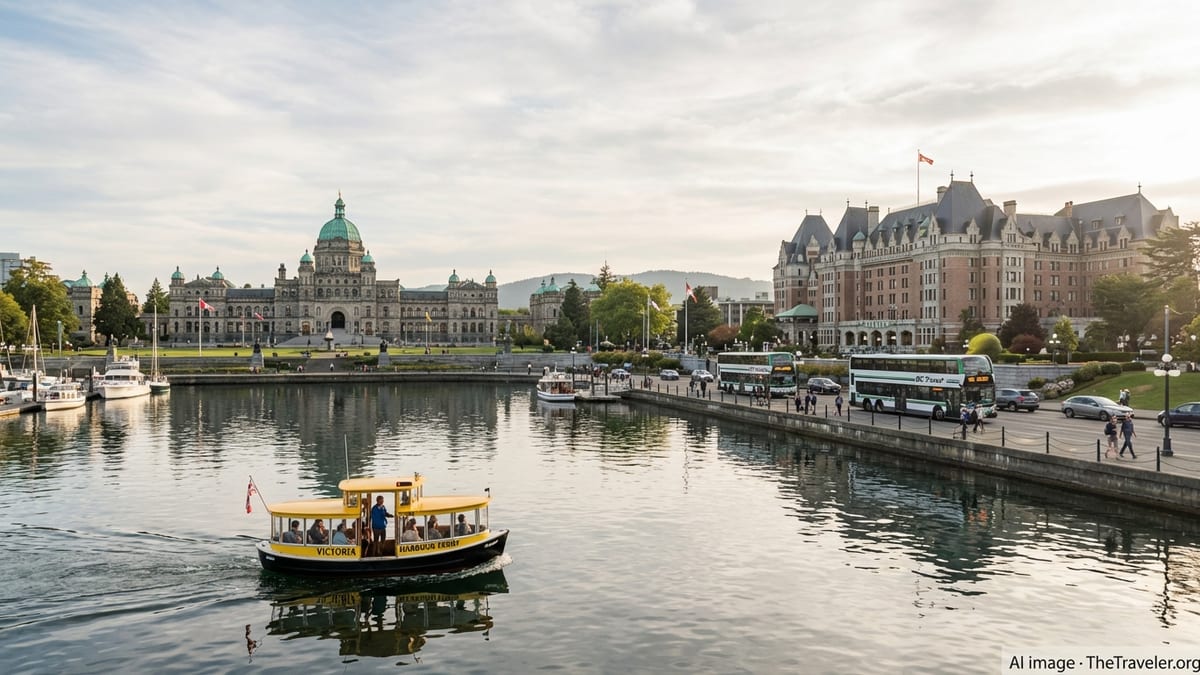
One of Victoria’s most charming and distinctive ways to get around is by water taxi. A long established operator runs a fleet of small, brightly coloured vessels that shuttle passengers across the Inner Harbour, Upper Harbour, and the Gorge Waterway. Often nicknamed “pickle boats,” these water taxis connect a network of docks at locations such as the Empress Dock, Fisherman’s Wharf, Chinatown, Old Town, Selkirk Landing, and several marina and residential areas along the shoreline.
The water taxi system operates on a hop on, hop off style pattern, but rather than following rigid fixed routes at all times, boats are often dispatched on demand. Travellers typically wait at marked docks and either scan a posted code or call a dispatcher to request the next available boat. On busy days the wait might be only a few minutes, while at quieter times it can be longer. Each vessel generally carries around a dozen passengers, making the experience intimate and providing good photo opportunities of harbour life.
Fares are charged per point to point trip between docks, with adult prices commonly in the mid teens in Canadian dollars and discounted fares for youth. Recent guides note that small children often ride free, though policies can change, so always confirm the current fare structure. Captains accept payment on board, and some visitors opt for round trip or multi stop tickets if they plan to use the service several times in one day. Schedules are typically more robust in the warmer months, with reduced or suspended service at certain stops during winter, depending on demand and daylight.
Using water taxis can be both a practical and scenic alternative to walking or driving between waterfront neighbourhoods. For example, a short ride from the Empress Dock to Fisherman’s Wharf saves time and offers harbour views of seaplanes landing, kayakers paddling near the shoreline, and tugboats maneuvering barges. In addition, themed experiences such as harbour tours or evening routes that connect waterside restaurants may be available in peak seasons, providing a social and relaxed way to explore the city’s culinary scene from the water.
Practical Tips for Smooth Connections and Everyday Getting Around
Because Victoria’s main transport hubs are separated from downtown by a modest but significant distance, planning your connections can make the difference between an easy arrival and a stressful one. When linking a BC Ferries sailing with a flight from YYJ or vice versa, it is usually wise to allow several hours between scheduled arrival and departure. This cushion gives you room to handle unexpected sailing delays, traffic backups on Highway 17, or longer than anticipated check in and security times at the airport.
Travellers choosing taxis for key legs, such as Swartz Bay to YYJ or YYJ to downtown, may want to prearrange pick ups during busy summer weekends or when late night flights arrive. Local taxi companies accept advance bookings for airport and ferry trips, and this can be reassuring if you are travelling with children or significant luggage. Ride hailing services exist in the region but may not always be available at outer terminals or during off peak periods, so consider them a supplement rather than your only option.
For those relying on BC Transit, studying a current system map and using the official trip planning tools ahead of time can help you identify the most efficient routes. Express routes between Swartz Bay, Sidney, and downtown are usually faster than those making many local stops. If you plan to use buses multiple times in a day, a day pass or contactless payment option, where available, can simplify boarding and reduce the need to handle exact change. Always watch for any service alerts that might affect your route, such as detours, construction, or schedule adjustments.
Within downtown Victoria, walking remains the most enjoyable and flexible way to get around. Many streets have wide sidewalks, pedestrian crossings are frequent, and most major attractions sit within a relatively small area. When distances stretch a little longer, such as between downtown and neighbourhoods like Cook Street Village or the beaches of Dallas Road, short bus rides or bike rentals can extend your reach. At night, taxis are widely used for trips back to hotels, and the presence of both harbour patrols and city police helps to maintain a generally safe environment in the core, though usual urban common sense is still important.
The Takeaway
Visiting Victoria involves an extra step compared with destinations directly connected to the continental highway and rail grid, but that separation is also part of its appeal. Whether you glide past the Gulf Islands aboard a BC Ferries vessel, land on the calm waters of the Inner Harbour by floatplane, or watch the Saanich Peninsula appear beneath your aircraft as you approach YYJ, your arrival is likely to be scenic and memorable. Once on the island, a manageable mix of buses, taxis, water taxis, and walkable streets makes it relatively straightforward to reach hotels, restaurants, and attractions.
Thoughtful planning is the key to smooth travel days in and out of Victoria. Confirm current ferry and flight schedules, build generous buffers when making same day connections, and decide in advance whether you prefer to rely on public transit or pay for the convenience of taxis and rental cars. In the city itself, embrace the opportunity to slow your pace, stroll along the Inner Harbour walkways, and, when the weather cooperates, trade road traffic for a short ride on a small harbour boat.
By understanding how Victoria’s ferries, airport access, and local transport fit together, you can choose the routes and timings that align with your budget, comfort level, and appetite for adventure. The reward is a relaxed arrival in one of the Pacific Northwest’s most picturesque small cities, ready to explore gardens, historic streets, waterfront trails, and island scenery without worrying about how you are going to get from place to place.
FAQ
Q1. How long does the ferry from Vancouver to Victoria take, and do I need a reservation?
The sailing between Tsawwassen and Swartz Bay usually takes about 1 hour and 35 minutes. Vehicle reservations are strongly recommended in busy seasons, while walk on passengers generally do not reserve but should still arrive early on popular sailings.
Q2. How far are Swartz Bay and Victoria International Airport from downtown Victoria?
Swartz Bay is roughly 32 kilometres north of downtown Victoria and typically 35 to 45 minutes by car. Victoria International Airport is about 25 kilometres away, with driving times usually around 30 to 40 minutes in normal traffic.
Q3. What is the approximate taxi fare from Swartz Bay to downtown Victoria?
Local operators quote fares in the approximate range of 60 to 70 Canadian dollars for a standard taxi between Swartz Bay and central downtown hotels, depending on traffic and exact drop off location.
Q4. How much does it cost to take a taxi between Victoria International Airport and downtown?
Typical taxi fares between YYJ and downtown Victoria fall in the approximate range of 50 to 60 Canadian dollars, with a travel time of about 30 to 40 minutes.
Q5. Can I use public transit to get from the airport or Swartz Bay into Victoria?
Yes. BC Transit operates routes connecting both Victoria International Airport and Swartz Bay with downtown. Express routes are usually faster, while local routes make more stops. Always confirm current schedules before travelling, especially for early morning or late night trips.
Q6. Are there water taxis in Victoria, and when do they operate?
Victoria’s harbour water taxis operate primarily from spring through autumn, with a network of docks around the Inner Harbour and Gorge Waterway. Service is most frequent in the warmer months, and some stops or routes may reduce or pause service in the winter.
Q7. Is downtown Victoria walkable, or do I need a car?
Downtown Victoria is highly walkable, with many hotels, restaurants, and attractions within a compact area. A car is useful for exploring farther afield on Vancouver Island, but not necessary for most city centre sightseeing.
Q8. What is Blink RapidBus, and will it help me as a visitor?
Blink RapidBus is a frequent bus rapid transit service on Route 95 between Langford and downtown Victoria. Visitors staying or visiting along this corridor benefit from fast, regular service with fewer stops and bus lanes in key sections.
Q9. How far in advance should I arrive at Victoria International Airport for my flight?
For most domestic flights, plan to arrive at YYJ at least 90 minutes before departure, and earlier for international routes or during very busy travel periods. Add extra time if you are coming from downtown by bus or during rush hour.
Q10. Do ferry and transit schedules in Victoria change seasonally?
Yes. BC Ferries schedules vary by season, with more sailings in summer and around holidays. BC Transit also adjusts some routes and frequencies over time. Always check the most up to date schedules before finalizing your travel plans.