

More news on this day
With less than eighteen months until kickoff, the 2026 FIFA World Cup is already transforming the urban fabric of host cities across the United States, Canada and Mexico, triggering a wave of stadium upgrades, transport expansions and hospitality construction whose impacts are expected to stretch far beyond the final at New York New Jersey Stadium.
Get the latest news straight to your inbox!
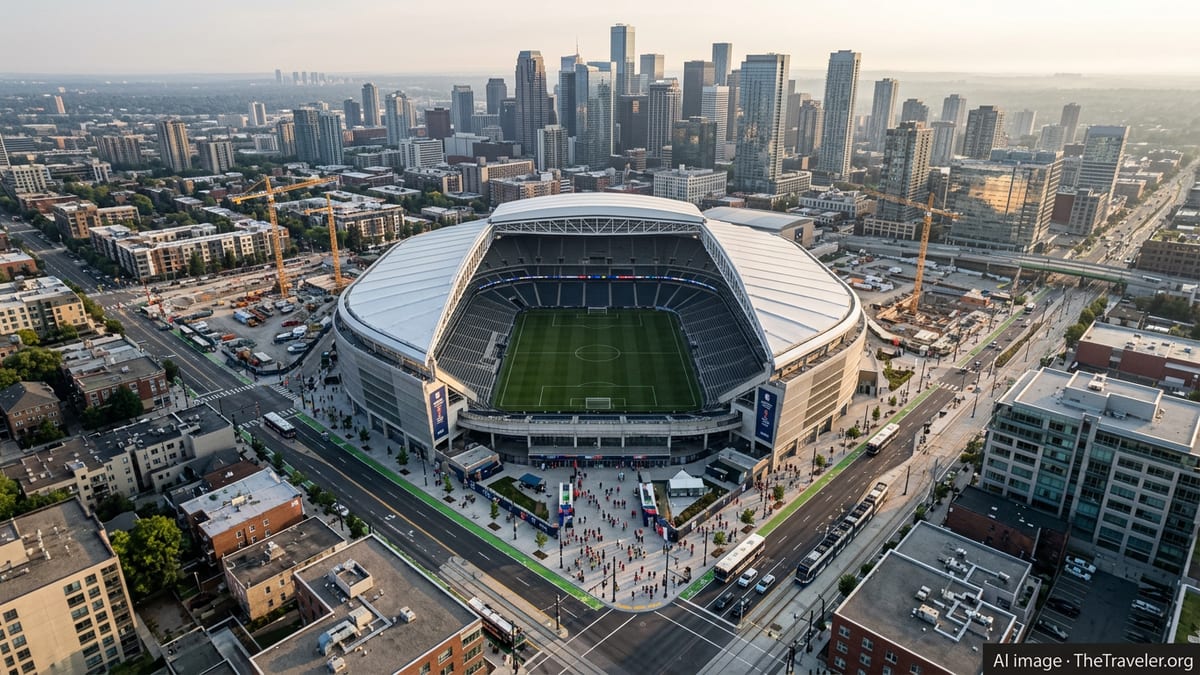
A Continental Tournament on an Unprecedented Scale
The 2026 FIFA World Cup will be the largest in the tournament’s history, with 48 teams playing 104 matches across 16 host cities in three countries. Official schedules indicate that the United States will stage the majority of fixtures, with Canada and Mexico sharing opening matches and key group games before the competition converges on major U.S. markets for the later knockout rounds and final.
The formal match calendar, released after the December 2025 draw, confirms that Mexico City’s Estadio Azteca will host the opening game on June 11, 2026, while the final is set for MetLife’s temporarily rebranded New York New Jersey Stadium on July 19. Between those dates, fixtures are spread across North American hubs from Vancouver and Toronto to Guadalajara, Dallas, Atlanta, Miami, Seattle, Kansas City, Houston, the San Francisco Bay Area, Los Angeles, Boston and Philadelphia.
This geographic sprawl is driving a form of regionalized World Cup planning rarely seen before. Instead of a single host nation concentrating investment in a handful of metropolitan areas, public documents and local coverage show overlapping project pipelines in at least a dozen large urban regions, each racing to align existing infrastructure with FIFA’s standards and the demands of millions of visiting supporters.
Planners and analysts describe the coming event as a stress test not only for stadiums and airports, but for how North American cities manage mobility, security, housing pressures and short-term tourism shocks while trying to secure longer-term economic gains.
Stadium Overhauls and Venue Rebranding
Unlike recent World Cups that relied heavily on new purpose-built arenas, the 2026 tournament will predominantly use existing NFL and CFL stadiums and long-established venues such as Estadio Azteca. Even so, the scale of required upgrades is substantial. Publicly available project summaries point to hundreds of millions of dollars in renovations, from expanded hospitality areas and refreshed seating to enhanced broadcast infrastructure and digital connectivity.
In North Texas, AT&T Stadium is undergoing a renovation program reported at around 295 million dollars, including premium suite refurbishments, new concessions and upgraded video and technology systems. The venue will operate under the non-commercial name Dallas Stadium for the tournament, part of a broader FIFA policy that temporarily removes corporate naming rights from host venues.
Similar rebranding will apply in the New York region, where MetLife Stadium is set to appear as New York New Jersey Stadium during the competition. The venue is scheduled to host the World Cup final and multiple knockout fixtures, prompting additional investments in fan facilities and security systems alongside routine maintenance and field conversions to meet FIFA pitch standards.
In Mexico, works at Estadio Azteca include structural refurbishments, improved accessibility, hospitality upgrades and technology enhancements as the historic arena prepares to host World Cup matches for a record third time. In Guadalajara and Monterrey, regional authorities and stadium operators are advancing improvements to concourses, seating, lighting and transport connections to manage significantly higher volumes of international visitors.
Transit, Public Space and Urban Mobility Upgrades
Beyond the stadium walls, some of the most visible World Cup spending is focused on how fans move through host cities. Local government plans and regional economic studies highlight investments in airport capacity, road corridors, public transit and pedestrian connections between transit nodes, entertainment districts and venues.
In the New York New Jersey region, an economic impact summary prepared for the host committee outlines a package of infrastructure and operational spending built around MetLife Stadium’s match load. While much of the outlay is tied to event operations, the planning framework emphasizes improved rail and bus connectivity between Manhattan, regional airports and the Meadowlands, along with upgraded wayfinding, accessibility measures and temporary fan transport services designed to reduce car dependence on match days.
Mexican cities are using the tournament to accelerate longer-term mobility projects. In Guadalajara, business and infrastructure reports describe an electric train link connecting key urban corridors with the stadium area, as well as major works on the Chapala highway, which is being expanded, resurfaced and fitted with bike paths and new lighting. These projects are framed as legacies for local commuters that also happen to support World Cup travel demand.
On the U.S. West Coast, state-level funding in Washington has been allocated to support Seattle’s hosting duties, with a portion earmarked for event-related transit operations and public-realm improvements around the downtown stadium district. In the San Francisco Bay Area and Los Angeles region, privately funded upgrades to airport terminals and regional rail stations are intersecting with World Cup planning as operators anticipate surges in international arrivals during June and July 2026.
Economic Windfalls, Risk and Uneven Benefits
Economic impact projections circulated by host committees and consulting firms point to tens of billions of dollars in combined activity across the three host nations, though estimates vary widely by city. Regional studies for the New York New Jersey cluster, for example, forecast several billion dollars in total economic output, driven by visitor spending on accommodation, food, transport and retail, as well as short-term jobs connected to event operations and construction.
In Mexico, recent figures from the national federation and state authorities suggest that the tournament could attract an additional several million tourists beyond baseline expectations during June and July 2026. Jalisco, home to Guadalajara, is projecting around three million visitors during the World Cup period alone, reinforcing its status as one of the country’s strongest tourism markets. Similar expectations are being voiced in Mexico City and Monterrey, where officials and business groups are positioning the event as a catalyst for hotel occupancy, restaurant revenues and broader destination marketing.
Canadian and U.S. host cities are also forecasting sizable gains. Analyses surrounding Seattle’s six matches estimate hundreds of thousands of visitors and close to one billion dollars in economic activity for the broader King County area. In North Texas, local business groups and city promotional campaigns reference projections in the multi-billion-dollar range for the region, tied not only to nine World Cup matches but to ancillary concerts, fan festivals and corporate events clustered around the tournament window.
At the same time, urban economists caution that headline numbers often mask uneven distribution of benefits and the risk of cost overruns. A significant share of projected gains flows to hospitality, aviation and venue operators, while public-sector entities assume much of the upfront expenditure on security, mobility and public services. There is also concern that temporary spikes in short-term rentals and hotel prices could intensify housing pressures in already strained markets such as Vancouver, Toronto, New York and Los Angeles.
Security Funding, Political Tensions and Legacy Questions
As construction and planning accelerate, attention is turning to security budgets and long-term legacies. Recent coverage in U.S. outlets has highlighted concerns from several host committees about delays in the release of federal security funding, with warnings that a prolonged freeze could complicate policing, emergency preparedness and fan-zone planning. Organizers in cities such as Miami have publicly signaled that some associated events may be scaled back if promised support does not materialize in the coming months.
Funding debates are layered onto broader questions about who pays for and who ultimately benefits from World Cup infrastructure. In many host areas, stadiums and transport corridors receiving upgrades were originally financed with substantial local tax contributions. Community advocates are pressing for clearer guarantees that new or improved facilities will remain accessible and useful to residents after the final whistle, rather than primarily serving occasional mega-events and high-income visitors.
Environmental implications are another emerging fault line. Analyses of cross-continental flight patterns suggest that travel between the three host nations could generate record levels of carbon emissions for a sporting event. Municipal climate plans in cities such as Vancouver, Seattle and Guadalajara are attempting to mitigate those impacts by promoting public transit, investing in lower-emission vehicle fleets and tightening sustainability requirements for temporary event infrastructure, but critics argue that the basic tournament design still encourages long-distance travel.
With the opening match now approaching on the calendar, what is already clear is that the 2026 World Cup is functioning as a powerful accelerant for projects that might otherwise have taken years to advance. Whether those investments translate into durable improvements in mobility, public space and economic opportunity across North America’s host cities will be measured long after the trophy leaves New York New Jersey Stadium.