

Vast, sparsely populated and ringed by tundra, rocky headlands and low-lying wetlands, Hudson Bay is one of the most remote and evocative places you can visit in North America. Stretching across the northern heart of Canada, this inland sea has long shaped Indigenous cultures, wildlife migrations and trade routes. Today it draws a growing number of travelers in search of polar bears, beluga whales, northern lights and the stark beauty of an Arctic frontier that is changing rapidly with the climate.
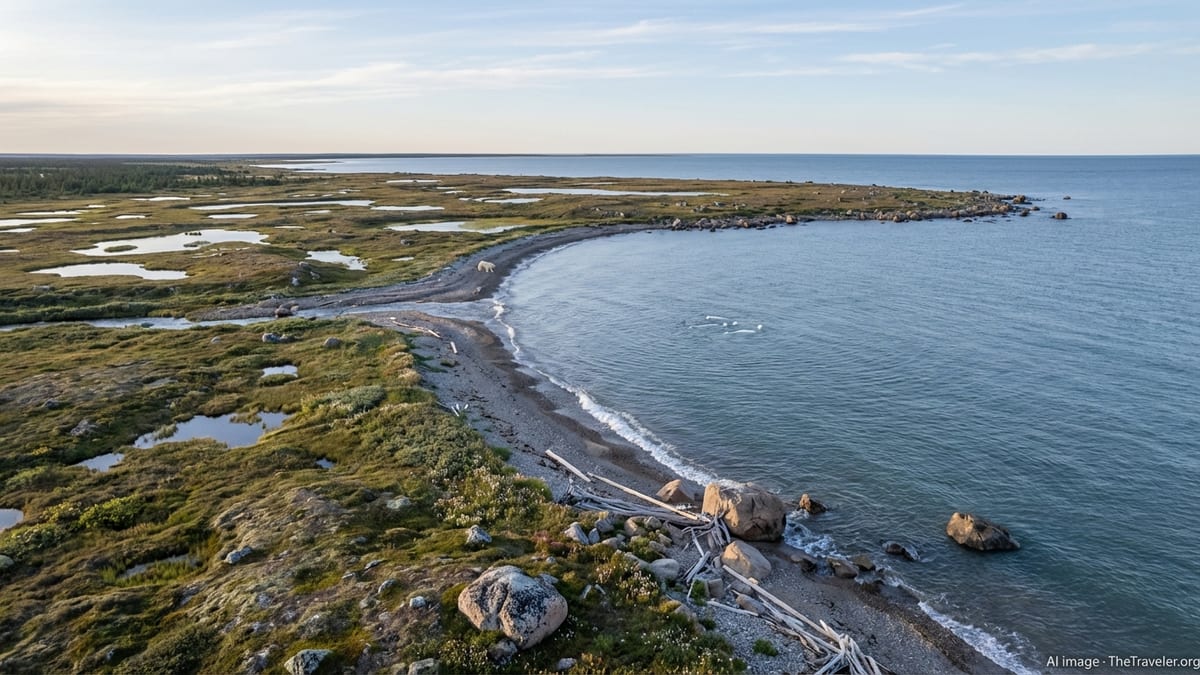
Understanding Hudson Bay’s Geography
Hudson Bay is a massive inland sea in northeastern Canada, bordered by Nunavut, Manitoba, Ontario and Quebec. Though it connects to the Arctic Ocean via Hudson Strait, it is largely enclosed by land, giving it a distinct character that is neither fully ocean nor typical inland lake. Its waters are cold and shallow compared with most oceans, and the bay freezes for much of the year, creating a dynamic environment where sea ice and open water constantly reshape the coastline experience for travelers.
The bay lies within a huge geological depression known as the Hudson Bay Basin, created by glacial scouring and the immense weight of ancient ice sheets. As those ice sheets retreated, the land began a slow rebound that continues today, subtly altering shorelines and wetlands. Around its rim stretch some of the largest peatlands and wetlands on Earth, particularly in the Hudson Bay Lowlands of Manitoba and Ontario, where bogs, muskeg and countless small lakes dominate the landscape.
For visitors, the geography translates into a sense of wide horizons and big skies. On the western shore near Churchill in Manitoba the boreal forest gives way to open tundra and wave-battered beaches of gravel and rock. To the east and north, low cliffs, islands and headlands form a ragged Arctic coastline. Most travel experiences are concentrated in a handful of communities and protected areas along this rim, where you can reach the shore by boat, tundra vehicle or on foot with qualified guides.
The region’s remoteness is part of its appeal. There are only a dozen or so coastal communities scattered around Hudson Bay and James Bay, many originally established as Hudson’s Bay Company trading posts. Outside of the few hubs that welcome visitors, you will see almost no development along the shore. On clear days, it is entirely possible to stand at the edge of the bay and see nothing but sky, water and tundra in every direction.
Climate, Seasons and When to Visit
Hudson Bay straddles several climate zones, from polar conditions along its northern coasts to subarctic and cool continental climates further south. Winter is long, dark and intensely cold, with the bay locked in sea ice that often stretches far beyond the visible horizon. Summer is short but surprisingly mild on land, with cool, bright days when migrating birds, wildflowers and insects fill the tundra with life. Shoulder seasons in spring and late autumn can be raw and stormy but offer dramatic seascapes and wildlife transitions.
Choosing when to visit depends largely on what you hope to see. Autumn on the western shore, particularly in October and November, is prime season for viewing polar bears as they gather along the coast waiting for the sea ice to form. During this time, tundra vehicles and guided tours operate near Churchill and in adjoining protected areas, offering controlled opportunities to see bears in their natural environment from a safe distance. Snow squalls, icy winds and limited daylight are common, so travelers must be prepared for harsh conditions.
Summer brings a very different experience. From roughly June through early September, the shorelines and river estuaries host huge numbers of beluga whales that migrate into western Hudson Bay to feed, molt and raise their young. The Churchill, Seal and Nelson river estuaries are especially important gathering points, and boat or zodiac excursions provide close but carefully managed encounters. At the same time, tundra wildflowers bloom, birdlife peaks and temperatures can be comfortably cool, making this the best season for general hiking, birding and photography.
Winter, while challenging, rewards those willing to brave the cold with vivid displays of the aurora borealis. Communities like Churchill lie under the auroral oval, and clear nights often reveal sweeping ribbons of green, pink and violet light across the sky. Travel logistics are more complex in midwinter, and many wildlife tours pause, but specialized operators offer northern lights packages that focus on night-sky viewing rather than wildlife encounters.
Wildlife Highlights: From Polar Bears to Belugas
Hudson Bay is home to one of the planet’s great wildlife spectacles. Along its coasts and islands live polar bears, caribou, Arctic foxes and countless seabirds, while its waters harbor beluga whales, seals and occasionally orcas and bowhead whales. The combination of marine and terrestrial ecosystems creates overlapping migrations and feeding grounds that offer exceptional opportunities for responsible wildlife viewing.
Polar bears are the region’s most famous residents. Western Hudson Bay supports one of the best-known bear populations, with many animals coming ashore in summer when the sea ice melts and gathering again near Cape Churchill and surrounding coasts in autumn. Controlled viewing occurs either from specialized tundra vehicles in designated wildlife management areas or from a small number of remote lodges that operate under strict safety protocols. Bears are powerful marine mammals and must never be approached on foot outside guided and sanctioned settings.
Beluga whales are another signature species. Western Hudson Bay is home to one of the world’s largest beluga populations, with tens of thousands entering river estuaries in summer. Their pale backs and constant vocalizations have earned them the nickname “sea canaries.” Travelers commonly see them on boat tours, sometimes in very shallow water where their shapes are visible against the pale riverbed. A few operators offer dry-suit snorkeling or kayaking with belugas under controlled, ethical guidelines that prioritize whale behavior and distance.
Beyond these icons, birdlife is extraordinarily rich. The Hudson Bay Lowlands provide habitat for hundreds of bird species, including nesting geese, shorebirds, loons, jaegers, Arctic terns and snowy owls. In late spring and early summer, migrating flocks swirl over the wetlands and barrier islands, while the tundra fills with the calls of songbirds and the drumming of shorebirds on their breeding grounds. Caribou, wolves, Arctic hares and foxes may also appear along the coast, particularly in more remote sections where human presence is minimal.
Landscapes of Tundra, Lowlands and Ice
What makes Hudson Bay so visually striking is the contrast between its open, steel-blue waters and the varied landscapes that frame them. On the western side, near Churchill and Wapusk National Park, you encounter a broad transition zone between boreal forest and true Arctic tundra. Stunted spruce and tamarack trees give way to dwarf shrubs, lichens and mosses, and finally to bare rock and gravel beaches. In summer, this seemingly barren ground bursts into color as wildflowers and sedges take advantage of the brief growing season.
To the south and southwest, the Hudson Bay Lowlands form one of the largest continuous wetland complexes in the world. Here, muskeg, peat bogs and shallow lakes stretch inland for hundreds of kilometers. This watery landscape is difficult to traverse, and visitors generally experience it from the air during scenic flights or from the edges of drier ridges and riverbanks with guides. The lowlands are critical carbon stores and important breeding grounds for waterfowl and shorebirds, adding a subtle environmental significance to every view.
In winter, much of Hudson Bay’s character is defined by ice. Sea ice begins forming in the northern and western sections in late autumn, spreading southward and thickening through early winter. Pressure ridges, leads and wind-carved drifts create an ever-changing seascape that can look almost sculptural in low-angle light. For polar bears, seals and Arctic foxes, this ice is essential habitat. For visitors, it reinforces the sense that Hudson Bay is part of a living Arctic system, even though it lies south of the pole itself.
Shorelines around the bay vary from low, marshy beaches to rocky headlands and islands. In places such as the Belcher Islands in the southeast and various archipelagos off the Nunavut coast, steep cliffs rise directly from the water, hosting nesting seabirds and offering dramatic perspectives for photographers traveling with experienced guides. Elsewhere, gently sloping beaches stretch for kilometers, with stranded ice blocks, driftwood and the occasional bear or caribou track etched into the sand and gravel.
Communities and Culture Along the Coast
The human story of Hudson Bay is as compelling as its natural history. For thousands of years, Inuit and Cree communities have lived along its shores, drawing sustenance from marine mammals, fish, caribou and birds, and developing profound knowledge of sea ice, weather and animal behavior. Many modern coastal settlements trace their origins to precontact seasonal camps that later intersected with fur trade routes and European exploration.
Churchill, on the western shore in Manitoba, is the best-known gateway for travelers. Although small in population, it offers hotels, guides, basic services and access to nearby wildlife viewing areas, research facilities and historic sites such as the remnants of military installations and fur trade forts. The town’s character reflects both its strategic role as a northern port and a deep connection to surrounding tundra and marine ecosystems. Churchill’s residents include long-established Indigenous families, researchers, tourism workers and port staff whose lives are closely tied to the rhythms of the bay.
Elsewhere around the bay, communities such as Arviat and Rankin Inlet in Nunavut, and Fort Severn and coastal villages on James Bay, are far less visited but equally shaped by the bay’s environment. Many are predominantly Inuit or Cree, with local economies that blend traditional harvesting, modern wage employment and services. Travelers who join community-based tours or cultural programs can learn about everything from traditional clothing and tools to contemporary art, music and storytelling that reflect ongoing relationships with the land and sea.
Responsible travel in these communities means recognizing that you are a guest in places where supplies are expensive, housing can be limited and public services are stretched. Simple gestures such as shopping locally, asking permission before photographing people and following local guidance on wildlife safety can make a meaningful difference, while also deepening your understanding of how life is lived on the edge of this inland sea.
Experiencing Hudson Bay: Access and Logistics
Reaching Hudson Bay requires planning and a willingness to travel slowly. There are no major highways to the coast, and most visitors arrive via regional flights from southern Canadian hubs such as Winnipeg, Ottawa or Montreal. In western Hudson Bay, Churchill is reachable by air year-round and by rail along the Hudson Bay Railway, with service adapting to seasonal conditions and ongoing infrastructure work in the muskeg and permafrost. Flight schedules and rail operations can shift with weather and maintenance, so it is wise to build flexibility into your timeline.
Once on the coast, your movements are generally tied to guided tours, small boats, tundra vehicles and occasional helicopter flights, rather than independent road travel. Autumn polar bear viewing near Churchill typically takes place in designated wildlife management areas using large, elevated tundra vehicles that minimize impacts on the sensitive ground and keep both bears and people at a safe distance. Remote lodges may provide small aircraft transfers, all-terrain vehicles or guided on-foot excursions, always governed by strict wildlife protocols.
Accommodation options range from modest hotels and inns in towns like Churchill to small, fly-in eco-lodges situated directly on the coast. Space is limited, especially in peak polar bear and beluga seasons, and many trips must be booked months, or even a year, in advance. Tour packages often bundle flights, lodging, meals and guided activities, which can simplify logistics but also add to overall cost. Independent travelers should pay particular attention to cancellation policies, given that storms, sea ice and rail conditions can disrupt schedules.
Weather is a major factor in daily planning. Even in summer, cold fog, wind and sudden temperature drops are common. Layered clothing, waterproof outerwear, sturdy boots and accessories like hats, gloves and neck gaiters are essential. In autumn and winter, high-quality insulated gear becomes critical for comfort and safety during long hours on tundra vehicles or standing outside to watch wildlife and the northern lights. Daylight hours also vary significantly by season, affecting photography plans and the pacing of excursions.
Changing Northern Landscapes and Responsible Travel
Like much of the Arctic and subarctic, Hudson Bay is experiencing rapid environmental change. Warmer air and ocean temperatures influence the timing and extent of sea ice formation and breakup, with direct implications for polar bears, seals and other ice-dependent species. Permafrost thaw and shifting muskeg affect rail lines, roads and buildings, creating challenges for communities that rely on the Hudson Bay Railway and coastal infrastructure for essential goods and economic activity.
For travelers, these changes manifest in subtle but noticeable ways: polar bear viewing seasons that may start or end differently from historical patterns, shifting bird migration timing and increased emphasis on monitoring the health of beluga populations and coastal wetlands. Researchers, Indigenous knowledge holders and conservation organizations are working together to track these trends and advise on adaptive management, from protected area planning to community-based wildlife stewardship.
Responsible tourism plays a role in this evolving story. Choosing operators that prioritize safety, environmental best practices and local employment helps ensure that visitor dollars support both conservation and community resilience. This can include small-group tours that limit disturbance to wildlife, adherence to strict viewing distances, investment in low-impact infrastructure and programs that bring visitors into contact with local guides, artists and knowledge keepers.
Visitors can contribute by traveling thoughtfully: packing out what they bring, minimizing waste, respecting closed areas and following all guidance on bear safety and sensitive habitats. Simply learning about the dynamics of sea ice, permafrost and Indigenous land stewardship before you arrive can deepen your appreciation of the bay and the people and wildlife that depend on it. In a region where change is accelerating, informed and respectful travel can help amplify local voices and reinforce the value of safeguarding Hudson Bay’s landscapes.
The Takeaway
Hudson Bay is not an easy destination, but that is precisely what makes it so compelling. Its vast inland sea, stark tundra, complex wetlands and scattered communities offer a portrait of northern Canada that is both ancient and in flux. From the white silhouettes of polar bears striding along the shoreline to the ghostly shapes of beluga whales tracing the shallows, the bay rewards patience, curiosity and humility.
For travelers willing to plan ahead, accept variable weather and embrace logistical quirks, Hudson Bay delivers experiences that linger long after the journey ends: the crunch of ice underfoot on a frozen beach, the flicker of the aurora over a silent town, the quiet conversations with local guides who read the landscape like a familiar book. As climate change reshapes this inland sea, traveling here carries a responsibility to tread lightly and listen closely.
Whether your focus is wildlife, photography, Indigenous culture or simply the allure of a map’s outer edges, Hudson Bay invites you to stand at the meeting point of forest, tundra and ocean and consider how interconnected north and south, land and sea, people and wildlife truly are. It is a place where the horizon feels both distant and surprisingly fragile, a reminder that some of the world’s most powerful travel experiences unfold far from roads, crowds and everyday routines.
FAQ
Q1. Where is Hudson Bay and how big is it?
Hudson Bay is a vast inland sea in northeastern Canada, bordered by Nunavut, Manitoba, Ontario and Quebec. It covers an area roughly comparable to several large European countries combined, making it one of the largest bays in the world.
Q2. When is the best time to see polar bears around Hudson Bay?
The most reliable time to see polar bears along western Hudson Bay, especially near Churchill, is from mid October through November, when bears gather along the coast awaiting the return of sea ice.
Q3. When can I see beluga whales in Hudson Bay?
Beluga whales are typically seen in large numbers from around June to early September, particularly in river estuaries along the western shore where they come to feed, molt and raise their young.
Q4. How do I get to Hudson Bay as a visitor?
Most travelers reach Hudson Bay communities by regional flights from southern Canadian cities. In western Hudson Bay, Churchill can also be accessed by rail via the Hudson Bay Railway, with schedules that vary by season and conditions.
Q5. Do I need to join a tour to see wildlife safely?
Yes, in practice most meaningful wildlife viewing is done with licensed guides or tour operators. They use specialized vehicles and boats, follow strict safety protocols and understand how to avoid disturbing animals or putting visitors at risk.
Q6. How cold does it get around Hudson Bay?
Winters are very cold, with temperatures often well below freezing, while summers are cool to mild. Even in summer, wind, fog and sudden weather shifts are common, so layered clothing and proper outerwear are essential.
Q7. Is Hudson Bay a good destination for seeing the northern lights?
Yes. Communities such as Churchill lie under the auroral oval and experience frequent aurora borealis displays, especially from late autumn through winter when nights are long and skies can be very clear.
Q8. Are there roads along the Hudson Bay coast?
There are no continuous highways along the coastline, and most coastal communities are not connected by road. Travel between them is typically by air, boat, rail in certain corridors, or on winter trails used locally.
Q9. What should I pack for a trip to Hudson Bay?
Plan for cold, changeable conditions. Bring layered clothing, a warm insulated jacket, waterproof shell, sturdy boots, hat, gloves, thermal base layers and any personal medications, as supplies in remote communities can be limited.
Q10. How can I travel responsibly in Hudson Bay communities?
Choose operators that hire local guides and follow environmental best practices, respect local customs, ask before taking photos of people, minimize waste and follow all advice on wildlife safety and sensitive habitats.