

More news on this day
A dramatic emergency landing of a small aircraft in the frigid Hudson River north of New York City has reignited questions about aviation safety over one of the nation’s most congested air corridors, after a pilot and passenger survived a nighttime crash by swimming through ice-choked water to shore.
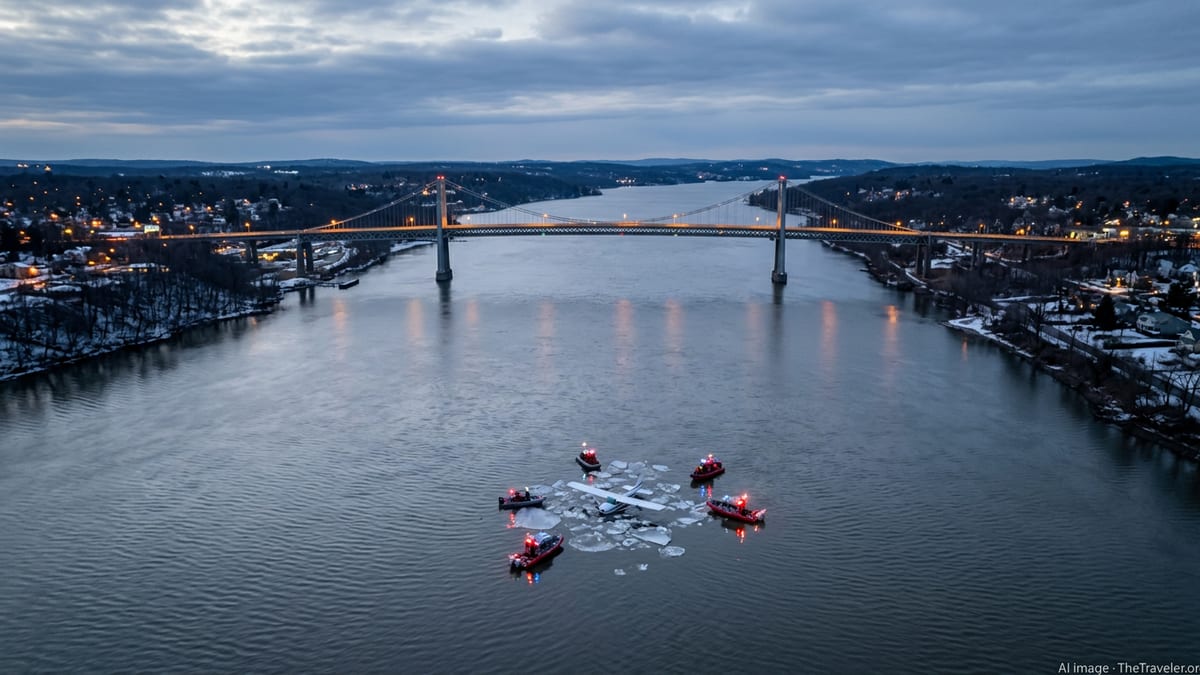
Nighttime Drama on the Hudson Near Newburgh
Authorities say the single engine Cessna 172 Skyhawk went down in the Hudson River near the Newburgh-Beacon Bridge on the evening of March 2, 2026, after reporting a loss of power while maneuvering near New York Stewart International Airport. The light aircraft had departed Long Island MacArthur Airport roughly an hour earlier and was attempting an emergency landing when it plunged into the dark, freezing water about 60 miles north of Manhattan.
Initial reports indicate the plane came to rest roughly 200 feet offshore in an area where broken river ice and strong currents complicated rescue efforts. Despite the conditions, the pilot and the lone passenger managed to free themselves from the partially submerged cabin and swim toward the western bank, where they were pulled from the water by first responders and bystanders.
Local officials said both occupants were transported to a nearby hospital with symptoms of hypothermia and minor injuries but are expected to make a full recovery. The aircraft, heavily damaged and largely submerged, is now the subject of a recovery operation overseen by state police and the Coast Guard, with investigators eager to examine the wreckage for mechanical clues.
Echoes of the “Miracle on the Hudson” and Recent Tragedies
New York Governor Kathy Hochul praised the rapid response by local fire departments, law enforcement agencies and Coast Guard crews, calling the survival of both occupants “another miracle on the Hudson,” a reference that immediately evoked memories of US Airways Flight 1549, which famously ditched in the river off Midtown Manhattan in 2009 with all 155 people on board surviving.
The comparison is not lost on residents along the lower Hudson Valley, where the waterway doubles as a heavily used air corridor for commercial jets, business aircraft, helicopters and general aviation flights. In April 2025, a sightseeing helicopter crashed into the Hudson near Jersey City, killing all six people on board and prompting questions about tour oversight and maintenance standards for rotorcraft operating over the region’s densely populated waterfront.
For many, this week’s survival story is a rare bright moment set against a backdrop of recent, deadly crashes in the wider Northeast, including a business jet accident in Bangor, Maine, and an air ambulance crash in Philadelphia. Each new event, even when lives are spared, feeds mounting anxiety among travelers and residents who live under busy flight paths.
Investigators Probe Possible Mechanical Failure
The Federal Aviation Administration and the National Transportation Safety Board have opened investigations into the Hudson River incident, focusing initially on the reported in flight power loss and the condition of the Cessna’s engine and fuel system. Investigators are expected to examine maintenance records, recent inspections and any refueling history to determine whether a technical malfunction, fuel contamination or pilot miscalculation contributed to the emergency.
With the aircraft lying in cold, fast moving water, recovery teams are working against tides and weather to hoist the wreckage onto a barge for transport to a secure facility. Only once the airframe, engine and instrumentation are accessible will investigators be able to reconstruct the final minutes of the flight in detail.
Safety analysts note that small piston aircraft lack the layered redundancy of large commercial jets, leaving pilots more vulnerable to single point failures. At the same time, general aviation pilots in the New York region contend with complex airspace, rapidly changing weather and limited options for safe off airport landings, making quick decision making crucial when something goes wrong.
Renewed Focus on General Aviation Risk in Busy Airspace
The emergency landing is already fueling debate over the role and regulation of small aircraft in one of the country’s most crowded aviation environments. The Hudson River corridor, long a favored route for sightseeing flights and training operations, threads between busy commercial airports such as LaGuardia, Newark Liberty and John F. Kennedy, as well as regional hubs like Stewart and Teterboro.
Aviation advocates argue that general aviation is essential for pilot training, medical transport and business travel, and point out that the overwhelming majority of flights are completed safely. They also stress that the outcome on the Hudson this week highlights the effectiveness of pilot training in emergency procedures, as well as the importance of coordinated rescue plans along the river.
Critics, however, say repeated incidents show that regulators have not gone far enough in tightening oversight of charter operators, sightseeing flights and privately operated aircraft. They are calling for more stringent maintenance audits, updated minimum equipment requirements for low altitude operations and better real time tracking of small aircraft over waterways and residential areas.
Local officials in riverfront communities say they expect a fresh round of public meetings on air safety, with residents seeking assurances that low flying aircraft are being closely monitored. Some have suggested expanding designated no fly zones over particularly sensitive stretches of shoreline or around key bridges and infrastructure.
Traveler Confidence and the Road Ahead
For travelers heading in and out of the New York metropolitan area, the Hudson River emergency landing is another reminder that aviation, while statistically very safe, is never entirely risk free. The image of two people climbing from an icy river after a nighttime crash resonates strongly with an audience that still remembers both headline making miracles and devastating losses above the same waterway.
Industry experts caution against drawing sweeping conclusions from a single event before investigators have finished their work. Even so, airlines, charter companies and flight schools in the region are likely to revisit their own emergency training, cold weather procedures and route planning policies in response to heightened public concern.
As the Cessna wreckage is raised from the Hudson and moved to a hangar for inspection, attention will turn to the preliminary findings from federal investigators, which typically arrive within weeks. Those early reports will help determine whether this incident is viewed as an isolated mechanical failure handled skillfully by a trained pilot, or as part of a broader pattern that demands new rules in the skies over New York.