

More news on this day
Thousands of passengers on long-haul routes between Dubai and major cities including London, New York, Mumbai and Manila faced severe disruption after 194 flight cancellations and 133 delays were recorded at Dubai International Airport, sharply curtailing operations for Emirates, FlyDubai, IndiGo and Gulf Air and rippling across global airline networks.
Get the latest news straight to your inbox!
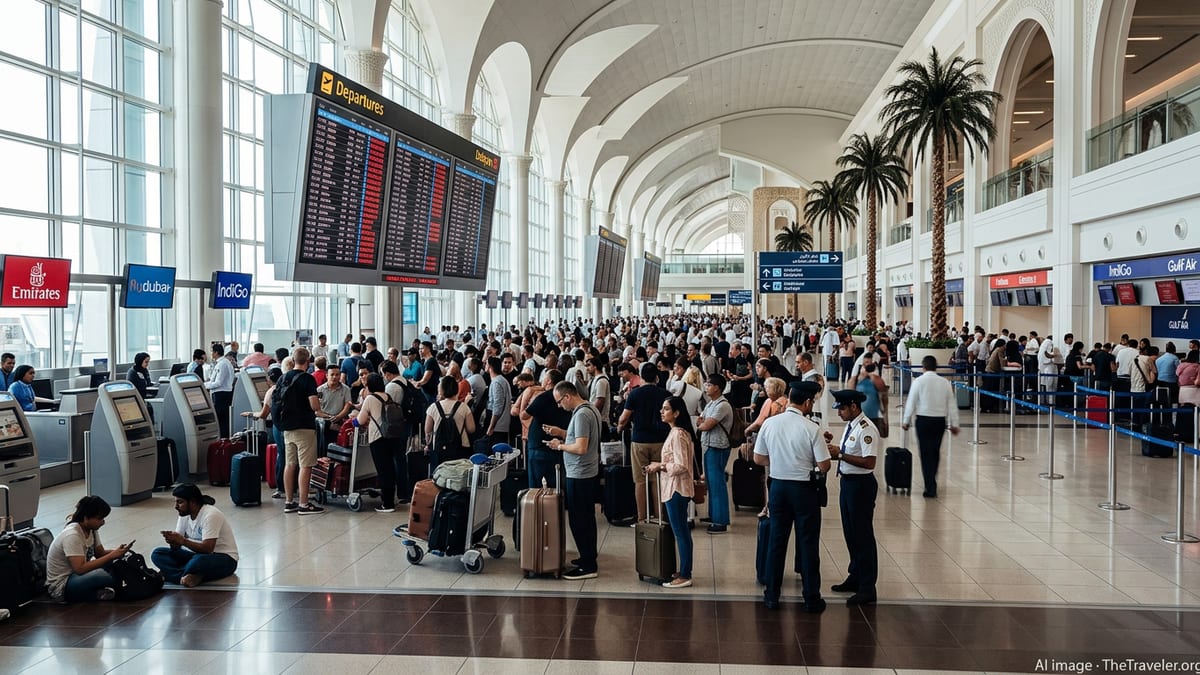
Severe Operational Disruption at Dubai International
Publicly available flight-tracking data and airline updates show that Dubai International Airport has been operating on a significantly reduced schedule, with 194 flights cancelled and 133 delayed over a short period, affecting both departures and arrivals. The figures highlight the scale of the disruption at one of the world’s busiest international hubs, where even routine delays can quickly cascade across multiple continents.
Dubai International is a critical connecting point between Europe, North America, Asia and Africa, and any sustained reduction in capacity has immediate global consequences. Reports indicate that the airport has been prioritising limited services while airlines adjust schedules, reposition aircraft and work through a mounting backlog of stranded travellers.
While some flights have been able to depart or arrive close to schedule, the volume of cancellations and rolling delays has made it difficult for passengers and travel providers to predict when normal operations might fully resume. Travel industry observers note that, given the scale of Dubai’s transfer traffic, disruption measured in hundreds of flights translates into tens of thousands of affected journeys worldwide.
Major Carriers Trim Schedules and Reroute Passengers
The disruption has had a pronounced effect on airlines that rely on Dubai as a primary hub. Emirates, the largest carrier at Dubai International, has been forced to consolidate services, cancel rotations and reroute aircraft. According to published flight information, a number of long-haul services to Europe and North America have been selectively maintained, while others have been suspended or merged to cope with constrained capacity and crew availability.
FlyDubai, which operates an extensive regional and medium‑haul network from Dubai, has also seen services curtailed, particularly on high-frequency routes across the Gulf, South Asia and parts of Eastern Europe. Reduced frequencies and last‑minute timetable changes have added complexity for travellers with onward connections, particularly where itineraries were built on tight transfer windows.
Indian low‑cost carrier IndiGo and Gulf Air, based in Bahrain, have likewise been drawn into the disruption as their Dubai services are adjusted or temporarily withdrawn. For IndiGo, Dubai is a key link in its international network, especially for flights serving major Indian cities and labour corridors, so the loss or delay of rotations has an outsized impact on migrant workers and budget-conscious travellers.
Airline advisories reviewed by travel agents and passengers stress that affected customers are being rebooked on the limited flights still operating, moved to alternative routings through other hubs in the Gulf and beyond, or offered refunds and travel credits. However, the concentration of demand on a reduced pool of flights has led to tight seat availability and extended waiting times for suitable alternatives.
Global Routes to London, New York, Mumbai and Manila Hit Hard
The knock‑on effects of the Dubai disruption are being felt most acutely on trunk routes linking the Gulf with major global cities. Flight-status feeds and timetable adjustments show significant interruption to services between Dubai and London, where multiple daily wide‑body flights normally provide abundant capacity for both point‑to‑point and connecting passengers.
Services between Dubai and New York, which typically carry a mix of business and leisure travellers alongside large numbers of onward connections to the Americas, have also experienced cancellations and extended delays. When these long‑haul flights are withdrawn, hundreds of passengers per service must be reallocated to other departures, often with limited options within the same travel window.
In South Asia, connections between Dubai and Mumbai have been especially strained, affecting both origin‑and‑destination traffic and those connecting onward to other Indian cities. Travellers on these routes often rely on tightly scheduled connections, and even modest delays in Dubai can lead to missed onward services. With 194 cancellations and 133 delays in the system, the chances of missed or heavily altered itineraries have risen sharply.
Manila and other major Southeast Asian destinations have not been spared. The Philippines has a large overseas workforce in the Gulf, and reduced connectivity through Dubai has complicated travel plans for workers heading home, as well as for tourists transiting between Asia and Europe or North America. Travel agents report that passengers on these routes are frequently facing multi‑stop reroutings through alternative hubs or being asked to accept significantly later travel dates.
Thousands of Travellers Stranded or Facing Extended Journeys
For individual passengers, the aggregate figures of cancellations and delays translate into missed connections, overnight stays and extended time in transit. Accounts shared through social media and traveller forums describe passengers stuck in Dubai terminals for many hours while they wait for new boarding passes, hotel vouchers or updated information on revised departure times.
Those connecting from regional cities to long‑haul flights have been particularly vulnerable. A delayed inbound flight into Dubai can easily result in a missed onward service to London or New York, which may now be operating at reduced frequency. With aircraft often departing full, rebooking can involve waits of a day or more, and in some cases travellers are being rerouted via entirely different regions to reach their destinations.
Families and tourists have faced similar uncertainty, with some itineraries being reshaped into complex multi‑stop journeys through secondary hubs. In markets like Mumbai and Manila, where a large share of travellers may have limited flexibility around work schedules and visas, these involuntary changes carry significant personal and financial consequences, from extra accommodation costs to rescheduled employment start dates or missed events.
Passengers already en route have had to navigate unfamiliar airports and changing transit rules as they are rerouted away from Dubai or placed on alternative services. Inconsistent communication across channels has at times compounded confusion, with online flight boards, airline apps and airport screens not always updating at the same pace as internal operational decisions.
Guidance for Travellers with Upcoming Flights via Dubai
Travel experts monitoring the situation advise that anyone scheduled to travel to, from or through Dubai in the coming days should verify the status of every flight segment well before heading to the airport. Publicly available information indicates that schedules remain fluid, and flights may be cancelled or retimed with limited notice as airlines continue to adjust operations.
Passengers are being encouraged to rely on official airline channels and airport flight trackers for the most up‑to‑date departure and arrival information, rather than assuming tickets will operate as originally booked. In several cases, travellers have reported that flights appeared as “scheduled” on early checks, only to be cancelled or significantly delayed closer to departure as capacity constraints worsened.
Those with essential travel who must transit Dubai are also being urged to allow for longer connection windows, travel with flexible itineraries where possible and prepare for the possibility of extended layovers. Travel insurance policies that cover delays, missed connections and additional accommodation costs may help mitigate some of the financial impact, though coverage varies widely by provider and policy.
With one of the world’s key aviation hubs experiencing such a high volume of cancellations and delays, industry observers expect the ripple effects to continue for some time, even after Dubai’s operations begin to stabilise. For now, travellers face an environment of heightened uncertainty, with patience and flexibility emerging as essential tools for anyone flying through the region.