

More news on this day
Thousands of passengers were left sleeping on terminal floors and lining up at customer service desks at Doha’s Hamad International Airport on Monday, as a cascading wave of 496 flight cancellations involving Qatar Airways, Gulf Air, IndiGo, EgyptAir, Royal Jordanian and other carriers choked off major routes between Doha, London, Jeddah, Bangkok, Dubai and dozens of onward destinations.
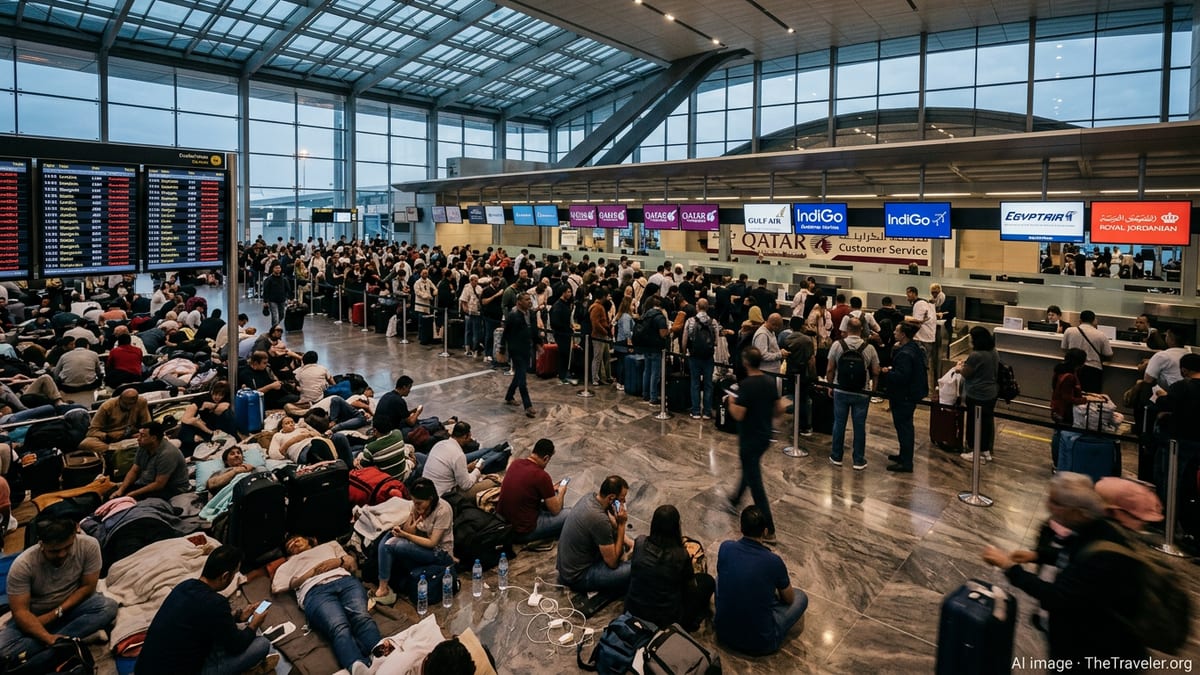
Regional Conflict Triggers Deepening Air Travel Crisis
The disruption at Hamad International is the latest flashpoint in a broader aviation crisis across the Gulf, triggered by the closure of Qatari airspace on March 1 following the escalation of the U.S.-Israel-Iran conflict. Qatar’s main hub, usually one of the world’s busiest transit airports, has seen normal commercial operations largely suspended as authorities restrict movements to essential and humanitarian flights.
Operational data compiled over recent days shows 276 flights cancelled with Doha as the origin and 217 as the destination, totalling 496 scrapped services linked to Hamad International alone. The cancellations affect a wide spectrum of airlines, from full-service Gulf carriers such as Qatar Airways and Gulf Air to regional operators and South Asian low-cost giant IndiGo, as well as EgyptAir and Royal Jordanian.
While Dubai and Abu Dhabi have also experienced sweeping shutdowns and rolling cancellations, the paralysis at Doha has had an outsized global impact. The airport normally functions as a critical bridge between Europe, Africa and Asia, meaning each cancelled departure or arrival can strand or delay passengers thousands of miles away from the Gulf.
Industry analysts say the combination of airspace restrictions, security concerns and complex aircraft positioning requirements has created an intricate operational puzzle. Carriers are being forced to juggle crew duty limits, limited safe corridors and shifting regulatory guidance, resulting in frequent last-minute schedule changes.
Passengers Stranded as Limited Relief Flights Begin
In recent days, Qatar’s civil aviation authorities have authorised a narrow operating corridor, allowing Hamad International to run a small number of evacuation and repatriation flights. Airport officials confirmed that these services were prioritised for stranded transit passengers and for critical air cargo, but emphasised that regular commercial operations remain suspended until airspace can be fully reopened.
Qatar Airways has begun cautiously reintroducing limited services into and out of Doha, publishing short rolling lists of flights on specific days instead of full timetables. Arrivals to Hamad International have included services from Amsterdam, Berlin, Frankfurt, London and Zurich, while departures have focused on key hubs such as London Heathrow, Paris, Madrid, Rome and Frankfurt, with additional rotations added to cities including Cairo, Jeddah, Manila, Kochi, Muscat, Istanbul, Mumbai, Delhi, Nairobi, Islamabad, Colombo and Milan.
Even with those relief flights, capacity is only a fraction of normal levels. Queues for rebooking and airline help desks have stretched across concourses, and passengers report waiting hours simply to receive confirmation of hotel accommodation or meal vouchers. With Gulf Air’s operations still largely suspended, and with knock-on disruptions at Cairo, Dubai, Kuwait and London Heathrow, many travellers have found alternative routings equally uncertain.
Airlines stress that only passengers who receive direct confirmation for a specific flight should proceed to the airport. Hamad International has urged the public not to arrive at the terminal without a valid ticket and written or digital reconfirmation, warning that access controls are in place and that facilities are already under severe strain.
Major Routes to London, Jeddah, Bangkok and Dubai Hit Hard
The cancellations have rippled through some of the world’s most heavily trafficked corridors. Services between Doha and London, a key business and leisure artery, have been repeatedly cut or consolidated as airlines work within narrow operating windows. Passengers connecting through Doha from North America and Europe to South Asia and Southeast Asia have been particularly affected, often finding themselves stranded in third countries as their onward segments are cancelled.
Religious and labour migration routes have also been badly disrupted. Flights linking Doha and Jeddah, vital for Umrah pilgrims and for workers travelling between the Gulf and the Horn of Africa or South Asia, have suffered extensive cancellations before a handful of services were restored to move priority travellers. Carriers including IndiGo and EgyptAir have reported significant operational knock-on effects on their wider networks as aircraft and crews are stranded out of position.
Further east, connections to Bangkok and other Southeast Asian gateways have been curtailed or rerouted via alternative hubs where possible, but capacity remains tight. At the same time, Dubai’s own wave of cancellations and temporary airport closures has limited the region’s ability to absorb displaced demand from Doha. Royal Jordanian and other regional airlines have cut or suspended services to multiple Gulf destinations, with delays and cancellations now common on flights touching Amman and Cairo as well.
Travel experts warn that the combined reduction in long-haul and regional capacity could reverberate far beyond the Middle East in the coming days, increasing fares on remaining seats and reducing flexibility for travellers seeking to rebook. Tour operators and corporate travel managers are scrambling to redraw itineraries that once relied heavily on the Doha and Dubai hubs.
Airlines Offer Waivers as Travellers Face Long Waits
Facing growing frustration from stranded customers, major carriers have rolled out an array of rebooking and refund options. Qatar Airways has extended date-change flexibility for passengers with tickets covering the peak disruption period, while some regional and South Asian airlines are allowing one-time free changes or full refunds for itineraries routed through Doha, Dubai and Abu Dhabi.
IndiGo, which has experienced some of the highest cancellation numbers on Middle East routes, has been operating dedicated flights from Jeddah and other gateways to help repatriate stranded passengers. EgyptAir and Royal Jordanian have introduced similar recovery services, although exact schedules are changing daily as conflict-related airspace assessments evolve.
Even so, relief is not always swift. With hotel rooms in Doha and other Gulf cities at a premium, some passengers are being asked to share rooms or remain in terminal rest areas as they await new travel dates. Others have chosen to accept refunds and attempt to piece together entirely new routes home via alternative hubs in Europe, North Africa or South Asia, often at significant additional personal expense.
Consumer advocates are urging passengers to document all expenses and communications with airlines, noting that in many jurisdictions carriers have specific obligations to provide care, rerouting or compensation following mass cancellations. However, the extraordinary nature of the regional security situation means that standard passenger rights frameworks may be applied with additional caveats or delays.
Uncertain Timeline for Full Reopening of Qatari Airspace
For now, there is no firm public timeline for a complete resumption of flights at Hamad International. Airport authorities say they are ready to scale up operations quickly once regulators declare the airspace safe, but any reopening is expected to be carefully phased to manage both security risk and operational complexity.
Industry observers anticipate that limited corridors for evacuation and essential travel will continue in the near term, with more destinations gradually reintroduced if the regional security picture stabilises. Airlines are already mapping out potential ramp-up plans, which would see priority given to trunk routes such as Doha to London, Jeddah, Bangkok and Dubai, followed by secondary cities as aircraft and crews become available.
Until then, travellers are being urged to avoid speculative bookings through the Gulf and to monitor official airline channels closely for schedule updates. With thousands still stranded and 496 cancellations already recorded around Hamad International alone, the crisis underlines just how central Doha has become to modern global air travel and how vulnerable that system can be when a single key hub suddenly grinds to a halt.