

More news on this day
Thousands of travelers across Asia and the Middle East are facing cascading disruption this week, as publicly available flight-tracking data points to 573 cancellations and 6,324 delays centered on major hubs in China, Indonesia, Japan, South Korea, Taiwan and the United Arab Emirates, snarling operations for carriers including Korean Air, ANA Wings, IndiGo and Saudia from Beijing and Jakarta to Jeju City, Taipei and Dubai.
Get the latest news straight to your inbox!
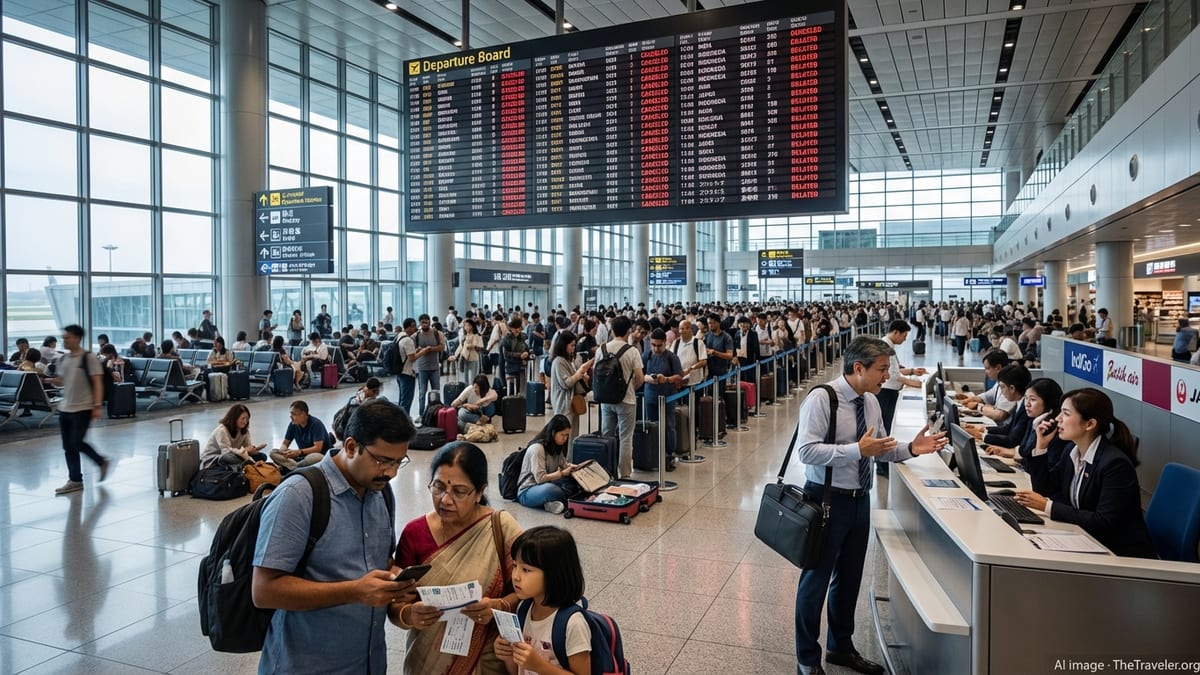
Regional Hubs Struggle Under Wave of Disruptions
Recent tallies compiled from aviation analytics platforms and regional media reports indicate that a dense band of cancellations and long delays has formed across some of Asia’s busiest airports. Activity logs highlight Beijing Capital and Daxing, Jakarta Soekarno Hatta, Jeju International, Taipei Taoyuan and Dubai International among the most affected, with knock on impacts spreading through secondary hubs across China, Japan and Southeast Asia.
Published coverage focusing on early April operations shows that weather, airspace constraints and operational bottlenecks have converged to create a volatile environment for airlines and airports. Industry trackers cited by travel outlets describe single day snapshots where hundreds of flights were scrubbed and several thousand pushed back by an hour or more, creating rolling queues at departure gates and extended aircraft holds on the tarmac.
The latest figures suggesting 573 cancellations and 6,324 delays appear to capture a particularly intense 24 to 48 hour window of disruption. Analysts note that such spikes are increasingly common in the region, reflecting the combination of rapid traffic growth, dense scheduling and limited slack in fleet and crew deployment.
While some airports, such as Singapore Changi and Tokyo Haneda, have avoided the worst cancellation rates in recent days, logs show that they are still absorbing a heavy burden of delayed arrivals and departures as late running flights from China, India and the Gulf ripple across network timetables.
Major Carriers From Korea, Japan, India and the Gulf Hit Hard
Publicly available disruption tables and airline status pages suggest that the latest wave of irregular operations has affected a broad mix of full service and low cost carriers. Korean Air’s short haul and leisure focused services through Jeju and Busan have featured in delay rankings alongside Japan’s domestic and regional operators, including ANA Wings on intra Japanese and cross strait routes.
Indian low cost giant IndiGo has continued to adjust schedules on sectors touching the Gulf and broader Middle East, following earlier cuts and rerouting triggered by airspace restrictions. Travel industry analysis notes that the carrier has periodically consolidated frequencies into Dubai and other United Arab Emirates gateways, leading to select cancellations and heavily delayed rotations when aircraft and crews are out of position.
In the Gulf, Saudi Arabian flag carrier Saudia and other regional airlines have recorded clusters of delayed departures on services linking Jeddah and Riyadh with Dubai and major Asian cities. Operational data shared in recent coverage points to longer routings and congested alternative corridors contributing to extended block times, which in turn reduce the number of rotations an aircraft can operate in a day.
Chinese mainline carriers, including large state owned groups, remain prominent in delay statistics for domestic and regional services through Beijing, Shanghai and interior hubs. Japanese and Korean operators also appear frequently in the logs, reflecting their dense schedules across Northeast Asia and reliance on tight turnaround times that are vulnerable when a single wave of flights slips out of sequence.
Beijing, Jakarta, Jeju, Taipei and Dubai Emerge as Bottlenecks
Across China, reports indicate that Beijing Capital and Beijing Daxing have once again risen to the top of regional delay and cancellation tables. Weather variations over North China, coupled with intensive airspace management requirements, have periodically forced temporary flow restrictions into the capital’s airfields, impacting both domestic trunk routes and long haul international flights.
In Indonesia, Jakarta’s Soekarno Hatta International has been dealing with thunderstorms and heavy rain at the onset of the rainy season pattern, with local media noting that low visibility and storm cells have slowed both arrivals and departures. When combined with the airport’s already crowded peak bank structure, even short ground stops can quickly cascade into hour long holds and missed connections.
South Korea’s Jeju International, a key leisure gateway, has featured prominently in tallies of disrupted services after a series of bad weather days and high traffic peaks. Travel outlets report that on some days more than 200 flights into and out of Jeju have been cancelled or heavily delayed, spilling disruption over to Incheon and Busan as airlines scramble to reposition aircraft.
Taipei Taoyuan and Dubai International, both central nodes in regional and intercontinental networks, are also absorbing the effects of long haul schedule adjustments and rerouting. Disruption logs show that late arrivals from Europe and South Asia into Dubai and knock on delays from North Asia into Taipei have complicated gate and crew planning, leaving some passengers facing late night and overnight waits even when their flights eventually operate.
Complex Mix of Weather, Airspace and Operational Strain
Aviation analysts following the situation describe a layered set of triggers behind the current spike in cancellations and delays. Seasonal storms over parts of China and Southeast Asia, including weather systems affecting Jakarta and interior Chinese cities, have periodically forced aircraft to divert, hold or reduce approach rates, shrinking effective capacity during peak waves.
Separate from weather, ongoing airspace constraints over parts of the Middle East have continued to reshape some long haul routings between Asia and Europe. Indian carriers such as IndiGo and Air India previously reported cancelling or rerouting selected services when Iranian and neighboring airspace was temporarily closed, and industry commentary indicates that some of those longer paths remain in use, stretching schedules and aircraft utilization.
Operationally, many regional airlines are still balancing fleet renewal, maintenance catch up and staffing levels after the intense post pandemic rebound in travel demand. When aircraft are taken out of service for checks or modifications, or when crew availability falls short, tight schedules can rapidly unravel, particularly at banks where multiple departures are scheduled within a short window.
Capacity reports from consultancies also show that several Asian carriers are running near pre crisis seat counts on key trunk routes while maintaining relatively thin spare capacity. This increases exposure to shock events, since there are fewer standby aircraft and crews ready to fill gaps created by an inbound delay or technical fault.
Passengers Face Missed Connections, Rising Fares and Crowded Airports
For travelers, the combined effect of 573 cancellations and 6,324 delays is being felt most acutely in the form of missed connections, unplanned overnight stays and higher short notice fares. Airport crowding has been reported at check in and transfer areas in Beijing, Jakarta, Dubai and other hubs as passengers attempt to rebook onto limited remaining seats.
Consumer discussions on social platforms and travel forums describe long lines at rebooking desks and busy call centers as airlines triage disrupted itineraries. Many passengers connecting between regional points such as Jeju, Taipei and Southeast Asian cities through major hubs have found themselves stranded when inbound delays caused them to miss onward services that were operating with few spare seats.
Industry observers suggest that in the short term, travelers across the region should build additional buffer time into itineraries, avoid overly tight connections and monitor flight status closely in the 24 hours before departure. With airlines facing constrained flexibility in aircraft and crew deployment, even a modest deterioration in weather or renewed airspace restrictions could trigger further spikes in disruption.
Analysts also note that sustained patterns of irregular operations may prompt some carriers to thin out schedules on the most vulnerable corridors in the weeks ahead, focusing on reliability over frequency. That could stabilize operations but may also keep last minute fares elevated on popular routes linking Asian capitals with Gulf hubs and onward European destinations.