

More news on this day
Air travel across Asia faced significant disruption over the past 24 hours, with publicly available flight-tracking data indicating 264 cancellations and 3,829 delays across major hubs in China, Japan, Singapore, India, Saudi Arabia and other markets.
Get the latest news straight to your inbox!
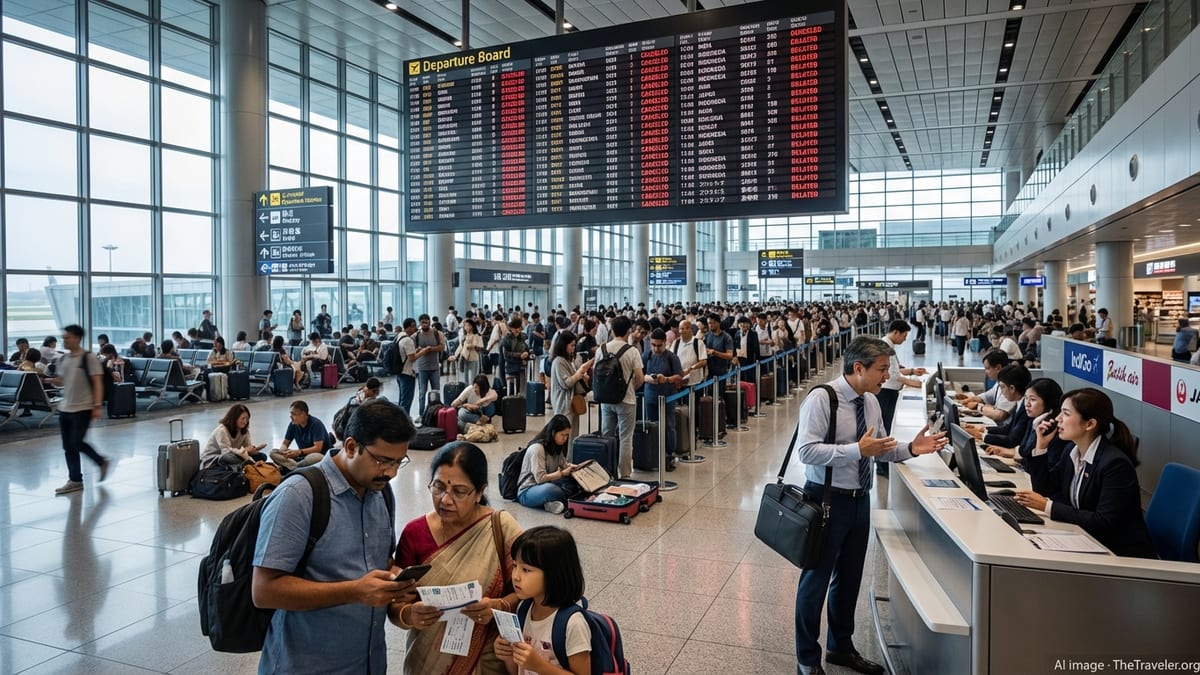
Major Asian Hubs Hit by Wave of Cancellations
The latest disruption has affected some of Asia’s busiest international gateways, including airports serving Tokyo, Shanghai, Kolkata and Abu Dhabi. Coverage from aviation and travel industry outlets indicates that a mix of operational constraints, congestion and localized weather conditions contributed to the spike in cancellations and late departures.
Flight data compiled on Monday shows that 264 flights were cancelled while 3,829 were delayed across the region, stranding or rerouting thousands of passengers. The figures highlight how quickly conditions can deteriorate across interconnected hub-and-spoke networks once bottlenecks emerge in key airports.
Reports indicate that the disruption was not confined to one subregion. Facilities across East Asia, Southeast Asia, South Asia and the Gulf all reported irregular operations, underscoring the continued fragility of airline schedules in a period of heightened geopolitical tension and strong post-pandemic travel demand.
Industry analysts note that while the single-day totals are modest compared with the most extreme global disruption days, the concentration of problems in heavily trafficked Asian hubs creates outsized ripple effects for long-haul connections between Europe, the Middle East and the Asia-Pacific.
Airlines from Batik Air to IndiGo and Air China Affected
The disruptions have touched a wide range of regional and international carriers. Publicly available information highlights impacts on Batik Air, IndiGo, Air China, FlyDubai and other airlines operating extensive networks through Tokyo, Shanghai, Kolkata and Abu Dhabi.
IndiGo, which has already been contending with schedule pressures on some international routes in recent weeks, saw additional strain as services through Indian and Gulf gateways were adjusted or held. Separate reporting on Indian carriers shows that operators have been periodically trimming or rerouting flights on select West Asia sectors in response to evolving airspace and security considerations.
Air China and other Chinese carriers, key players on routes linking mainland China with Japan, Southeast Asia and the Middle East, also recorded delays as congestion at large coastal hubs cascaded through their daily rotations. In the Gulf, FlyDubai and other operators serving Abu Dhabi and surrounding airports experienced knock-on effects as aircraft and crew were repositioned.
Regional specialists such as Batik Air, which connect secondary cities to larger Asian hubs, faced particular challenges when delays at major airports disrupted aircraft turnarounds and onward flight timings. In such situations, even a modest number of cancellations can force further schedule reshuffles as airlines work to restore aircraft and crew to their intended rotations.
Tokyo, Shanghai, Kolkata and Abu Dhabi Among Key Pressure Points
Tokyo’s major airports, together with Shanghai’s international gateways, featured prominently among the facilities reporting elevated disruption levels. Industry tracking platforms showed high volumes of delayed departures and arrivals, particularly during peak morning and evening banks when long-haul and regional services converge.
In India, Kolkata emerged as one of the focal points, reflecting its role as a significant hub for both domestic and short-haul international traffic. Publicly available airport statistics in recent months have already highlighted the sensitivity of India’s aviation system to weather events, festival-related congestion and shifting international routings linked to tensions in West Asia.
Abu Dhabi, an important connector between Asia, Europe and Africa, also reported cancellations and delays amid an already challenging period for Gulf airspace. Previous weeks have seen multiple carriers adjust schedules and routings around the wider Middle East, and Monday’s figures suggest that residual impacts are still filtering through operations.
Observers note that when hubs such as Tokyo, Shanghai and Abu Dhabi simultaneously encounter delays, the knock-on impact can spread quickly to secondary airports in Southeast Asia, South Asia and beyond, as aircraft arriving late are forced into compressed turnaround windows or late-night departures.
Weather, Congestion and Wider Regional Tensions Intersect
While the latest tally of 264 cancellations and 3,829 delays is not tied to a single triggering incident, published coverage points to a confluence of factors. Seasonal weather patterns in parts of East and South Asia, combined with persistent congestion at high-growth airports, continue to limit operational flexibility when problems arise.
At the same time, airspace adjustments and routing changes associated with tensions in West Asia have placed additional pressure on network planners. In recent weeks, several carriers serving India, the Gulf and Europe have publicly announced temporary suspensions, reroutings or frequency reductions as they navigate evolving risk assessments and regulatory constraints.
These shifts often require aircraft to fly longer routes or operate with tighter scheduling margins, leaving less room to absorb minor delays caused by local storms, ground-handling bottlenecks or technical checks. When multiple airlines are affected at once, queues for departure slots and arrival sequencing can grow rapidly, feeding into the kind of region-wide disruption recorded this week.
Analysts suggest that as long as geopolitical uncertainties, strong leisure demand and infrastructure limitations all coexist, episodes of concentrated disruption in Asian airspace are likely to recur, even without a singular dramatic event driving the numbers.
Travellers Advised to Monitor Schedules and Allow Extra Time
For passengers, the latest episode is another reminder of the importance of closely monitoring flight status when traveling through Asia’s busiest hubs. Airlines and airports across the region routinely update schedules and gate information through official apps, call centers and social media channels, particularly on days when disruption levels are elevated.
Travel experts cited in regional coverage recommend that passengers build in additional connection time when itineraries pass through multiple Asian hubs, especially Tokyo, Shanghai, Singapore, Gulf airports and large Indian metros. Allowing for longer layovers can reduce the risk of missed onward flights if earlier segments are delayed.
Those with imminent travel plans are also being encouraged to reconfirm reservations and consider flexible tickets or travel insurance that covers delays and cancellations. With many carriers adjusting routes in response to evolving conditions, being able to reschedule without significant additional cost has become increasingly important for long-haul travelers.
While operational performance across Asia often rebounds within a day or two after a spike in disruption, data from recent months shows that residual knock-on effects can linger in the form of rolling delays, isolated cancellations and equipment swaps. For now, the figures from this latest event underscore the need for both airlines and passengers to remain adaptable as the region’s aviation sector navigates a complex operating environment.