

More news on this day
Thousands of air passengers across Europe faced cancellations, long delays and missed connections on Tuesday as data from major tracking platforms showed at least 342 flights cancelled and 934 delayed across Germany, Austria, France, Italy, the Netherlands, Switzerland and the United Kingdom, disrupting operations at carriers including Lufthansa, British Airways, Air France, KLM and Ryanair.
Get the latest news straight to your inbox!
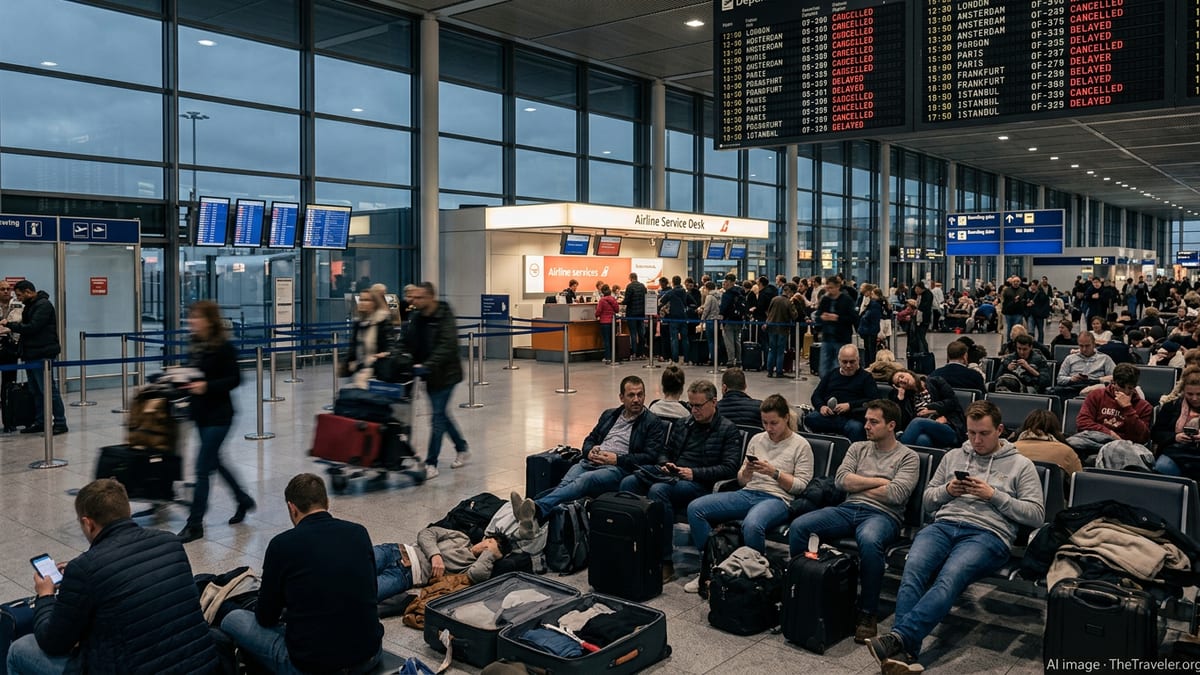
Major Hubs From Berlin To London Hit By Wave Of Disruption
Publicly available flight-tracking dashboards and airport status boards indicate that the heaviest disruption is concentrated around Europe’s busiest hubs, with Berlin, London, Paris, Vienna, Amsterdam, Zurich and major Italian airports all reporting elevated cancellation and delay levels compared with recent weekdays. The 342 cancellations and 934 delays identified across the seven countries translate into tens of thousands of passengers facing significant changes to their travel plans.
Reports from multiple European airports show clusters of cancelled departures and arrivals on intra-European routes, as well as knock-on effects to long-haul services. In London and Amsterdam, delays on morning departures created a rolling backlog into the afternoon bank of flights, while Berlin and Vienna saw wave-based disruptions that hit connecting passengers particularly hard.
Operational data referenced by industry analysts suggests that even airports with comparatively resilient infrastructure, such as Frankfurt, Munich and Heathrow, are struggling to absorb the combined impact of weather, staffing constraints and aircraft being in the wrong place at the wrong time after successive days of irregular operations. This has led to a notable increase in missed onward connections and unplanned overnight stays for transfer passengers.
Low-cost and network carriers alike have adjusted schedules during the day, cancelling selected rotations to create more buffer for the remaining flights. While this approach can stabilise operations, it also raises the raw number of cancellations, adding to the visible chaos on departure boards from Berlin to London.
Lufthansa, British Airways, Air France, KLM And Ryanair Among Worst Affected
According to operational summaries compiled from airline status pages and independent tracking services, Lufthansa, British Airways, Air France, KLM and Ryanair are among the airlines most affected by the current wave of disruption, reflecting their extensive European networks and reliance on the hubs now under pressure. Lufthansa has already been operating under strain following recent pilot and ground-staff industrial actions that led to waves of cancellations earlier in March, and today’s irregularities appear to compound existing challenges in rebalancing its fleet and crews across the network.
British Airways services to and from London Heathrow and London Gatwick display an above-average number of delayed and cancelled flights, particularly on short-haul routes linking the United Kingdom with Germany, France, Italy, Austria and the Netherlands. Public postings by passengers and timetable data show some routes experiencing multi-hour delays, while others are being proactively cancelled with rebooking options offered on later services or alternative carriers where seats are available.
Air France and KLM, which jointly manage major hubs at Paris Charles de Gaulle and Amsterdam Schiphol, are also visible among the carriers posting large clusters of delayed services on intra-European sectors. These hubs serve as key connection points between Europe and long-haul destinations in the Americas, Africa and Asia, meaning that local disruption is feeding into missed onward connections and longer journey times for travellers far beyond Europe.
Ryanair, as Europe’s largest low-cost airline by volume, is experiencing operational challenges across bases in Germany, Italy and other markets. While low-cost models can sometimes recover more quickly thanks to simplified point-to-point operations, the combination of adverse weather, congested airspace and staffing constraints at several airports is limiting the carrier’s ability to turn aircraft around rapidly and maintain schedule integrity.
Weather, Airspace Pressures And Recent Strikes Create A Perfect Storm
Industry commentary points to a convergence of factors behind today’s widespread disruption. Recent European windstorms, including severe systems affecting Germany, the Netherlands, France and parts of the Alps during January, prompted waves of cancellations earlier in the year and created a backlog of aircraft positioning and maintenance that some airlines have been working through for weeks. In Germany, for example, previous storms led to dozens of flights being cancelled at airports such as Hamburg, while rail and road networks were also affected, complicating crew movements.
At the same time, a series of industrial actions in early March, notably among Lufthansa pilot and ground staff groups, triggered large-scale cancellations and forced carriers to implement emergency schedules. Passenger accounts published online describe flights on key Lufthansa routes being cancelled or marked as disrupted days in advance, while airlines tried to rebook travellers on partner carriers or later dates. These disruptions have left some crews and aircraft out of position, increasing the sensitivity of the network to further shocks.
Broader geopolitical tensions and airspace closures in parts of the Middle East and North Africa have also added complexity to long-haul operations between Europe and Asia or Africa. Logistics and aviation updates released in early March outline how thousands of flights worldwide have been cancelled or rerouted due to regional airspace restrictions, leading to longer flight times, altered routings and fewer available aircraft cycles for European carriers. This global context increases the difficulty of absorbing even local weather or staffing issues inside Europe.
On the ground, staffing challenges in air traffic control, ground handling and security screening in several European countries continue to play a role. Economic analysis from aviation trade bodies has highlighted how delays attributed to air navigation service providers have risen over the last decade, costing billions of euros in lost time and additional fuel burn. When such structural issues intersect with acute shocks such as storms and strikes, widespread cancellation and delay figures like those seen today become more likely.
Passenger Experience: Long Queues, Confusion And Limited Rebooking Options
Travelers passing through today’s hardest-hit airports report long queues at check-in counters and customer service desks, particularly at hub terminals used by Lufthansa in Frankfurt and Munich, British Airways at Heathrow, and Air France and KLM at Paris Charles de Gaulle and Amsterdam Schiphol. Social media posts and online forums describe departure boards heavily populated with “cancelled” and “delayed” notices, making it difficult for passengers to understand in real time whether their journeys will proceed.
Publicly shared itineraries show that some travellers are being rebooked via alternative hubs or on alliance partners, such as moving passengers from cancelled Lufthansa flights onto other Star Alliance carriers, or shifting British Airways customers onto partner airlines where capacity allows. However, the volume of disrupted services means that alternative flights are often fully booked, leaving some passengers facing waits of one or more days before they can continue their journeys.
Accommodation and meal arrangements are also a growing concern. Under European passenger rights regulations, travellers whose flights are cancelled or subject to very long delays can in many cases claim assistance in the form of refreshments, hotel rooms where an overnight stay is required, and, in specific circumstances, financial compensation. Public advice shared by consumer groups encourages passengers to keep receipts, document communications with airlines and, where necessary, pursue claims after travel is completed rather than attempting to resolve everything at the airport.
Some travellers are opting to cancel or significantly alter their plans, particularly where travel is discretionary. Industry observers note that recurrent episodes of large-scale disruption may influence future booking behaviour, with passengers placing a premium on early-morning departures, non-stop services, or carriers perceived to manage irregular operations more robustly.
What Travellers Across Europe Can Do Now
Published travel advisories and airport notices stress that passengers scheduled to fly today and in the coming days should regularly check their flight status directly with their airline before leaving for the airport. Many carriers have activated flexible rebooking policies, enabling ticket changes without standard fees, especially for itineraries touching the most affected airports in Germany, Austria, France, Italy, the Netherlands, Switzerland and the United Kingdom.
Experts in air travel disruption management generally recommend that passengers who see their flight cancelled or significantly delayed act quickly to secure alternative arrangements, whether through official airline channels, travel agents or self-booked itineraries. With many services already heavily booked, those who move early have a better chance of finding remaining seats on workable routings, particularly on long-haul journeys with limited daily frequencies.
Travellers are also reminded to familiarise themselves with their rights under European passenger protection rules, which can apply both to EU-based airlines and to flights departing from EU, EEA and certain associated airports on non-EU carriers. These regulations set out when airlines must provide care, assistance and, in some cases, compensation, although extraordinary circumstances such as severe weather or external airspace closures can limit compensation eligibility even when disruption is severe.
Given the current combination of volatile weather, lingering strike impacts and global airspace pressures, aviation analysts suggest that Europe’s air travel network may remain vulnerable to further irregular operations in the short term. Passengers planning trips over the next several days are advised to build extra buffer time into tight connections, keep digital copies of travel documents at hand and remain prepared for last-minute schedule changes as airlines continue working to stabilise their operations.