

More news on this day
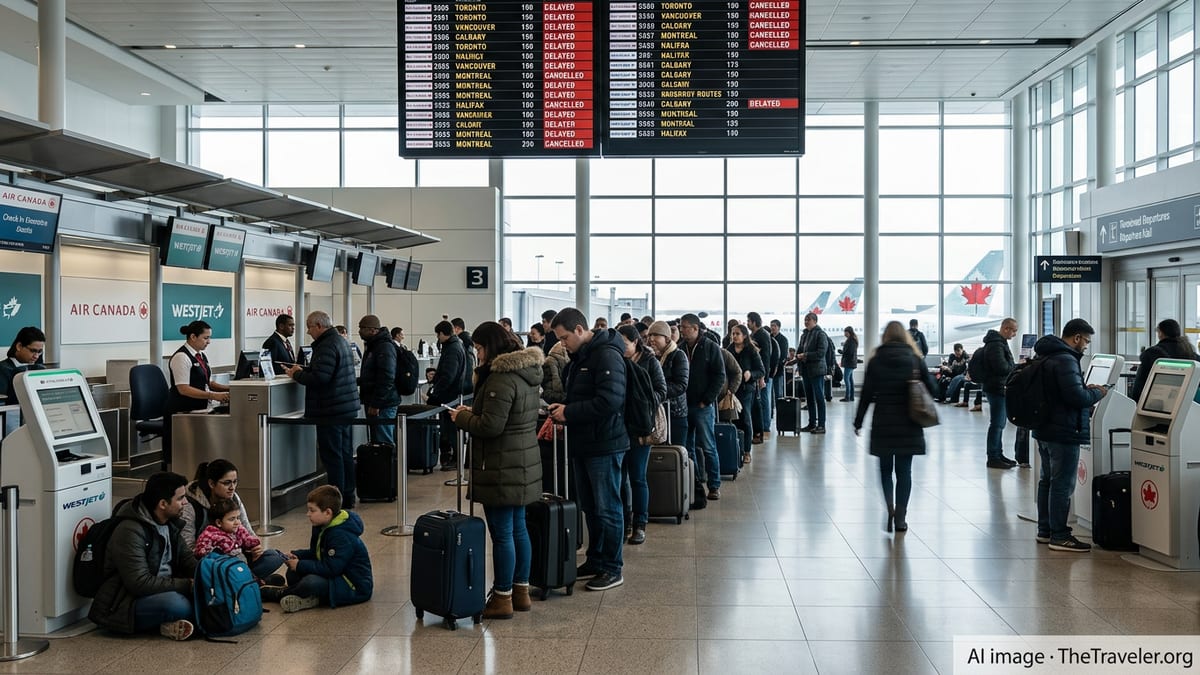
Thousands of passengers across Canada faced major travel turmoil this weekend as Air Canada, WestJet, Jazz and other carriers together recorded around 100 flight cancellations and nearly 500 delays, disrupting journeys through Toronto, Vancouver, Calgary, Montreal, Halifax and remote northern hubs such as Kuujjuaq.
Stormy Weather and Congested Skies Trigger Widespread Disruptions
The latest wave of disruption unfolded on March 8, with data showing close to 100 cancelled departures and arrivals and roughly 486 delayed flights across Canadian airports. The problems were concentrated at large hubs including Toronto Pearson, Vancouver International, Calgary International and Montreal–Trudeau, but also rippled through Halifax Stanfield and smaller northern airports serving communities such as Kuujjuaq in Nunavik.
A combination of early spring storms and knock-on congestion appears to be driving the problems. Heavy rain, low cloud and thunderstorms across parts of British Columbia, Ontario and Quebec forced aircraft to hold, divert or return to gates for extended periods, squeezing already tight schedules. Once rotations fell behind at major hubs, the delays quickly cascaded through the network, affecting routes hours and even provinces away from the original weather cells.
Operational pressures are amplifying those meteorological challenges. Airlines are still working with leaner fleets and crews after several seasons of restructuring and schedule adjustments, leaving less spare capacity to recover when weather or air traffic control constraints hit. Industry analysts say even modest disruptions can now produce outsized effects on peak-day traffic, particularly on busy domestic corridors such as Toronto–Vancouver and Calgary–Montreal.
By Saturday evening, departure boards at major terminals across the country were filled with delayed and cancelled flights. Airport authorities reported longer-than-normal lines at check-in and security, with some travellers waiting hours for rebooking assistance or updated information as airline call centres and digital channels buckled under a surge in demand.
Air Canada, WestJet and Regional Carriers Under Strain
National flag carrier Air Canada and low-cost rival WestJet bore much of the brunt of Saturday’s disruption, reflecting their dominant positions in Canada’s domestic and transcontinental markets. Both airlines reported clusters of cancellations and lengthy delays on routes linking Toronto, Montreal and Vancouver with Western Canada and Atlantic Canada, as they shuffled aircraft and crews to manage the evolving situation.
Regional operators feeding those hubs also struggled to maintain schedules. Jazz, which flies under the Air Canada Express brand, saw a significant number of delayed departures on short-haul routes connecting smaller communities to major airports. That included services to and from Halifax and several northern Quebec and Labrador destinations, where a single cancelled flight can leave passengers without an alternative for a day or more.
Other carriers, including airlines serving Indigenous and remote communities, reported smaller but still consequential disruptions. Flights linking Kuujjuaq and other Nunavik and Labrador communities to Montreal experienced delays and schedule changes, underscoring the vulnerability of remote regions when weather and operational issues converge at southern hub airports.
Although international services were less affected than high-frequency domestic routes, some long-haul and cross-border flights also ran late as crews and aircraft became displaced. Travellers heading to or from major U.S. and European gateways via Canadian hubs faced tight or missed connections and, in some cases, overnight stays while waiting for the next available departure.
Passengers Face Missed Connections, Extra Costs and Uncertainty
For passengers, the knock-on effects of Saturday’s disruptions ranged from frustrating delays to significant personal and financial hardship. Families returning from school breaks, business travellers bound for time-sensitive meetings and residents of remote communities all found themselves queuing at service desks or refreshing airline apps in search of alternatives.
At Toronto Pearson and Vancouver International, many travellers reported missing onward connections to domestic and international destinations after inbound flights arrived hours behind schedule. Hotel rooms around major airports quickly filled up as airlines issued vouchers and passengers scrambled to secure last-minute accommodation on a busy weekend.
In Montreal and Halifax, where weather and congestion combined to slow operations, some travellers described being held on aircraft awaiting gates or de-icing slots, only to be rebooked onto flights much later in the day. For those flying to or from northern communities, a cancelled evening departure could mean waiting until the next scheduled service, with limited local lodging and food options available.
Social media channels carried a steady stream of complaints about sparse updates, overwhelmed customer-service counters and conflicting information between airport screens, mobile apps and airline staff. While some travellers praised frontline employees for their efforts under pressure, others questioned why carriers had not built in more buffer capacity during a period of recurring weather-related disruptions.
What Travellers Need to Know About Their Rights
The scale of the latest disruption has once again drawn attention to Canada’s Air Passenger Protection Regulations, which set out minimum standards of treatment and, in some circumstances, compensation when flights are cancelled or heavily delayed. Under the rules, large carriers such as Air Canada and WestJet must provide food and drink in reasonable quantities and access to communication after lengthy waits, and may be required to offer hotel accommodation when overnight stays become unavoidable.
Eligibility for cash compensation depends on the cause of the disruption and the size of the airline. Weather and certain air traffic control issues are generally considered outside the carrier’s control, while some operational and staffing problems fall within it. Travellers affected by cancelled or significantly delayed flights are encouraged to keep boarding passes, receipts and written notifications from airlines documenting the reasons provided for the disruption.
Consumer advocates say passengers should file claims promptly through airline customer care channels, being as specific as possible about flight numbers, times and expenses incurred. If they are unsatisfied with a carrier’s response, they can escalate complaints to the Canadian Transportation Agency, which oversees enforcement of the regulations and can order compensation when it finds that airlines have not met their obligations.
In practice, the process can be lengthy, particularly after large-scale events that generate thousands of individual claims. However, recent cases have highlighted that detailed documentation and persistence can improve the chances of a successful outcome, especially in situations where the underlying cause appears to be within the airline’s control rather than solely the result of severe weather.
How to Navigate Ongoing Travel Uncertainty
With forecasters warning of further unsettled conditions in parts of Canada and airlines operating close to capacity, travellers planning trips in the coming days may want to build additional resilience into their itineraries. Aviation experts recommend booking earlier departures where possible, allowing longer connection windows at key hubs such as Toronto, Montreal and Vancouver, and avoiding tight back-to-back meetings or events on arrival.
Passengers are also urged to monitor flight status closely in the 24 hours before departure. Airline apps and airport departures boards provide the most up-to-date information on delays, gate changes and rebooked flights, although heavy disruption can strain digital systems. Checking in online as early as permitted, ensuring contact details are correct and enabling notifications can help travellers receive rebooking offers more quickly if their original flight is affected.
Carrying essential items, including medication, chargers and basic toiletries, in cabin baggage remains an important safeguard in case checked luggage is delayed or travellers are unexpectedly required to stay overnight en route. Those flying to or from remote communities such as Kuujjuaq may wish to coordinate closely with local carriers and accommodation providers, as alternatives can be limited when mainline flights into Montreal or other connecting hubs run late.
For now, Canadian travellers are again confronting an uncomfortable reality: even outside the depths of winter, a single day of poor weather combined with tight schedules and limited backup capacity can unravel air travel plans nationwide. Until airlines and regulators find ways to build more resilience into the system, days like this weekend’s network-wide disruption are likely to remain an unwelcome feature of the travel landscape.