

More news on this day
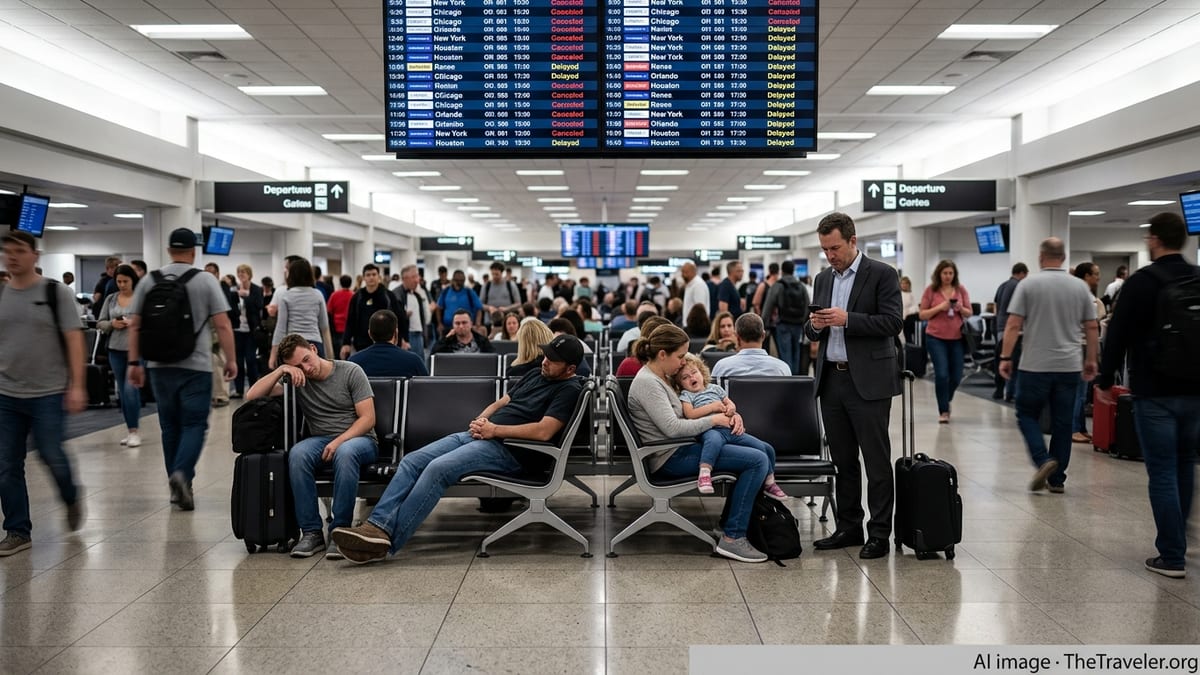
Thousands of US air travelers are facing another bruising travel day, as live tracking data shows 323 flights canceled and more than 750 delayed across major hubs from New York and Chicago to Orlando and Houston, with United, Delta and American among the most affected carriers.
Get the latest news straight to your inbox!
Where Disruptions Are Hitting the Hardest
Real-time airline tracking platforms on March 26 indicate that the heaviest operational strain is concentrated at some of the country’s busiest nodes: the New York area airports, Chicago O’Hare, Orlando International and Houston’s primary hubs. These airports serve as crucial transfer points for coast-to-coast and international itineraries, which means problems in one location quickly ripple through the wider network.
New York’s dense airspace is especially vulnerable when schedules tighten or weather conditions deteriorate, and reports show elevated levels of delays at both major international and secondary city airports in the region. Chicago, another cornerstone hub for domestic and transborder traffic, is seeing a combination of cancellations and late departures that are compounding congestion in the middle of the country.
Further south, Orlando and Houston are experiencing knock-on impacts as aircraft and crews arrive late from earlier disrupted segments. Orlando, a gateway for family and leisure travel, and Houston, a key connection point for Latin America and transcontinental routes, are both reporting a mix of scrubbed flights and creeping departure holds that are leaving passengers in terminals for hours longer than planned.
United, Delta and American Among the Most Affected
Publicly available data for March 26 shows that the largest full-service US carriers, including United Airlines, Delta Air Lines and American Airlines, are carrying a sizable share of the 323 cancellations and roughly 750 delays logged nationwide so far today. As the dominant or co-dominant operators at several of the affected hubs, issues within their networks have an outsized impact on overall national statistics.
These carriers operate dense schedules through New York, Chicago, Orlando and Houston, with many flights scheduled in tight succession. When an early-morning rotation is canceled or significantly delayed, the aircraft and crew tied to that service often fall behind for the rest of the day, creating a chain reaction of schedule adjustments. That pattern appears to be playing out again, with midmorning and early afternoon flights increasingly affected as the day progresses.
Recent months have already tested airline resilience, with major winter storms in January and February 2026 driving thousands of cancellations and delays across the country. While today’s disruption is far smaller in scale, it underscores that large network carriers are still operating near capacity, leaving limited margin to absorb fresh shocks from weather, air traffic flow restrictions or technical issues.
What This Could Mean for Your Upcoming Flight
For travelers scheduled to fly later today or over the next 24 hours, the current metrics suggest a heightened risk of schedule changes, even if your departure airport is not among the hardest hit. When hubs such as New York and Chicago experience disruptions, aircraft and crew are often out of position for subsequent flights elsewhere in the country, creating so-called downstream delays.
Even travelers on routes that appear unaffected in the morning may encounter rolling schedule adjustments as the day wears on. It is common for an aircraft scheduled for an evening departure to have already flown several segments earlier in the day; any of those legs running late can compress turn times or force airlines to swap aircraft or consolidate flights.
Passengers with tight connections, particularly those transiting through New York, Chicago, Orlando or Houston, are at increased risk of misconnecting if their first segment is delayed. Longer layovers offer a greater buffer, but the cumulative effect of hundreds of delayed flights means that minimum connection times may no longer be sufficient in congested terminals, especially during peak afternoon and evening banks.
How to Reduce Your Risk of Being Stranded
Given the elevated level of cancellations and delays, travelers planning to fly today or tomorrow may want to revisit their itineraries proactively. Publicly available guidance from consumer advocates and transportation agencies consistently highlights the importance of monitoring flight status frequently on the day of travel, since airline apps and airport departure boards tend to reflect schedule changes before announcements are made at the gate.
Same-day flexibility can be critical when networks are strained. Many major US carriers, including United, Delta and American, periodically publish travel alerts that allow fee-free changes for affected dates and routes. While not every traveler will qualify for these waivers, checking for such notices before heading to the airport can open up options to move to an earlier flight, reroute through a less disrupted hub or, in some cases, defer travel to a calmer day.
At the airport, passengers who are already facing cancellations or long delays often fare better when they immediately explore multiple rebooking channels at once, such as airline mobile apps, customer service phone lines and staffed desks in the terminal. Seats on alternative flights can disappear quickly when hundreds of passengers are being reaccommodated simultaneously, particularly on popular routes into and out of New York, Chicago, Orlando and Houston.
Why Disruptions Keep Cascading Across the System
Today’s numbers, while modest compared with major storm-related meltdowns earlier in the year, highlight structural vulnerabilities in the US air travel system. Airline networks are designed around complex hub-and-spoke operations; when one spoke falters, the resulting imbalance can extend across multiple regions. A single cancellation in the early morning might remove an aircraft from service for the entire day, while a short ground stop due to weather at a major hub can quickly grow into hours of network-wide delays.
Recent seasons have also shown how weather volatility, air traffic control constraints and tight airline staffing levels interact to create fragile operating conditions. Published analyses following large winter storms in January and February 2026 found that when multiple factors occur at once, carriers must juggle not only aircraft availability but also federal duty-time limits for pilots and flight attendants, complicating recovery efforts and lengthening disruptions.
For travelers, the upshot is that even a day with a few hundred cancellations and several hundred delays, as seen today, can feel significantly more disruptive than the raw numbers suggest. With heavy dependence on a handful of major hubs and limited slack in airline schedules, seemingly localized issues in New York, Chicago, Orlando or Houston can quickly become a national problem, testing the patience of thousands of passengers and reshaping travel plans well beyond the affected cities.