

More news on this day
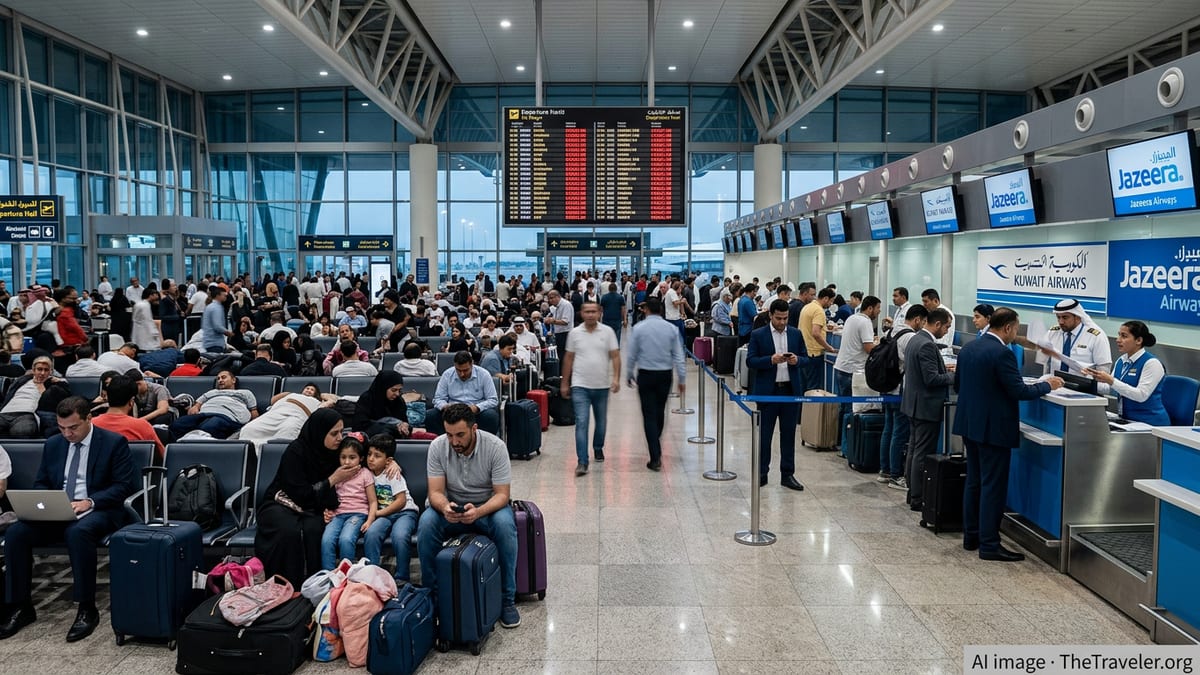
Hundreds of travelers were left stranded at Kuwait International Airport on Monday as at least 52 flights were canceled amid an ongoing shutdown of Kuwaiti airspace, snarling regional and long-haul connections for Kuwait Airways, Jazeera Airways and a string of international carriers.
Partial Operations Amid Continuing Airspace Shutdown
The latest disruption comes as Kuwait continues to enforce a sweeping closure of its airspace to civilian traffic following regional security tensions, with authorities confirming that commercial passenger flights remain suspended until further notice. While a limited number of technical, cargo or special movements have been permitted, scheduled passenger services have effectively ground to a halt, leaving aircraft and crews out of position and passengers stuck on both sides of the Gulf.
Against that backdrop, airport data and industry monitors on Monday pointed to at least 52 commercial flights linked to Kuwait International Airport that were formally canceled, with zero departures or arrivals recorded as delayed. Aviation analysts say the absence of logged delays reflects the fact that airlines are scrubbing services from the schedule entirely rather than holding aircraft on the ground in the hope of a late clearance.
Flight-tracking dashboards show Kuwait slotting into a wider Middle East pattern in which cancellations have overtaken delays as the defining characteristic of the crisis. In practical terms, that means passengers receive abrupt notifications that their flights no longer exist, rather than creeping departure-time pushes that might otherwise indicate gradual normalization.
For those already at the terminal, however, the distinction between a delay and a cancellation offers little comfort. Long queues have formed at airline counters as travelers attempt to secure scarce seats on repatriation services from neighboring hubs or wait for word that Kuwait’s airspace could reopen.
National and Low-Cost Carriers Hit Hard
Kuwait Airways and Jazeera Airways, the country’s two main homegrown carriers, are among the worst affected as the shutdown stretches into a fourth day. Both airlines rely on Kuwait International Airport as their primary hub, using it to funnel traffic between Europe, the Indian subcontinent and Southeast Asia. With the hub effectively frozen, their carefully balanced aircraft rotations and crew schedules have been thrown into disarray.
Industry observers report that Kuwait Airways has canceled multiple departures to Dubai, Doha, Cairo, Istanbul, Mumbai and London, while also scrapping inbound flights that would normally feed its long-haul network. Jazeera Airways has similarly pulled a swath of regional services, including popular routes to Dubai, Cairo, Hyderabad, Ahmedabad and other high-demand South Asian destinations.
International carriers are feeling the shock as well. Qatar Airways, Emirates, Etihad Airways, Saudia, Gulf Air, IndiGo and several other regional and South Asian airlines have halted Kuwait-bound services, affecting passengers across a chain of airports from Dubai and Abu Dhabi to Mumbai, Delhi and Istanbul. With airspace closed over multiple neighboring states, many of these airlines are choosing to reroute around the affected zone entirely rather than attempt patchwork workarounds into Kuwait.
Airline representatives say they are prioritizing safety while trying to preserve network integrity, a balancing act made more difficult by rapidly shifting security assessments and the lack of a firm timeline for when normal routes into Kuwait might resume.
Regional Ripple Effect Across Gulf and South Asia
The gridlock at Kuwait International Airport is part of a broader pattern of disruption reverberating across the Gulf and beyond. Airspace restrictions over Iran, Iraq, Kuwait, Bahrain, Qatar and parts of the United Arab Emirates have led to thousands of cancellations and diversions over the past several days, according to global flight-tracking analyses.
As Kuwait’s hub has gone quiet, the knock-on effects have been felt at major connecting airports such as Dubai International, Doha’s Hamad International, Abu Dhabi International and Bahrain International, all of which typically handle substantial traffic to and from Kuwait. Airlines that once relied on steady passenger flows from Kuwait are finding that empty seats and broken connections are rippling through their wider networks.
South Asian airports have also seen their timetables redrawn. Flights linking Kuwait with major Indian, Pakistani, Bangladeshi and Sri Lankan cities have been canceled outright or removed from sale for the coming days, complicating travel plans for migrant workers, students and families who depend heavily on Gulf routes. Travel agents in cities such as Mumbai and Dhaka report surging demand for alternative routings via unaffected hubs, though options remain limited and prices are climbing.
Aviation analysts warn that even when airspace restrictions begin to ease, the recovery will not be instantaneous. Aircraft and crew will need to be repositioned, and airlines will have to rebuild their schedules in phases, meaning passengers could continue to see reduced frequencies and lingering cancellations on Kuwait routes well after the initial crisis subsides.
Passengers Face Uncertainty on Refunds and Rebooking
For stranded travelers at Kuwait International Airport, the immediate concern is less about geopolitical dynamics and more about where they will sleep tonight and how soon they can get home. Many passengers arrived at the terminal to find departure boards filling with red “canceled” notices, while others received last-minute texts and emails advising them not to travel to the airport at all.
Airlines are offering a mix of full refunds, date changes and rebooking options via third-country hubs, but the process has been uneven. Kuwait Airways and Jazeera Airways have both activated disruption policies that allow passengers on canceled flights to change their travel dates without additional fees, subject to seat availability. Some foreign carriers are permitting rerouting via alternative gateways in the region once airspace corridors stabilize, though those options remain largely theoretical while closures are in place.
Travel industry experts recommend that affected passengers keep receipts for out-of-pocket expenses such as hotels, meals and local transport, as some airlines may reimburse reasonable costs incurred during extended disruptions. However, they caution that standard travel insurance policies often exclude coverage for events tied to war or security-related airspace closures, leaving many travelers reliant primarily on airline goodwill.
Inside the terminal, volunteer groups and airport staff have been helping families, elderly passengers and those with special needs to access food, water and basic medical care as they wait for clearer guidance. Language barriers and patchy mobile connectivity for some foreign nationals have complicated communication efforts, prompting calls for more consistent multilingual updates at the airport.
No Clear Timeline for Normal Flights to Resume
Kuwait’s Directorate General of Civil Aviation has stressed that passenger safety remains the overriding priority and that airspace restrictions will only be lifted once security assessments allow. Officials are coordinating with regional and international aviation bodies to evaluate risks, but have yet to publicly commit to a reopening date for Kuwait International Airport.
Industry insiders say the lack of a clear timeline makes it difficult for airlines to plan beyond rolling 24 to 48 hour windows, forcing them to rely on short-notice cancellations rather than publishing revised medium-term schedules. That uncertainty, in turn, discourages travelers from booking future trips involving Kuwait, raising concerns about the economic impact on tourism, business travel and the wider services sector.
For now, travelers with upcoming itineraries involving Kuwait are being urged to monitor their flight status closely, maintain contact with their airlines or travel agents and consider flexible routing options that avoid the affected airspace. With more than 50 flights already canceled in a single day and zero delays logged, the message from the schedules is clear: until Kuwait’s skies reopen, travelers should brace for further disruption.