

More news on this day
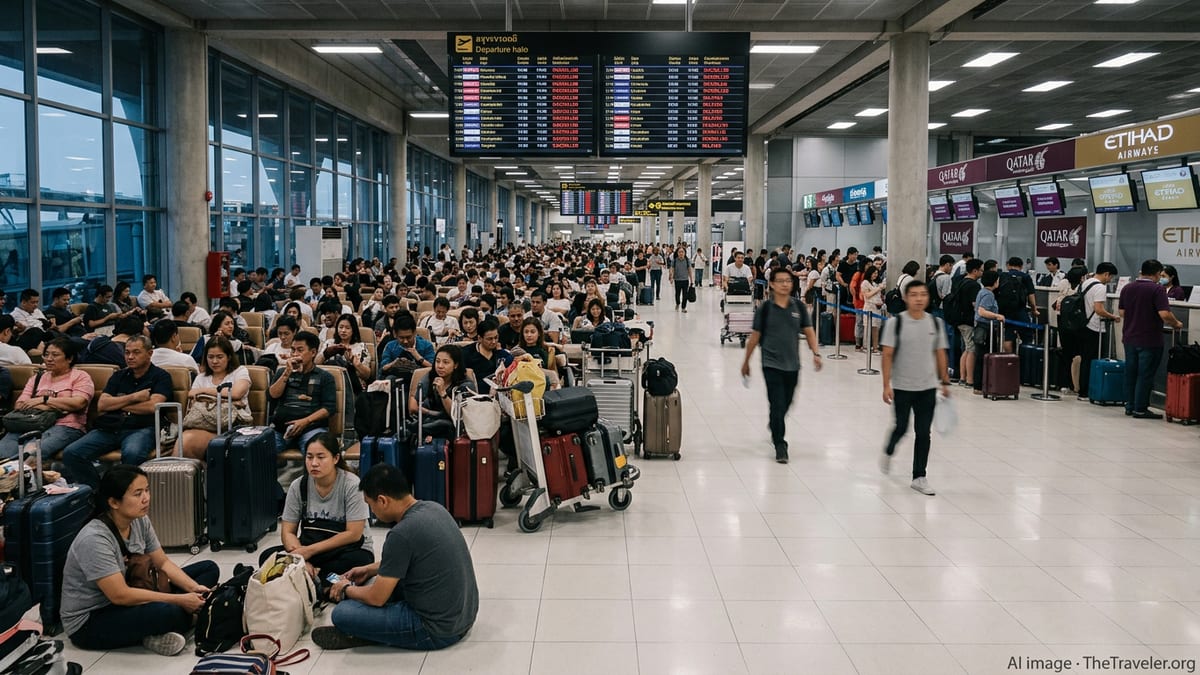
Hundreds of international passengers have been left stranded in Thailand after a fresh wave of flight disruptions caused 25 cancellations and 348 delays at Bangkok and Phuket airports, snarling services operated by Qatar Airways, Etihad Airways, Thai Airways, Mahan Air, Gulf Air, AirAsia and several other carriers.
Middle East Crisis Rippled Into Thailand’s Key Gateways
The latest disruption is tied to ongoing airspace closures across parts of the Middle East that have severed some of the region’s most heavily used transit corridors between Europe and Asia. Airlines that normally funnel passengers through Gulf hubs such as Doha and Abu Dhabi have been forced to cancel or reroute services, pushing operational stress further down the network into Southeast Asia.
Thai aviation officials confirmed that a combined 373 flights were affected at Bangkok’s Suvarnabhumi and Don Mueang airports together with Phuket International Airport over the past 24 hours, as carriers scrambled to adjust to fast-changing restrictions. While some flights were able to operate with extended routings around closed airspace, many others were either scrubbed outright or held on the ground for hours awaiting new clearances or aircraft.
Among the hardest hit were long haul services connecting Thailand to Europe and the Middle East. Routes that typically rely on Qatar Airways and Etihad Airways for one-stop connections via the Gulf were particularly vulnerable, as both airlines have curtailed or suspended services on multiple sectors pending clarity from regional air traffic authorities.
Thai Airways, which has already trimmed some services to the region in recent days, reported further schedule disruption on Friday, including knock-on delays to Europe-bound departures from Bangkok as aircraft and crews cycled out of position.
Qatar, Etihad and Gulf Carriers Face Operational Gridlock
Passengers booked on Qatar Airways flights from Bangkok and Phuket to Doha reported last-minute cancellations, long queues at transfer desks and difficulty securing timely rebookings. Many travelers said they had received automated text messages advising them not to proceed to the airport unless their flight status showed as confirmed, only to discover limited alternative options once services were officially canceled.
Etihad Airways customers described similarly chaotic scenes after Abu Dhabi-bound flights were withdrawn from departure boards. With both Gulf hubs experiencing their own heavy disruption, airlines have struggled to find spare capacity on alternative routings, leading to multi day delays for some Thailand-based passengers seeking to return to Europe, Africa or the Americas.
Regional carrier Gulf Air also pulled a number of services linking Thailand with Bahrain, while Iranian carrier Mahan Air adjusted operations in response to evolving route restrictions. The sharp reduction in Middle East connectivity has effectively narrowed Thailand’s long haul exit points overnight, intensifying demand for the remaining direct seats to Europe and for East Asian connections.
Travel agents in Bangkok reported airfares on remaining one way tickets to Europe rising steeply through Friday afternoon as stranded travelers searched for any available routes to get home, often accepting convoluted itineraries via East Asia instead of their original Gulf transits.
Thai, AirAsia and Other Regional Airlines Feel the Squeeze
The shock to long haul capacity quickly bled into regional operations. Thai Airways and Thai AirAsia, together with AirAsia’s wider network, saw increased pressure on flights linking Bangkok and Phuket with secondary hubs such as Kuala Lumpur, Singapore and Hong Kong, as disrupted travelers tried to stitch together new itineraries that bypassed the Middle East entirely.
AirAsia and Thai AirAsia reported a spike in day of departure changes and new bookings, particularly on routes feeding into major East Asian and South Asian gateways that still maintain relatively stable links to Europe. That surge, however, came on top of normal high season loads, leaving some departures oversubscribed and forcing further delays as ground teams accommodated involuntary rerouting.
Airport operators noted that even flights technically unaffected by airspace closures were departing late because displaced passengers needed to be reaccommodated, baggage had to be re sorted and crews bumped up against duty time limits. At Suvarnabhumi, departure boards showed delays of up to several hours for a mix of regional and domestic flights on Friday evening, even where weather and local operational conditions were normal.
Low cost carriers operating out of Bangkok’s Don Mueang airport, historically less tied to Middle Eastern transit traffic, nonetheless faced growing lines at customer service desks as passengers sought clarification on onward connections booked on multiple separate tickets.
Scenes of Confusion at Bangkok and Phuket Terminals
At Bangkok’s main international terminal, rows of passengers sat camped along the concourses, their luggage stacked beside makeshift charging stations as they tried to reach airline call centers or amend bookings via mobile apps. Airport staff deployed additional volunteers to direct crowds and answer basic queries about check in zones and immigration procedures for those whose stay in Thailand had suddenly been extended.
In Phuket, popular with European holidaymakers at this time of year, the mood was a mix of frustration and resignation. Families who had expected to be on overnight flights back to Gulf hubs or European capitals found themselves instead searching for hotel rooms near the airport, frequently at short notice and elevated prices due to the surge in demand.
Some travelers reported receiving meal vouchers and hotel accommodation from their airlines, while others said they were advised to arrange their own lodging and seek reimbursement later, depending on the operating carrier and point of ticket purchase. Long lines formed at airline counters as passengers sought written confirmation of cancellations and delays to support potential insurance claims.
Local tourism authorities in both Bangkok and Phuket said they were monitoring the situation closely and coordinating with airports and airlines to ensure that stranded travelers had access to basic information on accommodation, transport and immigration rules.
Immigration Flexibility and Advice for Affected Travelers
Thai officials stressed that travelers whose visas or visa exempt stays are nearing expiry due to the flight disruption will not be penalized if they can demonstrate that their departure was delayed by circumstances beyond their control. Legal advisers in Phuket reported that immigration officers have been instructed to show flexibility when presented with credible documentation such as cancellation notices, rebooking confirmations or updated itineraries.
Passengers were urged to keep every piece of communication from airlines regarding canceled or delayed flights, as well as receipts for hotels, meals and ground transport incurred while waiting for new departures. These documents may be required for future claims against airlines under relevant passenger protection rules or to support requests to travel insurance providers.
Travel experts also recommended that those yet to travel check their flight status repeatedly in the hours leading up to departure, use airline apps where possible and avoid heading to the airport without a clear confirmation that their service is operating. Given the rapidly evolving nature of the Middle East airspace restrictions, schedules are expected to change at short notice over the coming days.
While Thai regulators expressed confidence that regional networks would gradually stabilize later in March, they cautioned that further disruption remains possible so long as key Middle Eastern air corridors stay partially closed, leaving travelers at Bangkok and Phuket exposed to additional rounds of cancellations and delays.