

More news on this day
Hundreds of passengers were left stranded across Australia and beyond today after a fresh wave of flight disruptions at Sydney, Melbourne and Brisbane saw 20 services cancelled and 505 delayed, unsettling tight domestic schedules and rippling across international routes to Perth, Auckland, Dubai and other global hubs.
Get the latest news straight to your inbox!
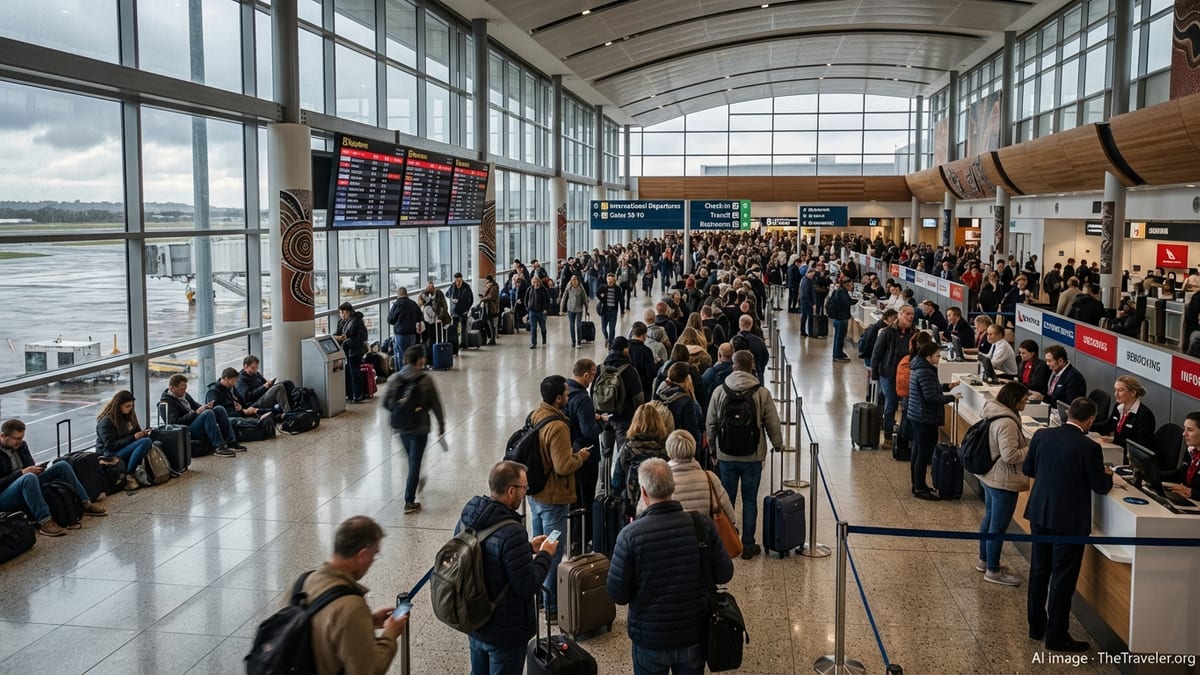
Fresh Turmoil on Australia’s Busiest Air Corridor
Newly compiled flight-tracking data for today indicates that Australia’s east coast triangle of Sydney, Melbourne and Brisbane once again experienced acute congestion, with a combined 20 cancellations and 505 delays recorded across the three airports. The figures add to a pattern of disruption reported in recent days on the country’s busiest air corridor, where previous tallies showed hundreds of delays and several dozen cancellations in a single day.
Published coverage of this week’s aviation performance highlights how quickly pressure can build across the system. Earlier in the week, monitoring platforms documented 38 cancellations and 380 delays in a single day across the same three east coast hubs, alongside broader disruption in Canberra, Adelaide and New Zealand cities such as Christchurch. Today’s 505 delays suggest the operational strain has not yet eased, even as the number of outright cancellations dipped.
Australia’s domestic network is heavily concentrated through Sydney, Melbourne and Brisbane, meaning even modest schedule changes can cascade quickly. Domestic competition reports and on time performance statistics show that these airports routinely handle some of the highest passenger volumes in the country and have also been among the most delay prone in peak periods, creating limited margin for error when weather, maintenance or staffing issues arise.
According to publicly available airport and aviation data, the current disruption follows a broader period of volatility for regional air travel, with recent analyses pointing to shifting weather patterns, high demand and infrastructure constraints as recurring triggers. For passengers booked today, that translated into long queues at departure halls, missed connections and last minute overnight stays in gateway cities.
Knock-on Impacts for Qantas, China Airlines, Cathay Pacific and Others
The rolling delays at Sydney, Melbourne and Brisbane had immediate implications for major carriers that depend on tightly timed turnarounds at these hubs. Flight-tracking snapshots and recent punctuality analyses show that Qantas remains the dominant player on many domestic trunk routes, meaning any disruption to its east coast schedule can quickly spill into its international services from Sydney and Melbourne.
Long haul operators including Cathay Pacific and China Airlines also rely on consistent departure slots from Australian gateways to maintain onward connectivity through Hong Kong, Taipei and other Asian hubs. When arriving aircraft are forced to hold, divert or depart late from east coast airports, subsequent rotations can be pushed back, affecting passengers boarding hours later in cities such as Perth, Auckland and Dubai, where Qantas and partner carriers operate onward connections.
Published data on delayed international flights from Australia this week points to Melbourne in particular as a standout for disruption, with several long haul services ranking among the most delay affected. While Sydney has recently recorded stronger on time performance overall, today’s figures show that it, too, remains vulnerable when multiple factors converge, especially during the busy morning and evening departure banks used by foreign carriers and alliance partners.
Operationally, every delayed departure at an east coast hub risks displacing aircraft and crews needed for later legs. Industry reports on previous disruption events across Australia and New Zealand describe how even short holdups on the ground can evolve into missed curfews, diversion of widebody aircraft and forced rebooking of passengers onto already crowded services the following day.
Weather, Maintenance and Crew Shortages Combine
In recent analyses of east coast flight performance, aviation data providers have described what they call a perfect storm of contributing factors behind this week’s wave of disruption. Low cloud, patchy rain and reduced visibility around Sydney and Melbourne have periodically lowered arrival and departure rates, forcing air traffic controllers to meter traffic more cautiously. At the same time, runway works and airspace management restrictions have further narrowed the window for recovery once backlogs form.
Crew availability has emerged as another significant constraint. Public reports on airline staffing highlight ongoing challenges in rebuilding rosters after the pandemic and subsequent recruitment waves. Training requirements for new aircraft types and regulatory limits on duty hours can leave operators with little flexibility when delays push crew beyond their scheduled shifts, sometimes requiring last minute cancellations even after passengers have boarded.
Maintenance scheduling can also compound these pressures. When short haul aircraft are held on the ground for weather or congestion related reasons, their carefully timed visits to engineering bases are pushed back, increasing the likelihood of technical holds later in the day. Industry submissions to regulators have previously warned that such knock on effects are particularly acute on high frequency shuttle routes such as Sydney to Melbourne and Brisbane, where aircraft are expected to complete multiple sectors in quick succession.
Against this backdrop, the current cyclone season in the broader Australian region adds a further layer of risk. While no single storm is solely responsible for today’s disruption, seasonal meteorological outlooks show that the late summer and early autumn period frequently produces unstable weather systems capable of affecting flight schedules along the east coast and across the Tasman.
Perth, Auckland, Dubai and Other Destinations Feel the Strain
Although the most visible queues and departure board changes were concentrated at Sydney, Melbourne and Brisbane, the operational shock spread far beyond the east coast. Westbound services to Perth rely heavily on connections from morning and midday flights out of the three major hubs; any delay to those feeders can leave passengers facing tight connections or unexpected overnight stops in transit.
Across the Tasman, Auckland’s schedule has also been sensitive to Australian disruptions this week. Recent reporting from regional travel outlets has documented how earlier clusters of delays in Sydney, Melbourne and Brisbane rapidly translated into late arriving aircraft in Auckland and Christchurch, affecting not only Australia bound returns but also onward services to Pacific islands and North America.
For long haul passengers routed through Middle Eastern hubs, today’s irregular operations present similar challenges. Flights from Australia that connect into late night departure waves to Europe and Africa from Dubai and other Gulf gateways must typically depart within narrow windows to preserve onward connections. When aircraft leave Sydney or Melbourne hours behind schedule, some travelers face rebooked routings or extended layovers while airlines work to accommodate them on later departures.
Industry commentary on previous disruption events notes that such ripple effects can persist for days. Aircraft arriving late into their overseas bases often depart late on their next sector, which in turn affects the following day’s arrivals back into Australia. This rolling imbalance places sustained pressure on carriers’ ability to restore their normal timetable, particularly where spare aircraft and crew are limited.
What Today’s Chaos Means for Travelers and the Industry
For passengers caught up in today’s 20 cancellations and 505 delays, the immediate impact has been measured in hours spent in terminals, reissued boarding passes and rearranged accommodation. Travel advisories circulating this week have urged flyers across Australia and New Zealand to factor in larger contingency windows, with some recommending buffers of three to four hours for critical same day connections on the east coast.
Consumer advocates and transport analysts in Australia have also highlighted the broader policy implications of repeated disruption cycles. A draft passenger rights framework discussed in recent public debate places greater emphasis on assistance, rebooking and refunds when flights are significantly delayed or cancelled, but stops short of mirroring the automatic compensation regimes used in some overseas markets.
For airlines, this latest episode underscores the delicate balance between maximizing aircraft utilization and preserving resilience. Competitive pressures and strong demand on routes between Sydney, Melbourne and Brisbane have encouraged carriers to run dense schedules, but official competition and punctuality reports suggest that even small operational shocks can have outsized impacts when the system is already running close to capacity.
With the Australian cyclone season continuing through the end of April and infrastructure projects ongoing at several major airports, industry observers expect further pockets of volatility in the weeks ahead. Travelers planning domestic and international journeys through Sydney, Melbourne or Brisbane are being advised, in widely circulated guidance, to monitor their flight status closely, build extra time into itineraries and consider flexible fare options where possible.