

More news on this day
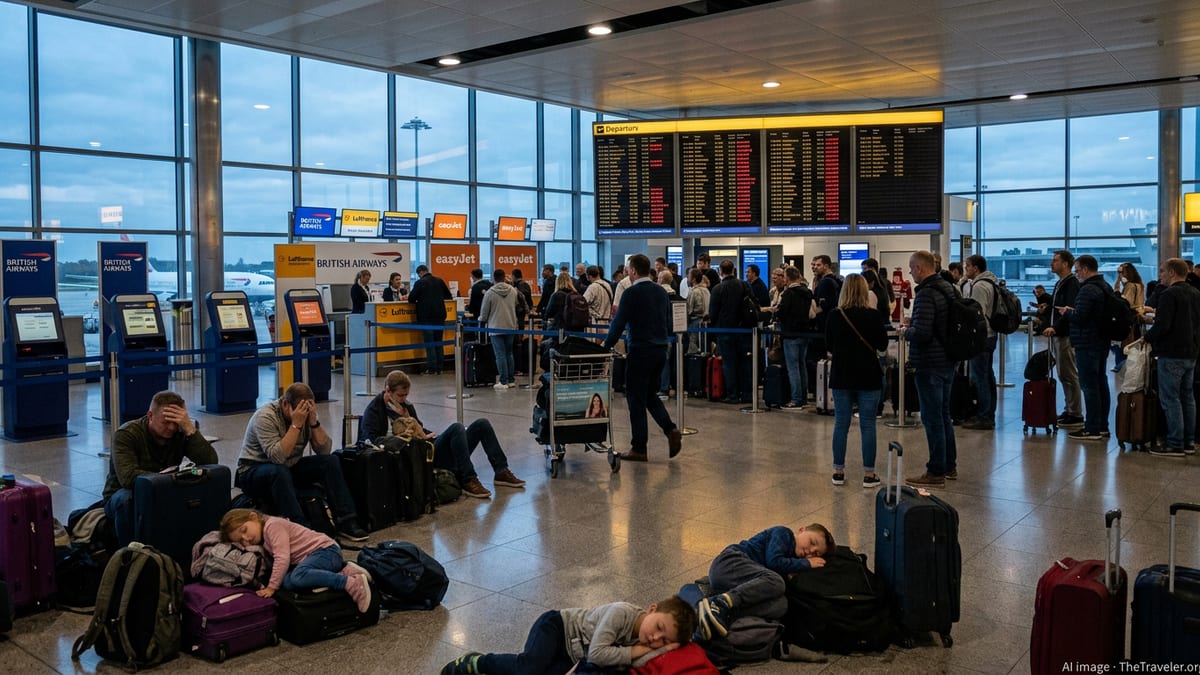
Hundreds of travellers were left sleeping on terminal floors and scrambling for last-minute rebookings on Monday as a fresh wave of flight disruptions swept across Europe, with Germany, France, Italy, Spain and other countries collectively delaying close to 2,000 services and cancelling more than 200, snarling operations for airlines including KLM, Finnair and British Airways at major hubs from London to Barcelona.
Major European Hubs Buckle Under Mounting Disruptions
Data compiled from real-time tracking platforms and passenger-rights groups for 9 and 10 March show Europe’s aviation network once again under intense strain, with more than 200 cancellations and around 1,700 to 1,900 delays reported in a single day across the continent. The worst disruption has been concentrated in the airspace of Germany, France, Italy, the Netherlands, Spain and the United Kingdom, where a mix of weather, congestion and wider geopolitical knock-on effects has stretched schedules to breaking point.
London, Paris, Frankfurt, Amsterdam and Barcelona have featured prominently on disruption tallies, with departure boards dominated by red and amber notices and security queues spilling into check-in halls. Travellers have reported missed connections, overnight strandings and hours-long waits to reach airline call centres, as carriers struggled to reposition aircraft and crew fast enough to restore normal operations.
In Spain alone, fresh figures on Tuesday highlighted a sharp spike in delays and cancellations at Barcelona, Madrid, Málaga and Valencia, where more than 460 flights were either delayed or scrapped in a matter of hours. That localised chaos fed directly into wider European networks, pushing knock-on delays into northbound and eastbound routes serving France, Germany, Italy and beyond.
The strain has been particularly visible on short-haul intra-European routes, where tight turnarounds leave little slack when weather or airspace complications arise. Even modest schedule changes can rapidly stack into hundreds of late arrivals and missed onward connections, creating precisely the kind of cascading disruption that has hit passengers in recent days.
KLM, Finnair and British Airways Among Carriers Hit Hard
While dozens of airlines have felt the impact of the latest disruption, European network carriers have once again borne a large share of the pain. KLM, operating from its Amsterdam Schiphol hub, has recorded scores of cancellations and more than 200 delayed flights over the current disruption window, leaving connecting passengers to and from the UK, Germany and Italy scrambling for alternatives.
British Airways has faced similar challenges on its European and transatlantic schedules out of London Heathrow and London Gatwick, with delayed inbound aircraft triggering late departures on popular business routes to Frankfurt, Paris, Milan and Barcelona. Travellers reported being rebooked via third countries or secondary European hubs, adding many hours to journey times and in some cases forcing overnight stays in airport hotels.
Finnair, whose network relies heavily on smooth east-west transfers through Helsinki, has not been spared either. Even a relatively small number of delays and cancellations can throw off tightly choreographed connection banks, with Asia-bound passengers in particular vulnerable to missed long-haul departures when feeder flights from Germany, France or the UK run late.
Low-cost and regional carriers have also appeared prominently in disruption statistics, but the knock-on effect is often most severe when large legacy airlines see their carefully planned hub waves collapse. Once missed connections begin to pile up, re-accommodating travellers on later services can quickly become a multi-day exercise, especially on heavily booked routes.
Local Weather and Global Conflicts Combine to Disrupt Air Traffic
Behind the headline numbers lies a complex mix of causes. In parts of central Europe, lingering winter conditions have periodically slowed operations, particularly at high-volume airports where snowfall or reduced visibility forces runway closures and de-icing bottlenecks. Even when local weather has improved, displaced aircraft and crew rosters have taken time to realign with published timetables.
At the same time, European airlines remain entangled in the wider aviation fallout from the escalating conflict in the Middle East, which has triggered airspace closures and prompted carriers to cancel or reroute services across large swathes of the region. Longer routings to Asia and Africa, as well as crew duty-time limits, have added further complexity to daily scheduling, reducing the margin for error when fresh disruptions strike within Europe itself.
French and German airspace has also seen recurring bouts of congestion linked to a combination of staffing pressures in air traffic control and occasional industrial action. While not always resulting in outright ground stops, these issues have contributed to increased airborne holding and departure slot restrictions, slowing the overall flow of traffic through some of Europe’s busiest corridors.
Analysts note that after several summers of high-profile disruption, Europe’s aviation system in 2026 is operating close to capacity in many markets, with strong demand for both business and leisure travel. That leaves operators more vulnerable to any shock, whether a dust plume over the Mediterranean, storms over northern Europe or conflict-driven diversions far to the east.
Scenes of Frustration in London, Barcelona and Other Gateways
On the ground, the statistics translate into difficult scenes for travellers. At London’s primary airports, early-morning cancellations have forced families, students and business travellers alike into long queues at airline service desks, where limited staff work through complex rebooking scenarios one passenger at a time. Those flying with KLM or British Airways to smaller European cities have been among the most likely to find only indirect options available for at least 24 hours.
In Barcelona, one of Spain’s key Mediterranean hubs, stranded passengers described terminal seating areas turned into makeshift dormitories as evening delays stretched past midnight. With hotels near the airport quickly filling up, some travellers reported being handed meal vouchers but told to make their own accommodation arrangements, while others waited for hours to retrieve checked luggage from cancelled flights.
Similar stories have emerged from Paris, Frankfurt, Amsterdam, Milan and Copenhagen, where travellers have struggled to get clear information on revised schedules. In some cases, airline apps and websites have updated more quickly than departure boards or call centres, allowing tech-savvy passengers to secure scarce seats ahead of those relying solely on airport queues.
For many, the most challenging aspect has been uncertainty. With aircraft and crews out of position, estimated departure times have often shifted repeatedly, leaving passengers unsure whether to remain airside, attempt to leave the airport or book replacement tickets on competing airlines at their own expense.
What Stranded Travellers Can Do Next
Consumer advocates across Europe are reminding passengers affected by the latest wave of disruption that strong protections exist under EU passenger-rights rules for flights departing from EU and UK airports or operated by EU and UK carriers. Depending on the cause of the disruption, travellers may be entitled to rerouting at the earliest opportunity, meal vouchers, hotel accommodation and, in some cases, financial compensation.
Advisers recommend that stranded passengers first use airline apps or self-service kiosks to search for rebooking options before joining physical queues, as digital channels often show real-time seat availability across partner airlines. Screenshots of delay notifications, boarding passes and receipts for food, transport or hotels should be retained to support any later claims.
Where possible, travellers with flexible itineraries are being urged to consider alternative routings via less congested hubs or even rail connections for shorter intra-European legs, relieving pressure on peak airports such as London Heathrow, Paris Charles de Gaulle, Amsterdam Schiphol and Barcelona El Prat. In some cases, flying into a nearby secondary city and completing the final segment by train or car has proved faster than waiting for a restored direct service.
With no immediate end in sight to the combination of weather volatility and geopolitical tension affecting global aviation, experts say that Europe-bound passengers in the coming weeks should build extra margin into their plans, avoid tight connections and ensure they have adequate travel insurance. For the hundreds still camped out in terminals from London to Barcelona, the priority remains far simpler: finding a seat on any flight that can finally get them home.