

More news on this day
Hundreds of travellers have been stranded across Europe after a fresh wave of disruption saw 2,497 flights delayed and 152 cancelled in key markets including Denmark, the Netherlands and the United Kingdom, severely impacting operations for major carriers such as easyJet, KLM and Lufthansa at hubs in London, Paris and other major airports.
Get the latest news straight to your inbox!
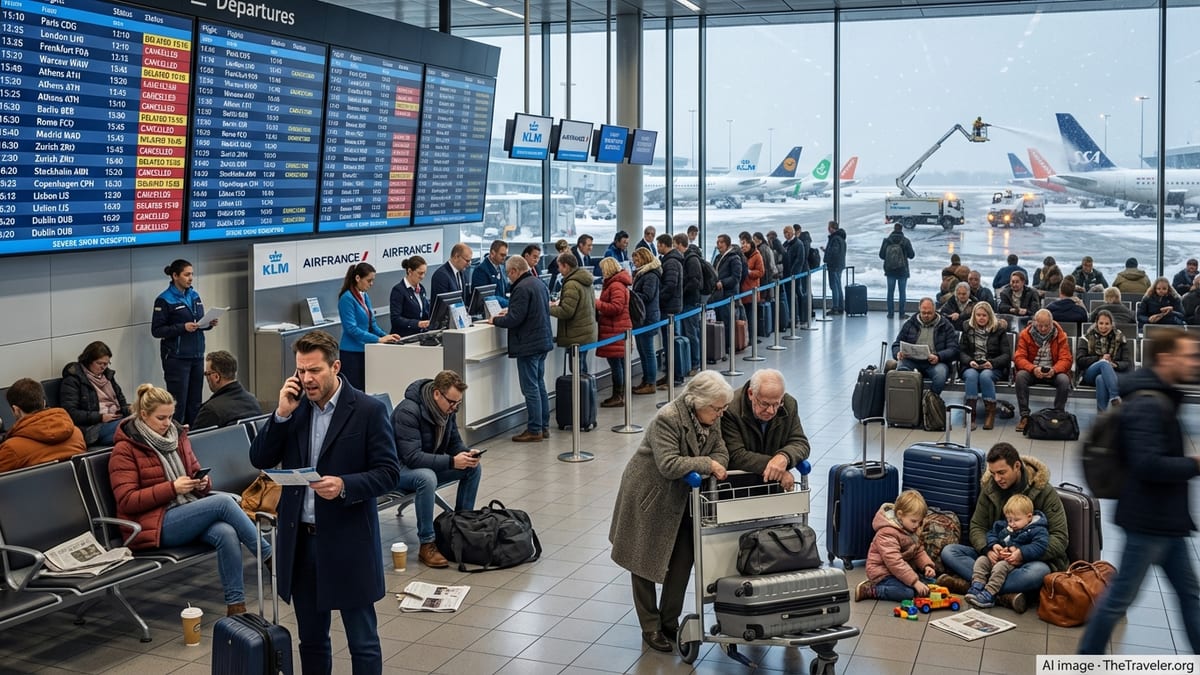
Wave of Disruption Hits Key European Hubs
The latest figures from aviation data trackers and travel-industry coverage point to a highly disrupted start to the week across Europe, with delays and cancellations building on several days of operational strain. Reports compiled on April 6 and 7 indicate that airports in the UK, Denmark, the Netherlands, France, Germany and Italy are among the worst affected, with London, Paris and Frankfurt emerging as particular hotspots.
In the UK, multiple London airports together with major regional hubs have reported hundreds of delayed departures and arrivals alongside dozens of cancellations. Publicly available summaries describe terminals crowded with passengers waiting for rebookings, often facing missed connections and overnight stays as airlines struggle to reposition aircraft and crew.
Across the North Sea, airports in Denmark and the Netherlands are also experiencing severe knock-on effects. Copenhagen and Amsterdam Schiphol have both featured prominently in disruption tallies in recent days, with Schiphol again under pressure as one of the main transfer points for European and transatlantic traffic.
France and Germany are contending with similar conditions, particularly at Paris Charles de Gaulle and Frankfurt, where dense schedules and complex transfer flows mean that each cancellation or long delay has the potential to cascade through airline networks, further inflating the regional totals of 2,497 delayed and 152 cancelled flights.
Major Airlines Including easyJet, KLM and Lufthansa Under Strain
The disruption is impacting a wide mix of full-service and low-cost carriers, with easyJet, KLM and Lufthansa among the airlines most visible in delay and cancellation statistics. Recent travel-industry roundups note that easyJet has logged more than one hundred delays on some of the busiest days of disruption, especially at London Gatwick and other UK and European bases.
KLM, which relies heavily on Amsterdam Schiphol as a transfer hub, continues to work through a challenging operational environment after an extended winter of weather-related constraints and airspace bottlenecks. Data published in recent weeks shows the carrier already operating with reduced resilience, making it more vulnerable to fresh waves of disruption as April travel ramps up.
Lufthansa and its partners are also facing difficulties at Frankfurt and other German airports, according to aviation analytics and consumer-rights platforms that track on-time performance. While the group has not reported a single triggering incident, a combination of earlier schedule adjustments, aircraft rotations and crew availability issues is contributing to delays that ripple through European routes, including services to and from the UK, Denmark and the Netherlands.
Other airlines, including British Airways, Swiss, Virgin Atlantic and several Scandinavian and regional carriers, feature prominently in recent disruption tallies as well, underscoring that the current situation is affecting much of the European market rather than a small number of operators.
Weather, Airspace Congestion and Systemic Pressure Converge
Published coverage suggests that no single cause fully explains the current pattern of disruption. Instead, a mix of unsettled spring weather, lingering effects from severe winter storms, crowded airspace and broader structural pressures on European aviation are coming together at a sensitive moment for travel.
Recent reports highlight that earlier storms over northern Europe forced large numbers of cancellations and diversions, leaving aircraft and crew out of position. Even as immediate weather conditions improve, airlines may need several days to restore normal rotations, especially on densely scheduled routes linking London, Paris, Amsterdam, Copenhagen and Frankfurt.
At the same time, operational briefings point to continuing constraints in European airspace, including reroutings connected to tensions and closures further afield. These adjustments can lengthen flight times and reduce schedule flexibility, increasing the likelihood that minor disruptions turn into long delays or cancellations later in the day.
The implementation and expansion of new border-control technologies, such as the European Union’s Entry/Exit System, are also contributing to longer processing times at some border checkpoints. While these measures are primarily aimed at security and migration management, the added pressure on airport infrastructure can exacerbate crowding and complicate recovery whenever flight operations fall behind schedule.
Passengers in London, Paris and Beyond Face Long Waits
For travellers on the ground, the cumulative effect is felt most acutely at major hubs. London’s airports have reported some of the highest raw numbers of delays in recent days, with certain terminals seeing more than one in four scheduled flights depart late on the worst-affected days. Social media posts and local coverage describe long queues at check-in and customer-service desks as passengers seek alternative routings.
In Paris, Frankfurt and Amsterdam, the situation is similar. Transfer passengers have been particularly exposed, with misaligned connections forcing many to spend unplanned nights in hotels or airport seating areas. Reports from consumer-rights organisations and travel advisories emphasise that travellers with separate tickets or self-connecting itineraries are at heightened risk of being stranded.
Smaller airports in Denmark, Norway, Sweden and Ireland are also “feeling” the disruption despite handling fewer flights. When regional services are cancelled or heavily delayed, replacement options are often limited, and passengers may face long overland journeys to reach alternative departure points or return home.
With the total disruption for the current episode reaching 2,497 delays and 152 cancellations across multiple European markets, travel advisors suggest that the impact is now comparable to some of the busiest disruption days seen so far in 2026.
What Travellers Should Know About Rights and Next Steps
Consumer information services and legal resources remind passengers affected by delays or cancellations on European itineraries that Regulation EC 261/2004 typically provides for assistance, rebooking and, in many cases, financial compensation. The exact entitlement depends on factors such as flight distance, length of delay and the underlying cause, but many travellers affected in recent days are likely to fall within its scope.
Travellers are generally advised to monitor their flight status closely through airline apps and airport information boards and to keep all documentation, including boarding passes, booking confirmations and any written notices about the reason for disruption. These records can be important when seeking reimbursement of meals, accommodation or statutory compensation at a later stage.
Industry guidance also highlights the value of acting proactively when disruption begins to mount. Where possible, passengers may benefit from contacting airlines early to request rerouting via alternative hubs or, for nonessential travel, to explore options to postpone or obtain vouchers. Some airlines have published flexible rebooking policies specifically addressing the current wave of delays and cancellations.
With peak spring and summer travel still ahead, analysts suggest that the recent turbulence serves as a reminder of the fragility of Europe’s aviation system when weather, airspace constraints and structural pressures coincide. For now, travellers departing from or connecting through London, Paris, Amsterdam, Copenhagen and other major hubs are being encouraged to allow additional time, build in longer connections and remain prepared for further short-notice changes.