

More news on this day
Thousands of passengers across Japan faced lengthy airport waits and missed connections this week after widespread delays and a cluster of cancellations disrupted operations at Tokyo, Osaka, New Chitose, Kumamoto and Takamatsu airports, hitting major carriers including Japan Airlines, All Nippon Airways, Solaseed, Jetstar Japan, Peach Aviation and several regional operators.
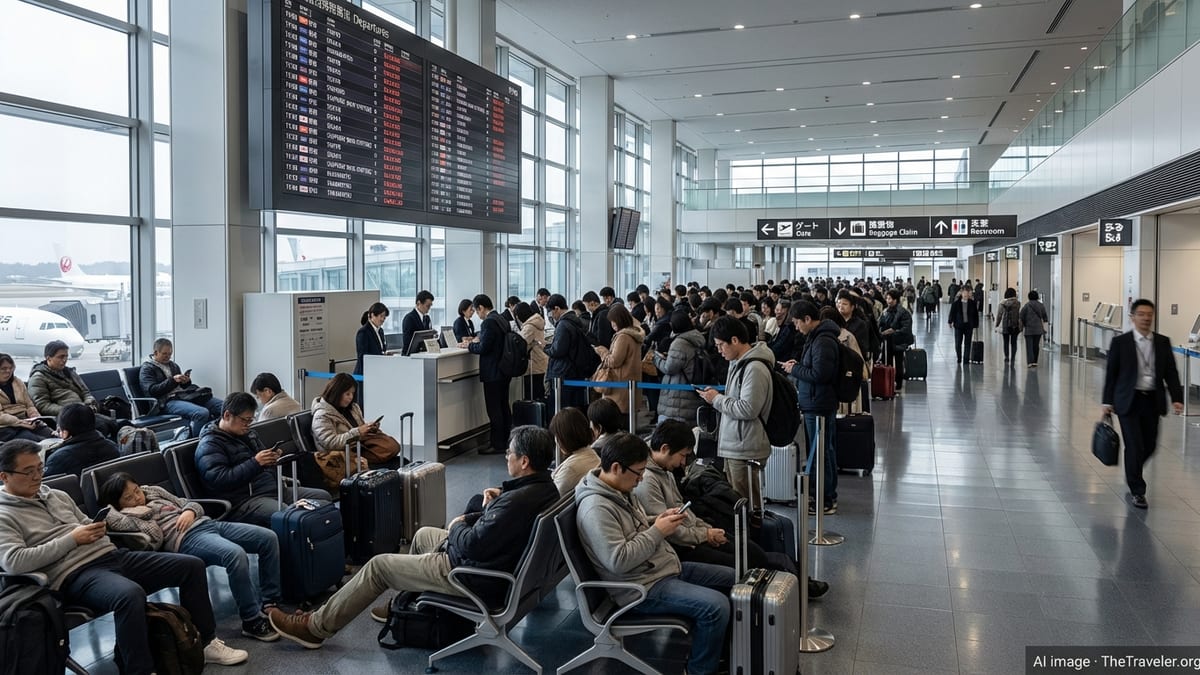
Hundreds of Flights Delayed Across Key Japanese Gateways
According to operational data compiled over the latest 24 hour period, a total of 519 flights were delayed and 13 cancelled across five of Japan’s busiest domestic gateways, severely disrupting travel plans at the tail end of February’s peak business and leisure travel period. The disruption spanned Tokyo’s primary domestic hub, Osaka’s key airports serving Kansai, New Chitose in Hokkaido, as well as Kumamoto and Takamatsu, important links for Kyushu and Shikoku.
The scale of disruption reflects mounting pressure on Japan’s tightly scheduled domestic network, where even modest operational issues can quickly cascade into broader gridlock. Airlines reported knock-on effects throughout the day as aircraft and crews fell out of rotation, compounding initial delays and forcing schedule adjustments on some of the busiest city pairs in the country.
While the majority of affected flights eventually departed, many passengers endured waits of several hours, rebooked itineraries or missed onward rail and international connections. For travelers with tightly timed business meetings or short stays, the day’s disruptions meant hastily rewritten plans and additional accommodation costs in hub cities.
Airport officials described the situation as a difficult but managed operational event, stressing that safety protocols remained the overriding priority as carriers sought to recover their schedules going into the weekend.
Major Carriers Hit, From Flagships to Low Cost Operators
The impact of the delays and cancellations was felt across the full spectrum of Japanese airlines, from full service flag carriers to low cost operators. Japan Airlines and All Nippon Airways shouldered a large share of the disruption, reflecting their dense domestic networks linking Tokyo with regional centers and tourism gateways such as Osaka, Sapporo and Fukuoka.
At the same time, low cost carriers including Jetstar Japan and Peach Aviation reported multiple delayed departures on high frequency routes connecting Tokyo and Osaka with New Chitose and other regional cities. For budget travelers and short-haul commuters, these delays undermined the reliability that has traditionally been a hallmark of Japanese domestic aviation.
Regional specialists such as Solaseed, which focuses heavily on Kyushu and southern Japan, also experienced operational strain as delays at larger hubs rippled outward. Smaller aircraft and tighter fleet utilization mean that a single late inbound flight can disrupt several subsequent departures, magnifying the effect of each initial delay.
Several airlines indicated that crews and aircraft were repositioned overnight in an effort to restore near-normal operations by early the next morning, but acknowledged that some residual delays would likely continue as rotations were gradually brought back into alignment.
Tokyo, Osaka and New Chitose Bear the Brunt
Tokyo’s main domestic airport again emerged as one of the most severely affected hubs, mirroring a pattern seen in previous disruption events where concentrated delays at the capital’s gateway quickly affect large numbers of passengers. High traffic density, short turnarounds and intersecting domestic and regional routes all contribute to the vulnerability of the Tokyo system when punctuality begins to slip.
Osaka’s airports, serving both business travelers to the Kansai metropolitan area and tourists heading for Kyoto and Nara, also reported substantial knock-on delays. Popular trunk routes between Tokyo and Osaka, traditionally among the busiest domestic corridors in the world, were particularly exposed as minor schedule disruptions on one leg quickly translated into overcrowded departure lounges and rolling boarding time changes throughout the day.
Further north, New Chitose Airport near Sapporo was again highlighted as a pressure point. The Hokkaido gateway has experienced several waves of disruption in recent months, driven at times by adverse weather and at others by tight fleet operations among domestic carriers. For travelers using New Chitose as a jumping-off point to ski resorts and winter destinations, even short delays risked cutting into already brief holiday windows.
Although smaller in scale, Kumamoto and Takamatsu played an outsized role in the day’s turbulence, as delays there reverberated through connecting services to Tokyo, Osaka and beyond. Travelers on regional routes reported being held on the ground while awaiting arrival of delayed inbound aircraft or the clearance of congestion at larger hubs.
Knock-on Effects for Passengers and Tourism
For affected passengers, the most immediate impact was uncertainty. Departure boards across these airports cycled through rolling delay notices as airlines reassessed their recovery plans. Travelers reported long queues at service counters as they sought alternative flights, overnight hotel vouchers or assistance rebooking onward rail or international sectors.
The timing of the disruption is particularly sensitive for Japan’s tourism industry, which is gearing up for the busy spring travel season. Domestic visitors heading to regional festivals, business travelers on tight schedules and inbound tourists using domestic legs to reach secondary cities all faced a higher risk of missed reservations, shortened stays and last-minute itinerary changes.
Local tourism operators in Hokkaido, Kyushu and Shikoku expressed concern that recurring episodes of widespread delays and cancellations, even when relatively short-lived, could erode confidence in domestic air links that underpin multi-city travel within Japan. Some hoteliers reported a spike in same-day cancellations and late check-ins tied directly to delayed domestic arrivals.
Rail operators, particularly on intercity routes linking Tokyo, Osaka and regional centers, may see a modest short-term boost as some travelers opt for the greater schedule resilience of the shinkansen on corridors where both air and rail are viable options. However, for island and remote destinations where air service is essential, passengers have few alternatives when disruption strikes.
Calls for Resilience as Airlines Work to Recover
In the wake of the latest wave of delays, passenger advocacy groups and industry observers renewed calls for greater operational resilience across Japan’s domestic aviation network. Suggestions include more flexible scheduling buffers on key trunk routes, additional standby aircraft and crews at major hubs and improved real-time communication tools to keep passengers better informed when plans change.
Carriers, meanwhile, emphasized the steps already taken to enhance coordination between airlines, airport operators and air traffic control when large-scale disruptions threaten to overwhelm standard procedures. Recent operational reviews have highlighted the importance of rapid, transparent information sharing so that cascading delays can be contained before they spread across the wider network.
For travelers, the episode serves as a reminder to factor potential disruption into tight itineraries, especially when connecting between domestic and international flights or planning same-day transfers to remote destinations. Travel agents and online booking platforms are increasingly advising customers to leave wider buffers and to consider travel insurance that explicitly covers delays and missed connections.
As operations gradually normalize at Tokyo, Osaka, New Chitose, Kumamoto and Takamatsu, airlines will be hoping that the latest disruption is viewed as a temporary operational shock rather than a sign of deeper systemic fragility. With the spring travel surge on the horizon, how carriers and airports learn from and respond to these events will be closely watched by passengers and industry analysts alike.