

More news on this day
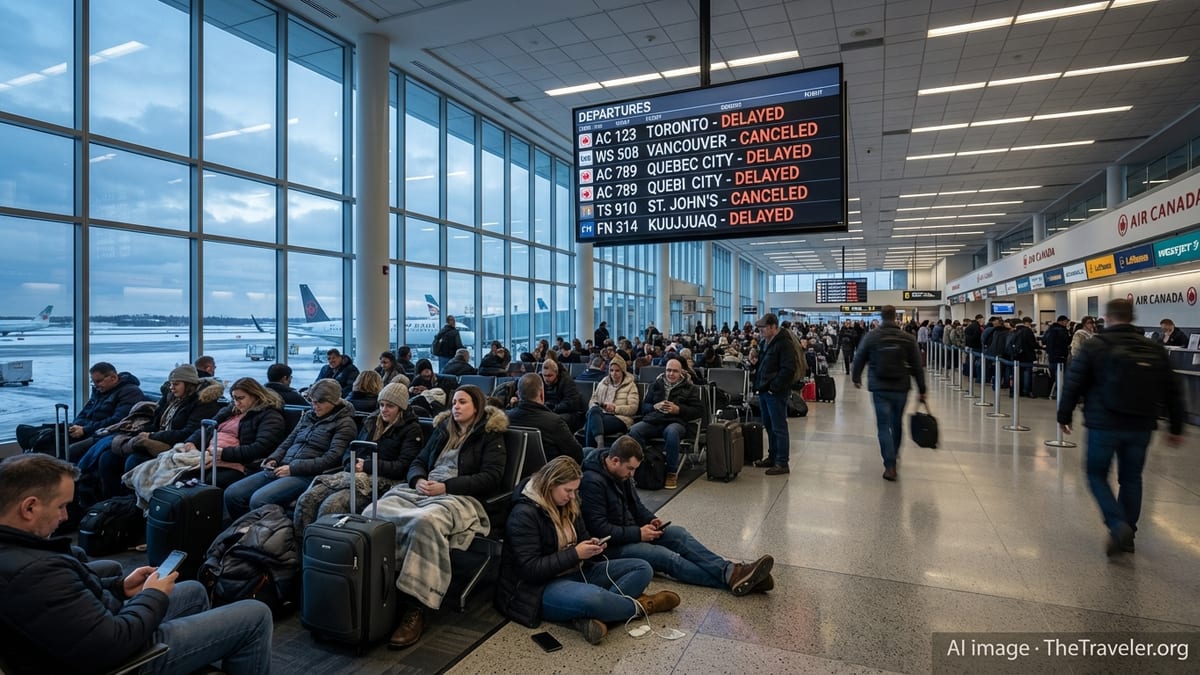
Hundreds of air travelers were left stranded across Canada on Saturday as at least 25 flights were canceled and 226 more delayed, with disruptions rippling from Toronto and Vancouver to Quebec City, St. John’s and northern hubs such as Kuujjuaq amid a cascade of schedule changes affecting major carriers including Air Canada, KLM, Etihad and Inuit-owned regional airlines.
Global Airspace Turmoil Hits Canadian Gateways
The latest wave of disruptions comes as Canadian airports absorb the knock-on effects of rapidly shifting international airspace restrictions and route changes tied to escalating tensions in the Middle East and broader operational challenges. Airlines are being forced to replan long-haul services in real time, creating congestion across already busy hubs in Canada.
Toronto Pearson International Airport, the country’s largest hub, recorded more than 20 cancellations and over 200 delays on Saturday, according to airport and aviation data reports, leaving passengers bound for cities across North America, Europe and Asia in hours-long queues and crowded gate areas. Flights operated by Air Canada, WestJet, Porter, Jazz and other carriers were all affected to varying degrees.
The timing has proved especially difficult for travelers connecting through Canada to onward destinations in the United States, Mexico and overseas. With some flights forced into longer routings and others scrubbed entirely, passengers at Pearson described a patchwork of rebookings, overnight hotel stays and last-minute itinerary changes as airlines worked to rebuild schedules.
Toronto, Vancouver and Quebec City Face Growing Backlogs
In Toronto, operational pressure mounted through the day as delayed arrivals displaced departure slots, creating a rolling backlog that left some aircraft waiting for gates and crew. Airport staff deployed extra customer-service teams in departure halls to direct travelers toward airline desks and self-service kiosks.
On the west coast, Vancouver International Airport also reported a sharp uptick in delays tied to both upstream disruptions on transpacific and transcontinental routes and lingering winter weather systems along the Pacific corridor. Several flights operated by Air Canada and international partners were pushed back, compressing turnarounds and narrowing the margin for on-time departures.
Quebec City’s Jean Lesage International and St. John’s International in Newfoundland saw a smaller number of outright cancellations but significant knock-on delays, particularly on regional services feeding into Toronto and Montreal. Passengers on domestic runs reported boarding, deplaning and then waiting for updated departure times as operations centers recalculated rotations and crew duty limits.
Remote Communities Feel the Strain in Kuujjuaq and Beyond
While Canada’s largest airports absorbed much of the media attention, the disruption was acutely felt in smaller and remote communities that rely on a limited number of daily flights. In Nunavik, services operated by Inuit-owned and regional carriers into Kuujjuaq and neighboring communities were delayed or rescheduled, affecting residents traveling for medical appointments, education and essential supplies.
With only a handful of connections linking these northern destinations to southern hubs on any given day, even a single cancellation can leave passengers stranded overnight or longer. Airport staff in Kuujjuaq reported busy terminals as travelers waited for revised departure information and confirmed seat assignments on the next available aircraft.
For many in the North, air travel remains the only practical link to larger urban centers, and schedule instability can quickly cascade into missed specialist appointments, postponed school terms and supply-chain delays. Local authorities urged passengers with non-urgent trips to consider postponing travel while airlines stabilized operations.
Major Carriers Juggle Long-Haul Disruptions
Canadian flag carrier Air Canada again found itself at the center of the turbulence, managing a mix of delayed and canceled flights as it rerouted select long-haul services and coped with congested turnaround windows at Pearson. The airline has also been recalibrating its broader international network, after earlier suspensions and adjustments to destinations including Cuba and routes affected by Middle East overflight changes.
European carrier KLM and Gulf-based Etihad Airways, both key players for Canadian travelers connecting to Europe, Asia and the Middle East, were also navigating altered routings and adjusted schedules. Extended flight times, crew-rest requirements and refueling constraints all contributed to a more fragile operating environment, where a single delay could ripple through multiple sectors.
Regional and Inuit-owned airlines feeding traffic into major hubs felt downstream impacts as misaligned connections forced last-minute schedule tweaks. In some cases, carriers consolidated lightly booked departures or swapped aircraft types in an effort to preserve capacity on the most time-sensitive routes, particularly those serving remote communities.
Travelers Confront Long Waits and Limited Options
Across affected airports, the passenger experience varied widely. Some travelers reported relatively smooth rebookings through airline apps and automated notifications, while others faced long lines at customer-service counters as they tried to secure alternative flights or accommodation vouchers.
Families traveling at the start of school breaks and business travelers heading for tight connections were among those hardest hit. With many flights running at or near full capacity, same-day rebooking options were limited, particularly on transcontinental and transatlantic routes. Some passengers opted to cancel trips entirely, requesting refunds or travel credits in the face of mounting uncertainty.
Aviation analysts noted that while Canada’s air travel system has become more resilient in handling winter weather, it remains highly vulnerable to sudden external shocks such as airspace closures and international security events. They added that the weekend’s disruptions underscore how quickly schedule instability in distant regions can strand passengers thousands of kilometers away in Canadian terminals.
Airports and airlines across the country were advising passengers to monitor their flight status closely, arrive early at the terminal and be prepared for evolving conditions as carriers work through backlogs and adjust to a rapidly changing global operating environment.