

More news on this day
Hundreds of travellers have been left stranded across Europe after a wave of delays and cancellations hit major airports in Germany, France and the United Kingdom, with more than 700 flights reportedly delayed and close to 300 cancelled in a single day, disrupting services for carriers including Ryanair, British Airways and easyJet.
Get the latest news straight to your inbox!
Widespread Disruption From Berlin to London
Published data from flight tracking platforms indicates that European air travel has faced another severe day of disruption, with 722 flights delayed and 293 cancelled across the continent. The heaviest disruption has been concentrated in Germany, France and the United Kingdom, where travel hubs such as Berlin, London, Paris and regional airports have struggled to maintain schedules.
Major low cost and legacy airlines have been among those most affected. Ryanair, British Airways and easyJet have seen a significant share of their departures and arrivals pushed back or scrubbed, compounding knock on effects throughout their networks. Reports from passengers on social media describe long queues, repeated gate changes and last minute notifications of cancellations.
Operational data shows that the impact has been particularly visible at large multi runway hubs and busy city airports that serve as key connection points within Europe. Disruptions at these airports have cascaded, affecting flights to and from secondary cities in Spain, Italy, the Netherlands and the Nordic countries as aircraft and crews end up out of position.
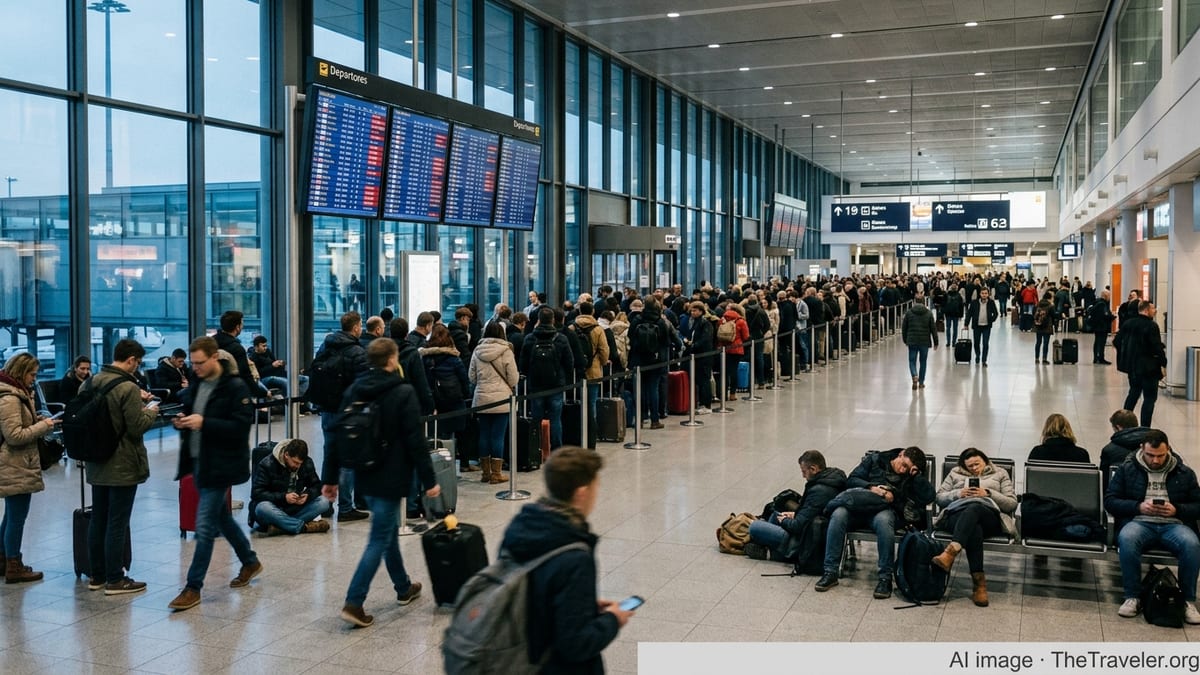
In Berlin and London, images shared by travellers show crowded departure halls with departure boards dominated by delayed and cancelled indicators. Publicly available airport information points to extended waiting times at check in, security and immigration, further straining capacity at peak travel periods.
Weather, Congested Skies and Operational Strain
Recent weeks have seen a series of strong winter storms sweep across northwestern Europe, bringing high winds, snow and heavy rain that continue to challenge air operations. Meteorological summaries for the 2025 to 2026 winter season highlight repeated episodes of severe weather over France, Germany, the Benelux countries and the British Isles, each time forcing airports to slow or suspend movements while conditions stabilise.
When runways require de icing, visibility drops, or crosswinds exceed safe operating thresholds, air traffic managers reduce the rate at which aircraft can land and take off. According to published aviation overviews, these capacity restrictions quickly generate backlogs, particularly at busy hubs where schedules already run close to their operational limits.
Industry reports note that airlines are still working within a tight margin for error after years of restructuring and cost cutting. Crews, aircraft and maintenance slots are planned with limited slack, so a period of poor weather or technical disruption can have knock on effects for days. Once rotations are disrupted, flights in completely different parts of the network can be delayed or cancelled while operators attempt to reset their schedules.
Analysts have also pointed to airspace congestion over parts of central and western Europe, where traffic levels are at or above pre pandemic volumes. When combined with weather related constraints, this congestion can lead to flow control measures that slow departures over wide areas, contributing to the kind of system wide disruption now being experienced.
Travellers Face Long Waits and Limited Options
For passengers caught up in the latest wave of disruption, the experience has often meant hours of uncertainty in crowded terminals. Accounts shared via consumer forums describe travellers in Berlin, London and other affected airports waiting in long lines for rebooking desks, or attempting to rearrange travel through airline apps that are struggling under heavy demand.
In some cases, travellers report being offered rebooked flights several days later, reflecting how few spare seats remain on already busy routes. Hotel rooms near major airports have also come under pressure, with same day rates rising as stranded passengers look for somewhere to stay while they await alternative flights.
Publicly available information on airport websites indicates that some facilities have set up extra rest areas and distributed basic amenities such as water and snack vouchers when delays extend late into the night. However, the scale of the disruption means that not all passengers are able to access dedicated rest spaces, and many have shared images of overnight crowds in departure lounges.
Travel advisers recommend that, when large scale disruption hits, passengers should proactively explore alternative routings, including connections through less congested airports, rail options within Europe, or departures from nearby regional airports. However, when cancellations are widespread, these options can quickly sell out, leaving many with little choice but to wait.
Passenger Rights Under EU and UK Rules
The disruption has again drawn attention to passenger protections under European and British regulations. Under the European Union’s air passenger rights framework, travellers departing from an EU or European Economic Area airport or flying into the region on an EU carrier may be entitled to assistance and, in some circumstances, financial compensation if flights are heavily delayed or cancelled.
Similarly, the United Kingdom maintains its own set of rules, often referred to as UK air passenger rights, which apply to flights departing from UK airports or operated by UK based carriers on many routes. Both regimes can require airlines to provide meals and refreshments after certain delay thresholds, as well as hotel accommodation and transport between the airport and accommodation if an overnight stay becomes necessary.
Eligibility for compensation depends on a range of factors, including the length of delay, flight distance and the cause of the disruption. In cases where severe weather or air traffic control restrictions are judged to be outside the airline’s control, cash compensation may not apply, although a duty of care typically still remains for affected passengers.
Consumer organisations advise travellers to keep boarding passes, booking confirmations and receipts for any extra expenses incurred during a disruption. These documents can support later claims directly with airlines or through national enforcement bodies and alternative dispute resolution schemes, particularly in more complex cases involving missed connections or multi airline itineraries.
What Travellers Can Expect in the Coming Days
Aviation outlooks for the next several days suggest that conditions may remain fragile across parts of Europe, even if immediate weather patterns improve. Once a large volume of flights has been delayed or cancelled in a short period, airlines often need several days to reposition aircraft and crews and to clear backlogs of rebooked passengers.
Industry observers note that European traffic has largely returned to or exceeded pre pandemic volumes on many routes, which leaves little unused capacity to absorb sudden spikes in displaced travellers. As a result, even minor operational issues can have outsized impacts until the system settles.
Travellers with trips planned through Berlin, London, Paris and other major European hubs are being encouraged, in publicly available travel advisories, to monitor their flight status closely before leaving for the airport, allow extra time for check in and security, and be prepared for potential schedule changes. Flexible tickets, travel insurance with disruption cover, and having a backup plan for accommodation can all help to reduce the impact if plans are thrown off course.
For now, the hundreds of travellers already stranded illustrate how quickly Europe’s crowded skies and busy hubs can become vulnerable to a combination of winter weather, capacity constraints and tight airline timetables, leaving many journeys on hold while the aviation system works to recover.