

More news on this day
Hundreds of airline passengers across Canada faced major travel disruptions today as severe late-winter weather and knock-on operational issues led to more than 60 flight cancellations and approximately 650 delays at key hubs including Vancouver, Toronto, Ottawa, Calgary and Edmonton, affecting services operated by Porter, Air Canada, Air Canada Rouge, American Airlines and several other carriers.
Get the latest news straight to your inbox!
Storm System And Operational Strains Snarl Canadian Air Travel
Publicly available flight-tracking data and airport status boards on March 17 indicate that a powerful mid-March storm system interacting with already stretched airline operations has created widespread disruption across Canada’s main aviation corridors. The weather disturbance, tied to a larger North American storm complex, has brought a mix of snow, freezing rain and strong winds to parts of British Columbia, Alberta and Ontario, complicating runway maintenance and aircraft de-icing efforts while slowing overall airport throughput.
In this environment, airlines have been trimming schedules and holding departures to maintain safety margins, contributing to a wave of cancellations concentrated in Canada’s largest hubs. While some flights are being proactively scrubbed to avoid aircraft and crew misalignment later in the day, others are departing hours behind schedule as airports work through backlogs. The pattern echoes other recent winter events, where a combination of fast-changing weather and high aircraft utilization has left little slack when conditions deteriorate.
According to public reporting on recent Canadian storm impacts, mid- and late-winter systems in 2026 have repeatedly translated into heavy operational pressures on carriers and airports, particularly in Toronto and Calgary, which serve as critical connecting points for both domestic and transborder traffic. Today’s disruptions appear to follow a similar trajectory, with weather-triggered slowdowns cascading through tightly interlinked schedules.
While not all affected flights are directly tied to the current storm bands, the overall effect is cumulative. Aircraft and crews delayed earlier in the week across North America have arrived late into Canadian hubs, leaving carriers with reduced flexibility as today’s weather and congestion intensified.
Major Hubs From Vancouver To Toronto Among The Hardest Hit
Vancouver International Airport is reporting elevated levels of delayed departures and arrivals, with a smaller but significant number of outright cancellations. Periods of low cloud, rain transitioning to wet snow at higher elevations, and intermittent gusty winds have required additional spacing between aircraft movements and lengthier de-icing cycles, complicating turnarounds for narrow-body and regional jets that typically operate on tight schedules.
In Alberta, Calgary and Edmonton are seeing a mix of cancellations and extended delays as the same weather system disrupts operations on the Prairies. Industry-focused weather and travel analysis released in recent days has highlighted Calgary as a recurring hotspot for winter-weather-induced cancellations in 2026, especially for flights linking the city with Vancouver and Toronto. Today, that pattern is visible again, with several westbound and eastbound runs withdrawn or heavily delayed as runway and taxiway conditions fluctuate.
Toronto’s Pearson International Airport, Canada’s busiest hub, is contending with the highest absolute volume of late-running flights. A combination of residual snow and slush from earlier systems, bursts of freezing precipitation, and intermittent wind shifts has slowed both arrivals and departures. Pearson’s central role in national connectivity means that even modest localized delays can ripple quickly to secondary cities such as Ottawa, where aircraft and crew availability are heavily dependent on on-time feeder and trunk services from Toronto and other major hubs.
Ottawa’s airport, while smaller, is also recording an outsized number of delays relative to normal midweek traffic patterns. Publicly accessible flight-status data show regional departures to Toronto, Montreal and western Canada pushed back repeatedly through the morning and early afternoon, as late-arriving inbound aircraft compress the operating window for subsequent departures.
Porter, Air Canada, American And Others Juggle Disrupted Schedules
Today’s disruptions are affecting a wide cross-section of carriers, with both Canadian airlines and foreign operators adjusting schedules. Porter Airlines, which has rapidly expanded in recent years from its Toronto and Ottawa bases, is experiencing notable delays on key routes that rely on tight turn times and coordinated connections to western Canada. Passengers on transcontinental services linking Ottawa and Toronto with Calgary, Edmonton and Vancouver are encountering rolling departure pushes as aircraft and crews arrive late from earlier segments.
Air Canada and its leisure subsidiary Air Canada Rouge are likewise contending with a wave of schedule changes. Recent public documentation on the airline’s operations in 2026 notes that winter-weather events, compounded by earlier network disruptions, have made same-day recovery more difficult when storms track across multiple hubs. Today’s combination of snow, freezing rain and gusty winds at several of the carrier’s core Canadian bases fits this pattern, leading to a clustering of cancellations and multi-hour delays across both domestic and transborder flights.
American Airlines and other United States carriers operating into Canadian cities are also facing knock-on impacts, particularly on cross-border services linking Toronto, Vancouver and Calgary with major U.S. hubs. When Canadian airports slow arrivals and departures due to runway and airspace constraints, downstream effects are often felt at connecting airports across the border, leading to further adjustments later in the day for passengers attempting to make international connections.
Across the network, many of today’s cancellations appear to be preemptive efforts by airlines to preserve overall stability, rather than isolated last-minute decisions. By thinning schedules and consolidating passengers onto fewer flights where possible, carriers aim to reduce the risk of aircraft and crew being stranded overnight at outstations if weather conditions worsen or if air traffic control imposes additional flow restrictions.
Passengers Face Long Lines, Rebookings And Compensation Questions
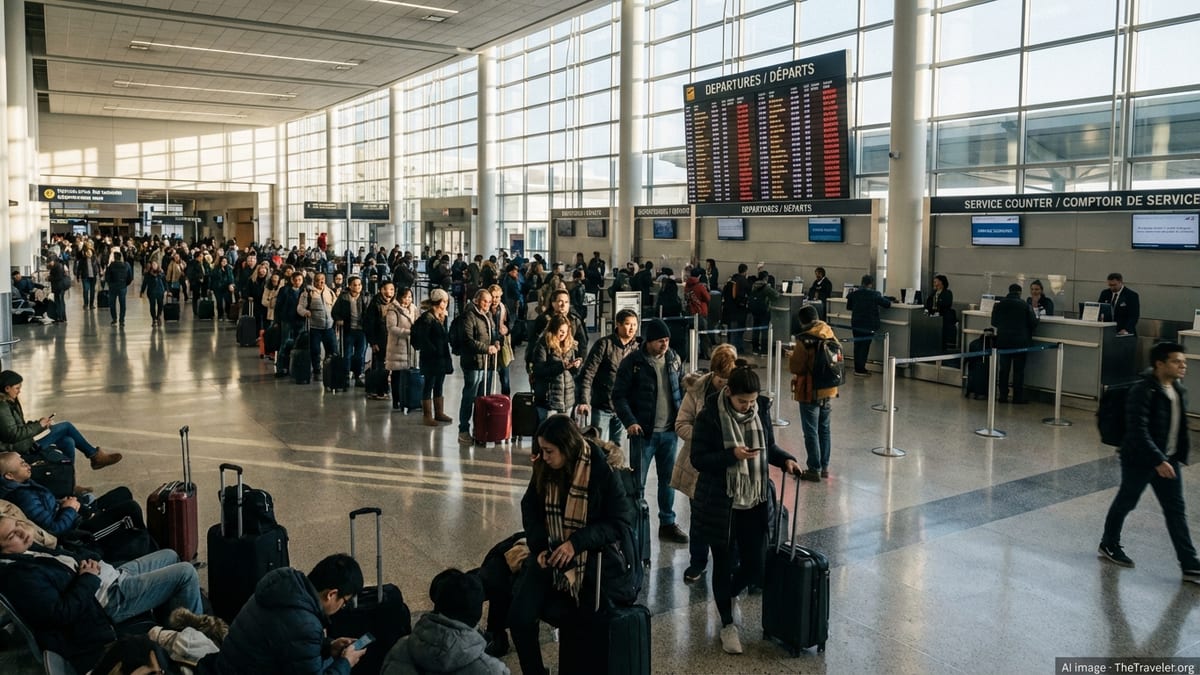
For travelers, the operational picture has translated into crowded terminals, lengthy customer service queues and rapidly shifting itineraries. Social media posts and passenger accounts shared publicly throughout the day describe long waits to speak with airline staff, as many try to secure alternate routings or accommodations when overnight stays appear likely. In some cases, passengers report spending several hours in line only to be rebooked on flights departing late tonight or even tomorrow.
Today’s events are unfolding against the backdrop of Canada’s Air Passenger Protection Regulations, which outline minimum standards for treatment and compensation depending on the cause of a delay or cancellation and the size of the operating carrier. Recent consumer-oriented guides and legal summaries published in 2026 emphasize that weather and air traffic control issues are typically categorized as outside the airline’s control, limiting cash compensation but still requiring assistance such as rebooking and, in some circumstances, meal vouchers and hotel arrangements.
However, determining whether a specific disruption is attributable solely to weather or to a mix of controllable factors such as crew or maintenance issues can be complex. Publicly available commentary from passenger rights advocates suggests that travelers are increasingly documenting events with photos of information screens and keeping records of airline communications to support potential claims. Today’s blend of storm-driven slowdowns and high network congestion is likely to prompt similar scrutiny once immediate travel needs are addressed.
Given the high number of affected flights, competition for limited seats on remaining services is intense. Some passengers are turning to alternative routings through secondary hubs or, in a few cases, switching to rail or intercity bus for shorter segments when feasible, particularly within Ontario and Quebec, to bypass the most heavily congested airports.
What Travelers Across Canada Can Expect Next
Meteorological outlooks and aviation-focused forecasts suggest that conditions associated with the current storm system could continue to affect parts of Canada into the late evening of March 17, with lingering operational impacts persisting into tomorrow as airlines work to reposition aircraft and crews. Even if weather improves quickly at individual airports, the accumulated delays mean that many evening flights will be operating out of sequence, increasing the risk of further knock-on disruptions.
Travel analysts observing this winter’s performance trends in Canada have noted that recovery from major weather events is increasingly taking longer than in previous years, in part because airlines are operating fuller schedules with fewer spare aircraft and more complex networks. Today’s wave of more than 60 cancellations and roughly 650 delays fits into a broader pattern in which even a single storm can reverberate across the system for several days before normal on-time performance is restored.
Passengers booked to travel later today or tomorrow through Vancouver, Toronto, Ottawa, Calgary, Edmonton and other affected airports are being urged by publicly available advisories and airline notices to monitor flight status frequently, check in as early as possible, and be prepared for gate or time changes on short notice. Flexible ticket policies and travel waivers introduced in response to recent winter storms in 2026 may offer options to move trips to later dates without additional fees, particularly where carriers anticipate ongoing operational strain.
For now, Canada’s key aviation gateways remain open but under stress, balancing safety protocols with the demand to move thousands of travelers whose plans have been upended by the latest bout of winter weather and its cascading effects on a tightly stretched airline system.