

More news on this day
Hundreds of U.S. travelers have been left stranded in Texas after significant disruption at Dallas Fort Worth International Airport, where operational data on Saturday indicated roughly 280 flight delays and around 30 cancellations affecting services by American Airlines, Delta Air Lines, PSA Airlines and several other carriers.
Get the latest news straight to your inbox!
Severe Operational Disruption Across Major Carriers
According to publicly available flight-tracking boards and airport status dashboards, Dallas Fort Worth International Airport has seen a fresh wave of disruption, with delays and cancellations rippling across both domestic and international networks. The latest figures indicate that close to 280 flights were operating behind schedule and approximately 30 had been canceled, affecting travelers throughout the United States who were relying on connections through the Texas hub.
American Airlines, which has a major hub operation at Dallas Fort Worth, appears to be the most heavily affected, with a large share of the delayed and canceled services tied to its schedule. Delta Air Lines, regional operator PSA Airlines, and several additional domestic and regional carriers also show notable disruptions on their timetables. The pattern reflects the vulnerability of a high-traffic hub, where relatively small bottlenecks can quickly cascade into large-scale schedule upheaval.
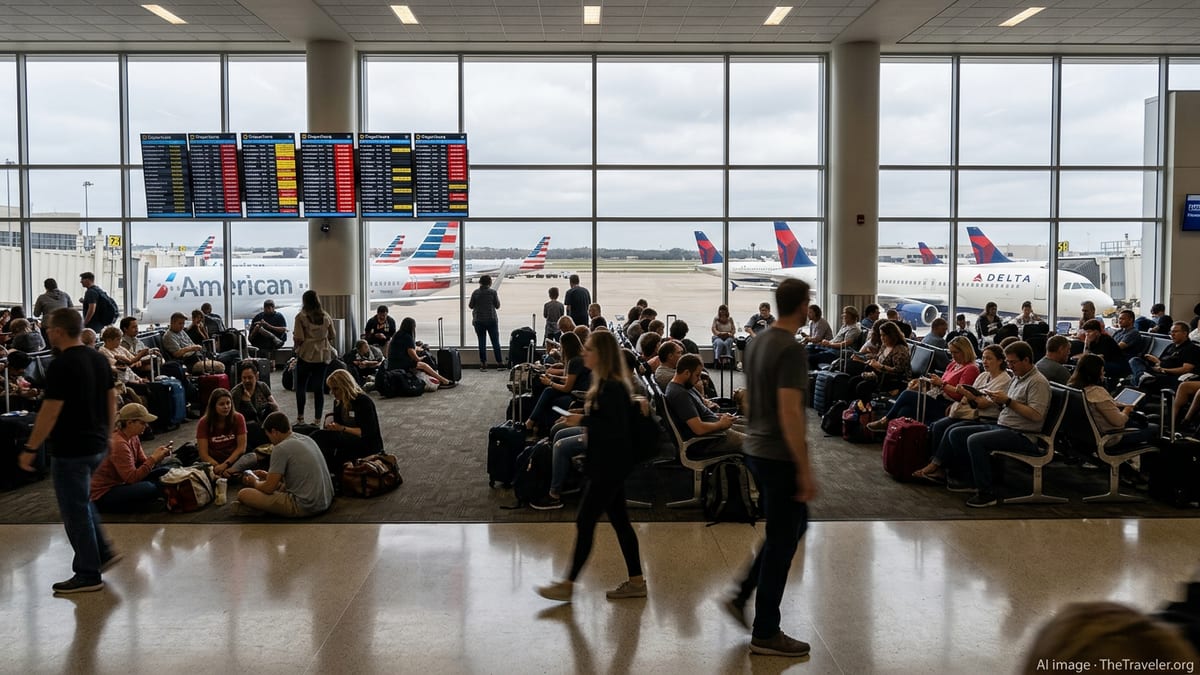
Reports from passengers and publicly shared airport imagery suggest crowded concourses, long lines at rebooking counters, and departure boards filled with rolling delay notifications. Travelers connecting through Dallas Fort Worth have reported missed onward flights, unexpected overnight stays, and difficulty securing new itineraries as available seats tighten across affected routes.
Weather, Congestion and Network Knock-On Effects
While the precise blend of causes varies from flight to flight, recent coverage of U.S. air travel indicates that adverse weather, air traffic control programs and ongoing operational constraints remain persistent contributors to disruption. Dallas Fort Worth has been subject at times to low clouds, storms and rapidly changing conditions in recent weeks, factors that frequently lead to inbound ground delays and reduced arrival rates, which then affect departure flows.
Industry data and prior incidents show that when a major hub experiences a slowdown, even for a few hours, aircraft and crews can become misaligned with their scheduled rotations. This leads to subsequent flights departing late or being canceled outright when legal crew duty limits are reached or aircraft are not in position. For multi-hub systems such as those operated by American and Delta, a disruption in Texas can therefore be felt as far away as the East Coast, Mountain West or transborder gateways.
Operational analyses published in recent months have also highlighted how tightly wound modern airline schedules can be, especially on high-demand days. Turn times, gate availability and crew swaps often leave little margin for recovery once delays set in. At Dallas Fort Worth, a combination of high traffic volume and complex connecting banks tends to magnify these challenges, leaving carriers with limited options to absorb extended disruptions without significant knock-on effects.
Stranded Travelers Face Rebooking and Accommodation Challenges
As delays lengthen and cancellations accumulate, stranded travelers report turning to a mix of airline apps, customer service centers and in-person airport desks to secure alternative options. In practice, same-day rebooking has become increasingly difficult when an entire bank of flights is affected, with remaining seats quickly claimed by those whose trips are most time-sensitive or who hold elite status and flexible fares.
Some passengers are reportedly being offered reroutes that involve multiple connections or travel into nearby airports with onward ground transport. Others are finding that the earliest available seats fall one or even two days later, particularly on popular business and leisure routes. For families and travelers on tight schedules, these options can mean lost vacation days, missed events and unexpected additional expenses.
Accommodation and meal costs present another challenge. While consumer protection rules in the United States require compensation in certain circumstances, the responsibility for covering hotels or food depends on whether disruptions are categorized as within an airline’s control or driven by factors such as extreme weather or air traffic control initiatives. Travelers stranded at Dallas Fort Worth are therefore navigating a patchwork of policies, with some securing hotel vouchers or meal credits and others paying out of pocket while they wait for updated itineraries.
Guidance for Affected and Upcoming Travelers
Travel industry advisories and consumer travel coverage stress that passengers with existing or imminent bookings through Dallas Fort Worth should monitor their flights closely and be prepared for last-minute schedule changes. Airline mobile apps, text alerts and real-time flight-tracking platforms remain among the fastest ways to see updated departure times, gate changes and potential cancellations as they are recorded in carrier systems.
Experts generally recommend that travelers avoid relying solely on airport departure boards, which can occasionally lag behind airline internal systems during periods of heavy disruption. Instead, checking directly with an airline’s digital channels and, if necessary, calling or messaging customer support can provide more detailed options, including alternative routings through other hubs.
Those yet to begin their journeys are being advised, in widely shared consumer guidance, to consider flexible arrangements such as packed essentials in carry-on bags, additional buffers for connections, and awareness of nearby airports that might offer more stable routings. In some instances, travelers have been able to rebook onto earlier or later flights, or even different carriers, to avoid the worst of the congestion at Dallas Fort Worth.
Broader Implications for U.S. Air Travel Reliability
The latest disruption at Dallas Fort Worth underscores the ongoing fragility of U.S. air travel operations in the face of busy schedules, evolving weather patterns and limited spare capacity in aircraft, crew and infrastructure. Even as airlines invest in technology to better anticipate delays and optimize their networks, significant turbulence persists for travelers when a major hub experiences a sudden spike in operational strain.
Consumer advocates and aviation analysts have repeatedly pointed to the need for greater transparency around delay causes, as well as clearer and more consistent passenger care standards across carriers. Events such as the current wave of delays and cancellations in Texas frequently reignite discussion about whether U.S. regulations provide sufficient guarantees for travelers when plans are severely disrupted.
For now, the situation at Dallas Fort Worth remains a reminder that even routine trips can be upended with little warning. As travelers affected by the 280 recorded delays and roughly 30 cancellations work their way through the rebooking process, the episode highlights how central hub airports in the United States continue to function as both essential connectors and potential single points of failure for nationwide air travel.