

More news on this day
Hundreds of travellers were left stranded across Europe this week after more than 1,300 flights were disrupted, with 1,073 services delayed and 263 cancelled across Germany, the UK, Spain, France and several other countries, snarling operations at major hubs including Frankfurt and Paris and hitting carriers such as Finnair, KLM and easyJet.
Get the latest news straight to your inbox!
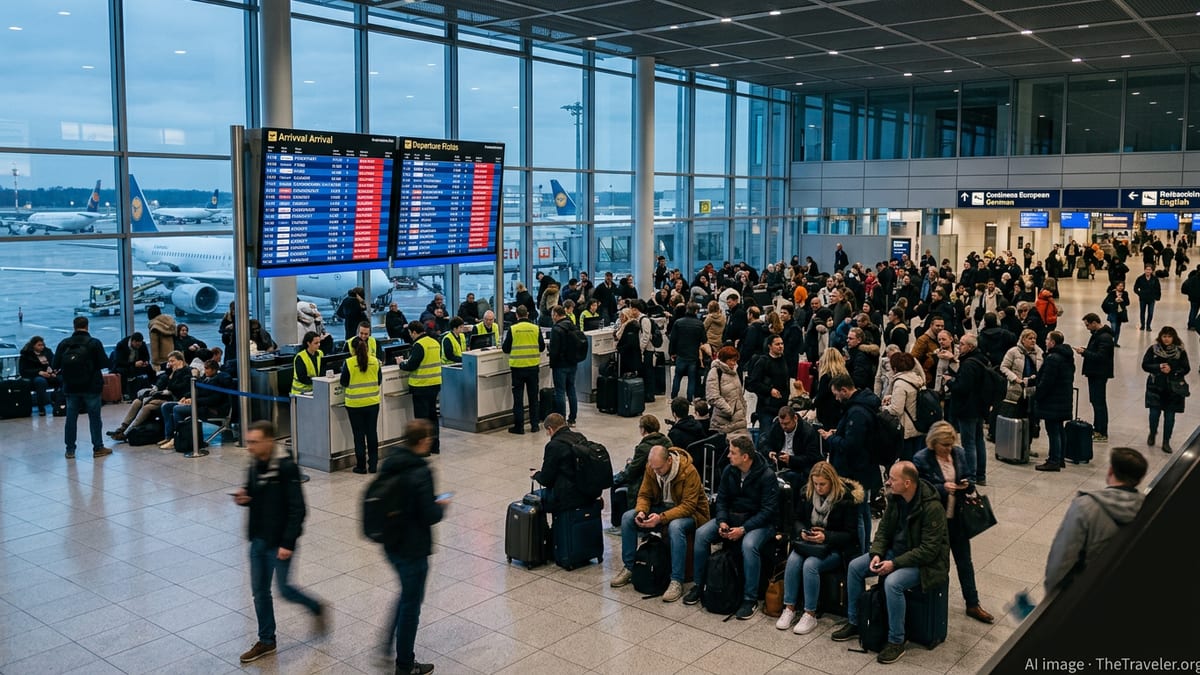
Major European Hubs Buckle Under Mounting Disruptions
The latest wave of disruption has rippled through some of Europe’s busiest airports, with Frankfurt and Paris Charles de Gaulle among the worst affected. Operational data from industry trackers show delay and cancellation rates spiking well above seasonal norms, particularly on intra-European routes that connect secondary cities through these major hubs.
At Frankfurt, one of the continent’s key transfer airports, airlines struggled to keep departure banks aligned as incoming services arrived late or were rerouted. Knock on effects quickly spread to connecting flights bound for the UK, Spain and the Nordic region, leaving passengers facing missed connections, ad hoc overnight stays and long queues at rebooking desks.
Paris Charles de Gaulle reported dozens of cancellations and close to a hundred delayed departures in a single day, with disruption concentrated on medium haul services to other European capitals as well as selected long haul routes. Similar patterns were seen at London Heathrow, Amsterdam Schiphol and Madrid Barajas, where aircraft and crew were frequently out of position, complicating already tight winter schedules.
While each airport cited a combination of local weather and wider air traffic control constraints, the cumulative impact was a day of rolling delays that left many travellers unsure if or when they would reach their destinations.
Finnair, KLM, easyJet and Others Forced to Trim Schedules
The disruption has had a particularly sharp impact on European network and low cost carriers that rely heavily on tight turnarounds and dense schedules. KLM and its partners saw cascading delays on routes feeding Amsterdam, Frankfurt and Paris, complicating efforts to protect long haul connections for passengers heading to North America, Asia and Africa.
Finnair services linking Helsinki with key Western European hubs, including Frankfurt and Paris, were among those affected by late inbound aircraft and slot restrictions. Even when flights operated, many departed outside their scheduled windows, forcing travellers to rebook onward journeys or accept lengthy layovers.
EasyJet, which operates extensive point to point networks between the UK, Germany, Spain and France, also faced a wave of delays and targeted cancellations. With aircraft cycling through multiple airports per day, a delay on a morning departure often reverberated through several subsequent sectors, leaving afternoon and evening services running significantly behind schedule or being scrapped altogether when crew duty limits were reached.
Other carriers, from flag airlines such as Lufthansa and Air France to leisure and regional operators, reported similar challenges as they attempted to balance on time performance with safety and regulatory requirements.
Germany, UK and Spain Among Hardest Hit Markets
Germany, the UK and Spain emerged as three of the most heavily affected markets in terms of both raw numbers of disrupted flights and the breadth of routes impacted. In Germany, Frankfurt and Munich experienced waves of delays as weather systems and airspace restrictions reduced capacity during busy bank periods, squeezing already congested departure and arrival flows.
Across the UK, hubs such as London Heathrow, Gatwick and Manchester saw cancellations and rolling delays on flights to and from continental Europe. Services to popular business and leisure destinations in France, the Netherlands, Italy and the Iberian Peninsula were repeatedly pushed back, with knock on disruption for domestic feeders and transatlantic connections.
Spain’s major airports, including Madrid and Barcelona, contended with their own backlog of late running arrivals from northern Europe. Aircraft arriving behind schedule forced airlines to reshuffle rotations, and some services to secondary Spanish cities were cancelled in order to protect higher demand international routes. The result was a patchwork of gaps in the timetable that left passengers scrambling for alternatives.
Secondary markets in Italy, Ireland, Scandinavia and Eastern Europe were not spared, as route networks are tightly interlinked and dependent on smooth operations at the big Western European hubs.
Passengers Face Long Queues, Rebookings and Limited Options
For travellers caught up in the disruption, the experience on the ground was one of uncertainty and frustration. At Frankfurt and Paris, long queues quickly formed at airline counters and customer service desks as passengers sought rebookings, hotel vouchers and meal allowances. Airport concourses and seating areas remained crowded well into the evening as rolling updates filtered through departure boards.
Digital tools such as airline apps and self service kiosks helped some passengers secure replacement flights or rerouted itineraries, but capacity was limited on many routes with school holidays and late winter city breaks keeping load factors high. Travellers reported accepting indirect routings that added several hours and extra stops to journeys that would normally be served by a single non stop flight.
Families and elderly passengers were particularly exposed, with some left waiting for clarification on accommodation or transfers when late night cancellations were announced. While many airlines provided refreshments and overnight hotels in line with European passenger rights regulations, availability varied by airport and carrier, and some travellers opted to arrange their own stays in nearby cities to avoid long waits in terminal buildings.
Social media was quickly filled with images of crowded departure halls, snaking customer service queues and departure boards dominated by delayed indicators, underscoring the scale of the disruption across the continent.
Airlines and Airports Urge Travellers to Check Status and Allow Extra Time
As operations gradually stabilise, airlines and airports are urging travellers to build additional buffer time into their journeys and to monitor flight status closely before heading to the airport. Carriers including Finnair, KLM and easyJet are emphasising the importance of providing up to date contact details so that passengers can receive real time notifications about schedule changes, gate moves and rebooking options.
Airports in Germany, France, the UK and Spain have advised passengers to arrive earlier than usual, particularly during morning and late afternoon peaks, to allow for potential bottlenecks at security and check in created by bunching of delayed flights. Some hubs are also temporarily relaxing cut off times for checked baggage on certain routes to accommodate late running connections.
Travel industry analysts note that winter and early spring remain vulnerable periods for Europe’s aviation network, as weather patterns, constrained airspace and dense timetables can combine to create systemic strain. They expect airlines to continue making tactical cancellations in the coming days to restore resilience, even if headline delay numbers begin to fall.
For now, passengers with imminent travel plans in and out of Frankfurt, Paris and other key European hubs are being advised to keep itineraries flexible, stay in close contact with their airline and prepare for the possibility of extended travel days as the network works through the backlog.