

More news on this day
Hundreds of passengers across the United Arab Emirates faced major disruption today as Dubai, Abu Dhabi and Sharjah airports reported dozens of cancellations and hundreds of delays, sharply reducing schedules for Emirates, Etihad Airways, Air Arabia, Gulf Air, EgyptAir and other carriers.
Get the latest news straight to your inbox!
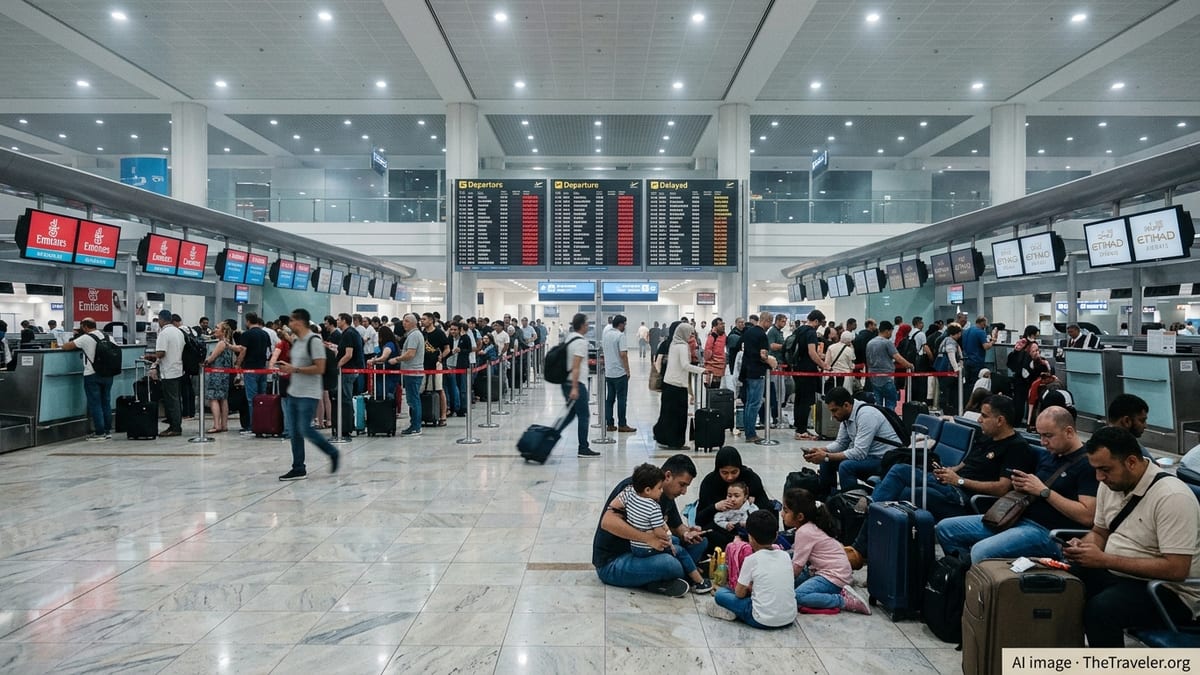
Severely Curtailed Schedules at Dubai, Abu Dhabi and Sharjah
Publicly available flight-tracking data and local media reports indicate that a combined 38 flights were cancelled and more than 300 services delayed across Dubai International, Abu Dhabi International and Sharjah International over the course of the day. The disruption affected both departures and arrivals, with peak-hour services among the hardest hit.
Dubai International, normally one of the world’s busiest hubs for international traffic, has been operating well below its usual capacity since regional airspace restrictions intensified in late February. Today’s wave of cancellations and rolling delays further compressed already limited seat availability, leaving transit passengers in particular with few immediate alternatives.
Abu Dhabi and Sharjah reported similar patterns of disruption, with a reduced number of movements and extended turnaround times as airlines attempted to work around restricted routings and tighter operating windows. Airport operations have focused on maintaining a limited but stable schedule, prioritising safety measures and operational constraints over network breadth.
Additional knock-on delays were reported at secondary airports around the Gulf as flights arriving from the UAE missed allocated slots or required last-minute re-routing. Industry trackers show a ripple effect across connecting hubs in Europe, South Asia and North Africa linked to curtailed UAE operations.
Emirates, Etihad and Air Arabia Adjust Operations
Flag carrier Emirates has continued operating a trimmed schedule from Dubai, having previously suspended or reduced many routes when regional airspace closures first came into force. According to published coverage and airline advisories, the carrier has been consolidating services on high-demand trunk routes while temporarily limiting frequencies on secondary destinations.
In Abu Dhabi, Etihad Airways has relied on what officials have previously described as “exceptional” operations, gradually rebuilding a reduced network after earlier suspensions of regular commercial services. Today’s delays and cancellations added fresh pressure to the carrier’s recovery timetable, with priority given to connecting stranded travellers and maintaining essential long-haul links.
Low-cost operator Air Arabia, based in Sharjah, also faced schedule changes as regional restrictions continued to affect short- and medium-haul flights. Public information shows that several departures were retimed or consolidated, a common tactic among carriers attempting to accommodate disrupted passengers on fewer overall rotations.
Aviation analysts note that while the number of cancelled flights appears modest relative to typical daily traffic, the impact is magnified because schedules were already sharply reduced. Every additional cancellation removes scarce capacity, making it more difficult for airlines to rebook passengers within a short timeframe.
Gulf Air, EgyptAir and Other Carriers Also Hit
The disruption was not limited to UAE-based airlines. Gulf Air, which uses Bahrain as its primary hub, has been heavily affected by regional airspace closures and operational restrictions in recent weeks. Today’s cancellations and delays involving Gulf Air services to and from the UAE added an extra layer of complexity for passengers attempting to connect via Bahrain to Europe and Asia.
EgyptAir has also adjusted its schedules in response to the broader Middle East security environment, previously suspending or rerouting certain regional routes. Flights touching the UAE have been subject to last-minute timing changes, extended flight times and occasional cancellations as the airline adapts to changing overflight permissions and congestion on available corridors.
Other international carriers serving Dubai, Abu Dhabi and Sharjah have continued to trim frequencies, upgauge aircraft on select rotations, or temporarily pause operations while conditions remain volatile. Travel advisory bulletins issued by major global corporations and travel management firms urge travellers to anticipate sudden changes and to build in greater flexibility around departure and arrival dates.
Industry observers say that the combined effect of reduced operations by both Gulf mega-carriers and foreign airlines has shifted some demand towards alternative gateways in the region, including airports in Saudi Arabia and Oman, which are being used as staging points for overland or multi-leg rerouting.
Passengers Face Long Waits, Limited Alternatives
For travellers on the ground, today’s operational data translated into long waits, overnight stays and uncertain onward journeys. Social media posts and traveller forums from Dubai, Abu Dhabi and Sharjah highlighted crowded customer service desks, limited same-day rebooking options and difficulties securing hotel rooms near the airports.
Publicly available guidance from several airlines continues to stress that passengers should not proceed to the airport without a confirmed booking and updated flight time. With capacity constrained, many carriers are prioritising customers whose earlier flights were cancelled, re-accommodating them on the next available services and offering flexible change or refund options where possible.
Travel specialists recommend that passengers monitor airline apps and official channels closely, avoid tight connections through the UAE for the time being, and consider alternative routings via less-affected hubs when feasible. Some travellers are reportedly opting for overland journeys to neighbouring countries with more stable flight operations, then connecting onward from there.
Families, in particular, have been advised to prepare for longer-than-usual airport stays, pack essential medications and supplies in carry-on luggage, and maintain contingency plans if flights are re-timed or held on the ground for extended periods.
Outlook for UAE Hubs in the Coming Days
Despite the day’s disruption, there are early signs that carriers are working toward a gradual stabilisation of schedules as regional conditions evolve. Network maps and timetable updates from major Gulf and international airlines suggest a cautious return of some services, subject to airspace availability and risk assessments.
Aviation analysts point out that large hub carriers such as Emirates and Etihad have significant flexibility in redeploying widebody aircraft and adjusting frequencies once operating conditions improve. However, they also warn that the backlog of disrupted passengers could take days to clear, even if more flights are restored quickly.
For now, the expectation among industry watchers is that UAE airports will continue to run reduced and changeable schedules, with further cancellations and delays likely as airlines respond to short-notice operational constraints. Travellers planning to pass through Dubai, Abu Dhabi or Sharjah in the coming days are being urged, in publicly available advisories, to maintain close contact with their airlines and to remain prepared for last-minute changes.
As one of the world’s most interconnected aviation markets, the UAE’s experience illustrates how quickly regional security and airspace issues can reverberate through global travel networks. Today’s 38 cancellations and more than 300 delays are the latest sign that recovery to normal operations across the country’s key hubs will be incremental rather than immediate.