

More news on this day
Hundreds of passengers were left stranded at Dubai International and Abu Dhabi’s Zayed International Airport as a new wave of disruption saw at least 113 flights delayed and 32 cancelled, rippling across regional and international carriers from FlyDubai and Gulf Air to EgyptAir, SunExpress and several other airlines.
Get the latest news straight to your inbox!
Delays and Cancellations Hit Key Gulf Transit Hubs
According to airport status dashboards and regional aviation coverage, operations at Dubai and Abu Dhabi remained heavily constrained following recent airspace instability linked to wider regional tensions. While both airports have technically reopened to commercial traffic, the combined impact of rolling schedule changes, equipment repositioning and airspace rerouting has created severe knock-on delays.
Operational data for the latest disruption window indicates that at least 113 flights were delayed and 32 cancelled across the two UAE hubs, affecting a mix of outbound, inbound and transit services. These figures include narrow-body and wide-body operations on busy regional corridors as well as long-haul services linking the Gulf with Europe, Asia and Africa.
Publicly available information shows that the cancellations were concentrated in peak connection banks, when hubs like Dubai and Abu Dhabi typically manage high volumes of transfer traffic. As aircraft arrived late or were unable to depart on schedule, turnaround times stretched and subsequent rotations were pushed back, amplifying disruption across multiple carriers.
Industry analysts note that even when full airspace closures are lifted, it can take days for complex hub schedules to normalize. Aircraft and crew may be out of position, slots at destination airports may no longer align, and airlines must reconfigure flight plans around ongoing security-related airspace constraints.
FlyDubai, Gulf Air, EgyptAir and SunExpress Among Worst Affected
While UAE-based Emirates and Etihad have dominated headlines in recent weeks, the latest bout of disruption has also weighed heavily on a wider group of regional and international carriers that rely on Dubai and Abu Dhabi for connectivity. Schedules and tracking data reviewed by travel media show FlyDubai, Gulf Air, EgyptAir and SunExpress among the airlines with notable delays and cancellations through the affected period.
FlyDubai, the Dubai-based low-cost carrier that feeds short and medium-haul traffic into the emirate, has seen multiple rotations retimed or cancelled as aircraft and crew cycles were disrupted. For point-to-point passengers, this has meant longer waits in departure halls; for transit travellers, misaligned connections have led to unscheduled stopovers and rebookings onto later flights.
Gulf Air, EgyptAir and SunExpress, which operate into UAE hubs from Bahrain, Egypt and Turkey respectively, have also been caught in the turbulence. Public timetable changes and airport departure boards highlight instances where inbound services operated with significant delay, only for onward or return sectors to be scrubbed entirely when available time and crew duty limits no longer aligned with updated airspace conditions.
Additional carriers serving the UAE, from low-cost operators in South Asia to European and Middle Eastern full-service airlines, have reported similar challenges. Many have issued rolling travel advisories urging passengers not to proceed to the airport without confirmed departure times and updated contact details in booking profiles.
Terminal Crowding, Overnight Stays and Passenger Backlogs
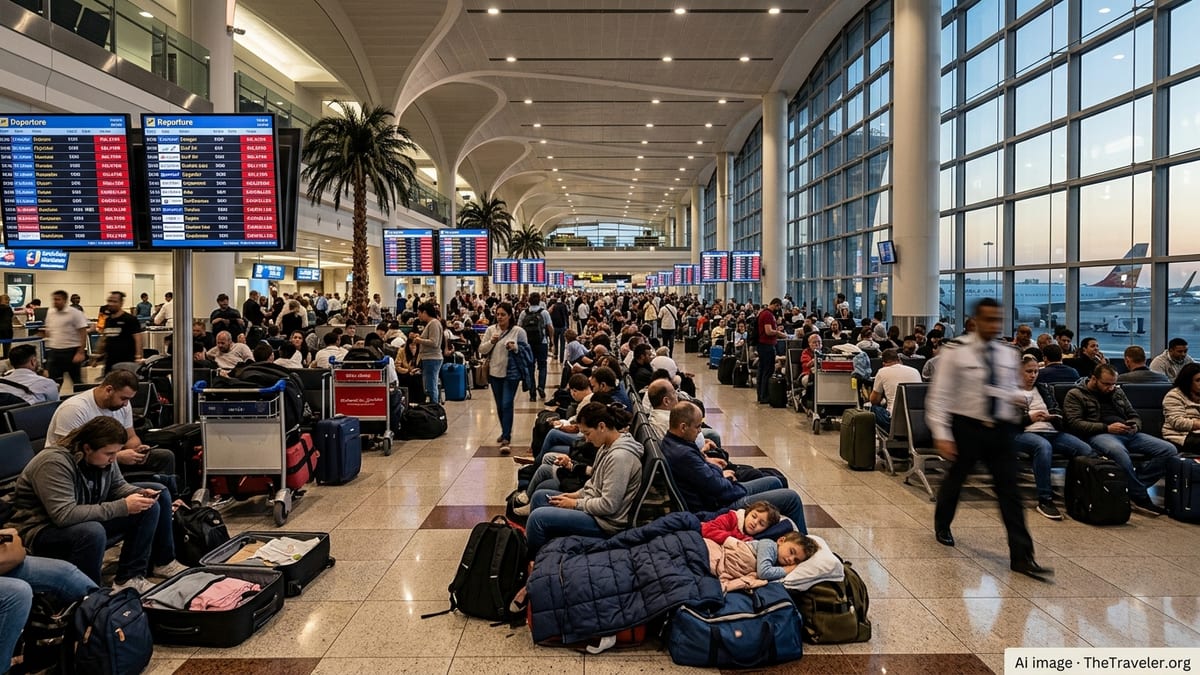
The cumulative effect of repeated cancellations and long rolling delays has been visible inside the terminals at both Dubai International and Zayed International. Reports from travellers and images shared on social platforms depict crowded gate areas, long queues at transfer desks and makeshift sleeping arrangements as passengers wait for rebooking options.
Transit passengers, in particular, have found themselves stranded after arriving in the UAE to discover that onward connections were delayed beyond crew duty limits or cancelled outright. In some cases, travellers have been issued hotel vouchers or meal coupons by operating carriers, while others have remained airside, sleeping on benches or floors as they wait for confirmation of new itineraries.
Families with young children and older travellers appear to have been among the most vulnerable, especially when delays extended into overnight or multi-day waits. For some, visas and entry conditions limited the possibility of leaving the airport to arrange their own accommodation, increasing dependence on airline-led disruption handling.
Travel forums show that a number of passengers have chosen to bypass the UAE hubs altogether, purchasing new tickets on alternative routings via airports such as Muscat, Doha or Riyadh. Others have attempted overland journeys to open airports in neighboring countries when rebooked flights were not available within a reasonable timeframe.
Airspace Constraints and Security Concerns Complicate Recovery
Behind the immediate operational headaches at Dubai and Abu Dhabi lies a broader pattern of regional airspace disruption tied to ongoing conflict dynamics. Publicly available aviation and geopolitical reporting indicates that the UAE has experienced repeated interruptions to normal air traffic flows following missile and drone attacks in recent weeks, including incidents that temporarily halted operations at major airports.
Each closure or restriction forces airlines and air navigation providers to rapidly redesign flight paths, sometimes diverting aircraft to alternate airports at short notice. Even when damage on the ground is limited, the need to ensure safe routing and to inspect infrastructure can keep key runways or taxiways out of regular service, constraining capacity.
The latest tally of 113 delayed and 32 cancelled flights reflects not only individual operational decisions but also the accumulated strain of days of disruption. Aircraft that were diverted or held on the ground elsewhere must be ferried back into the schedule, while crews require mandatory rest before resuming duty. These layers of complexity slow the restoration of normal service even once domestic airspace is nominally open.
Aviation observers point out that hubs such as Dubai and Abu Dhabi, which handle heavy volumes of connecting traffic, are particularly sensitive to regional security events. When a single node in the global network is affected, ripple effects can be felt across multiple continents, as delayed departures from the Gulf cause missed connections in Europe, Asia and Africa.
What Travellers Through Dubai and Abu Dhabi Should Expect Next
For travellers planning to pass through the UAE in the coming days, the latest disruptions underscore the importance of flexibility and real-time information. Airline advisories reviewed by travel media stress that passengers should monitor booking status closely and avoid heading to the airport until their flight shows as confirmed and on time in official channels.
Where possible, passengers are encouraged to ensure that contact details in their reservations are up to date so airlines can send rebooking offers or new boarding times by email or text message. Self-service tools on mobile apps and websites are being used widely to shift affected passengers onto later flights, though high call volumes and limited capacity mean that some travellers will still experience extended waits.
Travel experts suggest allowing generous connection times for itineraries involving the UAE hubs, or considering routings via alternate regional gateways while schedules remain volatile. Those already in transit are advised to keep essential items such as medications, chargers and a change of clothes in their cabin bags, in case an unplanned overnight stay becomes necessary.
Although recent updates from regional aviation authorities and airport operators indicate a gradual move toward more stable operations, the latest figures on delays and cancellations at Dubai and Abu Dhabi show that the system is still under significant strain. Passengers connecting through these key Gulf hubs should expect continued schedule adjustments and prepare for a longer-than-usual journey.