

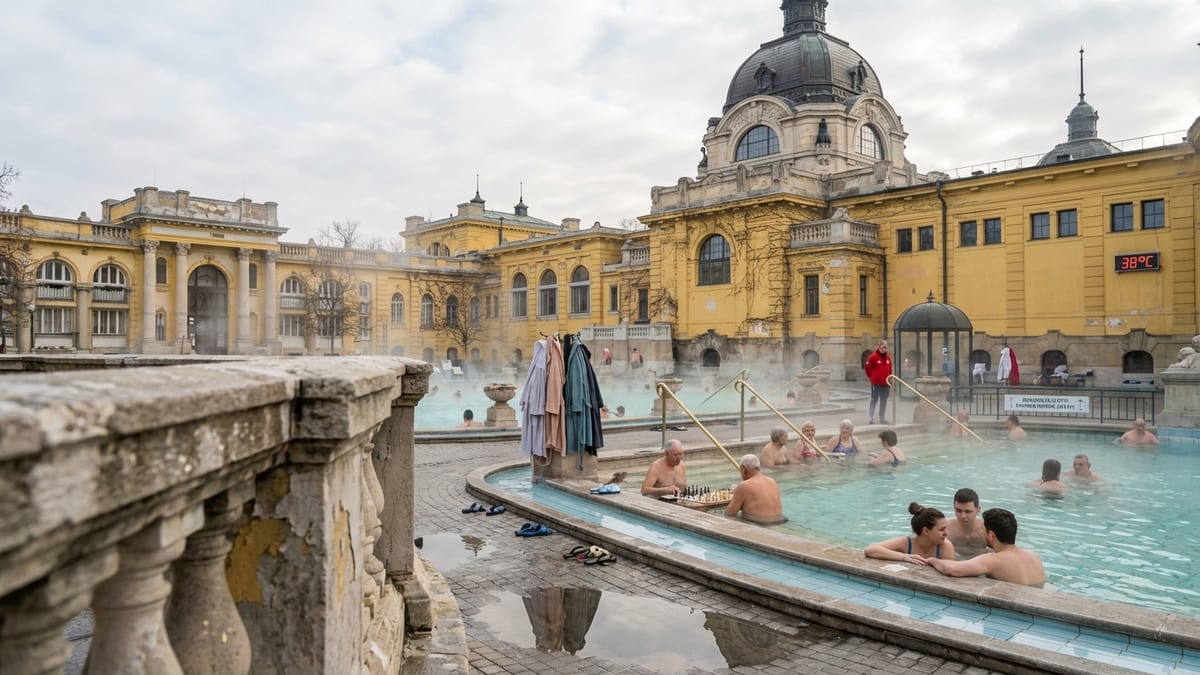
Across Hungary, elaborate palaces of stone and steam sit above a hidden world of hot, mineral rich water. From shadowy Ottoman domes to bright neo baroque courtyards and sleek wellness resorts, Hungarian baths are far more than pretty pools.
They are social clubs, medical institutions, architectural monuments and deeply rooted rituals. Understanding the differences between thermal, medical, Ottoman and modern spas will help you choose the right experience, whether you are chasing healing, history or simply a long, luxurious soak.
How Hungary Became a Land of Baths
Hungary sits on a geological fault line where the Earth’s crust is unusually thin, allowing geothermal heat to rise close to the surface. More than a thousand thermal springs bubble up across the country, and over a hundred are concentrated in and around Budapest. Warm water rich in minerals like calcium, magnesium, bicarbonate and sulfates has been used for bathing here since the Romans, who built sophisticated bath complexes in what is now Óbuda, and likely even earlier by Celtic tribes who named the area for its abundant waters.
Ottoman rule in the 16th and 17th centuries brought a new bathing culture, with cupola topped hammam style baths that are still standing today. Under the Austro Hungarian Empire in the 19th and early 20th centuries, advances in drilling technology and balneology turned hot springs into grand spa institutions. Budapest embraced its natural wealth so enthusiastically that it came to market itself as a spa capital, while provincial towns from Hévíz to Miskolctapolca built their identities around bathing and wellness.
Modern Hungarians use baths both casually and clinically. For locals, a midweek soak, a course of doctor prescribed treatments for chronic pain, or a multigenerational Sunday outing are all normal. For visitors, the same facilities become destinations, combining sightseeing with wellness. This dual role explains much of the complexity travelers encounter when navigating Hungarian baths. A single complex may be at once a heritage site, a medical institution and a contemporary wellness center.
To make sense of it all, it helps to separate baths by their primary purpose and historical layer. Thermal baths, medical spas, Ottoman era hammams and modern resorts share the same geological source, but each offers a distinct kind of experience, set of rules and atmosphere.
Thermal Baths: Soaking in Mineral Rich Waters
In Hungarian usage, a “thermal bath” simply refers to a facility that draws naturally heated water from underground springs and offers it for recreational or wellness oriented bathing. Almost every major city, and many towns, have at least one. Some are plain concrete pools under a 1970s dome. Others are ornate architectural landmarks where steam swirls under chandeliers and frescoes. What unites them is the feeling of sinking into warm, mineral rich water that seeps gradually into your muscles and mind.
Budapest’s Széchenyi Baths are the best known example. Fed by deep drilled springs discovered in the early 20th century, Széchenyi is one of Europe’s largest spa complexes, with dozens of pools at different temperatures, indoor and outdoor. Its yellow neo baroque facade and steaming outdoor basins in City Park have become an emblem of Hungarian thermal culture. Locals play chess on floating boards while tourists photograph the plumes of steam rising into winter air, but beneath the spectacle is a serious tradition of hydrotherapy.
Typical thermal baths offer a mix of soaking pools that range from roughly 28 to 40 degrees Celsius, along with saunas, steam rooms and cold plunge pools. The mineral composition varies by spring but often includes calcium, magnesium, bicarbonate and sometimes trace elements like fluoride. Hungarians believe these waters can ease joint pain, improve circulation, support recovery after injuries and calm the nervous system. Many visitors notice effects even after a short session: looser muscles, deeper sleep, and a pleasantly heavy relaxation that lingers for hours.
Etiquette in thermal baths is straightforward but important. You shower before entering the pools, move gradually from warm to hotter water, and keep loud conversation to a minimum in the quieter therapy areas. Swimwear is the norm in mixed sections, and flip flops are strongly recommended on wet surfaces. Most baths rent towels and swimsuits, but frequent users bring their own and often a bathrobe. More recently, operators have introduced clearer zoning between recreational and medicinal pools, with rules designed to protect water quality and ensure safe use of the hotter, more mineralized basins.
Medical Spas: Where Wellness Meets Medicine
Hungary’s medical spas occupy a unique space between wellness center and clinic. Officially certified by national health authorities, these facilities use mineral rich waters, therapeutic muds and related treatments as part of evidence based programs for chronic conditions. Patients may be referred by doctors, and in many cases Hungarian citizens receive treatments reimbursed or partially covered by the public health insurance system. International visitors usually pay out of pocket but can access the same services.
A medical spa often grows out of an existing thermal bath or lake. Hévíz, home to Europe’s largest biologically active thermal lake, is a classic example. Here, patients and wellness seekers alike float among lily pads in naturally warm, slightly radioactive water whose composition is famous for helping musculoskeletal and rheumatic conditions. Around the lake, sanatorium style hotels and clinics provide multi week programs including supervised bathing, underwater traction therapy, physiotherapy, massage and sometimes drinking cures using the same mineral water.
Treatments are highly structured. A course might combine daily soaks in pools with specific mineral concentrations, sessions in weight bath devices that gently stretch the spine using harnesses, and mud packs applied to affected joints. Doctors trained in balneology assess each patient, taking into account cardiovascular health, joint status and other conditions before prescribing how long to stay in each pool and how many days to continue. For many Hungarians with arthritis, post operative recovery needs or chronic back pain, an annual course at a spa is as routine as a checkup.
For travelers, the medical spa layer offers both benefits and constraints. On the positive side, the same rigorous water analysis and safety standards that underpin clinical use ensure that recreational bathers are soaking in clean, well monitored pools. On the other hand, access rules can be stricter. Certain heavily mineralized or very hot pools may be reserved for patients or limited to adults. New regulations introduced in recent years restrict children’s use of medicinal thermal pools, especially those above 36 degrees Celsius, because of concerns about cardiovascular strain and endocrine development.
Ottoman & Historic Baths: Under the Domes
Step into one of Budapest’s surviving Ottoman era baths and you are entering a space designed four and a half centuries ago. Low stone doorways open into rooms centered on octagonal pools, lit by pinpricks of daylight that filter through star shaped openings in a domed roof. Steam clings to thick stone walls, and the acoustics turn every movement into a soft echo. These hammam style baths, built during the 16th century by Ottoman governors, are among the most atmospheric places to experience Hungarian thermal culture.
Rudas Baths on the Buda side of the Danube is perhaps the most iconic of these. Its central pool, directly under a large dome supported by eight pillars, still follows the classic Ottoman layout, with smaller side pools at different temperatures and adjacent steam chambers. The thermal water, slightly radioactive and rich in minerals, has long been promoted for degenerative joint diseases and spine problems. In recent decades, a contemporary wellness wing with panoramic rooftop pool overlooking the river has been added, creating a striking contrast between medieval and modern bathing.
Király Baths, a more modest complex fed by springs near Lukács and Császár Baths, preserves another Ottoman era dome and octagonal pool. The building dates back to the late 16th century, when the occupying Turkish authorities built a bath within the city walls so they could enjoy hot water even if the outer defenses were under siege. Although Király has been closed in recent years for extensive renovation, it remains a symbol of Budapest’s layered bathing history. Nearby, the Rác thermal complex, with a 16th century cupola integrated into later imperial era architecture, has also undergone a long and complicated restoration, with reopening plans closely watched by spa lovers.
Ottoman baths have a distinctive rhythm. Traditionally they offered gender segregated days or sections, and a ritual of heating, washing, steaming and resting. While modern operations have adapted schedules, often moving toward mixed bathing and integrating wellness facilities, the core spaces retain their original purpose. Stone benches surround the pools, where locals sit and chat quietly or lean back against warm walls. Visitors should be prepared for lower light levels, higher humidity and an intimacy that feels very different from the bright, open courtyards of later baths.
Modern Spa & Wellness Resorts
Beyond historic bathhouses, Hungary has embraced a contemporary wellness model that blends traditional thermal cures with spa culture borrowed from Alpine and Nordic countries. Newer complexes in towns like Egerszalók, Sárvár, Zalakaros and Makó combine family friendly water parks with adults only wellness zones, offering something closer to a Central European resort than an urban public bath.
At Egerszalók, gleaming white travertine terraces formed by mineral deposits cascade down a hillside where the hot spring emerges. Hotels and a bath complex at its base offer indoor and outdoor pools with views of the “salt hill,” plus saunas, relaxation rooms and treatment suites. Similarly, many regional spas pair thermal basins with slides, lazy rivers and children’s pools, turning what was once a strictly therapeutic environment into an all day recreational destination.
Architecturally, modern Hungarian spas experiment far beyond the classic neo baroque shell. The Hagymatikum complex in Makó, designed by celebrated architect Imre Makovecz, uses organic shapes, timber structures and onion like domes to create a whimsical interior where pools feel like secluded grottos. Other new builds focus on glass and light, opening onto forests or vineyards and marketing themselves as nature retreats, where silence, yoga classes and fine dining are as important as the water itself.
For travelers, these contemporary resorts offer flexibility. Day visitors can enjoy a few hours of soaking and sauna hopping, while overnight guests book wellness packages that combine accommodation, meals and a menu of treatments. Prices vary widely, but even the most upscale thermal resorts in Hungary often feel more affordable than comparable properties in Western Europe. The trade off is that English information may be patchier in smaller towns, and the atmosphere can be livelier and more family oriented during holidays and school breaks.
What To Expect: Practicalities, Rules & Etiquette
Hungarian baths can feel unfamiliar at first, but a few practical pointers make the experience smoother. Most large baths operate a ticketing system that includes locker or cabin rental. You receive a waterproof wristband that opens your assigned locker or private changing cabin. In older complexes, sexes may have separate changing areas even when pools are mixed, so follow the signs carefully. Always shower before entering any pool, and use the foot wash stations where provided.
Swim caps are often required in lanes swimming pools but not usually in leisure or thermal basins. Many Hungarians bring their own flip flops, towel, small bottle of drinking water and sometimes a bathrobe for moving between indoor and outdoor areas, especially in winter. Renting towels and robes is usually possible, though deposits and queues can be involved on busy days. If you plan to use saunas, a towel to sit on is recommended for hygiene and comfort, and some facilities have designated quiet saunas where conversation is discouraged.
Health regulations have become more prominent in recent years. Children’s use of hot medicinal pools is increasingly restricted, particularly under the age of 14, reflecting updated national rules about exposure to high temperatures and mineral concentrations. In practice, this means that in some iconic baths children may be welcome only in cooler leisure pools or certain sections, while hotter indoor thermal basins are reserved for adults or for those with medical prescriptions. If you are traveling with a family, it is worth checking in advance which baths have dedicated children’s areas and water slides, and which function more as serious therapeutic centers.
Finally, respect the pace of local bath culture. Regular users often spend several hours moving between pools, resting on loungers and hydrating at on site cafes. Rushing from one attraction to another defeats the purpose. Instead, think of your visit as a slow ritual: warm up in a mid temperature basin, then alternate between hotter pools, cooler plunges and short rests. Listen to your body, especially if you have cardiovascular issues, and limit time in very hot water or saunas. Hungarian baths reward patience, and the deepest pleasures emerge only when you allow yourself to truly linger.
Beyond Budapest: Regional Bath Experiences
Budapest’s baths draw most of the international attention, but some of Hungary’s most memorable soaking experiences lie outside the capital. Lake Hévíz in western Hungary, covered in part by water lilies and steaming even on cold days, offers the rare chance to float in a natural thermal lake. Wooden walkways and pavilions grant access, and the slightly sulfurous scent and silky feel of the water underscore its volcanic origin. Many visitors combine a lake session with time in nearby wine regions, blending wellness with gastronomy.
In the northeast, the Cave Bath of Miskolctapolca makes use of a natural cave system where warm water flows through vaulted chambers. Bathers move between semi dark caverns where acoustics amplify the sounds of waterfalls and quiet conversation. The water here has a lower salt concentration than many Hungarian springs, which allows for longer soaks without the same drying effect on skin. Although the attraction temporarily closed after a fire in 2024, plans for reopening underscore the importance of such unique sites to regional tourism.
Smaller Ottoman era remnants can be found in provincial towns like Eger, where the Török Fürdő keeps alive another chapter of the hammam tradition. Modern wellness resorts dot the Great Plain and the country’s southern borderlands, often tied to local features like saline soils, alkaline lakes or artesian wells discovered during oil and gas exploration. Across these locations, Hungarian spa culture adapts to different landscapes while maintaining its core: a belief that hot, mineral rich water is a public good to be shared.
Visiting a regional spa also offers a cultural experience. Away from the capital’s tourist crowds, you are more likely to share pools with retirees following daily routines, local families on weekend outings and patients on multi week treatment stays. Announcements may be only in Hungarian, and schedules can feel more influenced by community life than by tourism patterns. With a bit of flexibility and curiosity, this can be one of the most authentic ways to encounter everyday Hungary.
The Takeaway
Hungarian baths are not a single attraction but a layered world. Thermal baths provide accessible pleasure in warm, mineral water that eases the body and quiets the mind. Medical spas elevate those same waters into structured therapies, blending folk knowledge with formal medicine. Ottoman era hammams immerse you in the intimate geometry of domes and stone, while modern resorts reinterpret bathing as holistic wellness, with design and hospitality to match.
Understanding the distinctions between thermal, medical, Ottoman and modern spas helps you match your expectations to the place you visit. Some baths are best approached as quiet sanctuaries for rest and rehabilitation. Others are social stages where friends gather, where parties are held among columns and steam, or where families spend entire weekends sliding between pools. All of them, however, are anchored in a common resource and a shared conviction that water can be both healing and communal.
If you approach Hungarian baths with respect for their rules, an openness to unhurried time and a willingness to let the water dictate the pace of your day, you will find that a single afternoon can reveal as much about Hungary as any museum or monument. Under the domes and in the courtyards, history, health and simple human pleasure converge. It is there, half submerged and enveloped in warmth, that the country’s bathing culture truly makes sense.
FAQ
Q1. What is the difference between a thermal bath and a medical spa in Hungary?
Thermal baths focus on recreational soaking in naturally heated mineral water, sometimes with added wellness features like saunas and massages. Medical spas hold official certification to provide doctor supervised treatments for specific health conditions, using the same waters in structured programs that can include traction therapy, mud packs and physiotherapy, often prescribed and monitored by physicians.
Q2. Are Hungarian thermal waters really good for your health?
The mineral content and warmth of Hungarian thermal waters are widely considered beneficial for certain conditions, particularly joint and spine problems, some rheumatic diseases and recovery after injuries. Warm hydrotherapy can ease muscle tension, support circulation and promote relaxation. However, effects vary by individual, and people with heart disease, uncontrolled high blood pressure or acute illnesses should seek medical advice before using hot pools or saunas.
Q3. Can children visit Hungarian baths?
Children are welcome in many Hungarian baths, especially those with leisure pools and water park style areas, but access to hot medicinal pools is increasingly restricted. Recent regulations limit or forbid use of the hottest, most mineralized pools for visitors under 14, due to concerns about cardiovascular strain and developmental effects. Families should check each bath’s current policy and focus on complexes with dedicated children’s sections and cooler water zones.
Q4. Do I need to book in advance to visit popular baths like Széchenyi or Gellért?
Advance booking is not always mandatory, but it is strongly recommended during peak travel seasons, weekends and holidays, when popular baths can reach capacity. Buying timed entry tickets or passes ahead of time helps you avoid long queues and ensures access. For treatments such as massages, private baths or medical consultations, reservations are almost always required.
Q5. What should I bring with me to a Hungarian bath?
Plan to bring a swimsuit, flip flops or pool shoes, a towel and, if you plan to stay for several hours, a light robe. Many locals also bring a water bottle, a small bag for personal items and a spare towel for sauna use. Most baths rent towels and sometimes swimsuits for an additional fee, but quality and availability can vary, so bringing your own gear is usually more comfortable and economical.
Q6. How long should I stay in the thermal pools?
For healthy adults, a common guideline is to spend about 10 to 20 minutes at a time in very hot pools, interspersed with cooler showers, rest periods or dips in lower temperature basins. Total visit times of two to three hours are typical. If you begin to feel light headed, overly drowsy or uncomfortable, leave the hot water, cool down gradually and hydrate. People with known health issues should be more conservative and follow medical advice.
Q7. Are the baths mixed gender or segregated?
Most large Hungarian baths now operate primarily as mixed gender facilities in their main pool areas, with everyone wearing swimsuits. Some Ottoman era sections, particularly steam rooms or older pools, may still have men only or women only days or hours. Sauna zones sometimes include nude or towel only areas, typically signposted. Checking current schedules before visiting will clarify the specific arrangements at each bath.
Q8. Are Hungarian baths open year round?
The majority of major baths and spa complexes operate throughout the year, including outdoor thermal pools that are especially atmospheric in winter when steam rises into the cold air. Occasional closures occur for maintenance, renovation or unforeseen events such as technical problems, and smaller regional facilities may have seasonal schedules. It is wise to confirm opening hours and any planned renovations before planning a trip around a specific bath.
Q9. Can foreigners access medical treatments at Hungarian spas?
Yes, international visitors can usually book medical spa services such as balneotherapy sessions, doctor consultations and treatment packages, although they will pay privately rather than through the national health fund. Some larger medical spas employ staff who speak major foreign languages and may offer tailored programs for international guests. Bringing relevant medical records or summaries can help local doctors design appropriate treatment plans.
Q10. How do Hungarian baths compare in price to other European spas?
In general, Hungarian baths offer good value compared with spa facilities in many Western European countries. Public bath entry fees in Budapest are higher than in smaller towns but still moderate by international standards, especially given the architectural setting and range of pools. Treatments and full wellness packages at medical or resort style spas can add up but often remain competitively priced, making Hungary an attractive destination for spa focused travel.