

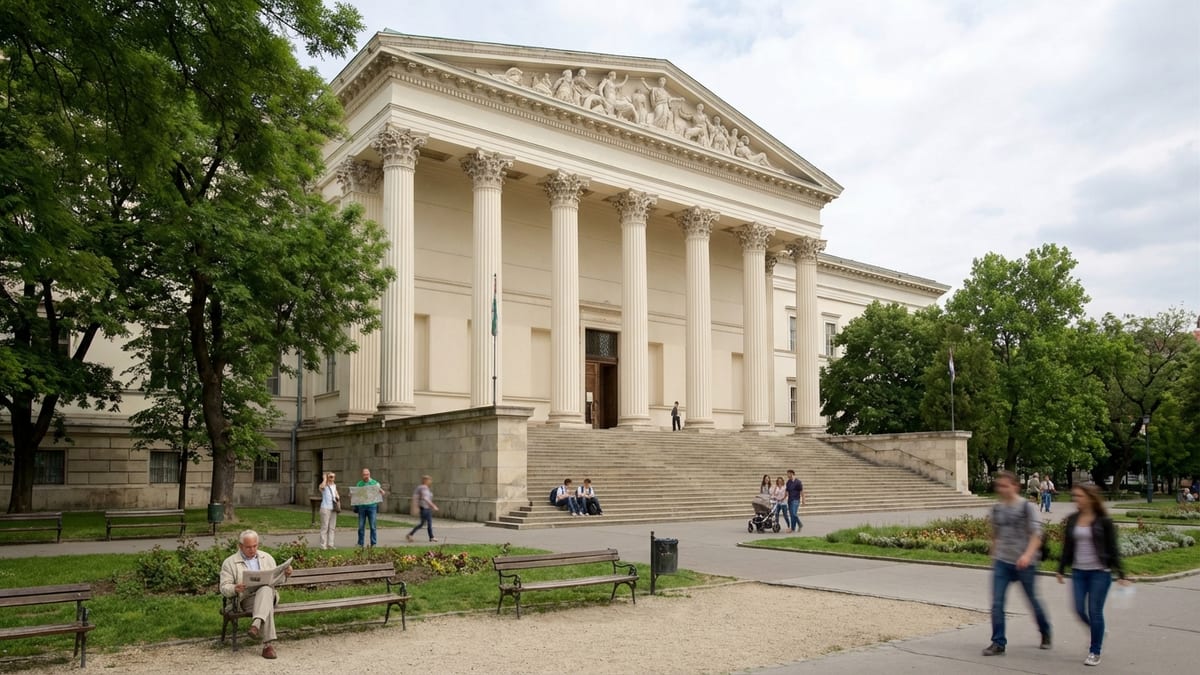
The Hungarian National Museum is one of Budapest’s defining landmarks and a cornerstone of Hungarian cultural identity. Behind its neoclassical facade, visitors can trace more than a thousand years of history, from medieval kingdoms and Ottoman sieges to twentieth century revolutions and regime changes.
Whether you are a first-time visitor to Budapest or a returning traveler keen to explore the country’s story in depth, the museum offers a rich mix of grand national narratives, evocative artifacts, and quiet spaces to pause and reflect.
A Brief History of the Hungarian National Museum
The origins of the Hungarian National Museum date back to 1802, when aristocrat Count Ferenc Széchényi donated his extensive library and collections to the Hungarian nation. This gesture led directly to the creation of a national institution that would safeguard the country’s historical memory, artworks, and archaeological treasures. Within a few years, donations from other noble families and scholars had expanded the holdings to encompass minerals, manuscripts, coins, and objects of everyday life, transforming a private collection into a public museum devoted to Hungary’s past.
In 1807, the Hungarian Parliament formally recognized the institution and issued a call for nationwide support. As collections grew, the need for a dedicated building became pressing. During the 1830s the parliament allocated funds for a purpose-built home, reflecting not only the practical demands of preservation but also a growing sense of national consciousness. The result was one of the most important cultural projects of nineteenth century Hungary, intended to showcase the nation’s heritage with dignity and ambition.
The museum’s current building was completed between 1837 and 1847, and by 1846 the institution had moved to its permanent address on Múzeum körút, in what is now central Budapest. Over time, the museum’s scope shifted as specialized institutions were spun off from its collections. In 1949, the ethnographic and natural history departments became independent museums, and the National Széchényi Library was reorganized as a separate entity. Yet all remain closely connected, forming a broader network of national collections rooted in the original vision of Count Széchényi.
Today the Hungarian National Museum serves both as a guardian of artifacts and as a symbolic space for civic reflection. Its galleries frame the long sweep of Hungarian history while its role in key political events gives it an importance that extends well beyond the world of art and archaeology.
An Iconic Building and Garden in the Heart of Budapest
The museum’s neoclassical building is itself one of Budapest’s architectural highlights. Designed by architect Mihály Pollack, the structure features a monumental portico supported by Corinthian columns, a broad ceremonial staircase, and harmonious proportions typical of early nineteenth century classicism. For many visitors, the museum’s exterior is their first encounter with this refined architectural language in the city, and the building has become a visual shorthand for Hungarian statehood and culture.
Statues by sculptor Raffaele Monti adorn the portico, including an allegorical figure of Hungary holding a shield emblazoned with the national coat of arms. Flanking this central figure are personifications of Science and Art, underscoring the museum’s mission to bring knowledge and creativity together under one roof. Inside, the grand staircase and richly decorated ceilings, with frescoes by painters Károly Lotz and Mór Than, create a setting that feels more like a palace than a conventional museum.
Surrounding the building, the Museum Garden provides a green refuge amid the busy streets of the 8th district. Open daily from early morning until the evening, it is a popular meeting point for locals and travelers alike. The garden contains statues of literary and historical figures, as well as memorials connected to watershed moments in Hungarian history. In warm weather the lawns and benches fill with students, families, and office workers taking a break from the city’s pace.
The garden also serves as a venue for cultural events, including concerts and the Museum Festival, which brings together heritage institutions from across the country. Even if you do not plan to visit the galleries, the steps and garden of the Hungarian National Museum offer a memorable place to sit, people watch, and absorb Budapest’s atmosphere.
Revolution, Memory and the Museum’s National Significance
Beyond its collections, the Hungarian National Museum occupies a central place in the country’s modern political imagination. On March 15, 1848, the steps of the museum became the stage for the outbreak of the Hungarian Revolution against Habsburg rule. Poet Sándor Petőfi recited his poem “Nemzeti dal” and the so-called “Twelve Points” of revolutionary demands to an enthusiastic crowd, turning the museum into a symbolic platform for national self-assertion.
This association with 1848 has never faded. Statues to key literary and political figures were erected on and around the museum grounds in the late nineteenth century, and in the decades that followed the building was frequently used for important state events. For a period, the Upper House of the Hungarian Parliament even held its sessions in one of the museum’s ceremonial halls, underlining the close link between culture and politics.
Every year on March 15, which is now a national holiday, commemorations of the 1848 Revolution take place in front of the museum. Speeches, wreath-laying ceremonies, concerts, and family programs transform the plaza and garden into a large open-air forum. For visitors, attending these events offers a powerful insight into how Hungarians interpret their past, and why the museum remains an essential reference point in contemporary debates about identity and democracy.
Even outside anniversary dates, the building’s revolutionary heritage shapes the visitor experience. Exhibitions devote substantial space to nineteenth and twentieth century struggles for independence and reform, while temporary shows often explore themes of memory, resistance, and social change. The museum thus functions as both a repository of objects and a living space where the nation’s story is continually evaluated and reinterpreted.
Permanent Exhibitions and Unmissable Highlights
The Hungarian National Museum’s permanent exhibitions are organized to guide visitors through the country’s history from its earliest archaeological traces to the close of the twentieth century. Although the precise arrangement and design of rooms change over time, the overarching structure remains consistent, making it easier for travelers to plan a focused visit. The core history galleries are divided into two major chronological sections that correspond to Hungary’s medieval and modern eras.
The first major permanent exhibition, often described as the medieval or early history section, traces the story from the establishment of the Hungarian state up to around 1703. Here you will encounter artifacts that illuminate the formation of the medieval kingdom, its Christianization, and its role as a crossroads between East and West. Expect to see weaponry, religious objects, royal seals, manuscripts, and items connected to daily life under both Hungarian and foreign rule, including the centuries of conflict with the Ottoman Empire.
The second large section follows Hungarian history from the early eighteenth century to 1990. This part of the museum is especially compelling for visitors interested in the Habsburg era, the 1848 Revolution, the Austro Hungarian Compromise, the First World War, and the turbulent twentieth century. Exhibits on the interwar period, the Second World War, the 1956 Uprising, and the communist decades provide context for understanding modern politics and social change. Personal belongings, photographs, propaganda posters, and audio-visual materials help humanize events that might otherwise feel abstract.
In addition to these chronological journeys, the museum presents a series of specialized permanent displays. The Roman Lapidary, for example, showcases carved stone monuments from the province of Pannonia, offering a glimpse into everyday life, religion, and commemoration in what was once a frontier of the Roman Empire. Other sections highlight numismatics, decorative arts, and historically significant treasures that demonstrate Hungary’s place within wider European networks of trade and cultural exchange.
Special Treasures: From the Coronation Mantle to the Seuso Hoard
Among the museum’s most famous individual objects are two spectacular ensembles: the Coronation Mantle of the Hungarian kings and the late Roman silver known as the Seuso Treasure. These are widely regarded as must see highlights, both for their artistic quality and for the stories of power, faith, and controversy that surround them. Due to ongoing conservation and renovation works, however, visitors in early 2026 should be aware that these galleries may be temporarily closed, with full reopening currently expected in the spring of 2026.
The Coronation Mantle is an embroidered silk and gold textile traditionally associated with the crowning of Hungarian monarchs. Richly decorated with Christian iconography and inscriptions, it embodies the fusion of religious symbolism and royal authority. Although it is fragile and displayed under carefully controlled conditions, the mantle vividly evokes the ceremonial world of medieval kingship. Interpretive materials explain both the mantle’s artistic features and its role in long running debates about Hungary’s constitutional order.
The Seuso Treasure is an extraordinary hoard of late Roman silver tableware, believed to have been buried in the territory of present day Hungary and rediscovered in the twentieth century. Its elaborate platters, ewers, and bowls are decorated with hunting scenes, mythological figures, and finely worked geometric patterns. The hoard’s journey from antiquity to the museum has involved complex legal disputes and international negotiations, which the exhibition also explores. For many visitors, the Seuso objects are among the most visually dazzling works of art on view anywhere in Budapest.
When these galleries are closed for renovation, the museum adjusts its displays to highlight other key artifacts. Staff often move select masterpieces or explanatory materials into adjoining rooms to maintain continuity in the visitor experience. It is advisable to check current exhibition status shortly before your visit, but even without access to these star objects, the museum offers many other compelling pieces that articulate the richness of Hungarian material culture.
Planning Your Visit: Opening Hours, Tickets and Practical Tips
The Hungarian National Museum currently opens from Tuesday to Sunday, 10:00 to 18:00, and is closed on Mondays. The ticket office stops selling tickets at 17:00, and staff begin closing the galleries from around 17:30, so arriving well before late afternoon is strongly recommended if you want to tour the exhibitions at a comfortable pace. During the summer season, the museum often extends its opening hours on Friday evenings, keeping the building and its exhibitions accessible until 22:00 and complementing this with concerts, guided tours, and special programs.
Ticket prices are structured with several categories and discounts for students, seniors, and groups, as well as free entry for some visitors such as young children, people over a certain age, and holders of specific cards or professional identifications. Citizens of Hungary and other European Economic Area countries benefit from additional concessions, including free access to permanent exhibitions on the third Saturday of each month for visitors under 26, and for families with children under 18 accompanied by close relatives. On key national holidays such as March 15, August 20, and October 23, admission may also be free for all visitors.
For travelers planning a short stay in Budapest, it is worth keeping an eye on combined tickets and city cards that include entry to the museum alongside other attractions. The museum accepts widely used local card payment schemes and participates in discount programs tied to the Budapest Card. If you intend to join a guided tour, advance booking is advisable, especially for tours in foreign languages or during peak tourism months, as group sizes are limited by house rules and safety regulations.
Within the building, you will find cloakrooms, restrooms, a museum shop, and a café. Photography is generally permitted for personal use in many areas, though flash and tripods may be restricted. Some special exhibitions or objects have stricter photography and access rules, which are clearly signposted. As with most major European museums, security checks are in place at the entrance, and large bags may need to be deposited before you enter the galleries. Planning at least two to three hours gives you sufficient time to see the highlights, but history enthusiasts could easily spend half a day exploring in more detail.
Navigating the Galleries and Making the Most of Your Time
Given the breadth of the museum’s holdings, it is wise to approach your visit with a loose plan. A straightforward strategy is to follow the chronological route from medieval foundations to the late twentieth century, which takes you through the two main “History of Hungary” sections. This provides a coherent narrative arc even if you skip some side rooms. Along the way, look for displays that connect national events to everyday experiences, from domestic interiors and crafts to uniforms and personal letters.
If your interest lies more in specific themes than in a comprehensive timeline, you might focus on a particular era. Visitors drawn to medieval history, for instance, can concentrate on the early royal period, Christianization, and the society of knights and monasteries. Others might prioritize the nineteenth century to examine the 1848 Revolution and the dual monarchy years, or delve deeply into the twentieth century rooms, which explore topics such as the First World War, the Treaty of Trianon, fascism and communism, and the 1956 Uprising.
Audio guides, printed leaflets, and select interpretive panels in English and other major languages help international visitors orient themselves. These materials are particularly useful in spaces like the Roman Lapidary, where inscriptions and iconography can be difficult to decode without context. If you enjoy a more structured experience, consider joining a scheduled guided tour, especially during late openings on Fridays, when tours are sometimes paired with music and thematic events.
Finally, do not overlook the quieter corners of the museum, such as smaller temporary exhibitions and the upper floor corridors, where changing displays highlight recent acquisitions or focused research projects. These shows often offer fresh perspectives on topics like urban life, minority communities, or the intersection of art and politics, and they can be less crowded than the headline galleries. Combined with regular rest breaks in the café or garden, this approach turns a potentially overwhelming visit into a pleasurable, layered exploration.
The Takeaway
A visit to the Hungarian National Museum is far more than a checklist stop on a sightseeing itinerary. It is an invitation to engage with the complexities of a country that has often stood at the crossroads of European history. Within its neoclassical walls, you can trace the rise and fall of kingdoms, the struggles for independence and reform, and the everyday lives of people who lived through war, occupation, prosperity, and transformation.
For travelers, the museum offers both breadth and depth. Its permanent exhibitions deliver a structured overview of more than a millennium, while its star objects and special displays reward close attention with striking beauty and powerful stories. The building and garden themselves are cultural landmarks, tied to the 1848 Revolution and to subsequent civic rituals that continue to shape Hungary’s public life.
With thoughtful planning, a few hours at the Hungarian National Museum can enrich your understanding of Budapest and of Central Europe more generally. Whether you are captivated by medieval relics, Roman stonework, revolutionary pamphlets, or the contested memories of the twentieth century, this institution provides the context that turns a city break into a deeper journey through time.
FAQ
Q1. Where is the Hungarian National Museum located in Budapest?
The Hungarian National Museum stands on Múzeum körút in the city’s 8th district, a short walk from Kálvin Square and close to central public transport hubs, making it easy to reach from most parts of Budapest.
Q2. What are the current opening hours of the museum?
As of early 2026, the museum is open from Tuesday to Sunday between 10:00 and 18:00, with the ticket office closing at 17:00 and gallery closures beginning around 17:30; the museum is closed on Mondays, and Friday evening late openings to 22:00 typically apply in the summer season.
Q3. How much time should I plan for a visit?
Most visitors are comfortable with a two to three hour visit to see the core exhibitions and major highlights, but history enthusiasts or those using audio guides and guided tours may wish to allocate half a day to explore more thoroughly and take breaks in the café or garden.
Q4. Are there any free admission days or discounts?
The museum offers various concessions, including free admission for certain age groups and professional categories, and on the third Saturday of each month many citizens of Hungary and other European Economic Area countries under 26, as well as families with children under 18, can visit the permanent exhibitions without charge; national holidays such as March 15, August 20, and October 23 may also feature free entry.
Q5. Which exhibitions are currently affected by renovation works?
From December 2025 parts of the museum, including the galleries devoted to the Coronation Mantle, the Seuso Treasure, the Széchényi Hall, and the Open Repository, have been temporarily closed for renovation, with reopening currently expected in the spring of 2026, so visitors should check the latest information before planning around these highlights.
Q6. Is the museum suitable for children and families?
Yes, the museum offers family friendly activities, educational programs, and engaging displays that can appeal to older children and teenagers, while the Museum Garden provides space to take breaks; however, the content is primarily historical, so younger children may benefit most from shorter, focused visits and interactive elements.
Q7. Can I take photographs inside the museum?
Photography for personal, non commercial use is generally allowed in many areas of the museum, though flash, tripods, and photography in certain special exhibitions or near particularly sensitive objects may be restricted, so it is important to follow posted signs and instructions from staff.
Q8. How accessible is the museum for visitors with reduced mobility?
The museum has taken steps to improve accessibility, including ramps, elevators, and adapted facilities, but because it is housed in a historic building, some areas may still pose challenges; visitors with specific mobility needs are encouraged to contact the museum in advance or inquire at the entrance for the most accessible routes through the exhibitions.
Q9. Are guided tours available in English?
Guided tours can be arranged in several foreign languages, including English, for groups that reserve in advance, and during high season or special Friday evening programs the museum sometimes offers scheduled public tours that do not require a private booking, though places are usually limited.
Q10. What is the best way to combine the museum with other sights nearby?
Thanks to its central location, many travelers pair a visit to the Hungarian National Museum with walks through the nearby pedestrian streets, the Great Market Hall at Fővám Square, or the riverside promenade, creating a day that balances intensive historical exploration with the everyday life and culinary culture of Budapest.