

When I first started planning an elephant-focused safari in Southern Africa, the two names that kept coming up were Hwange in Zimbabwe and Chobe in Botswana. Over two separate trips I ended up doing both, at roughly the same time of year and with similar budgets.
On paper they sound almost interchangeable: huge elephant populations, classic dry-season game viewing and easy links to Victoria Falls. In reality, they feel very different.
Some of my best elephant encounters ever have been in these two parks, but I also had a few frustrating days where the hype did not quite match what I actually saw. If you are trying to decide between Hwange and Chobe for an elephant safari, the differences matter more than the brochures suggest.
Setting the Scene: How Hwange and Chobe Actually Feel
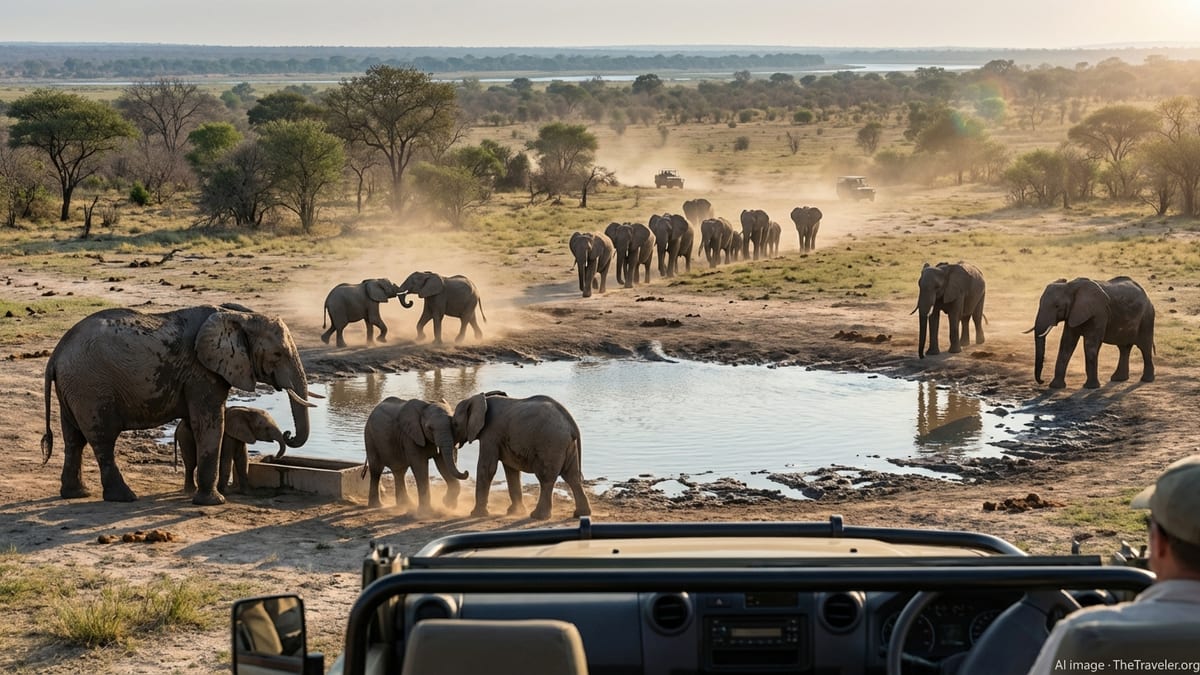
Stepping into Hwange, my first surprise was how wild it felt compared with what I had imagined. The park is enormous, and the central and southern sectors where I stayed felt remote, with long drives between waterholes and very few other vehicles. Pumped waterholes are scattered across an arid, open landscape, and in the dry season from about July to October big herds of elephants drift in and out all day, then pile in at dusk when the light turns gold. It did not feel like a production; it felt like I was sitting at the edge of a real, working ecosystem that mostly ignored me.
Chobe, by contrast, hit me as busy and concentrated. Along the Chobe Riverfront near Kasane, everything squeezes into a narrow strip of floodplain, river and riverine woodland. In the core dry season from May to October, particularly August to October, the daily ritual is predictable: land-based game drive in the morning, boat cruise in the afternoon, all focused on the same stretch of river where what feels like half of Africa’s elephants come down to drink. The spectacle is undeniable, but I was always aware of the other boats, other vehicles and nearby lodges. It felt more like a stage where the elephants and guides know their marks.
Those first impressions stayed with me. Hwange felt like a slow-burn park where you let the day come to you at a waterhole. Chobe felt like a high-intensity, high-reward loop of drives and boat cruises with very little downtime. Neither is automatically “better,” but they suit different temperaments. If you want raw wilderness and do not mind a bit of uncertainty, Hwange leans that way. If you want guaranteed elephant overload and do not mind sharing it, Chobe is more your place.
Elephant Encounters: Numbers vs Intimacy
In terms of sheer elephant numbers, both parks are in a different league from most of Africa. Chobe is famous for holding around 50,000 or more elephants in the wider ecosystem, and in September on the riverfront I saw literal walls of grey moving down to the water in the late afternoon. On one river cruise I counted at least 300 elephants in view at once, spread along the banks and islands. It was the kind of scene that stops conversation on the boat. At peak dry season, guides routinely talk about herds of 200 to 500 elephants congregating along the river and this matched what I saw.
What impressed me about Chobe was not just the numbers but the behaviors you can see from the water. From the boat I watched families swim across deep channels, with adults using their trunks like snorkels and calves bobbing between them. I saw bulls cover themselves with red mud, and youngsters play-fighting at eye level while I sat in a chair with a cold drink. It is very hard to beat that mix of proximity, comfort and drama. At times it almost felt too easy: I did not have to work for these sightings at all, beyond booking a spot on the boat.
Hwange’s elephants are more about context than quantity. The park is also renowned for its large herds, especially from July to October when pumped waterholes become essential lifelines. At a couple of pans I visited in late August, I watched a steady flow of breeding herds rotate through from mid-afternoon until after dark, sometimes gathering in groups of 50 to 100 animals. I never saw the same instant overload that Chobe delivered, but I did get extended, unhurried sessions with elephants interacting around a single pan: matriarchs shouldering others away from the cleanest water, tiny calves trying to reach the trough, bulls testing each other at the edge of the herd.
Where Hwange really won me over was the quiet. At one remote waterhole I spent almost three hours with one other vehicle in sight. The elephants were skittish at first, then gradually ignored us as they settled in. The mood was very different from the slightly frenetic energy of the Chobe riverbank, where boat engines and camera shutters form the soundtrack. In Hwange I felt like I had more time to observe subtle behavior. In Chobe I got bigger set pieces. If you want guaranteed drama and are not bothered by other people, Chobe clearly leads. If you care more about atmosphere and fewer vehicles, Hwange has the edge.
Costs, Logistics and Booking Headaches
The financial side of this decision is not trivial, and I learned quickly that “just going where the elephants are” glosses over some important differences. Park entry fees are lower for Hwange than Chobe for international visitors, and accommodation in Zimbabwe, at least for now, generally came out cheaper for a similar standard of lodge. In Hwange I could still find solid mid-range camps in the dry season without going into the ultra-luxury bracket. In Chobe, anything right on the river with good access to the prime game-viewing area was noticeably pricier, and the top lodges were firmly in bucket-list territory.
Booking also felt different. For Chobe, particularly around the Chobe Riverfront and Savuti area, I had to plan well ahead for a peak dry-season visit. Over August and September, many riverfront lodges and the better-located campsites are booked months in advance. Some operators I spoke with recommended securing July to October dates six to twelve months out, especially if you want a specific lodge, a private vehicle or a camping spot along the river. On one trip I left it late and ended up cobbling together a slightly awkward combination of a town guesthouse in Kasane plus outsourced game drives and boat cruises. It worked, but it missed the seamless feel I had hoped for.
Hwange was kinder to my procrastination. The most sought-after independent camps still fill up in the July to October window, but I found a decent range of options a few months out, including smaller bush camps that offered fully inclusive rates with guiding, meals and activities. Transfer logistics were also fairly straightforward. From Victoria Falls, I could reach Hwange by road in a few hours, and most lodges handled the transfer from the main road or small airstrips. I did still need to line things up, but it felt less like competing for a limited number of riverfront beds and more like choosing among several good, slightly more spread-out options.
One place Chobe did win on convenience was flight access and border logistics. Kasane has its own international airport and sits near the point where Botswana, Namibia, Zambia and Zimbabwe meet. On one itinerary I combined a Chobe stay with Victoria Falls and a short hop into Namibia without much hassle. Hwange, by comparison, almost always slotted in as part of a Zimbabwe-focused trip anchored around Victoria Falls. If you are trying to build a multi-country circuit, Chobe’s location saves time and money. If your main priorities are cost control and avoiding peak-season sticker shock, Hwange gives you more room to maneuver.
Crowds, Comfort and Overall Atmosphere
Elephants aside, the thing I felt most strongly in Chobe was the density of tourism. Around Kasane and the riverfront in prime season, the boat jetties are busy and multiple vehicles often converge on the same lion sighting or leopard in a tree. There were moments when I counted eight or nine boats all watching the same herd at sunset. Guides did their best to manage positioning and not crowd the animals, but the reality is that this is one of the most easily accessed, popular safari destinations in Southern Africa. If your mental image of a safari involves silence and solitude, Chobe near the town is going to challenge that, especially in July, August and September.
Comfort levels, however, are excellent. The range of accommodation around Chobe is wide, and even fairly simple guesthouses in Kasane are comfortable, with air conditioning, good showers and reliable internet. The boats used for cruises have proper seats, shade and often drinks on board. Drives stick mostly to decent roads close to town, so you are rarely far from relative comfort. For many first-time safari-goers or for families, that combination of easy access, reasonable comfort and jaw-dropping wildlife is exactly what they want, and I understand why.
Hwange’s atmosphere is quieter and a bit more old-fashioned. Most of the camps where I stayed were unfenced, and I regularly heard elephants moving through at night or found tracks around the tent in the morning. Game-drive routes can be sandy and rough, especially in the southern parts of the park, and some days I barely saw another vehicle. I liked that a lot, but it also meant longer bumpy drives, dusty conditions and more basic infrastructure. Power cuts are not unusual, and while most camps have generators or solar, it all feels slightly more rustic.
This difference in atmosphere became very real when I hit small frustrations. In Chobe, a temporary delay or a missed sighting felt less serious because I knew another boat cruise in a few hours would give me more chances, and the town infrastructure was right there. In Hwange, a flat tire or a radio issue felt more consequential because we were genuinely far from anything. Safety was never a problem in either park with competent guides, but in Hwange I needed to be more accepting of the fact that I was in a remote wilderness where things sometimes run on bush time.
Seasonality and When I Would Actually Go Back
Both parks are classic examples of Southern African seasonality, and on my trips timing made a huge difference. I aimed for the heart of the dry season: around August and September for Chobe, and late August and early September for Hwange. In Chobe, from May to October the bush dries out and animals concentrate along the river, reaching peak densities as the last of the inland water disappears around August to October. That is also when temperatures climb, especially in September and October, and afternoon drives can feel brutally hot on open vehicles and boats.
In Hwange, the picture is similar but not identical. July to October is widely regarded as the prime elephant season, with pumped waterholes pulling in ever-larger herds as the months pass. By September, I was seeing exceptional concentrations around certain pans, but I also noticed how parched the landscape looked and how dusty the drives became. Afternoon heat built up here too, although night and early morning temperatures in Hwange during winter can be downright cold, something I underestimated on my first trip. I ended up layering every piece of clothing I had on some 6 a.m. drives.
If I could redo my timing, I would probably choose late June or early July for Hwange, to get strong game viewing, cooler temperatures and slightly fewer people at the most popular camps. For Chobe, I would lean toward June or very early July on the riverfront, or alternatively late May or early June combined with a few nights in the less crowded Savuti area. The elephant densities then are still impressive, but the crowding is more manageable, and the heat less aggressive than in September or October.
I did one short Chobe visit in the early wet season as well, in November, to see how it compared. The difference was stark: the landscape was greener, birds were fantastic, but elephants were more spread out and the riverfront felt much quieter. Game viewing was still enjoyable, but nowhere near the concentrated spectacle I had seen months earlier. In Hwange, I have not yet done a full wet-season trip; every guide I have spoken to emphasizes that from December to March the bush is lush, roads can be tricky and animals are dispersed. Both parks are technically year-round destinations, but if elephants are your main reason for going, I would not compromise on hitting the dry months.
Real Decision Moments: How I Chose, and Where I Got It Wrong
The first big decision I had to make was where to base myself in Chobe. The obvious choice was a riverfront lodge near Kasane, but once I saw the prices and realized how busy high season gets, I hesitated. I ended up splitting my stay: a few nights in a more affordable guesthouse in town, booking boat cruises and drives separately, and then two nights at a more expensive, fully-inclusive lodge further up the river. In hindsight, that split worked but it also diluted the experience. The town-based days felt a bit transactional and rushed. If I did it again, I would either commit fully to a good riverfront lodge for fewer nights, or spend part of my time in the quieter Savuti area to balance out the crowds.
My second big decision point involved combining these parks with Victoria Falls. On one itinerary I had to choose between spending an extra two nights in Hwange or allocating those nights to Chobe so I could tick off the classic “Falls plus Chobe” combo. I picked Chobe, assuming the riverfront spectacle would be impossible to beat. While that part of the trip delivered on elephants, I realized afterwards that I had shortchanged Hwange’s slower rhythm and deeper sense of wildness. If you already have one strong river-based elephant destination on your longer itinerary, adding another can feel repetitive. Next time I would probably lean into Hwange for longer rather than stacking Chobe onto every Falls trip.
The third decision involved cost versus exclusivity. In Hwange, I was tempted by some of the high-end, small camps that promised private concessions and limited vehicle numbers, but the prices were steep. I compromised with a comfortable mid-range camp in a busy area, telling myself that elephants do not care about price tags. The game viewing was still excellent, but I did occasionally end up in informal convoys around good sightings, and it broke the illusion of solitude I had hoped for. In Chobe, I had the opposite issue: a couple of cheaper options were available further from the park, but the travel time into the core game-viewing zones would have eaten into already short drives. The lesson for me was that, in both parks, location and guiding quality are worth paying extra for, within reason.
Finally, there was the timing decision. On my first Chobe trip I scheduled my days around shoulder-season deals rather than optimal wildlife, ending up in May when the concentrations were just starting to build. It was still very good, but after seeing what September looked like on a later trip, I realized how much I had missed the first time. In Hwange, I did the opposite and went all-in on late August and early September without fully appreciating how dusty and hot those weeks could be. If you are sensitive to either crowds or climate, do not just copy the generic “July to October is best” mantra. Pin it down to a narrower window that matches your own tolerance for heat, dust and other people.
Who Each Park Suits Best, and What I Would Change Next Time
Looking back over my trips, I have started to think of Hwange and Chobe not as competitors but as different styles of elephant safaris. Chobe is ideal if this is your first safari, if you want maximum visual impact in a short time, and if you like the idea of mixing land and water activities without too much logistical complexity. It is especially strong for travelers who want to bolt a high-impact wildlife experience onto a visit to Victoria Falls with minimal extra planning. The tradeoff is that you are sharing that spectacle with many others, especially around Kasane and the riverfront, and true solitude is rare.
Hwange, on the other hand, suits people who already know they enjoy safaris or who value a sense of remoteness more than a guaranteed daily checklist. Its elephant viewing in the dry season is world class, but it unfolds slower, and the feel of the park is shaped by long dusty drives, pumped pans and big open spaces. Costs are generally a bit lower than Chobe for comparable quality, and I found that my days there left more mental space. There were quiet hours with no dramatic sightings at all, just the feeling of being in a huge piece of wilderness that keeps running whether I am there or not.
If I were planning a new trip for myself, I would do both again but in a more deliberate way. For Chobe, I would reduce the number of nights on the crowded riverfront and invest in either a more remote lodge in the park or a combination that includes Savuti for a contrasting, wilder feel. I would also avoid the very hottest and busiest weeks of late September and early October unless I had a private vehicle and a clear understanding of what crowd levels would be like.
In Hwange, I would prioritize location more, choosing camps near productive pans and accepting that I might have fewer facilities in exchange for better, less pressured game viewing. I would also pack more carefully for the temperature swings, including very warm layers for early-morning drives and lighter, breathable clothes for afternoon heat. Above all, I would give Hwange at least four or five nights, ideally split between two different areas of the park, instead of treating it as a quick add-on. It rewards time and patience more than any other elephant destination I have visited.
The Takeaway
After spending meaningful time in both Hwange and Chobe, I do not think there is a single “better” elephant safari in Southern Africa. There is a better choice for specific people, budgets and expectations. If you want huge, photogenic herds at close range, easy access, a mix of boat and vehicle safaris and you are willing to accept crowds and higher prices in return, Chobe is extraordinarily hard to beat. If you want something that still feels like a classic, slightly old-school African wilderness, where elephants dominate the landscape but not every sighting is shared with ten other vehicles, Hwange is probably the one you will talk about years later.
For a first safari, or a short four-day add-on to Victoria Falls, I would lean toward Chobe and make peace with the fact that I will not have it to myself. For a longer trip where I want space, a feeling of remoteness and time to let the bush breathe between big moments, I would choose Hwange or pair it with a quieter part of Chobe. Both parks have their frustrations: heat, dust, logistics, booking stress and, occasionally, days when the animals simply do not cooperate. But both also offer those rare, perfect hours when elephants surround you and everything else falls away. If you can match your expectations to what each park really offers, rather than to the marketing slogans, either Hwange or Chobe can deliver an elephant safari that genuinely feels like a once-in-a-lifetime experience.
FAQ
Q1: Which park has more elephants, Hwange or Chobe?
Chobe generally has higher overall elephant numbers in the wider ecosystem and delivers denser dry-season concentrations along the riverfront, especially from August to October. Hwange has very impressive herds too, particularly around pumped waterholes from July to October, but the viewing is more spread across a large area rather than squeezed into a single river corridor.
Q2: If I only have three nights, should I pick Hwange or Chobe?
For just three nights and especially if it is your first safari, I would pick Chobe because it is easier to access, the schedule of boat cruises and drives is efficient, and your chances of big elephant sightings in a short time are extremely high in the dry season. Hwange benefits more from a longer stay to appreciate its space and slower rhythm.
Q3: Which destination is better for avoiding crowds?
Hwange is better if your priority is solitude. Even in high season, the park’s size and the distribution of camps mean you are less likely to encounter clusters of vehicles. In Chobe, especially around the Kasane riverfront in peak months, you should expect multiple boats and vehicles at major sightings.
Q4: How far in advance do I need to book?
For Chobe in peak dry season, I would aim to secure riverfront lodges or prime campsites six to twelve months in advance, particularly for August and September. Hwange is a little more forgiving, but the best small camps for July to October can still fill several months ahead, so I try not to leave it later than three to six months if I want specific dates or rooms.
Q5: What is the best time of year for an elephant-focused safari in these parks?
For both Hwange and Chobe, the dry months from about July to October are best for elephants, as water becomes scarce inland and herds concentrate at rivers and waterholes. If you want to balance wildlife, temperatures and crowds, I personally like June and early July as a sweet spot, with still-strong viewing and fewer people than the absolute peak weeks.
Q6: Are these parks suitable for families with young children?
Both parks can work for families, but I find Chobe generally easier because of shorter transfers, more structured activities and a wider range of accommodation with family rooms. The main caveat is the heat and crowds in peak season. Hwange’s remoteness can be magical for older children but the longer drives and more rustic feel may be challenging for very young kids.
Q7: How do the overall costs compare between Hwange and Chobe?
In my experience, Hwange is usually slightly more affordable for similar-quality lodges and park fees, especially once you get beyond the absolute top tier. Chobe’s prime riverfront locations carry a premium, and extras like private vehicles or exclusive boat cruises add up quickly. That said, flying into Kasane and combining Chobe with Victoria Falls can save on internal flights, which partially offsets the higher nightly rates.
Q8: Is it necessary to visit both Hwange and Chobe on the same trip?
It is not necessary, but if you have the time and budget, combining them gives you two distinct versions of an elephant safari: high-intensity riverfront viewing in Chobe and a quieter, more spacious experience in Hwange. If you are constrained to a week or less, I would usually recommend choosing one and doing it properly rather than rushing through both.
Q9: How important is staying inside the park versus in town or outside?
In both Hwange and Chobe, staying inside or right on the boundary of the park makes a noticeable difference. You spend less time commuting, can access good sightings earlier and later, and you feel more immersed in the environment. In Chobe, basing yourself far from the riverfront to save money often means longer, more crowded drives. In Hwange, being close to productive waterholes is worth a premium in the dry season.
Q10: If I am sensitive to heat and dust, which destination should I prioritize?
If heat and dust are major concerns, I would either time both parks for the cooler months (May to July) or, if I had to pick one, lean slightly toward Hwange in June or July. Chobe’s riverfront can be extremely hot and dusty from August to October, especially on afternoon drives. Hwange is not immune to heat and dust either, but the combination of cooler winter nights and the option to choose camps in more open areas made it feel a bit more manageable for me.