

I booked Hyatt House because I needed something between a classic hotel and a short-term apartment. On paper, it sounded ideal: proper kitchenette, more space to spread out, breakfast included, a brand with a generally reliable reputation. What I actually experienced was more nuanced.
There were things Hyatt House did very well for an extended stay, and other areas where the gaps only reveal themselves after several nights instead of one. This is my honest account of staying at Hyatt House as a mid-range, extended-stay guest who cares about value, comfort, and not feeling like I live in a beige box.
Booking, Rates, and First Impressions
I booked my stay directly through Hyatt’s website after comparing prices across several booking platforms. The rate structure was clearly geared toward longer stays. Once I passed the four or five night mark, the nightly price dropped noticeably compared with a standard Hyatt Place or full-service Hyatt in the same area. Taxes and parking quickly added up, though, which meant the final bill looked significantly higher than the enticing base rate. It was still cheaper than many conventional hotels for the same period, but it did not feel like a steal.
The booking process itself was smooth enough. I appreciated that I could see room layouts and confirm a studio versus a one-bedroom suite. The site made it clear that housekeeping would be limited for extended stays, generally around once a week with trash removal and towel refresh available on request. That sounded reasonable before arrival. In practice, I found the reduced service convenient on some days and a mild annoyance on others.
Arriving at the property felt less like arriving at a flagship hotel and more like pulling into a modernized apartment complex. The exterior was functional rather than inspiring: lots of concrete, neutral siding, and the usual corporate signage. Inside, the lobby leaned into the standard extended-stay aesthetic: a mix of lounge-style seating, a small bar, a pantry area, and front desk. Check-in was efficient, but not exactly warm. The staff were polite and got me my keys, but there was no particular effort to orient me as a longer-stay guest beyond mentioning breakfast hours and Wi-Fi.
My first impression was that Hyatt House is designed to be practical, not memorable. If you want a strong sense of place or design, you probably will not find it here. If you care about basic functionality and a reasonably modern feel, it hits the mark, if somewhat blandly.
Room Layout, Space, and Living Comfort
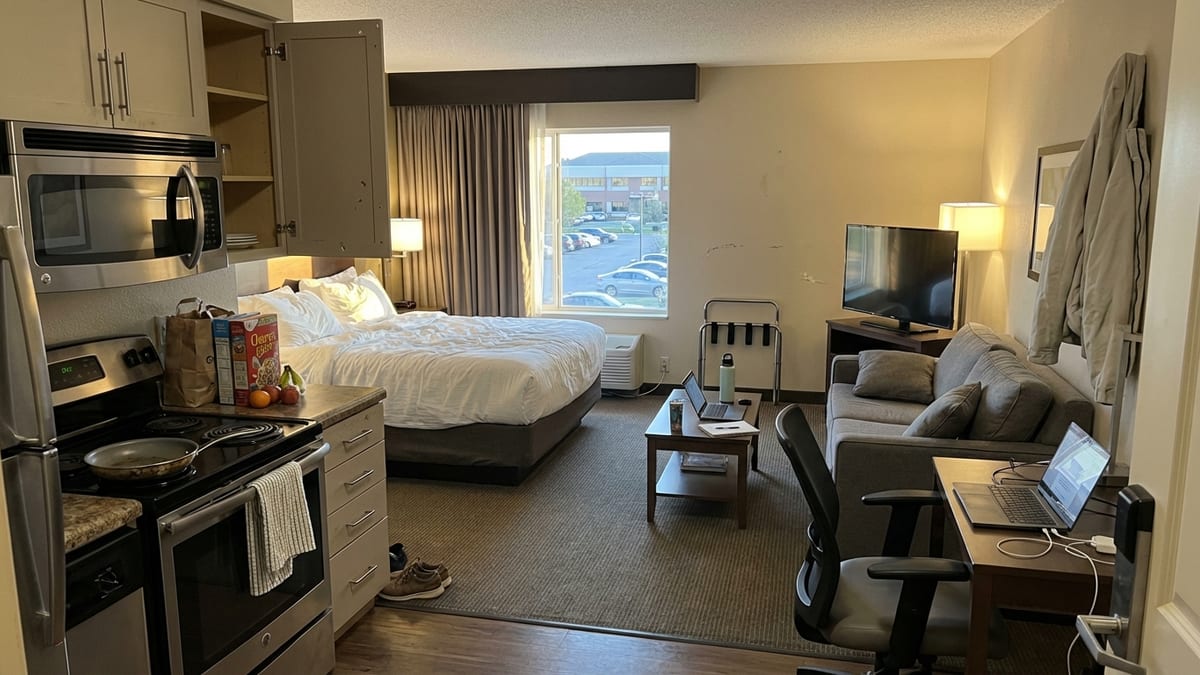
The main reason I chose Hyatt House was the promise of extra space, and in that sense it largely delivered. My room was a studio-style suite with a clear division between sleeping and living areas. There was a small sofa, a work desk with ergonomic chair, a TV that could be angled toward either the bed or the seating area, and enough floor space to move around without feeling boxed in. For an extended stay, that breathing room matters a lot more than the glossy finishes you get at some full-service hotels.
The bed itself leaned firm, with decent but not luxurious linens. After several nights, I appreciated the consistent support but wished the pillows were less lumpy and synthetic-feeling. The blackout curtains worked reasonably well, though a bit of light still seeped around the edges in the early morning. Soundproofing was adequate but not exceptional. I could hear doors closing in the hallway and occasional footsteps above, especially on weekends when more families checked in. It was not disruptive enough to ruin my sleep, but it reminded me that this is still a mid-range product, not a sound-insulated sanctuary.
Storage space was one of the quiet strengths of the room. There was a proper closet, drawers, and some shelving, which made it easy to unpack and stop living out of a suitcase. That is the kind of benefit you really notice around day four, when piles of clothes and gadgets can start taking over a traditional hotel room. I could set up a small “home base,” which psychologically makes an extended stay much easier to tolerate.
On the downside, some details felt cheap or slightly worn. A cabinet door did not close perfectly flush, and there were a few scuff marks and dings on the walls that had obviously survived several turnover cycles. The overall aesthetic was clean but plain: lots of grays and beiges, generic artwork, and utilitarian lighting. It felt like an upgraded corporate apartment rather than a destination in itself, which might be exactly what some travelers want but left me a bit underwhelmed.
The Kitchenette: Helpful, But Not Quite Home
The in-room kitchenette was one of the key selling points for me. Mine came with a full-size refrigerator, a two-burner cooktop, microwave, dishwasher, and a surprisingly deep sink. There were basic pots and pans, plates, bowls, glasses, and cutlery. For a hotel, this is a solid setup that immediately reduces how often you need to eat every meal out. I appreciated being able to store groceries, cook simple meals, and make coffee without paying lobby cafe prices.
Still, it is important to temper expectations. The cookware and utensils were serviceable but very basic. The pan had seen better days, with a scratched surface and slightly warped bottom that made even heating a bit of a challenge. Knives were dull, so cutting anything more robust than fruit or bread felt like a workout. I ended up buying a cheap knife and a few small kitchen items to make cooking less frustrating. If you are a serious home cook, you will likely notice these limitations quickly.
Ventilation was another minor issue. Cooking something with any real aroma, like sautéed garlic or searing meat, tended to linger in the room longer than I would have liked. The fan above the cooktop helped a little but not enough. For short stays, this might not matter much. Over a week or more, having your room smell like last night’s dinner gets old. To be fair, that is a challenge for most hotel-style kitchens, not just Hyatt House, but it is something to consider if you plan to truly cook and not just heat up leftovers.
In spite of the compromises, the kitchenette did what I needed it to do. I could have breakfast in the room if I missed the buffet, store leftovers from nearby restaurants, and make a simple pasta or salad without thinking too hard. It delivered on functionality more than finesse, and for the price point, that felt acceptable, if not impressive.
Housekeeping, Laundry, and Living Like a Temporary Local
Hyatt House’s housekeeping model is clearly oriented toward extended stays. During my time there, full room cleaning was scheduled about once a week, with trash and towel service available on request. Conceptually, I liked the idea of not having cleaners in my room every day, and it does align with a more apartment-like routine. In practice, the once-a-week deep clean felt a bit thin, especially when you are cooking in the room and tracking in daily life.
I found myself calling down for extra trash pickup and fresh towels more often than I expected, and while the staff always obliged, it did start to feel like I was managing my own mini-household rather than enjoying a hotel level of service. When the weekly clean finally happened, it was efficient and reasonably thorough, but it did not quite reach the corners. A few stray crumbs near the kitchenette and some dust along baseboards made it clear the cleaning was focused on visible surfaces only.
The guest laundry room was a genuine practical benefit. Machines were card or app-operated, and while not luxurious, they worked. It meant I could pack lighter and do a mid-stay wash without hunting for an external laundromat. That said, peak times were an issue. In the early evening, several machines were often in use, and I had to time my loads to avoid hovering around waiting for someone else’s laundry to finish. Detergent was available from a vending setup, but the pricing was predictably inflated. If I were staying again for a similar length of time, I would bring my own detergent and plan laundry for off-peak hours.
Overall, Hyatt House let me approximate a “temporary local” rhythm. I could handle my own laundry, manage my own dishes, and not worry about daily housekeeping disruptions. The tradeoff is that you lose some of the pampering and frictionless ease that makes a hotel feel like an escape. Whether that is a positive or a negative depends on what you want from your stay.
Breakfast, Common Areas, and On-Site Amenities
Breakfast at Hyatt House was included in my rate, which was one of the value propositions that drew me in. The specifics vary by property, but in my case it was a predictable buffet: scrambled eggs (sometimes powdery, sometimes decent), some form of breakfast meat, cereals, yogurt, fruit, bread, and a make-your-own waffle or pancake station. There were days when it felt satisfying and days when it felt like pure fuel, nothing more. The coffee was weak and never really improved, no matter what time I went down.
One thing I noticed quickly was crowding and noise during peak breakfast hours. Families, work crews, and long-stay guests all converge roughly between 7 and 8:30 in the morning. Tables filled fast, and seating was not always comfortable for solo travelers who just need a quiet corner with a laptop. On a couple of mornings, I ended up taking food back to my room simply to escape the ambient chaos. Again, this is not unique to Hyatt House, but it shaped how often I truly wanted to use the included breakfast.
The lobby and common areas were functional but did not truly invite lingering. There were a few work-friendly tables with power outlets, a small bar that opened in the evening with a limited menu, and a pantry area where I could buy snacks and microwave meals at a markup. The small outdoor area and pool (where available) added some variety, though they did not have the resort feel you might associate with higher-tier hotels. I used the lobby mainly as a pass-through, not as an extra living room.
The fitness room was adequate for basic workouts: a couple of treadmills, an elliptical, a bike, free weights, and a multi-function machine. It did get busy at predictable times, especially early morning and early evening, so I sometimes had to adjust my routine or skip certain exercises. Equipment was in working order but starting to show wear. For maintaining a baseline fitness level during a longer stay, it did the job. It just did not inspire me to work out more than I normally would.
Location, Transport, and Practical Access
Hyatt House properties tend to position themselves in business corridors, suburban clusters, or near transport hubs rather than in the most central, walkable parts of a city. The one I stayed at fit that pattern. It was close to office parks, a major highway, and a cluster of chain restaurants and big-box stores. For a car-based trip or a work assignment nearby, this made sense. For exploring the city as a tourist, it felt more like a compromise.
Parking was available on-site and not especially cheap, but at least it was straightforward and felt safe. That predictability counts when you are coming and going with luggage and groceries over multiple days. If you are relying on public transport, though, the experience is different. While some locations offer shuttle services to nearby business districts or transit centers, those typically run on fixed schedules and may need to be reserved in advance, especially during peak periods. I had to plan my movements more carefully than I would have in a more central, transit-rich neighborhood.
Basic amenities like supermarkets and casual dining were easy to reach by car and often within a 10 to 15 minute walk. That helped justify having a kitchenette. I could stock the fridge without a major expedition. Still, walking along busy arterials with little shade and lots of traffic does not exactly feel pleasant. After dark, I opted to drive rather than walk, more out of comfort than genuine safety concern.
In short, Hyatt House worked well as a base of operations for someone with a rental car or who is stationed near a particular office or campus. It is less appealing if you romanticize walking out your front door into a lively neighborhood or historic district. These properties are built around convenience and practicality, not atmosphere.
Service, Issues, and How Problems Were Handled
Service at Hyatt House sat in an interesting middle ground. Staff were generally polite and responsive when I asked for something, but there was little proactive hospitality. No one checked in during my stay to see how things were going, and there was not the warm recognition you sometimes get at smaller properties when you return after a few days. I did not feel unwelcome, but I did feel largely anonymous, which may be fine if your priority is privacy and independence.
During my stay, I had a couple of minor issues. One involved a persistent cooking smell from another room that seeped into the hallway and faintly into mine. When I mentioned it, the front desk acknowledged the complaint and said they would talk to the guest and housekeeping. The smell improved over the next day but did not fully disappear. It was handled, but not decisively. The second issue was a malfunctioning TV input that would randomly switch sources. Maintenance came by the same day and managed a workaround but admitted the system was due for an update.
What stood out to me was how transactional the interactions felt. Staff solved problems, but without much warmth. For extended-stay guests, a bit of human connection can go a long way in making what is essentially temporary corporate housing feel more like a community. I did not experience rudeness, just an efficient, somewhat distant style of service that matched the property’s overall utilitarian vibe.
If your expectations are set at “competent mid-range hotel” rather than “high-touch service,” you will not be disappointed. If you are used to being greeted by name, offered personal suggestions, or having staff go out of their way to anticipate your needs, Hyatt House may fall short of that level of hospitality.
Value for Money and Who Hyatt House Really Suits
Evaluating whether Hyatt House is worth it depends heavily on the kind of trip you are taking. For my extended stay, the nightly rate compared favorably to a traditional hotel, especially once I factored in breakfast, the ability to cook, and laundry access. The total cost was still substantial, but I would have spent more on meals and extras at a standard full-service property with no kitchenette and only a restaurant or room service for food.
That said, Hyatt House is not always the absolute cheapest option. Depending on the city and season, you may find comparable or lower rates at competing extended-stay brands or even short-term rentals. Where Hyatt House earns its keep, in my opinion, is in providing a relatively consistent corporate standard. I knew I was getting a certain level of cleanliness, a real front desk, and a brand-backed approach to safety and maintenance. With some short-term rentals, you trade that predictability for more personality or lower prices, and not everyone wants that trade.
Where value felt thinner was in the details that did not quite rise to the level of the nightly rate. Worn furnishings, uneven breakfast quality, generic design, and limited housekeeping all chipped away at the sense of getting a real bargain. On a two- or three-night stay, I might have overlooked those things. Over a week, they became part of the daily calculus of whether I would choose Hyatt House again in the same circumstances.
For business travelers on long assignments, relocating professionals, families needing a base during a move, or anyone who values space and a kitchenette more than hotel polish, Hyatt House makes sense. For a short city break, romantic getaway, or design-focused trip, I would probably look elsewhere.
The Takeaway
My time at Hyatt House left me with a clear impression: this is not a hotel trying to charm you; it is a place trying to house you comfortably, predictably, and with enough extras to soften the edges of an extended stay. When I framed it that way, I found it easier to appreciate the things it does well and forgive some of the shortcomings.
The extra space, workable kitchenette, and practical amenities made daily life simpler. I could stock the fridge, do laundry on-site, and set up a functional workspace without feeling cramped. These are not glamorous features, but they matter a lot during a multi-night or multi-week stay. At the same time, the lack of strong design, the moderate wear and tear, and the somewhat impersonal service kept reminding me I was in a standardized product, not a memorable destination.
If I were planning a similar stay again, I would still consider Hyatt House, but with adjusted expectations and a bit more homework. I would look closely at the specific property’s recent reviews, check whether parking and any resort or service fees materially change the value equation, and confirm details like housekeeping frequency and shuttle availability. I would also pack a few small items to upgrade the kitchenette experience, like a decent knife or seasoning basics, because those minor improvements can make extended living much more pleasant.
In the end, I think Hyatt House is worth it under the right conditions. If you are staying at least four or five nights, need real space to live and work, prefer the reliability of a major hotel brand to the uncertainty of a random rental, and you are comfortable trading some hotel polish for day-to-day practicality, Hyatt House can be a smart, if somewhat bland, choice. If your priority is character, central location, or being actively looked after, you may walk away feeling like you paid mid-range prices for an experience that is solid but emotionally forgettable.
FAQ
Q1: Is Hyatt House better for long stays than a regular hotel?
For me, yes. The extra space, kitchenette, and on-site laundry made a noticeable difference once I crossed the three- or four-night mark. In a standard hotel room, I quickly feel cramped and reliant on restaurants. At Hyatt House, I could settle in and live more normally, even if the experience felt more functional than special.
Q2: How was the cleanliness during your stay?
Overall cleanliness was good but not immaculate. Surfaces and linens were clean, but I noticed small scuffs, minor wear, and areas like corners and baseboards that did not get much attention. It felt like a well-used but cared-for property rather than a freshly renovated one.
Q3: Did the kitchenette really save you money?
It did. I still ate out regularly, but having a fridge and cooktop let me handle breakfast, some lunches, and simple dinners without paying restaurant prices every time. Over a week, that added up to real savings, even after buying a few extra kitchen items to make cooking easier.
Q4: How did you find the breakfast quality?
Breakfast was acceptable but inconsistent. Some days the eggs and hot items were decent; other days they tasted mass-produced and tired. The variety was enough to avoid complete boredom, but the quality rarely rose above “good enough.” I saw it as a convenient perk, not a reason to book on its own.
Q5: Was the location convenient for getting around without a car?
Not especially. Like many Hyatt House properties, the one I stayed at was geared toward drivers, with easy highway access and plenty of parking. Public transport and walkability were limited. If you rely on transit or want to explore on foot, this setup can feel isolating and inconvenient.
Q6: How did the Wi-Fi and workspace hold up for remote work?
The Wi-Fi was generally reliable and fast enough for video calls and large file transfers. The in-room desk and chair were comfortable for several hours of work at a time. It was not a full ergonomic office setup, but it was far better than balancing a laptop on a bedside table or bar stool, which is sometimes the case in regular hotels.
Q7: Did you feel safe staying at Hyatt House?
Yes, I felt safe throughout my stay. Access to guest floors was controlled, the parking area was well lit, and the front desk was staffed whenever I passed through. The area outside the hotel felt more commercial than charming, but I never had any serious concerns about personal safety on the property itself.
Q8: How does Hyatt House compare to booking an apartment or vacation rental?
Hyatt House felt more predictable and professionally managed than many short-term rentals I have used. I knew I could get help from a front desk, rely on housekeeping at set intervals, and expect a certain baseline of cleanliness and safety. What you lose is character, more generous kitchens, and sometimes better location value that you can find in private rentals.
Q9: Would you stay at Hyatt House again?
Yes, but selectively. For a work trip, relocation period, or any stay over four or five nights where I prioritize space and a kitchenette, I would consider it again. For a short leisure trip or a city break where I care more about neighborhood and atmosphere, I would likely pick a different type of property.
Q10: What would you do differently next time you stay at a Hyatt House?
I would choose my specific property more carefully based on recent guest feedback, budget for parking and any extra fees upfront, and pack a few small items to improve day-to-day living, like a better knife, a reusable water bottle, and basic pantry staples. I would also set my expectations realistically: a comfortable, practical base rather than a hotel that tries to impress me at every turn.