

More news on this day
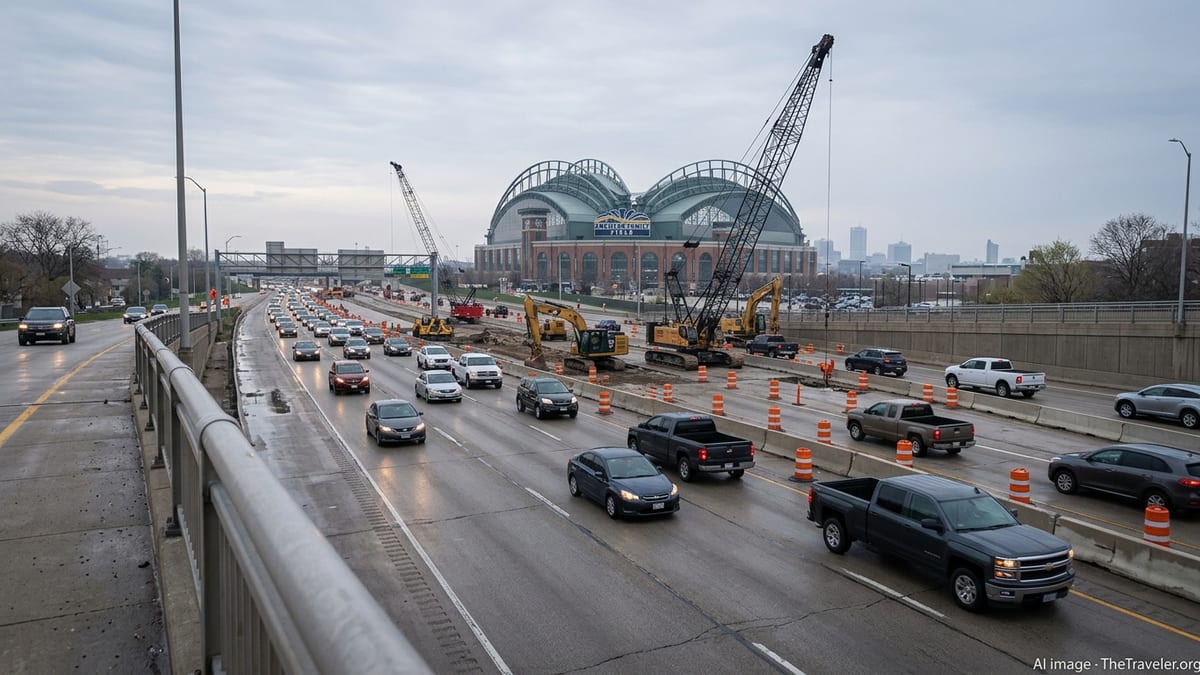
Baseball fans planning road trips to Milwaukee in 2026 may find that the toughest part of a Brewers game is not the opponent on the field, but the traffic getting to American Family Field as major Interstate 94 construction tightens its grip on the city’s primary ballpark gateway.
Get the latest news straight to your inbox!
I-94 East-West Project Collides With Brewers’ 2026 Season
Milwaukee’s long-debated I-94 East-West project is moving from planning documents to daily reality just as the Brewers prepare to open their 2026 regular season at American Family Field. Publicly available information from the Wisconsin Department of Transportation indicates that major work on key segments is scheduled to run from 2026 into 2028, with lane and ramp closures already affecting drivers near the stadium area.
The construction targets one of the region’s busiest stretches of freeway, a roughly three and a half mile corridor that carries traffic past American Family Field and links the Stadium Interchange to other major routes. Transportation documents describe the work as a significant reconstruction and widening of an aging corridor that has long struggled with congestion and crash rates during peak commuting hours and on game days.
For fans who have long relied on a quick hop off I-94 to reach the Brewers’ parking lots, these changes mean 2026 will be a season of recalculating routes, leaving earlier than usual and potentially sitting through extended backups on approaches that once flowed relatively smoothly outside of the biggest sellout crowds.
Closures, Detours and Delays Around American Family Field
Project updates from transportation planners describe a rolling series of lane reductions and ramp closures along I-94 between roughly 70th Street and the Stadium Interchange, with additional work on the so called Early East Leg near 27th Street. In early 2026, that segment includes the closure of the eastbound exit to 26th Street and St. Paul Avenue, a route commonly used by drivers heading toward the stadium from the west.
Although exact traffic patterns will shift as stages advance, the overall picture for 2026 is one of reduced capacity on I-94, narrower work zone lanes and intermittent night and weekend closures. These conditions are likely to be most painful in the hours before and after home games, when thousands of vehicles converge on the same small cluster of interchanges and local streets.
Local commentary and planning documents have already described the project as disruptive for commuters and businesses along the corridor, and those same pressures will spill into the game day experience. Drivers who typically glide in on familiar ramps may be forced onto signed detours that add miles, time and uncertainty to trips, particularly for out of town visitors unfamiliar with Milwaukee’s tangle of alternate routes.
Early Season Home Games Face Peak Construction Pressure
The Brewers’ 2026 regular season schedule, released in late 2025, puts an unusual spotlight on March and early April home dates. The team is set to open at home on March 26 against the Chicago White Sox, marking its first season opener in Milwaukee since 2021. That means some of the earliest and highest profile crowds of the year will be testing new traffic patterns on I-94 at a time when major construction stages are ramping up.
According to published coverage of the schedule, the club will play multiple early homestands before embarking on road trips to Kansas City and Boston and other cities. With American Family Field’s retractable roof, early season weather is less of a concern inside the ballpark, but on the roads outside, variable spring conditions combined with active work zones may further slow traffic and complicate parking arrivals.
Later in the season, the schedule includes out of town series such as a June trip to Las Vegas, but the bulk of home dates from late spring through early fall will coincide with some level of ongoing I-94 disruption. Fans making summer weekend trips to Milwaukee should not expect that congestion will ease simply because the school year has ended or the weather has improved.
Alternate Routes and Local Streets Likely to Feel the Strain
Transportation planners are encouraging drivers to consider local and regional alternate routes during I-94 construction, and that message extends directly to Brewers fans. Public project resources recommend adding extra time, exploring detours and staying current on closures, a signal that standard freeway approaches may be unreliable on high demand days.
Common alternatives for reaching American Family Field, such as using city streets from the north and south or approaching via other freeway interchanges, are likely to absorb some of the traffic displaced from I-94. That shift could push congestion deeper into nearby neighborhoods and along arterials like Bluemound Road and National Avenue, where signals, crosswalks and lower speed limits already constrain flow.
Parking lots around the ballpark, which are designed with I-94 access in mind, may see more uneven arrival patterns as some fans breeze in via lesser known side routes while others remain stuck in bottlenecks. The result could be longer lines at certain gates, heavier pressure on staff directing traffic and a more chaotic feel for those accustomed to predictable pregame rhythms.
What Travelers Can Do Now to Avoid a Game Day Meltdown
For baseball fans planning a 2026 visit, the emerging consensus from public information is clear: advance preparation will matter more than ever. Out of town travelers booking hotels may want to pay closer attention to neighborhood location and proximity to alternate corridors, rather than assuming that simple freeway access guarantees a quick drive to the stadium.
Arriving earlier than usual, particularly for marquee opponents and weekend games, will be a simple but important strategy. Leaving an extra 30 to 60 minutes could mean the difference between catching the first pitch and missing entire innings while idling near a lane drop or ramp closure. Travelers might also consider using navigation tools that reflect real time closures and work zones, rather than relying on printed directions or old habits.
Fans comfortable with public transportation, rideshare services or even biking from nearby neighborhoods could find those options comparatively more attractive during the construction window, especially for weekday evening games that overlap with rush hour. While these modes have their own limitations, they may help some visitors sidestep the worst freeway snarls and parking lot queues.
Ultimately, the 2026 season in Milwaukee is shaping up as a test of patience and planning for anyone driving to American Family Field. The payoff remains the same views of the retractable roof and on field drama, but the journey along I-94 is set to become a central part of the story for baseball travelers throughout the construction years.