

The night before my flight to Lisbon, I lay in bed watching a radar map that looked like a bruise stretching across the North Atlantic. A slow moving storm was marching toward Portugal, and every app on my phone warned of heavy rain, coastal wind, and “disruption to outdoor plans.” My outdoor plans, specifically. I had hiking routes pinned in the Sintra mountains, a sunset cruise on the Tagus, and a long list of pastel painted miradouros I had dreamed of photographing in golden light. Instead, it looked like I was flying straight into a week of gray. For several hours, I hovered over the “cancel trip” button and wondered if I was about to waste precious vacation days and a good chunk of money. I went anyway, mostly because my ticket was nonrefundable and my hotel in Alfama had a strict cancellation policy. I am glad it did. That stormy, imperfect week turned into one of the best trips I have ever taken.
The Forecast That Almost Grounded Me
The warning signs started stacking up five days before departure. My airline, TAP Air Portugal, sent a polite email about “possible weather related delays” at Lisbon’s Humberto Delgado Airport. The National Weather Service and European forecasts showed the same system that had dumped heavy snow on the US Midwest pushing across the Atlantic toward Iberia. News outlets reported hundreds of weather related cancellations in Chicago and New York the week before, with airlines issuing waivers and moving passengers around just to keep planes and crews in the right places. It was not hard to imagine my own flight ending up in that tangle.
On my phone, Lisbon’s ten day forecast morphed from scattered showers to solid rain icons. Wind speeds crept up. The sunset cruise operator I had booked messaged to say they were “monitoring conditions” and might need to reschedule. I did the math on what I had already spent: roughly 780 dollars for a round trip economy ticket from New York booked two months earlier, four prepaid nights at a small guesthouse in Alfama at about 110 dollars per night, plus a nonrefundable 60 dollar ticket for a food tour. Canceling would mean eating at least half of that cost, even with some flexible terms.
I called the airline to see if there was any wiggle room. The agent was sympathetic but firm. Because my flight was still scheduled to operate and no official weather waiver had been issued for my dates, changing to another week meant paying the fare difference plus a change fee that together came close to rebooking from scratch. Travel insurance was no help either; the basic policy I had through my credit card covered trip interruption if weather shut things down after I arrived, not fear of bad weather beforehand. I realized I was facing a classic decision point travelers across the world quietly negotiate every season: cancel and lose money to avoid a maybe miserable week, or go and gamble that “100 percent chance of rain” is not quite as absolute as it sounds.
Why I Chose to Fly Anyway
In the end, what pushed me onto that plane was not optimism so much as perspective. The week before, US travelers had watched a major winter storm close runways and trigger thousands of delays from Denver to Boston, yet most of those disruptions cleared within a day or two once crews and aircraft were back in place. The pattern was familiar. Severe weather looks apocalyptic on a radar map and in breaking news headlines, but the on the ground reality for many travelers is more nuanced: a long security line, a rebooked flight later in the afternoon, or an extra coffee in the terminal while you watch rain streak the windows.
I reminded myself that Lisbon is a city that lives comfortably in less than perfect weather. This is not a tropical island where a week of storms means nothing but gray water and closed beaches. This is a capital with covered markets, tiled churches, trams that rattle through drizzle, and cafes that feel even cozier with a jacket dripping on the back of your chair. Travelers had been adapting to weather there for centuries long before smartphones started shouting red alerts at us. Canceling entirely began to feel like letting a five day forecast dictate an entire year of travel dreams.
There was also the simple fact that weather forecasts are best at the big picture and notoriously imprecise at the hour by hour level, especially several days out. A 90 percent chance of rain for a day in Lisbon often translates into a heavy shower in the morning and low clouds that break into blue by late afternoon. I had seen this play out in other places. In Ireland, a forecast of “rain all day” for Galway turned into an early squall followed by hours of dramatic sunlight rolling over the Connemara hills. In Tokyo one spring, a supposedly washed out cherry blossom day ended up with soft drizzle that made the lanterns in Ueno Park glow even brighter. Remembering those trips made the red radar blob feel less like a wall and more like a filter I could plan around.
Landing in a Different Trip Than I Planned
When we landed in Lisbon, the storm had arrived before us. The runway shone slick under the plane’s landing lights, and gusts rocked the fuselage as we taxied. But the airport itself was calm. There were no crowds of stranded passengers lining the floor with foil blankets, just a few clusters of people refreshing flight boards and checking new departure times. My own delay had been just 40 minutes leaving New York, absorbed into the normal ebb and flow of an international hub used to Atlantic weather.
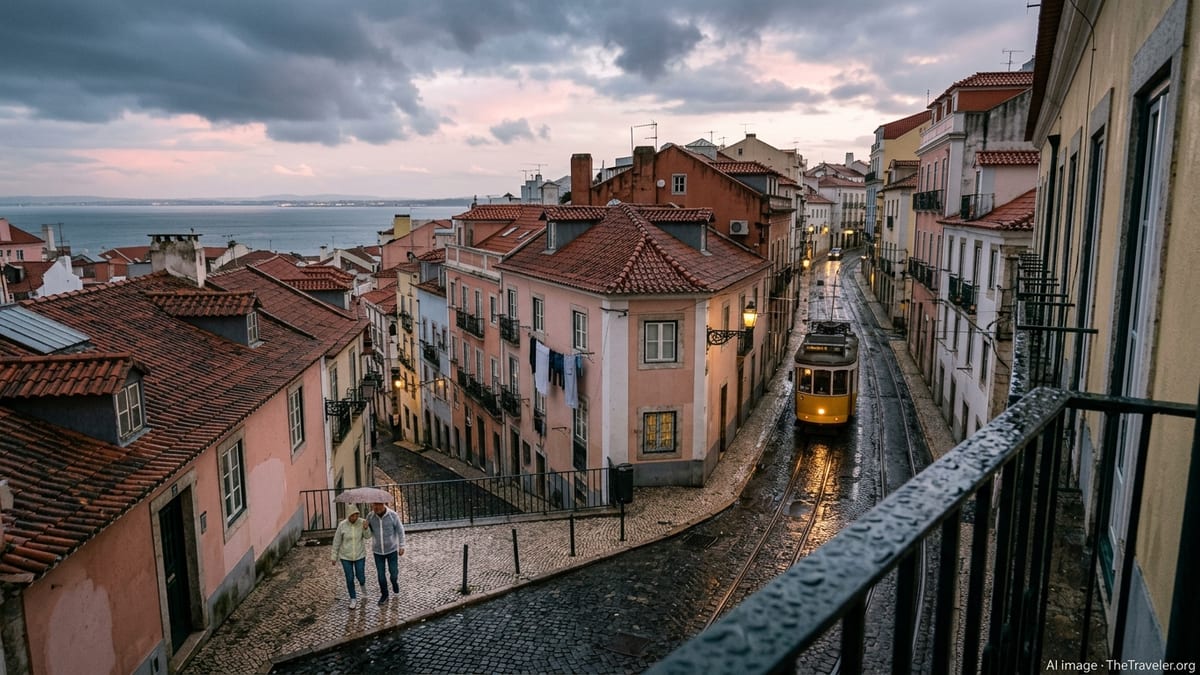
The real adjustment happened once I checked into my guesthouse in the steep lanes of Alfama. The city outside my small balcony was wrapped in a soft, persistent rain that made the cobblestones shine like polished marble. The plan I had built, hour by hour, on a spreadsheet weeks earlier did not survive first contact with reality. The sunset sail on the Tagus was rescheduled to later in the week. My plan to walk the entire waterfront from Cais do Sodre to Belem that first afternoon was quickly shelved. Instead, I ducked into a pastelaria for a bica and a still warm pastel de nata and watched locals shake umbrellas dry at the door.
That first day, the weather forced me to trade wide outdoor vistas for details. I spent an hour in the Igreja de Sao Domingos, tracing the fire scarred stone and darkened arches while rain hammered the roof. The gloom outside made the orange glow of votive candles look almost theatrical. I lingered in the Time Out Market, which on dry days I might have breezed through between other sights. Now I watched fishmongers wrapping orders, locals comparing cheeses, and tourists lined up for plates of cod fritters and black pork sandwiches, all under the clatter of rain on the glass roof.
On my second morning, I walked up toward the Castelo de Sao Jorge under clouds so low the hilltop disappeared and reappeared like a ship sliding in and out of fog. Views from the ramparts were not the sweeping postcard panoramas I had seen online. The 25 de Abril Bridge and the Cristo Rei statue across the river were suggestions in the mist rather than bold silhouettes. Still, the mood was unforgettable. Terracotta roofs glistened. Tram bells echoed up the hill. A stray dog shook off water and trotted along the old walls like he owned the place. It was not the Lisbon I had expected, but it was unquestionably Lisbon.
When Bad Weather Makes a City Better
By the third day, something subtle shifted. I realized many of the experiences I was loving most were directly tied to the very weather that had almost kept me home. In the rainy backstreets of Bairro Alto, I ducked into a small wine bar simply because the sky opened up and I needed shelter. Inside, a local sommelier poured small glasses of vinho verde and explained how the damp Atlantic climate shapes the region’s grapes. The windows fogged, the conversation stretched, and the storm outside became a soft percussion backing track.
A planned beach day in Cascais, advertised in glossy brochures with bright umbrellas and sparkling surf, turned into a long coastal walk in a stiff onshore wind instead. Thick clouds tore open just enough to send shards of sunlight across the Atlantic. Surfers in black wetsuits chased clean sets rolling in off the storm. At a cafe near the marina, blankets appeared on chairs, and the staff served strong coffee and caldo verde to a mix of determined walkers and locals who clearly considered this just another winter day by the sea. That coffee never would have tasted as good on a perfect, predictable afternoon.
Even classic viewpoints took on a different character. At Miradouro da Senhora do Monte, one of the highest lookouts over Lisbon, the usual crowd of selfie sticks was thinner, chased away by wind and the threat of more rain. The city stretched out under a patchwork sky, soaked and shimmering. A group of teenagers huddled under a shared umbrella, laughing at their soaked sneakers. An older couple in matching raincoats sat on a bench and simply watched the clouds move. Bad weather had edited the scene down to people who truly wanted to be there.
I started noticing that other travelers were adapting in similar ways across Europe that season. In Paris, museum staff mentioned that visitor numbers for outdoor attractions dropped sharply on wet spring days, while the Louvre and Orsay grew busier. In Barcelona, hotel concierges talked about steering guests from crowded beach clubs to indoor food markets and neighborhood tapas bars when thunderstorms rolled over the Mediterranean. Weather was not canceling travel so much as reshaping it, nudging people away from guidebook checklists and toward slower, more local rhythms.
Learning When Not to Push Through
None of this means that ignoring weather warnings is wise. There is an important difference between inconvenient and unsafe. Airlines cancel flights for a reason when winter storms shut down runways or when crosswinds exceed safety limits. Travelers on ski holidays in the Alps see resorts close entire lift systems when avalanche risk spikes after heavy snowfall. In the Caribbean, resorts board up windows and evacuate guests when hurricanes approach, even if a few determined vacationers would happily ride out the storm with a bar full of rum punch.
On my Lisbon trip, that line between adventurous and reckless came into focus when I tagged a Sintra hike onto my itinerary. The rail line between Lisbon and Sintra was running on a slightly reduced schedule after fallen branches on the tracks earlier in the week. A local guide I had contacted was clear: trails around the Pena Palace and the Moorish Castle were muddy but passable, but cliffs along the Atlantic coast near Cabo da Roca were off limits due to strong gusts. Standing at the station in Rossio, watching day trippers in ponchos check train times, I realized that listening to people who live and work in a place is the single best barometer for what is reasonable.
Travelers in recent years have shared dozens of stories about discovering this limit the hard way. Hikers in Iceland have had tours canceled because gale force winds on exposed ridges made it genuinely dangerous to be out, even if rental car drivers were still creeping along the Ring Road. In Hawaii, visitors have seen authorities close access to popular waterfalls during flash flood warnings after sudden downpours. In these situations, the right decision is not to push through but to accept that safety trumps sunk costs.
My one major cancellation in Portugal came on the fifth day, when the rescheduled sunset cruise company finally pulled the plug. Winds on the Tagus were stronger than anticipated, and the captain did not want to risk it. Because this was a decision based on active conditions, not forecasts, the company offered a full refund or a credit for another date. I took the refund and instead spent the evening in a tasca in Mouraria, listening to live fado in a room where the walls sweated and wine glasses rattled to the beat of the guitar. It was not the waterborne sunset I had imagined, but I walked back up the hill that night feeling that the city had given me something even better.
How the Trip Changed the Way I Plan
Flying home through a sky that had finally cleared, I thought about how close I had come to canceling everything five days earlier. The cost would not only have been financial. I would have missed conversations, tastes, and moments that I still carry with me. That realization has quietly changed the way I evaluate weather and risk for future trips. Instead of treating a gloomy forecast as a verdict, I now see it as one factor among many, weighed against how adaptable the destination is, what kind of experiences I am seeking, and how flexible my bookings are.
Practically, that means I build more indoor anchors into every itinerary. For a long weekend in Copenhagen in February, I looked at the historical weather patterns and assumed there would be at least a day of bone chilling wind off the harbor. So I planned time for the National Museum, the Design Museum, and long coffee breaks in Norrebro cafes, right alongside walks along Nyhavn and bike rides if conditions allowed. For a shoulder season trip to Vancouver, I accepted that May on the Pacific Northwest coast can swing from glorious sunshine to days of drizzle, and I booked a mix of seawall cycling and Gastown food tours that could be shifted around day by day.
I have also become much more deliberate about understanding which types of travel genuinely are weather dependent. A dedicated surf camp in Costa Rica, a fragile wildflower bloom in California’s desert, or an Arctic Northern Lights chase each hinge on the whims of nature. For those, I try to build in redundancy: extra nights, flexible bookings, and travel insurance that includes “cancel for any reason” options when they are affordable. In contrast, city breaks, food focused trips, and cultural festivals almost always reward showing up, even if I end up spending more hours under awnings and in galleries than on terraces.
The Takeaway
If there is a lesson buried in that week in Lisbon, it is this: our relationship with weather as travelers has become strangely amplified. We carry an entire atmospheric control center in our pockets, complete with storm trackers, push alerts, and social media snapshots from people already on the ground. It is easy to confuse information with certainty and to forget that for generations, people simply went and adjusted once they arrived. Some of my richest memories from that trip are inseparable from the conditions I had tried to avoid: rain beading on azulejo tiles, wind bending palm trees along the coast, clouds opening just long enough to turn the Tagus silver.
When you are staring at a grim forecast before a long awaited vacation, ask yourself a few questions. Is the weather likely to make the trip unsafe, or just different? How resilient is the destination to rain, snow, or wind? Are there indoor experiences, local traditions, or seasonal moods that might only reveal themselves when the sun is not out? And finally, what will you miss, beyond money, if you walk away. There will always be trips you should cancel because conditions cross that line from inconvenient to dangerous. But there will also be many more where showing up, raincoat in hand, turns what could have been a disappointment into the story you tell years later.
FAQ
Q1. Should I cancel a city trip if the forecast shows rain all week?
In most cases, no. Cities like Lisbon, Paris, Tokyo, or New York have enough indoor museums, markets, and cafes to keep a trip enjoyable even in steady rain.
Q2. When is bad weather a valid reason to cancel travel?
Consider canceling when authorities issue formal warnings, airlines start canceling large numbers of flights, or local experts say conditions are unsafe for planned activities.
Q3. How close to departure can I rely on a weather forecast?
Forecasts are usually more reliable within three days of travel. Long range predictions can change, so treat them as guidelines rather than guarantees.
Q4. What types of trips are most weather dependent?
Surf camps, ski holidays, beach only vacations, storm season cruises, and Northern Lights trips depend heavily on conditions and benefit from extra flexibility.
Q5. How can I protect my money if weather ruins my plans?
Flexible airfares, hotels with generous cancellation policies, and travel insurance that includes weather related trip interruption can reduce financial risk.
Q6. Is it worth paying for “cancel for any reason” insurance?
It can be useful for expensive, once in a lifetime trips or those in hurricane or typhoon seasons, because it offers partial reimbursement even for noncovered reasons.
Q7. What should I do if my flight is delayed or canceled by a storm?
Stay in close contact with the airline via app and text alerts, get in line at the gate, and simultaneously call customer service to secure the best rebooking options.
Q8. How can I adapt my itinerary to bad weather once I arrive?
Swap outdoor days for museum or food tour days, move hikes to clearer windows, use public transport more, and ask locals for their favorite rainy day spots.
Q9. Are shoulder season trips more at risk of bad weather?
Yes, shoulder seasons often bring more changeable conditions, but they also mean fewer crowds and lower prices, which many travelers find a worthwhile tradeoff.
Q10. What should I pack if I decide to go despite a bad forecast?
Bring a compact waterproof jacket, quick drying layers, waterproof shoe spray or boots, a small umbrella, and a dry bag or cover for electronics and important documents.