

I did not plan to fall for Lake Huron. On a route that traced the famous Great Lakes, I had penciled it in as a scenic connector, the quieter sibling between the drama of Superior and the name recognition of Michigan. I almost drove past its shoreline entirely. Instead, a last-minute detour turned into a slow, meandering relationship with a lake that keeps pulling me back, with its shipwrecks beneath turquoise water, small towns painted in sunset light, and miles of sand where you can still hear your own footsteps.
Rewriting the Great Lakes Script
Before I met Lake Huron properly, I assumed I already understood the Great Lakes. Superior was the wild one, Michigan the crowd-pleaser, Erie the working lake, Ontario the urban backdrop. Huron, on paper, was a middle child: huge but quiet, more often used as a geographic reference than a destination. It took a slow road trip tracing its shoreline, from Michigan’s “Sunrise Coast” to Ontario’s Bruce Peninsula, for me to realize that this lake has a personality that is subtle at first and unforgettable later.
Part of Huron’s magic is the way it feels both endless and intimate. Stretching between Michigan and Ontario, dotted with islands and carved with wide, sandy bays, it offers the kind of freshwater horizon you expect from an inland sea but pairs it with a string of small towns that still feel human in scale. Many of them lean into simple pleasures: a perfect soft-serve cone after a swim, a wooden boardwalk along the dunes, a community park steps from the water where kids cannonball off a dock as the sun sinks into the lake.
Huron is also a study in contrast. On one side, its Michigan shore is gentler and more pastoral, with wide beaches, harbor towns and a rich maritime past anchored by lighthouses and shipwreck stories. On the Ontario side, especially around Georgian Bay and the Bruce Peninsula, the lake shifts to a rugged, almost Mediterranean palette: cliffs of limestone, water that ranges from pale jade to deep cobalt, and forests that march right down to the shore. Experiencing both shores is like reading two very different chapters of the same book.
Perhaps what surprised me most was how uncrowded Huron still feels, especially compared with the marquee summer destinations on Lake Michigan. Even at well-known beaches and in popular Ontario parks, it is still possible to find quiet early-morning stretches or shoulder-season evenings when you share the view with only a handful of locals. That combination of scale and solitude is rare, and it is one big reason I keep replaying this lake in my mind.
Michigan’s Sunrise Coast: Where The Lake Feels Endless
My reeducation started on Michigan’s Sunrise Coast, the long run of shoreline that faces east toward Lake Huron. Here, the lake becomes a front-row seat to daybreak. Towns like Alpena and others along Thunder Bay offer sandy municipal beaches, waterfront parks and a network of trails and river walks that constantly pull you back to the water’s edge. At Starlite Beach and adjacent parks in Alpena, the sand is wide, the water is clear enough to count your toes in the shallows, and the horizon feels like it belongs to a much larger sea.
This stretch of shoreline carries deep maritime history. Thunder Bay is home to a national marine sanctuary that protects dozens of historic shipwrecks, many resting in relatively shallow, transparent water. Glass-bottom boat tours and snorkeling excursions reveal skeletal hulls below, preserved by the cold freshwater. Even if you never leave the deck of a tour boat, seeing the outlines of sunken schooners beneath your feet is a powerful reminder that this beautiful lake has always been a working one, with all the risk and resilience that implies.
In town, the Great Lakes heritage continues in waterfront museums and visitor centers, where artifacts, stories and interactive exhibits trace the evolution of shipping, fishing and coastal life along Huron. But it is the everyday scenes that linger: anglers lining up along a pier at dusk, kids chasing each other between picnic tables and the surf, and locals who still mark time by the seasons of the lake rather than the schedule of the highway.
Venturing north and south from Alpena, you find more of these small communities where the lake is the common denominator, even if the personality shifts. Some towns feel like classic Midwest summer resorts with ice cream counters and painted cottages. Others are quieter, almost austere, framed by forest and long, nearly empty beaches. Each sunrise looks a little different, but the rhythm repeats: pale light, empty sand, and the slow appearance of life along the shore.
Ontario’s Quiet Towns and Legendary Sunsets
Crossing to the Canadian side of Lake Huron, the atmosphere changes again, but the appeal only deepens. Along Ontario’s eastern shore, towns like Goderich, Port Elgin and others scattered through Huron County and Bruce County face west, straight into what locals love to remind you are some of the best sunsets in the province. In Goderich, a trio of public beaches step down from a bluff-top town laid out around an octagonal central square. A wooden boardwalk runs along the waterfront, passing family beaches, a playground and a working harbor where freighters load salt while swimmers wade just across the channel.
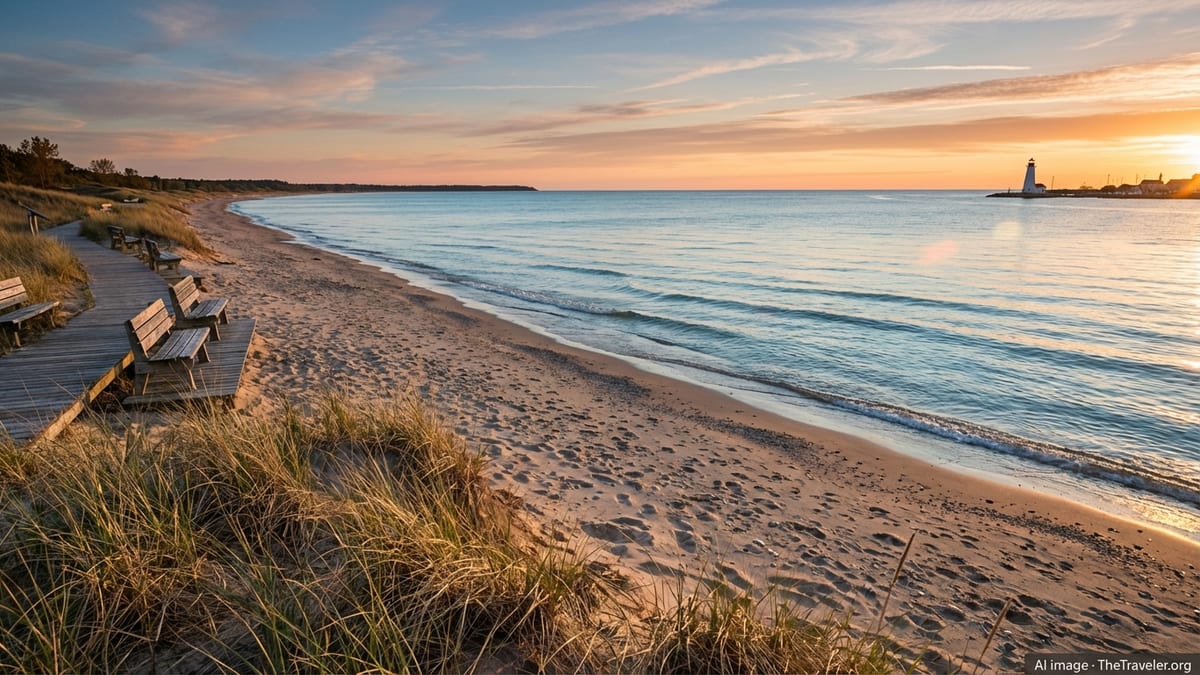
Further up the coast, the community of Port Elgin and neighboring Saugeen Shores lean fully into the sunset mythology. Here, broad, sandy beaches meet a long horizon, and on clear evenings the sky seems to ignite in bands of orange, pink and violet. Locals and summer visitors gather along the water’s edge, some on benches, others on the grass or the sand, to watch the show. Even in peak season, the atmosphere is relaxed rather than raucous. People linger with takeout fish and chips, kids build last-minute sandcastles, and the conversation drops to a murmur as the sun finally slips below the line where lake meets sky.
Just south and north of the better-known towns, quieter beaches wait for anyone willing to leave the main road. Small parking areas, short footpaths through dune grass and simple signs pointing toward “municipal beach” or “day use” are all the infrastructure you will find. That minimalism is part of the draw. Many of these stretches of shore remain free of heavy development, offering uninterrupted views, natural dune systems and room for shorebirds to feed along the tideline.
These Ontario towns also do something subtle but important: they treat the lake as a living neighbor rather than a backdrop. Information boards along the waterfront highlight coastal erosion, dune restoration and water quality efforts. Local outfits host guided paddles, bird walks and interpretive tours. Seasonal festivals and markets often center their schedules around the lakeside parks and pavilions. Spending a few days here, you begin to understand that Lake Huron is not simply scenery. It is an organizing force in community life, shaping everything from town planning to weekend rituals.
From Sandy Beaches to Limestone Cliffs: Huron’s Many Shorelines
One reason Lake Huron lingers in memory is the sheer variety of shorelines you encounter as you move along its perimeter. In some places, like Sauble Beach on the eastern side of the Bruce Peninsula, the lake behaves like a classic resort coast, with an impressively long stretch of sand, shallow water and a summer main street that comes alive with shops and patios. Inland sandbars help keep the nearshore water warmer and calmer in season, making it especially appealing to families and casual swimmers.
Elsewhere, Huron reveals a completely different character. On the Bruce Peninsula’s eastern flank, where Georgian Bay forms part of the greater Lake Huron system, the coast hardens into cliffs and rocky shelves. Places like Lion’s Head sit beneath towering limestone escarpments, where forested trails lead to lookouts with sheer drops to turquoise water. The beaches here are often a mosaic of smooth stones and coarse sand, the water colder but startlingly clear. Sitting on the shoreline, you can trace underwater ledges and boulders for many meters offshore.
Further south, smaller communities such as Point Clark mix soft-sand areas with rocky outcrops and river mouths, punctuated by historic lighthouses. These are working landscapes as much as leisure ones, with small harbors, boat ramps and remnants of older maritime infrastructure. The diversity extends inland, where rivers and creeks wind through farmland before meeting the lake in quiet estuaries rich with birdlife. On a single day you might walk a dune-backed beach in the morning, scramble across flat limestone shelves in the afternoon and watch waves break against a man-made pier at dusk.
For travelers, this means Lake Huron rarely feels repetitive. If a particular stretch of shore does not resonate, the next curve of the coastline often tells a different story. Sand becomes stone, open coast narrows into a sheltered bay, bustling beach town gives way to a near-empty provincial park. It is a reminder that this is not one uniform lake but a complex system of micro-landscapes, each with its own mood and rhythm.
Lighthouses, Shipwrecks and Stories in the Depths
Like all the Great Lakes, Huron has a reputation among mariners that mingles beauty with hazard. Its wide, open fetch can turn sudden winds into steep waves, and fog can descend without warning. To travel its shores is to move through a landscape of navigation and loss, marked by lighthouses and the remains of ships that never made it to safe harbor. These elements give the lake a narrative depth that goes far beyond its surface views.
On both sides of the border, lighthouses stand as sentinels from another era. In Ontario, the Imperial Tower lighthouses built in the nineteenth century still guard key points along Lake Huron and Georgian Bay, including one at Point Clark. Constructed from stone, these towers were part of a coordinated effort to make navigation safer during the height of Great Lakes shipping. Many are now open seasonally for tours, offering views across the water and exhibits about the keepers who once lived in isolation, tending the light through storms and long winters.
Out on the water, especially around Thunder Bay off Alpena and the archipelago of islands at the lake’s northern reaches, historic shipwrecks attract divers and history-minded travelers. Protected marine areas work to document and preserve these sites, some more than a century old. Because Lake Huron is cold and fresh rather than salty, many wrecks remain remarkably well preserved. Even when experienced only from a glass-bottom vessel, their outlines and details are clear, from twisted iron to wooden hulls resting quietly on the lakebed.
These maritime stories are not confined to museums or tour brochures. Locals often have their own family connections to the lake, whether through commercial fishing, shipping, the Coast Guard or simply growing up in communities where storms and high water levels were part of everyday life. Listening to these stories over coffee or on a dock at dusk, you begin to see Lake Huron less as a scenic backdrop and more as an active character in the region’s history, capable of both generosity and sudden danger.
Seasons of a Lake: Beyond the Summer Postcard
It might be tempting to picture Lake Huron only in high summer: bright umbrellas, beach towels and the steady buzz of vacation conversations. Yet part of what makes this lake so compelling is how dramatically it changes from season to season. Visit in late spring, and you may find beaches still half empty, dune grass just shifting from brown to green and water that looks inviting but remains bracingly cold. In early autumn, the crowds thin again, replaced by migrating birds along the shoreline and maples turning crimson just inland.
Winter arrives differently along various parts of the lake, but it brings its own kind of quiet spectacle. In some years, ice forms along the shore, creating shelves, ridges and wind-sculpted formations that look almost arctic. Harbors that buzzed with small boats in July become still, and the soundscape changes from splashing waves to the muffled creak of ice on cold nights. Many coastal towns adapt with winter festivals, cross-country ski trails, snowmobile routes and indoor markets, proving that the lake remains part of daily life even when it is too cold to swim.
For returning visitors, seeing Lake Huron in multiple seasons deepens the relationship. You recognize the same lighthouse in different weather, walk the same boardwalk in sandals and later in a parka, and stand on the same beach watching a delicate spring sunrise and then a heavy autumn storm roll in. These repeated encounters underscore that the lake is a dynamic presence, not a static postcard. The result is a sense of familiarity that feels almost like friendship.
Travel planning often focuses on peak weeks, but Lake Huron rewards anyone willing to lean into shoulder seasons. Accommodation is easier to find, lines shrink at popular ice cream stands and viewpoints, and locals have more time to talk. Even in summer, choosing early mornings or late evenings for your shoreline walks can reveal a slower, more reflective side of the lake that is easy to miss at midday.
Traveling Gently: Respecting a Fragile Freshwater Giant
Spending time around Lake Huron also means recognizing its fragility. Shoreline erosion, fluctuating water levels and pollution pressures are all part of the modern story here. Communities on both sides of the border have had to grapple with damaged boardwalks, flooded low-lying parks in high-water years and exposed lakebed in seasons of lower levels. Conservation groups and local governments continue to adapt, restoring dunes, planting native vegetation and revising building standards close to the water.
The good news is that travelers can easily become part of the solution rather than the problem. Many beaches and parks now feature clear guidelines about staying off sensitive dunes, packing out all waste and respecting seasonal closures for nesting birds. Simple changes, such as choosing reusable water bottles, supporting local businesses that prioritize environmental responsibility and walking or cycling short distances instead of driving between nearby beaches, make a cumulative difference along a coastline that stretches for hundreds of kilometers.
Visiting Lake Huron with intention also means learning a bit about its human history beyond tourism. Indigenous communities have lived along these shores for generations, maintaining cultural and spiritual ties to the water long before recreational visitors arrived. Where possible, seek out Indigenous-led tours, cultural centers or educational programs that share this deeper perspective on the lake and its surrounding lands. Understanding that you are a guest in a long-inhabited place shifts the way you move through it.
In a time when overtourism is reshaping some of the world’s most beautiful coastlines, Lake Huron still sits in a kind of sweet spot. It is popular and beloved, yet large and diverse enough to absorb visitors who are willing to spread out, slow down and tread lightly. Approaching it with curiosity and care is one of the best gifts you can offer a freshwater giant that, in many ways, feels far more vulnerable than its vast surface might suggest.
The Takeaway
Looking back, it is almost funny to remember how close I came to skipping Lake Huron entirely. It was meant to be a line on a map, a stretch of blue between better-known destinations. Instead, it became the part of the journey that lingers most clearly: early-morning walks on quiet Michigan beaches, late-summer evenings in Ontario towns where the whole community turned toward the setting sun, the flash of a lighthouse beam across dark water and the ghostly silhouettes of shipwrecks glimpsed beneath a glass-bottom hull.
What makes Huron so compelling is not a single marquee attraction but an accumulation of experiences. It is the way the lake reveals itself slowly, from sandy bays suitable for families to wild-feeling cliffs and hidden coves, from historical lighthouses to living towns where the waterfront is genuinely part of daily life. It is the combination of beauty and understatement, of vastness and small-scale detail. When I think about the Great Lakes now, Huron is no longer the one in the middle. It is the one that quietly changed the way I see them all.
If you are planning a Great Lakes journey and find yourself tempted to save time by cutting Land Huron from your route, consider doing the opposite. Stay an extra night in a small harbor town. Wake up for at least one sunrise and stay out for at least one full sunset. Walk a boardwalk, climb to a lookout, listen to local stories, and sit long enough on a beach that the rhythm of the waves settles into your bones. You may discover, as I did, that the lake you nearly overlooked is the one you will keep thinking about long after you have gone home.
FAQ
Q1. Is Lake Huron worth visiting if I have already seen the other Great Lakes?
Yes. Lake Huron offers a different feel from the other Great Lakes, with quieter towns, varied shorelines and a strong sense of maritime and small-town character.
Q2. What are some good starting points for exploring Lake Huron?
On the U.S. side, coastal towns along Michigan’s Sunrise Coast make excellent bases. On the Canadian side, communities in Huron County and Bruce County are ideal entry points.
Q3. When is the best time of year to visit Lake Huron?
Summer is warmest for swimming and boating, while late spring and early autumn offer fewer crowds, cooler temperatures and beautiful light along the shore.
Q4. Are there family-friendly beaches on Lake Huron?
Yes. Many towns maintain sandy municipal beaches with shallow entry, nearby playgrounds and facilities, making them suitable for families with children.
Q5. Can I see shipwrecks on Lake Huron without scuba diving?
In some areas, glass-bottom boat tours and snorkeling trips allow visitors to view historic wrecks resting in clear, relatively shallow water without needing dive certifications.
Q6. How cold is the water in Lake Huron for swimming?
Water temperatures vary by location and season, but in many popular areas the nearshore water becomes comfortable for swimming in mid to late summer.
Q7. Is Lake Huron suitable for a road trip itinerary?
Yes. The lake’s long shoreline and string of small towns, parks and viewpoints make it ideal for a multi-day road trip with frequent stops.
Q8. Are there hiking opportunities near Lake Huron?
There are numerous trails, especially near protected areas and along the Bruce Peninsula, offering coastal views, forest walks and access to lookouts over the lake.
Q9. Do I need a car to explore Lake Huron properly?
A car makes it much easier to reach smaller beaches, parks and viewpoints, although some towns are walkable or bike-friendly once you arrive.
Q10. How can I visit Lake Huron responsibly?
Respect local guidelines, stay on marked paths, pack out all waste, support local businesses and learn about the area’s cultural and environmental history.