

I did not go to Block Island looking for magic. I went because the ferry schedule fit my calendar, the ticket was cheaper than a flight to somewhere glamorous, and everyone else seemed to be booking places I could not afford. It was the kind of last-minute choice you make when summer is slipping away and you just need an island, any island. I expected a cute New England weekend at best. Instead, this quiet speck of land off the coast of Rhode Island got under my skin in the gentlest, most surprising way and ended up being the highlight of my year.
First Impressions: An Island That Felt Almost Accidental
The first sign that Block Island was going to subvert my expectations came before I even landed on it. Standing on the ferry deck as we pulled away from Point Judith, I realized how small the island looked on the horizon, a low green rise stitched with sandy bluffs. It did not have the booming reputation of Martha’s Vineyard or Nantucket, no celebrity gossip attached to its name. I had done just enough research to know it was about 13 miles off the Rhode Island coast and that roughly 40 percent of the island was protected as conservation land, including wildlife refuges and preserved coastal bluffs. That sounded interesting, but in my mind I still filed it under: simple, pleasant, probably forgettable.
By the time the ferry eased into Old Harbor about an hour later, the scene felt almost like a postcard from another decade. Instead of a glossy marina lined with designer boutiques, there were weathered wooden inns with wraparound porches, bicycles stacked in cheerful chaos, and a handful of family-run restaurants where the chalkboard specials were written in imperfect handwriting. There were no glass towers, no massive resort complexes, just Victorian hotels and modest guesthouses facing the harbor. It was an island that looked as if it had gently resisted the urge to modernize too much.
Checking into my inn confirmed that impression. My room was on the second floor of an old shingled building, with slightly slanted floors, a metal key instead of a key card, and a view of the harbor where the ferry I had just stepped off was already heading back to the mainland. I had paid around 220 dollars a night in late summer, not cheap but considerably less than what similar waterfront rooms on better-known islands were demanding. I unpacked my small bag, expecting nothing more than a few days of beach time and seafood. Somewhere between putting my sneakers by the door and opening the window to the salty air, I felt my shoulders drop. The island’s pace, even from that first hour, was slower than I had anticipated.
The Moment It Clicked: A Bike, A Bluff, And A Sudden Quiet
The next morning I rented a bike from a shop a short walk from the harbor. The process was endearingly low-tech: a clipboard, a quick signature, a basket strapped on with fading bungee cords. For about 30 dollars I had wheels for the day and no fixed plan beyond riding toward the northern tip. Within ten minutes, I was on a narrow road bordered by stone walls, with fields rolling down toward the sea on both sides. Traffic was almost nonexistent, aside from the occasional pickup truck and other vacationers wobbling along on their own rental bikes.
As I pedaled north, the island revealed itself in small, specific ways that began to undo my earlier indifference. Swallowtail butterflies floated over the tall grass. A small farm stand sat unmanned with a handwritten sign inviting me to leave cash in a metal box for fresh eggs and tomatoes. On a longer trip, I might have stocked up. That little honor-system table, though, told me more about the island’s personality than any brochure: this was a place that still trusted strangers.
The real conversion moment came when I left the paved road and followed a sandy path toward the North Lighthouse. The wind picked up, and the sound of the surf arrived before the view. Then, all at once, there it was: a wide, almost empty curve of beach, waves breaking in clean lines, the stone lighthouse standing solid against a pale sky. There were no beach clubs, no music thumping from portable speakers, just a few scattered walkers and a couple sitting with a thermos of coffee. I slipped off my shoes and walked along the waterline until the cold Atlantic numbed my ankles. Somewhere on that stretch of sand, with gulls circling and the mainland reduced to a faint smudge in the distance, the island won its quiet victory. It felt like it was mine, even though I knew it belonged to everyone who needed this kind of gentle escape.
Nature On Its Own Terms: Trails, Bluffs, And Unpolished Beauty
On many islands, nature is curated: boardwalks everywhere, scenic lookouts with rails, guided tours at every turn. Here, although there were marked paths and clear signage, it often felt like the landscapes were allowed to be themselves. I noticed it later that afternoon at the Clay Head Preserve on the eastern side of the island. Reaching the trailhead required a short ride and a little faith; there were no huge parking lots or visitor centers, just a small sign and a path heading into low scrub.
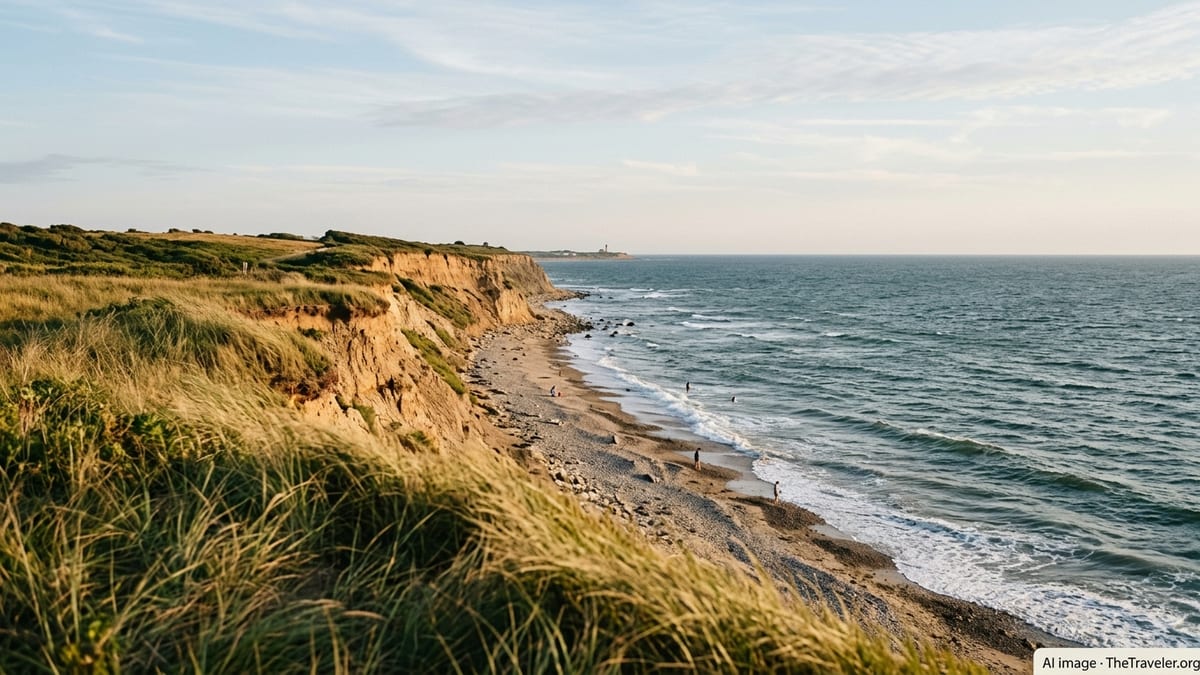
The trail opened onto the famous Clay Head cliffs, where the land drops steeply to the Atlantic. The view was expansive: a ribbon of pale sand below, the sea shifting between slate blue and green, and distant sailboats reduced to tiny silhouettes. A network of side paths, known locally as the "maze," threaded through the brush. I followed a few of them, emerging at different angles along the bluff, each slightly different from the last. The only sounds were wind, waves, and the occasional call of shorebirds. It was the kind of place that could have easily been overdeveloped, but instead had been mostly left alone. Conservation efforts over decades have kept significant portions of the island undeveloped, and here it showed as open horizons rather than hotel rooftops.
Another day, I headed south toward Mohegan Bluffs, where a wooden stairway of more than 100 steps leads down to a narrow beach pressed against the base of the cliffs. At the top, near a small parking area, families snapped pictures with the Block Island Southeast Lighthouse behind them. It is one of the most photographed spots on the island, but even there the scale felt human rather than grandiose. The lighthouse itself, once moved back from the eroding bluff to protect it, stands on a grassy field that looks almost modest in person compared with its postcard image.
The steps down to the beach demand a bit of effort, and that effort acts as a natural filter. By the time I reached the last step, my legs were humming and the crowd had thinned. The beach at the bottom was a mix of stones and narrow strips of sand, the cliffs rising in textured layers of clay and soil. There were no loungers, no rental kiosks, just people who had brought what they needed on their backs: towels, water bottles, maybe a paperback. I stayed for hours, watching surfers catch the intermittent waves and feeling the sun move across the sky. If other islands sell spectacle, this one trafficked in something slower and steadier: the satisfaction of being in a place that did not try too hard.
Life Without All-Inclusive: Inns, Breakfasts, And Dinners That Feel Local
One of the things that had kept my expectations low before the trip was what I had read about accommodations. There are no sprawling all-inclusive resorts on Block Island. That can sound like a drawback if you are used to buffets, swim-up bars, and package deals. In practice, the absence of mega-resorts is part of what keeps the island’s character intact. It also shapes the kind of experience you have from the moment you arrive.
My inn served a simple breakfast each morning: coffee in mismatched mugs, a plate of scrambled eggs, toast, and local jam. On the second day, I learned that the blueberries in the jam came from a farm on the island. The owner mentioned this casually in conversation, the way someone might talk about the weather. Rooms like mine on the harbor-front go for around 200 to 350 dollars per night in peak summer, less in shoulder seasons like June or September. On the inland roads, you can find more modest guesthouses and rentals that dip lower, especially if you travel midweek. None of them promise the polished anonymity of a resort brand. Instead, you get creaky staircases, conversations on wide porches, and the kind of personal recommendations you only get from people who actually live where you are staying.
Dining follows the same pattern. On my second night, I ate at a seafood spot overlooking the harbor, where a plate of fried local squid and a beer set me back around 30 dollars with tip. The next day, I moved inland for dinner at a more casual place where a generous fish taco plate hovered around 20 dollars. There are white-tablecloth rooms on the island where you can spend far more, especially if you order raw bar platters and a bottle of wine, but there are also food trucks, clam shacks, and delis where a sandwich and drink can be had for under 15 dollars. What struck me was not just the prices, which are understandably higher than the mainland in peak season, but the feeling that most of these places existed for repeat visitors and locals as much as for one-time vacationers like me.
In the evenings, the harbor bars filled up with a mix of people: day trippers in still-damp swimwear, couples lingering over a last drink before the ferry, seasonal workers in logoed T-shirts. Live music was more likely to be a lone guitarist than a high-energy DJ. Closing times, especially outside of high summer, came earlier than many city dwellers might expect. Yet there was a comfort in that too. This was nightlife shaped not by an algorithm of maximum revenue but by the natural limits of an island with a small year-round population.
Days That Fill Up Quietly: Beaches, Ponds, And Unexpected Encounters
My days on Block Island followed a gentle rhythm that emerged almost by accident. In the morning, I would pick a direction on the map, grab my bike, and go. Often I ended up on one of the island’s beaches, each with its own subtle personality. Crescent Beach, stretching north from Old Harbor, tended to be the busiest, especially near the main access points where families set up umbrellas and coolers. A bit farther north, Scotch Beach felt sparser, with more space between towels and a stream of surfers and swimmers coming and going. On the western side, at places like Dories Cove, the sunsets dissolved slowly into the Atlantic with few witnesses.
Not every beautiful spot involved the ocean directly. On one especially warm afternoon, I detoured toward one of the island’s freshwater ponds. These quiet inlets, some accessible from the road and others by short walks, offer a different mood: reeds shifting in the breeze, kayaks sliding silently across the surface, and the occasional heron lifting off from the shore. Stand-up paddleboard rentals are available in season for those who want to explore the protected waters. Prices vary, but a couple of hours on a board usually runs in the range of 40 to 60 dollars. I opted instead to sit on the grass and watch dragonflies track their tiny flight paths.
The encounters that stayed with me most were the small, unscripted ones. A woman at a coffee shop recommended a side road that led to a hill with one of the best views of the island’s patchwork of fields and coastline. A local fisherman at the harbor casually mentioned which chowder hut did the best job with clams on a given day, his opinion based on who he had sold to that morning. A group of teenagers at the beach, clearly seasonal workers, discussed which restaurants were about to close for the year and what that meant for their evening plans. These moments, brief as they were, made me feel part of something that continued before I arrived and would continue long after I left.
Getting There, Getting Around, And When It Feels Most Like Itself
Part of what kept my expectations muted before the trip was the logistics. From the perspective of a traveler used to booking flights, ferries can feel like an extra hurdle. In reality, getting to Block Island was straightforward. From mainland Rhode Island, the traditional ferry crossing from Point Judith takes roughly an hour, with a faster high-speed option that cuts the time in half. In peak summer, round-trip fares for foot passengers generally sit in the 30 to 60 dollar range, depending on speed and time of day. There are also seasonal ferries from New London in Connecticut and other ports, which open up options for travelers from New York or Boston without requiring long drives.
Once on the island, it becomes clear why so many visitors abandon cars altogether. The main roads are perfectly manageable by bike for reasonably active travelers, and rental shops cluster around Old Harbor. Daily rates hover around 25 to 40 dollars for standard bikes, a bit more for e-bikes if you prefer some support on the hills. Mopeds and small cars are also available for hire, though the island’s narrow roads and the occasional foggy morning make cautious driving essential. Public transportation is minimal, but the island’s compact size works in your favor. You can cross from one end to the other in under an hour by bike if you are motivated, and much more slowly if you allow yourself to stop at every appealing trailhead and overlook.
Timing matters, perhaps more than I realized when I booked. Summer weekends can feel busy, particularly when day trippers arrive on morning ferries and leave in the late afternoon. The beaches near Old Harbor and the most famous sights, like Mohegan Bluffs, absorb much of that energy. Weekdays in June and September fall into a sweet spot: enough open restaurants and services to feel lively, but fewer crowds and slightly gentler prices on rooms. In the shoulder seasons, some businesses reduce hours or close entirely, so it is worth checking ahead, but the trade-off is an island that feels more like the place locals know.
Why This Modest Island Stayed With Me Long After I Left
It has been months since I folded my bike basket, handed in my metal key, and watched the island recede from the ferry deck. Bigger trips have happened since then. I have flown to a European capital, visited a tropical archipelago with turquoise lagoons, and checked into a few hotels where the lobby alone cost more to decorate than my entire house. Yet when people ask about my favorite recent trip, I keep finding myself telling them about Block Island, the place I originally chose because it happened to fit a gap on my calendar.
Part of that loyalty is rooted in what the island does not have. It does not have traffic lights. It does not have a skyline or a luxury shopping district. It does not have, at least for now, the feeling that it is built primarily for social media moments. When you walk a trail there, you are more likely to see a field biologist or a local walking their dog than a professional photo shoot. That lack of spectacle gives the remaining details room to breathe: the call of birds in one of the refuges, the smell of salt in the air after a storm, the way the late light slides over the bluffs and turns the clay warm and golden.
Mostly, though, it is the way the island altered the scale of my expectations. I arrived thinking I needed a certain kind of destination to feel transported: grand, famous, maybe a place that comes with a list of top ten things you must do. Block Island showed me that transformation can also happen on an island where the most memorable moments involve getting a little lost on a trail, eating chowder on a porch while a storm passes, or standing alone on a beach where the only footprints are your own. It reminded me that sometimes the places you choose almost by accident are the ones that teach you how to travel differently: slower, more attentive, and open to being surprised by quiet.
The Takeaway
Looking back, I realize that my low expectations were not really about Block Island at all. They were about my own assumption that a place has to be loudly famous to be deeply affecting. This small island, with its protected open spaces, modest accommodations, and unhurried rhythms, quietly dismantled that belief. It proved that you do not need overwater villas or infinity pools to feel like you have stepped out of your regular life and onto different ground.
If you arrive here expecting nonstop nightlife, a strip of luxury boutiques, and the convenience of an all-inclusive bracelet, you may be puzzled at first. But if you come willing to ride a slightly rusty bike down a country road, to walk down a long staircase to a small stone beach, to stand at the edge of a bluff and let the wind push against you as the Atlantic rolls in below, the island has a way of working on you. It is not spectacular in the obvious ways. Instead, it is the kind of place that stays with you quietly, like the feeling of sand still clinging to your feet hours after you have left the beach.
I did not expect much when I booked my ferry ticket. What I found was an island that felt deeply itself, a community that has chosen conservation over unchecked development, and a landscape that rewards anyone willing to slow down and pay attention. In a travel world often dominated by superlatives and must-see lists, that might be the most winning quality of all.
FAQ
Q1. Where exactly is Block Island and how do you get there?
Block Island lies about 13 miles off the southern coast of Rhode Island in the Atlantic Ocean. Most visitors arrive by ferry from mainland ports such as Point Judith in Rhode Island or, seasonally, from New London in Connecticut and other nearby harbors.
Q2. Is Block Island a good alternative to places like Martha’s Vineyard or Nantucket?
Yes. Block Island has a similar New England coastal feel but on a smaller, quieter scale. It generally has fewer luxury resorts and less intense crowds than some better-known islands, while still offering beaches, lighthouses, and charming inns.
Q3. When is the best time of year to visit Block Island?
High summer from late June through August offers the warmest beach weather and the fullest slate of open businesses, but it is also the busiest. Many travelers find June and September ideal, with milder crowds, slightly lower prices, and still-pleasant temperatures.
Q4. Do you need a car on Block Island?
No. The island is compact enough that many visitors rely on bikes, walking, or occasional taxis. Bike rentals are widely available near the ferry landing, and reasonably fit travelers can reach most beaches, lighthouses, and trailheads on two wheels.
Q5. Are there all-inclusive resorts or big hotel chains on the island?
No. Accommodations lean toward independent inns, small hotels, guesthouses, and rental homes. Rooms range from simple, older properties with character to more polished boutique options, but large all-inclusive resort complexes are not part of the scene.
Q6. Is Block Island expensive compared with other coastal destinations?
Summer prices reflect its popularity, especially for harbor-front rooms and restaurant meals, but it often undercuts some high-profile islands in neighboring states. Travelers on moderate budgets can keep costs manageable by visiting in the shoulder seasons, staying slightly away from the harbor, and mixing sit-down dinners with casual takeaways and picnics.
Q7. What kinds of outdoor activities are available besides the beach?
In addition to swimming and sunbathing, visitors can hike bluff-top trails, explore wildlife refuges, kayak or paddleboard on ponds, cycle around the island, fish from shore or by charter, and watch sunsets from the western shoreline.
Q8. Is Block Island suitable for families with children?
Yes. Families often appreciate the relaxed pace, walkable main village, wide beaches with gentle sections of surf, and the novelty of arriving by boat. Parents should keep an eye on kids around cliffs and stairways, but many areas are well suited to family outings.
Q9. What should first-time visitors absolutely not miss?
Many first-timers make sure to visit Mohegan Bluffs and the Southeast Lighthouse, walk or bike to the North Lighthouse and surrounding beach, spend time on Crescent or Scotch Beach, and sample local seafood in town or at a harbor-side restaurant.
Q10. How long should you plan to stay on Block Island?
A single day trip offers a good introduction, but staying two or three nights allows enough time to explore beaches, trails, and village life without rushing. Travelers who enjoy slow, nature-focused breaks often find that a long weekend feels surprisingly short once they settle into the island’s pace.