

There is a particular kind of dread that settles in my stomach every time I follow a stream of rolling suitcases toward a “must see” attraction. I start imagining bland chain restaurants, souvenir shops selling plastic Eiffel Towers made in another country, and an experience that costs too much and means too little. As a travel writer, I have learned to be suspicious of anywhere described as “iconic” and “bucket list” in the same sentence. So when I walked into a few of the world’s most notorious tourist traps recently, I was fully prepared to hate every second. Instead, they forced me to admit something I do not say lightly: sometimes the cliché is crowded for a reason.
Following the Neon to Times Square
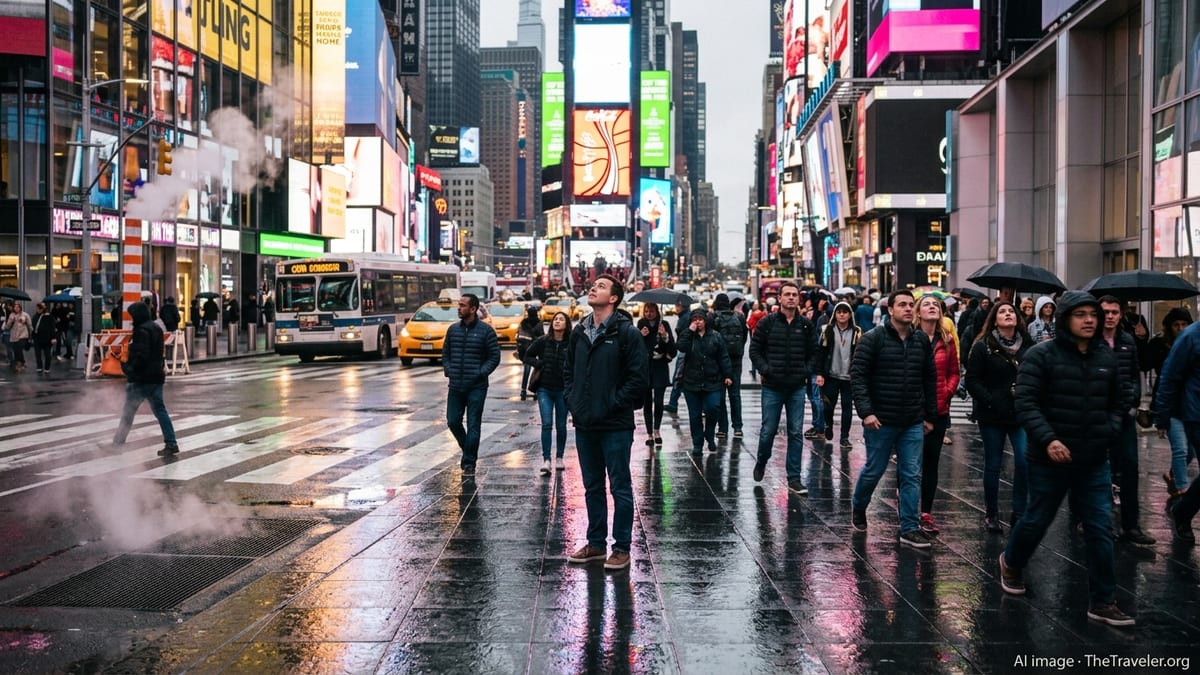
On a cold March evening in New York City, I finally gave in and walked up Seventh Avenue toward Times Square. Every New Yorker I know had warned me off it. Articles list it among the classic American tourist traps, citing the chain restaurants, aggressive costumed characters, and souvenir shops selling “I ♥ NY” hoodies at triple the price you would find in Queens. Yet I was staying in Midtown, and the glow of the billboards pulled me like a tide.
The crowds thickened near 42nd Street. I passed a family debating whether to pay nearly 50 dollars a person for an observation deck and a street vendor selling umbrellas for 20 after a five minute drizzle. It was every stereotype I expected. But then I reached the red steps above the ticket booth and turned around. The entire square shimmered with reflected light on the wet pavement. Yellow cabs slid past like bright fish in a digital aquarium. It looked exactly like every movie scene I had ever seen, only now I could hear the low roar of it in my ears.
I stood there for fifteen minutes, maybe twenty, watching visitors film themselves under a billboard cycling from a Broadway musical trailer to a Korean beauty brand. It was chaotic and absolutely not “authentic” New York in the way small bars in the East Village might be, but it was New York as the world imagines it. I would not tell anyone to spend a whole afternoon there, and I would still suggest eating elsewhere, but those twenty minutes on a drizzly night earned their place in my memory.
The secret, I realized, is timing and intention. I did not go expecting a neighborhood. I went expecting a light show. I did not book a 90 dollar themed restaurant meal; I grabbed a two dollar slice from a tiny pizzeria on Eighth Avenue and treated Times Square as a spectacle, not a dining room.
Venice: The Gondola Ride I Swore I Would Not Take
Venice appears on almost every modern list of over-touristed destinations. Headlines warn about the cruise ships, the high prices for average coffee on Piazza San Marco, and of course the gondola rides that can run around 80 to 100 euros for half an hour, depending on time of day and route. Before my first visit, I told friends I would never pay that much to sit in a boat while someone in a striped shirt pretended not to hate his job.
For three days I stuck to my vow. I navigated vaporetto water buses like a local, bought a 24-hour transit pass, and zigzagged through quieter districts like Cannaregio and Dorsoduro. Venice without the clichés was already captivating: laundry hanging across narrow alleys, schoolchildren racing each other over arched bridges, elderly women comparing artichokes at the Rialto market. I felt smug every time I sidestepped a gondola traffic jam near the Grand Canal.
On my final evening, though, a pink-gold light spilled over the lagoon and I found myself near a small canal off Campo Santa Maria Formosa. A gondolier leaned on his oar and said a simple “Giro?” I checked the hand-painted price board fixed nearby: the standard daytime rate posted by the city, no inflated “special sunset” surcharge. A German couple hesitated, then walked away. I hesitated too, then thought of how often people mentioned regretting not doing it once. I climbed in.
We slipped under stone bridges as the sky turned from gold to mauve. The gondolier pointed quietly at details I would have missed: a lion carved above a door for protection, a hidden courtyard where a fig tree grew through crumbling brick, a narrow passage that locals used to reach a tiny church. The noise of the main canals faded; I heard only the hollow clink of the oar and the muffled talk from apartment windows. Yes, it was undeniably “touristy.” Yes, I could have had a full dinner elsewhere for the price. But the perspective of seeing Venice from water level in that moment felt like the city revealing its original logic. It turned out some clichés are simply distilled versions of what made a place remarkable in the first place.
Blue Lagoon, Iceland: Spa or Overpriced Puddle?
When I started planning a winter stopover in Iceland, the Blue Lagoon came up in every conversation, usually with a grimace. Friends complained about the cost, with basic entry packages often hovering around 80 to 100 US dollars depending on season and timing. Photos online showed shoulder-to-shoulder bathers with plastic cups of prosecco, which struck me as the opposite of the quiet geothermal pool experience I wanted. Many recent travel columns have called it an Instagram trap and suggested smaller, cheaper hot springs instead.
Still, it was easy to reach between Keflavik Airport and Reykjavik, and a long layover gave me time to experiment. I booked one of the earliest morning slots in late January and used public bus connections rather than an organized tour to keep costs reasonable. When I stepped from the locker room into the steam, the air temperature was below freezing. A thin crust of ice ringed the milky water, and a pale blue light leaked over lava fields in the distance.
Instead of crowds, I found perhaps fifty people scattered through the wide pool. The high season summer chaos I had feared simply had not arrived yet. I floated on my back and watched a faint watercolor sunrise smear across low clouds. My hair stiffened in the cold but my shoulders melted in the warmth. Staff members moved quietly around with trays of the included silica mask, and yes, there were people buying 15 dollar drinks at the swim-up bar, but the overall mood felt surprisingly calm.
Was it expensive for a few hours of hot water? Absolutely. I would not suggest it to a backpacker counting every krona. But as a jet lag cure and a sensory introduction to Iceland’s volcanic landscape, it worked better than any airport hotel bed would have. The trick here was treating it as a controlled splurge and choosing a slot that aligned with low light and lower visitor numbers, not the middle of a Saturday afternoon in July.
Niagara Falls: The Carnival Around a Natural Wonder
Niagara Falls has one of the worst reputations of any major natural attraction in North America. Travelers complain that the Canadian side feels like a mini Las Vegas, all neon arcades, chain restaurants, and haunted houses. The American side has its own strip of motels and fast food spots. Even some locals will tell you to skip it entirely. Before I went, I could almost hear their voices warning me as I searched room rates and winced at the cost of some viewpoints-based attractions.
I arrived on a weekday in early autumn and checked into a simple hotel a fifteen minute walk from the main drag, avoiding the priciest falls-view suites. Walking toward the water, I passed wax museums, themed mini golf, and a store selling maple leaf everything. It was noisy and visually overwhelming, the sort of place where a family could easily spend hundreds of dollars in a single afternoon without noticing, just moving from one small ticketed experience to another.
Then the road curved, the roar grew louder, and I stepped onto the promenade facing Horseshoe Falls. The tourist clutter dropped away, at least visually. Mist rose in steady plumes, refracting weak sunshine into a blurry half rainbow. A Maid of the Mist style boat nosed cautiously toward the base of the falls, tiny against the rush of water. I leaned on the railing and thought, “Oh. That is why people come.”
I did take one of those boat tours, booking a weekday midday departure. The plastic poncho was as ridiculous as I expected, and the onboard photos felt like textbook upsell. Yet the moment the boat pushed into the spray and the roar swallowed every other sound, the rest of the strip vanished. My shoes filled with water; my glasses fogged; I laughed out loud. Ten minutes later, we were back at the dock and the carnival atmosphere resumed, but the memory I kept was that small segment right at the base of the falls, pure and huge and indifferent to ticket prices.
How to Survive a Tourist Trap and Still Enjoy It
After a year of tentatively embracing places I once swore off, patterns started to appear. The difference between a miserable trap and a worthwhile classic often came down to when I went, where I spent money, and how long I stayed. In Times Square, arriving after a light rain on a weekday evening meant reflections instead of shoulder-to-shoulder crowds. In Venice, picking a gondola on a quiet side canal and checking the city-posted rate saved me from bargaining at the most crowded docks near Rialto.
It also helped to be deliberate about where not to spend. In Niagara, I skipped the bundle passes that included wax museums and themed rides that did not interest me, and paid only for the boat tour that brought me closest to the falls. In Iceland, I chose the basic entry level to the Blue Lagoon without add-ons like private changing suites or full spa treatments, because what I really wanted was just the water and the view. Saying no to the extras meant I felt less resentful about the core experience price.
Another quietly powerful tactic was pairing the classic with something quieter nearby. After my twenty minutes in Times Square, I walked west to Hell’s Kitchen for a simple bowl of noodles in a small neighborhood spot where the only souvenir was the bill. After the Blue Lagoon, I visited a small local pool in Reykjavik the next day for a fraction of the price and found myself chatting with residents about daily life. Instead of choosing between “authentic” or “touristy,” I treated both as two sides of the same trip.
The attitude shift mattered most. If I arrived expecting a life changing spiritual revelation, the crowds and prices would always disappoint me. If I arrived expecting a spectacle that millions of people were also curious about, the experience could land more gently. There is value in saying, “I just want to see what all the fuss is about,” and allowing that to be enough.
Rethinking What We Call a “Tourist Trap”
The phrase “tourist trap” gets thrown around easily, especially online. It can mean anything from a genuinely cynical attraction built only to extract money to a world class monument that happens to be popular. Lumping them together hides important differences. Times Square’s neon billboards are not pretending to be a hidden gem; they are an unapologetic advertisement for themselves. Venice’s gondola rides operate within a regulated system that publishes rates and routes, even if they are expensive. The Blue Lagoon is a commercial spa built on geothermal runoff, but it also showcases a landscape that defines Iceland’s global image.
What tends to make people angry is not the presence of other tourists. It is the gap between promise and reality. If a brochure shows empty pools and you arrive to a packed complex, you feel misled. If a restaurant in a famous square serves reheated pasta at triple the going price two blocks away, you feel scammed. The solution is not to avoid every famous place. It is to approach them with a clear-eyed understanding of what they are actually selling: a view, a feeling, a photo, a brush with history, or sometimes just bragging rights.
There is also a subtle privilege in declaring that you are “too cool” for the big sights. Many people save for years to visit New York once and want to stand in front of those flashing billboards because that is the image of the city they grew up with. Others dream of that misty photo in front of Niagara Falls or the pastel houses of Venice reflected in water. Writing off those desires as naive misses the point of why travel stories matter at all.
The question I now ask is not “Is this a tourist trap?” but “What will I personally gain from seeing this, and is the trade off of money and time worth it for me?” Sometimes the answer is still no. But when the answer is yes, it feels liberating to stop apologizing for wanting to stand where countless others have stood and to let the experience be what it is.
The Takeaway
I set out on this informal experiment fully expecting to confirm my bias against the world’s most crowded sights. Instead, I learned that a place can be overhyped, expensive, and imperfectly managed and still deliver a moment that justifies the plane ticket. Times Square gave me a single, vivid frame of New York’s global myth. A Venice gondola glide offered a brief window into the city’s original rhythm. The Blue Lagoon softened a red eye flight into something almost luxurious, and Niagara Falls roared loud enough to drown out every souvenir stand.
None of these experiences erased the legitimate criticisms travelers raise. They are busy. They are not cheap. They sit inside ecosystems of upsells and tacky side attractions. But if you choose your moment, protect your budget from the worst of the add-ons, and accept that you are stepping into a shared spectacle rather than a private discovery, they can still be worth your time. The trick is not to confuse popularity with inauthenticity, or crowds with failure.
So go ahead and see the thing you secretly want to see, even if the internet calls it a trap. Walk through the neon, climb into the boat, wrap yourself in the poncho. Take the photo, then put the camera down and pay attention to the small, unscripted details at the edges of the frame. That is where the story you will still remember years later often quietly unfolds.
FAQ
Q1. How can I tell if a tourist trap is still worth visiting?
Ask what specific moment or view you want from it, check recent photos and reviews for realistic crowd levels, and decide if the time and ticket price feel fair for that one experience.
Q2. When is the best time to visit busy places like Times Square or the Blue Lagoon?
Weekdays, early mornings, and shoulder seasons generally mean smaller crowds and lower stress. In New York, a rainy evening can thin out visitors; in Iceland, early winter slots can feel calmer than peak summer.
Q3. How do I avoid overpaying at famous attractions?
Look up official prices on the venue’s own channels, avoid buying from touts in the street, skip expensive “gold” packages you do not need, and eat a few blocks away from the main sight.
Q4. Are gondola rides in Venice really regulated, or is everything negotiable?
The city publishes standard base rates and typical ride durations, though some extras can change the price. Check the posted rate board at a gondola station before agreeing, and confirm cost and length of ride up front.
Q5. What should I pack for high-splash attractions like Niagara Falls boat tours?
Bring a light waterproof layer, quick drying shoes or sandals, a small dry bag for your phone, and a microfiber cloth for glasses or camera lenses that will fog or spot with spray.
Q6. How can I balance famous sights with more local experiences on the same trip?
Pair each headline attraction with time in a nearby residential neighborhood, market, or park. For example, combine Times Square with a walk through Hell’s Kitchen, or Venice’s main canals with an afternoon in Cannaregio.
Q7. Are there ways to experience these places on a tighter budget?
Yes. Use public transport instead of tours, choose basic entry levels, share costs with friends when possible, and limit yourself to one or two paid attractions per day while enjoying free viewpoints and city walks.
Q8. How do I keep from feeling overwhelmed by crowds at popular sites?
Set a maximum time you will spend there, take short breaks on side streets or quieter corners, stay hydrated, and remember that you can always leave and come back at a different hour.
Q9. Is it still ethical to visit heavily touristed places?
It can be, if you respect local rules, support small businesses alongside major ones, avoid damaging behavior, and visit in seasons and ways that spread out pressure whenever possible.
Q10. What should I do if I arrive and immediately regret coming?
Give yourself a short window to see the main highlight, then pivot: walk a few blocks away, find a local café, or switch to a nearby park or neighborhood so the entire day is not defined by one disappointing stop.