

I went to Turkey expecting postcard beauty: the rose canyons of Cappadocia, the blue shimmer of the Aegean, the skyline of Istanbul cut with minarets. What I did not anticipate was how intense the country would feel in every direction at once. Turkey is not a soft-focus Mediterranean dream. It is noisy and complicated, emotionally charged and physically overwhelming, and it pulls you in far more deeply than a simple beach holiday ever could.
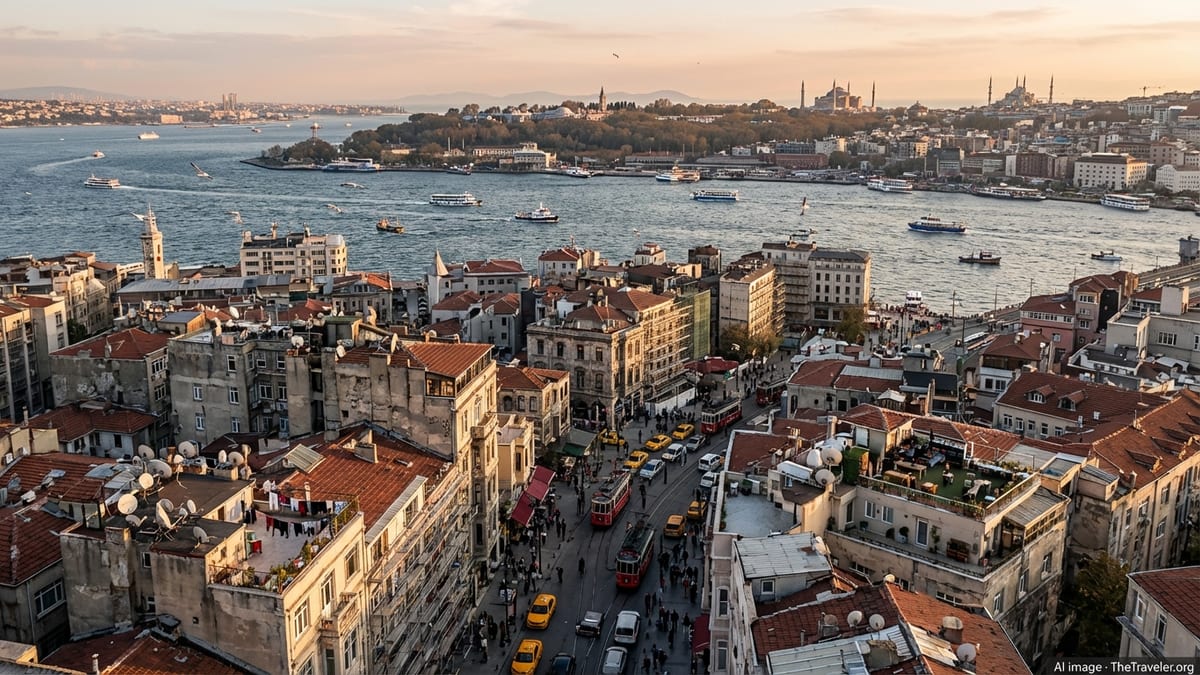
The First Shock: Istanbul Hits All the Senses at Once
My introduction to Turkey was Istanbul, and it arrived not as a gentle welcome but as a tidal wave. This is a city of more than 15 million people straddling Europe and Asia, and you feel that scale the moment you step into it. Ferries cut across the Bosphorus, traffic grinds and surges, and the call to prayer rolls over the hills in layered echoes. Istanbul remains Turkey’s premier tourist magnet, drawing tens of millions of visitors a year, and at peak hours you feel as if all of them are crossing the Galata Bridge at once.
The beauty is undeniable. From the rooftop terraces in Karaköy and Beyoğlu you see domes and minarets unfurl toward the Marmara Sea, container ships waiting on the horizon. Yet the intensity runs just as deep. Street vendors shout over one another to be heard, trams rattle past historic churches and mosques, and you are constantly shifting gears between eras. One minute you are in the shadow of a Byzantine cistern, the next in a sleek café serving third wave coffee to students on their phones. It is exhilarating and slightly exhausting, like trying to read three different centuries at once.
Even Istanbul’s landmarks now carry an extra emotional charge. Hagia Sophia, nearly 1,500 years old, is undergoing a fresh phase of structural restoration focused on reinforcing its domes against earthquakes. Work continues while it functions as a mosque, a reminder that Turkey sits on restless earth and must protect its treasures even as crowds fill the aisles. The line outside snakes around the forecourt, a mix of pilgrims and tourists, all of them sharing the same hushed intake of breath when they first step beneath the soaring dome.
That was my first lesson in Turkey. Nothing exists in isolation. Every view, every monument, every taste of street food is embedded in a wider story that you can sense even if you do not fully understand it yet. The country welcomes you, but it also insists that you pay attention.
Beauty With an Edge: Traveling in a Land of Fault Lines
Part of Turkey’s intensity comes from the ground itself. This is a country of snowcapped mountains, volcanic plateaus and long fault lines. In recent years, powerful earthquakes in the south and west and a strong tremor in Balıkesir province have reminded everyone, locals and visitors alike, that the landscape here is still moving. Popular cities like Istanbul and Izmir were largely unaffected by the most recent quake, and day to day life continues. Yet earthquake drills, reinforced buildings and public-safety announcements are part of the national rhythm.
Traveling through the country, you feel that tension between beauty and vulnerability. In Cappadocia, balloon operators watch weather patterns with forensic attention before gently lifting visitors into the sky at sunrise. Along the Aegean, resorts promote Turkey as a year-round destination, pointing to mild winters and expanded infrastructure. Behind the marketing lies a quiet seriousness about preparedness and resilience, born from hard experience.
That awareness does not make Turkey feel unsafe so much as hyper-aware. Sirens in the distance trigger a flicker of unease until you learn they are as likely to announce a football victory as an emergency. Hotel staff casually mention where the emergency exits are and how to reach open ground. In Istanbul, renovations at historic sites take into account seismic strengthening, while new buildings on the outskirts go up under stricter codes than in the past. You travel in full view of the forces that shape the country’s destiny.
For many visitors, this combination of natural drama and fragility becomes part of Turkey’s pull. Watching the sun go down over the jagged outline of Mount Erciyes or the Taurus Mountains, you know that this is a landscape that has risen, cracked and settled over millennia. To stand there, even briefly, is to be reminded that travel is never just about pretty views. It is about entering into a place that continues to be written by the earth itself.
A Country at Full Volume: Crowds, Commerce and Constant Motion
Turkey’s tourism numbers have surged in recent years, with more than 60 million visitors annually and revenues measured in tens of billions of dollars. That success is visible on the ground. In Istanbul’s Grand Bazaar, in Antalya’s marina, in Cappadocia’s valley viewpoints, the sheer volume of people can feel overwhelming, particularly in the high summer months when European school holidays collide with regional travel peaks. This is not a destination where you are likely to have a famous site to yourself.
The upside is an energy that rarely drops below high. In coastal cities such as Antalya and Bodrum, resort promenades thrum late into the night with music, conversation and clinking tea glasses. In the Black Sea hills above Rize and Trabzon, tea houses buzz with local families on weekend drives, hikers in muddy boots and road-tripping students singing along to pop songs on their phones. Turkey’s domestic tourism is strong, and as a visitor you are simply another thread in a vast, moving tapestry.
At times, the commercial intensity can feel like too much. Around popular sites, guides and touts call out in multiple languages, restaurants compete with elaborate menus and photo boards, and shopkeepers are practiced in the art of gentle persuasion. The rhythm softens a little when you learn a few Turkish phrases, smile, and let your curiosity show. Conversations shift from “Where are you from?” and “Come see my carpets” to talk of family, football clubs, inflation and the latest television dramas. The country’s economic realities, including rising prices and currency fluctuations, are written into these encounters as clearly as any price list.
For travelers, that means budgeting for higher costs than guidebooks from a few years ago might suggest and being ready for negotiation to be part of daily life. It also means accepting that Turkey operates at a faster, louder, more improvisational pace than many of us are used to. Traffic surges and then dissolves, ferries are crowded one day and calm the next, and plans are constantly adjusted around weather, prayer times and family obligations. Once you accept that you are joining a system already in motion, not designing a private trip for yourself, the intensity becomes part of the attraction.
The Emotional Weight of History, Layered in Every Street
Even if you came to Turkey only for beaches and balloon rides, history finds you. It is there when you look up at the mosaics in a medieval church-turned-museum, when you trace Roman paving stones in Ephesus, or when you see a modern apartment block built over what was once an Ottoman garden. What struck me most was not the age of the ruins but the way different eras press against each other with almost no empty space between.
In Istanbul’s historic peninsula, you can stand between Hagia Sophia and the Blue Mosque, aware that one began as a Byzantine cathedral and the other as a statement of imperial Ottoman power. A short walk away lies the Hippodrome, where chariots once raced, and beyond that, small side streets where neighborhood cats sleep on warm car hoods. The conversion of Hagia Sophia back into a mosque in 2020, followed by ongoing restoration work, continues to spark debate about how a modern republic balances its secular framework with public expressions of faith. You do not need to follow every nuance of Turkish politics to feel that these spaces are alive with arguments about identity and memory.
Elsewhere in the country, ancient sites sit beside contemporary life in striking ways. In the Aegean town of Bergama, modern houses climb the slopes beneath the ruins of Pergamon, a Hellenistic city that once hosted one of the ancient world’s great libraries. In southeastern Anatolia, the carved stones of Neolithic sites lie within driving distance of busy regional hubs. These juxtapositions are part of what makes travel in Turkey feel so intense. You are not only looking back; you are constantly reminded that people here are still deciding how to live with their past.
For visitors, this can be both moving and disorienting. You might find yourself deeply affected by a museum exhibit on population exchanges, then step outside into streets filled with wedding photography and honking car horns. The country’s history of empire, war, migration and reform is everywhere, but so is the unselfconscious joy of daily life. Holding both truths at once is part of the experience.
Hospitality, Negotiation and the Intimate Scale of Everyday Life
If Turkey feels intense at the macro level, it is just as powerful up close. Hospitality here is often described as legendary, and that is not an exaggeration. In cities and small towns alike, strangers offered me tea, directions and advice with a directness that felt almost startling compared with more reserved travel destinations. Shopkeepers remembered my name after a single visit, café owners slipped extra meze onto the table and hotel receptionists shared personal recommendations that went far beyond standard tourist scripts.
This generosity coexists with a culture of negotiation. Prices are not always fixed, and conversations about money can be more open than visitors might expect. Taxi fares, carpet purchases and even hotel rates in low season can involve a back-and-forth that is part business and part performance. Learning to navigate this without anxiety requires a small mindset shift: treating bargaining not as conflict, but as an accepted social dance. Smiles, patience and a willingness to walk away politely are invaluable.
Behind that intensity of interaction lies a strong sense of community. Extended families remain tightly knit, and friendships are maintained with frequent visits and shared meals. The tea glass is the basic unit of social life; to sit down with someone over tea is to step into their world, at least briefly. Stories of relatives abroad, of children studying in different cities, of struggles with rent or mortgages come quickly once you break the ice. It is easy to arrive in Turkey thinking of yourself as a detached observer. It is much harder to leave without having been drawn into at least a few people’s personal narratives.
This intimacy can catch you off guard. You might be asked quite direct questions about your own life, relationships or income that would be unusual elsewhere. These are rarely meant as intrusions. They are a way of placing you on the mental map, of understanding who you are and how to take care of you while you are in someone’s orbit. The result is a style of travel that feels less like passing through and more like repeatedly stepping into other people’s living rooms, even when you are technically standing in a shop or small restaurant.
Faith, Secularism and the Daily Rhythm of the Call to Prayer
Religion in Turkey is impossible to miss, and that is part of what makes the country feel so emotionally charged for many visitors. Islam is woven into the soundscape of daily life through the call to prayer, which rings out five times a day from thousands of mosques. In cities like Istanbul, Izmir and Konya, those calls overlap in waves, creating an auditory layer that is both beautiful and insistent. Whether you are religious or not, you find yourself planning your days around that rhythm without quite meaning to.
At the same time, Turkey remains a republic founded on secular principles, and its big cities showcase a broad spectrum of lifestyles. You will see women in bright headscarves walking beside friends in jeans and T-shirts, families heading to Friday prayers and others to rooftop bars, dervish ceremonies advertised near live-music venues. The debates around how religion should appear in public life are ongoing, but as a visitor, what you most often encounter is coexistence rather than open confrontation.
For travelers used to seeing religion mainly in designated spaces, the everyday visibility of faith here can feel intense. You might be offered a quick primer on mosque etiquette by a stranger who notices you hesitating at the entrance, or invited to sit in the back during a prayer time to watch quietly. Many major mosques maintain areas where visitors can observe respectfully outside of worship hours, and staff or volunteers are often eager to explain what you are seeing.
Navigating this environment comfortably requires a mix of curiosity and humility. Dressing modestly for religious sites, paying attention to closing times around major holidays and listening when locals advise you where to stand or sit all go a long way. In return, you gain access to some of the most powerful spaces in the country, where architecture, belief and community converge in a way that is hard to experience at a distance.
Practical Intensity: Getting Around and Staying Grounded
On a practical level, traveling in Turkey is easier than many first-time visitors expect, but it comes with its own form of intensity. Infrastructure between major cities is strong, with an expanding high-speed rail network, extensive domestic flights and comfortable intercity buses. Istanbul’s public transport system, from its metro lines and tramways to its ferries crisscrossing the Bosphorus, allows you to traverse continents for the price of a transport card tap. Yet peak hours bring crushes of commuters, and navigating transfers in a language you may not speak well can spike your adrenaline.
Language itself plays a role. In the most visited destinations, English is widely understood in hotels, popular restaurants and tour operations, but less so in smaller neighborhoods or provincial towns. That gap can feel daunting, especially in moments of minor crisis such as finding the right platform or resolving a bill. Translation apps help, but so does the simple act of writing information down, learning a handful of key phrases and staying calm when misunderstandings arise. Turks are generally patient with visitors making an effort, and good-humored improvisation often solves more problems than perfect grammar.
The country’s recent economic turbulence adds another layer. Prices for accommodation, dining and activities have shifted upward in local-currency terms, and exchange-rate movements can make costs feel either surprisingly affordable or unexpectedly high depending on your home currency and timing. It is wise to keep an eye on current guidance from your government and reputable travel publications, and to build some flexibility into your budget. Many travelers now mix a few big-ticket experiences, such as hot-air balloon rides or private boat trips, with simpler pleasures like neighborhood food walks and local hammam visits.
Staying grounded in the midst of all this requires pacing yourself. It is tempting to try to cover Istanbul, Cappadocia, Pamukkale and the Mediterranean coast in a single short trip. In practice, slowing down and allowing time for aimless neighborhood wandering or a full afternoon in a single museum often yields richer memories. Turkey rewards depth over breadth. The more you let it unfold gradually, the more its intensity becomes something you can absorb rather than something that knocks you off balance.
The Takeaway
Turkey is beautiful in ways that are easy to capture: domes against pink skies, balloons drifting over stone valleys, turquoise bays protected by pine forests. What stays with you, though, is the country’s intensity. It is present in the press of people on an Istanbul ferry, in the taste of strong tea offered by a stranger, in the siren call of the muezzin at dusk and in the visible traces of earthquakes and empires that line the streets.
Traveling here means accepting a certain loss of control. Crowds will be thicker than you hoped, conversations more direct, emotions closer to the surface. The past will press in at unexpected moments, and the present will demand your attention with its traffic, its politics and its relentless hospitality. This is not a destination that allows you to stay detached. It asks you, constantly, to participate.
If you arrive expecting a gentle, sun-drenched escape, you may be startled by the volume of life in Turkey. But if you are willing to meet that intensity on its own terms, you will find a country that offers not only beauty, but also an uncommon depth of experience. You leave not just with photographs, but with a sense that a piece of the country’s complexity has lodged under your skin, asking you to pay attention long after you have flown home.
FAQ
Q1. Is Turkey safe to visit right now?
Turkey remains one of the world’s most visited countries, and the vast majority of trips are trouble free. As with any large destination, it is wise to follow your government’s latest travel advice, stay aware of your surroundings in crowded areas and follow local guidance during any extreme weather or seismic events.
Q2. How intense are the crowds at major sights in Turkey?
Crowds at landmarks in Istanbul, Cappadocia and coastal resort areas can be very heavy in peak seasons, especially summer and major holidays. Visiting early in the morning, traveling in shoulder seasons and prebooking timed entries where available can make the experience more comfortable.
Q3. Do I need to worry about earthquakes when traveling in Turkey?
Turkey lies on several active fault lines, and earthquakes do occur. Popular destinations are used to managing this risk through building standards, emergency planning and public communication. Travelers should know basic earthquake safety, pay attention to any instructions from authorities and avoid damaged structures after a tremor.
Q4. What is it like for solo travelers in Turkey?
Solo travelers, including solo women, commonly visit Turkey and often report positive experiences, especially in well traveled areas. Usual precautions apply: choose reputable accommodation, be cautious with late night transport, dress with local norms in mind and trust your instincts about people and places.
Q5. How expensive is Turkey for visitors?
Costs in Turkey have risen in recent years and can fluctuate with currency movements. Many travelers still find it reasonably good value compared with parts of Western Europe, especially outside the most touristy districts. Building some flexibility into your budget and checking recent price reports before you go is sensible.
Q6. Is English widely spoken in Turkey?
English is commonly spoken in major tourist areas, hotels and many restaurants, but less so in smaller towns and local neighborhoods. Learning a few basic Turkish phrases, carrying key addresses in writing and using translation apps will make day to day interactions much easier.
Q7. What should I wear when visiting mosques and conservative areas?
Modest clothing is appreciated. Shoulders and knees should be covered in mosques, and women are generally expected to cover their hair inside prayer spaces. Many major mosques provide scarves and wraparound skirts at entrances, but bringing your own light scarf or shawl is convenient.
Q8. When is the best time of year to visit Turkey?
Spring and autumn are often ideal for combining city sightseeing with coastal or inland travel, thanks to milder temperatures and somewhat thinner crowds. Summer is hot and busy in many regions, while winter can be rewarding for city breaks, cultural travel and some snow sports.
Q9. How intense is the bargaining culture in markets?
Bargaining is expected in many markets and some independent shops, particularly for carpets, textiles and souvenirs. It is usually friendly rather than aggressive. Approach it with a smile, know your upper limit, and be prepared to walk away if the price does not feel right.
Q10. Can I travel independently or should I join a tour?
Turkey is well suited to both independent and guided travel. Major routes are easy to navigate with public transport or domestic flights, while guided tours can simplify logistics and add local insight, especially in more remote regions. Many travelers combine independent city stays with a few organized excursions.