

By the time I crossed into Iowa for a weeklong road trip, I thought I knew what to expect: flat cornfields, interstate truck stops and long, straight miles of nothing. Seven days later, after tracing rivers, wandering small-town main streets and standing on a baseball field carved from a cornfield, I left with a completely different picture of the state. Iowa turned out to be a place of quiet surprises, layered history and landscapes far more varied than its flyover reputation suggests.
The First Surprise: Iowa Is Not Flat
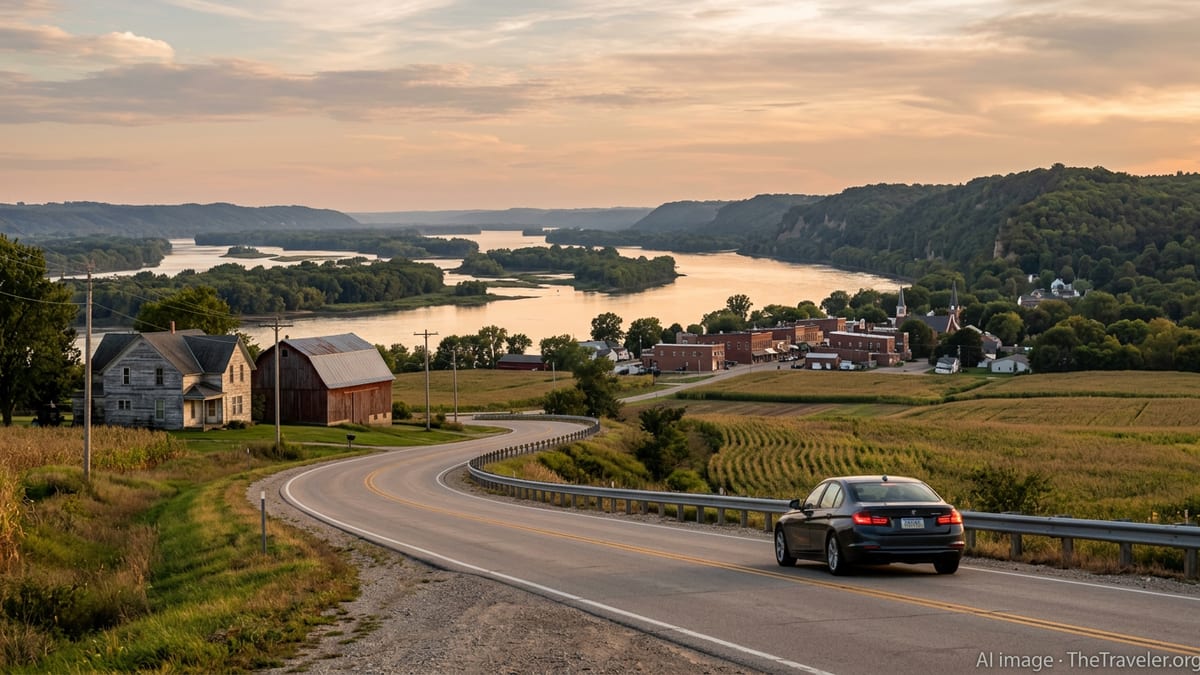
I realized how wrong my assumptions were within 24 hours. Leaving the interstate near Dubuque and following the Great River Road along the Mississippi River, the horizon suddenly folded into wooded bluffs and winding valleys. Northeast Iowa sits in the Driftless Area, a region glaciers missed during the last Ice Age, so the land was never ironed smooth. Instead, I found curving roads, high overlooks and river towns tucked into steep hillsides that felt more like parts of Wisconsin or Minnesota than the stereotype of Iowa.
Near Dubuque, I drove up to one of the city’s hilltop neighborhoods and looked down over a tangle of church steeples, historic brick warehouses and the wide Mississippi below. Later, following local advice, I continued north toward Guttenberg and McGregor, where the highway climbed to overlooks with parking pullouts. From there, the river looked almost lake-like, braided with islands and lined with forest. In the early evening, the water reflected a soft pink sky, and the only sounds were barge horns and the wind in the trees.
The real revelation came when I detoured west toward Decorah. Instead of flat farm grid, the road dipped into limestone-sided valleys and rolled over ridges with views of patchwork fields. Around Decorah itself, the Upper Iowa River cuts a series of S-curves through forested bluffs. Standing on a riverside trail in town, listening to the current and watching kayakers drift by, it was hard to reconcile this scene with the jokes people make about driving “across the corn.”
Small Towns With Big Personality
Another surprise was how distinct Iowa’s small towns felt from one another. They are not interchangeable dots on a map. Each place I visited had a specific story, often tied to immigrant groups who arrived in the 1800s and never quite let go of their heritage. Instead of generic main streets, I found tulip-trimmed facades, German communal villages and Norwegian museums.
In Pella, about an hour southeast of Des Moines, the Dutch influence was impossible to miss. Brick storefronts wrapped around a central square anchored by a working windmill and a canal-style water feature. I stopped into a local bakery and finally tried a Dutch letter, the almond-filled pastry that locals kept recommending. For around three to four dollars, I walked out with a still-warm S-shaped pastry dusted in sugar, the kind of hyper-local snack that immediately makes a place stick in your memory.
A few days later, in Decorah, the tone changed from Dutch to Norwegian. Here, the Vesterheim Norwegian-American Museum takes up multiple downtown buildings, and the sidewalks were dotted with flags and rosemaling motifs. I wandered into an independent outdoor shop, where the staff talked as easily about nearby trout streams as they did about Nordic ski trails in winter. The main street was busy on a weekday afternoon with students from the local college, day-trippers browsing galleries and a steady trickle of cyclists coming off the nearby trails.
The Amana Colonies, a cluster of seven historic villages west of Iowa City, showed yet another side of the state’s cultural patchwork. Founded as a communal society by German immigrants in the 19th century, the villages today are laced with stone and brick buildings, communal kitchens turned restaurants and family-run shops. I stopped in Amana for lunch and ordered a plate of sausages and spaetzle at one of the long-running restaurants, then walked over to Iowa’s original craft brewery for a pint that cost about what you would pay in any mid-sized American city. The difference was the setting: picnic tables shaded by mature trees, conversations drifting between English and German phrases, and the slow hum of visitors exploring the byway.
Iconic Film Locations in Unlikely Fields
Before this trip, I knew little about Iowa’s connection to film beyond a vague sense that Field of Dreams existed somewhere in the state. Driving the back roads toward Dyersville changed that. Cornfields closed in on both sides of the gravel lane, and then, suddenly, the view opened onto a perfectly manicured baseball diamond nestled among rows of corn. It looked exactly like the movie, only quieter.
The Field of Dreams movie site is not a theme park so much as a preserved location with just enough infrastructure for visitors. Admission to walk around the field itself is free, with a suggested donation posted near the parking lot. A small visitor center and shop sell caps, jerseys and baseballs, but the heart of the experience is simply stepping onto the infield and listening to the crunch of the gravel under your shoes. On a weekday morning, families played pickup games, kids practiced sliding into home and a couple in their 60s sat in the wooden bleachers, clearly reliving a favorite film scene.
What surprised me is how uncommercial the place still feels, despite its fame and the Major League Baseball games occasionally held at an adjacent ballpark. The original farmhouse sits on a low rise behind the field, and the corn is close enough that the rustling leaves become a kind of soundtrack. At the edge of the outfield, I watched a father and daughter emerge from between the stalks and onto the grass, laughing at their own recreation of the movie’s ghostly players. It is cheesy and sincere in equal measure, and that mix is precisely what makes it memorable.
This pattern repeated itself elsewhere. Near Winterset, just west of Des Moines, I drove Madison County’s scenic roads to see the covered bridges that inspired a bestselling novel and film. Rather than a single heavily commercialized site, the bridges are scattered around the countryside, linked by twisting roads suitable for an afternoon drive. At one bridge, a handwritten guest book sat inside a small wooden box. Names from around the world filled the pages, proof that people are willing to seek out quiet corners of Iowa when there is a story attached.
Scenic Byways, Gravel Roads and the Joy of Slowing Down
One of the most pleasant surprises of my week in Iowa was how satisfying it felt to get off the interstate and onto the state’s network of scenic byways and county roads. Iowa officially maintains more than a dozen designated scenic byways that connect small towns, state parks and historical sites. Instead of pushing through on Interstate 80, I found myself piecing together routes along the Great River Road, the Iowa Valley Scenic Byway and quiet gravel spurs that locals recommended over gas station counters.
The Iowa Valley Scenic Byway, which runs through the Amana Colonies and along the Iowa River, turned out to be a highlight. The two-lane road wound past farmsteads with red barns, clusters of timber and occasional river overlooks. Farm equipment moved between fields, and I passed more pickup trucks than passenger cars, but the traffic was light enough that I could pull off for photos or to watch sandhill cranes in a flooded field. Speeds were slower than the interstate, but so was the entire rhythm of the day.
Even the gravel roads, which visitors often overlook, became part of the experience. After a conversation with a barista in Decorah, I followed a county gravel road east of town where the pavement ended and fields gave way to a narrow valley, the river flashing between trees. The road was perfectly passable in a standard sedan on a dry day, and the lack of traffic made it easy to stop safely and listen to the wind. In certain sections, clusters of limestone outcrops rose above the roadside ditches, stained with moss and water, hinting at the deeper geologic story under all that topsoil.
Patience is required here. Distances between towns can be deceptive on the map, and adding scenic byways to your route can easily double drive times. But that slower pace is also what turns a utilitarian crossing of Iowa into a trip in its own right. In a single day of meandering, I drove from the Mississippi River bluffs near Dubuque through Amish country around Kalona, then ended up in the Amana Colonies in time for a late dinner, having watched the landscape shift in subtle but constant ways.
Food, Beer and the Comfort of Small-Town Hospitality
Ask Midwesterners what to eat on a road trip, and they will probably mention pork tenderloin sandwiches and pie. Iowa delivered both, but with more variety than I expected. In nearly every town, the local café or bar had its own version of a breaded tenderloin, often so large it overflowed the bun. Prices tended to hover around ten to fifteen dollars with a side, making it one of the better-value meals you can find while covering miles.
In Pella, the bakeries were the real draw. By midmorning, lines formed outside the doors as locals and visitors queued for pastries. I watched a family walk out with a cardboard box of Dutch letters, stroopwafels and loaves of cinnamon bread, the total ringing up less than what a similar haul might cost in a big coastal city. In Decorah, I found a thriving food and drink scene built around the local college and outdoor tourism. A brewery housed in a former industrial building poured IPAs and lagers for a crowd that included trail runners, retirees and families with strollers, all sharing long communal tables.
Back in the Amana Colonies, food is inseparable from history. Some restaurants still serve communal-style meals with casseroles, sauerkraut, potatoes and seasonal vegetables passing from hand to hand down long tables. Even when ordering off a menu, plates arrived heavy with side dishes and breads. At the local brewery, I sampled a flight of beers brewed on-site, with individual pints priced similarly to what you might pay in Des Moines or Minneapolis. On a summer evening, the beer garden felt like an outdoor living room for both residents and visitors, with live music spilling out over the lawn.
The intangible thread tying all of this together was the hospitality. At nearly every stop, someone struck up a conversation the moment they heard I was on a weeklong circuit through the state. A clerk in Dubuque recommended a hidden staircase up the bluff. A server in Decorah drew me a route on a napkin to her favorite river access point. In Winterset, a bridge volunteer pointed me toward a backroad picnic spot. None of this shows up in official brochures, yet it is often what people remember most from a trip.
Practical Realities: Costs, Driving and When to Go
Spending a week driving around Iowa also revealed a few practical surprises, especially for travelers used to coastal or big-city prices. Lodging in most of the towns I visited ranged from budget-friendly motels on the edges of town to locally owned inns and small hotels in the center. In places like Decorah and Dubuque, mid-range hotel rooms can climb in price during peak summer weekends or on event dates, but they still tend to undercut rates in larger metropolitan areas. Meanwhile, smaller communities along scenic byways often have independent motels and bed-and-breakfasts at more modest nightly rates.
Fuel and food costs felt fairly typical for the Midwest, but the value for money was unexpectedly good. Chain restaurants and national fast food outlets are present along the interstates, yet it seldom cost much more to choose a locally owned café in town. In Pella, a generous plate of Dutch-inspired comfort food came in under what I usually pay in comparable touristy small towns elsewhere in the country. Even at popular attractions like the Field of Dreams site, the lack of a formal admission fee and the modest pricing in the souvenir shop kept the experience accessible.
Driving itself was less stressful than I anticipated. Outside of Des Moines and the largest highway junctions, traffic was light. The main adjustment for visitors is simply getting comfortable on two-lane roads, where farm equipment, slow-moving trucks and occasional wildlife are part of the landscape. Distances between fuel stops can grow on the quieter byways, so filling the tank in larger towns before venturing onto gravel or scenic loops is a wise habit. Cell coverage held up along major routes, but there were still pockets where navigation apps dropped out, which made paper maps or downloaded offline maps a useful backup.
As for timing, late spring through early fall is when Iowa’s scenery is at its most engaging. May brings bright green fields and cool days suited to hiking and town-wandering. By July and August, corn and soybeans are high, small-town festivals are in full swing and river recreation is at its peak, though heat and humidity can be intense. Early October is ideal if you want to experience fall color along the Mississippi River bluffs and in the Driftless Area near Decorah, with fields turning gold and hardwood forests shifting through orange and red.
The Takeaway
If you measure destinations by how dramatically they overturn your expectations, Iowa should rank high on any list of American road trips. I arrived assuming I would simply pass through on my way to somewhere else. Instead, I spent a week threading together river towns, immigrant-founded villages, film locations and scenic byways that rewarded a slower pace and a willingness to turn off the main highway.
This is not a state that shouts for your attention. Its beauty is quieter, the kind you notice when the sun breaks through low clouds over a hillside cornfield, or when you turn a corner in a small town and find a meticulously kept public garden tucked behind brick storefronts. The cultural stories, from communal German villages to Dutch windmill towns and Norwegian museums, are woven into everyday life rather than segregated into theme parks.
Perhaps the biggest surprise of all was how much Iowa made me want to return. There were still byways I did not drive, river towns I only passed through and state parks I barely had time to explore. For travelers who enjoy road trips that are more about discovery than ticking off icons, a week in Iowa offers exactly that: room to wander, space to be curious and a chance to reframe what the middle of the country can look and feel like.
FAQ
Q1. How many days do you need for a road trip in Iowa? For a satisfying circuit that includes river bluffs, small towns and a few key attractions, plan at least five to seven days so you are not rushing between stops.
Q2. What is the best time of year to visit Iowa for a road trip? Late May through early October is ideal, with lush green fields in early summer and impressive fall color in northeast Iowa around late September and early October.
Q3. Is it worth getting off Interstate 80 when driving across Iowa? Yes. Detouring onto scenic byways and county roads adds time but reveals bluffs, river valleys and historic towns you would never see from the interstate.
Q4. Do I need a special vehicle for Iowa’s scenic and gravel roads? In normal weather, a standard car is usually sufficient for paved byways and many gravel roads, though you should avoid unpaved routes after heavy rain and watch for farm equipment.
Q5. Is the Field of Dreams movie site open to casual visitors? The Field of Dreams site near Dyersville welcomes day visitors, and you can usually walk the field and sit in the bleachers during posted hours, with a voluntary donation encouraged.
Q6. Are Iowa’s small towns easy to explore without a lot of planning? Generally yes. Most towns have compact main streets, clear signage and visitor information at local shops or chambers of commerce, making it simple to park once and explore on foot.
Q7. How expensive is lodging on a weeklong Iowa road trip? Prices vary by town and season, but you can usually find mid-range chain hotels and independent motels at lower rates than in major cities, with higher prices during festivals and peak weekends.
Q8. What local foods should I try in Iowa? Look for breaded pork tenderloin sandwiches, seasonal sweet corn, locally baked pies and regional specialties like Dutch letters in Pella or communal German-inspired meals in the Amana Colonies.
Q9. Is driving in rural Iowa safe for visitors unfamiliar with farm country? Yes, as long as you drive cautiously, give farm vehicles plenty of space, watch your speed on gravel and remain alert for deer and other wildlife, especially at dawn and dusk.
Q10. Can I combine Iowa with neighboring states on a longer Midwest road trip? Absolutely. Many travelers link Iowa’s river towns and scenic byways with routes through Wisconsin, Minnesota, Illinois or Missouri to create a broader loop around the Upper Midwest.