


I landed in Ljubljana with what I thought were realistic expectations. Friends had described it as “cute for a day” and several guides bundled it into a 24-hour stop between Lake Bled and Croatia. My plan was simple: stay a week, catch up on work, wander a bit, and save my real excitement for elsewhere. By day two, that plan had completely unraveled. Ljubljana was not the quiet, secondary city I had imagined. It was something far more compelling: a small capital that behaves like a big one, just without the chaos.
Arriving With Low Expectations
My first impression of Ljubljana was from the airport bus: fields, low hills, and a compact city appearing almost suddenly on the horizon. After days of delayed flights and crowded hubs, I was braced for another stressful arrival. Instead, thirty minutes after touching down, I was rolling my suitcase over cobblestones near Prešeren Square, past students with ice creams and cyclists ringing their bells. It felt less like a capital and more like a university town that just happened to govern a country.
I had booked a small guesthouse just off the Ljubljanica River, thinking I would need a quiet corner to retreat to. Prices were noticeably kinder than in nearby tourist magnets. A simple, central room with breakfast ran about what I had paid for a bunk bed in Amsterdam earlier that year. It was my first hint that Ljubljana was going to upend my assumptions about cost and comfort in European cities.
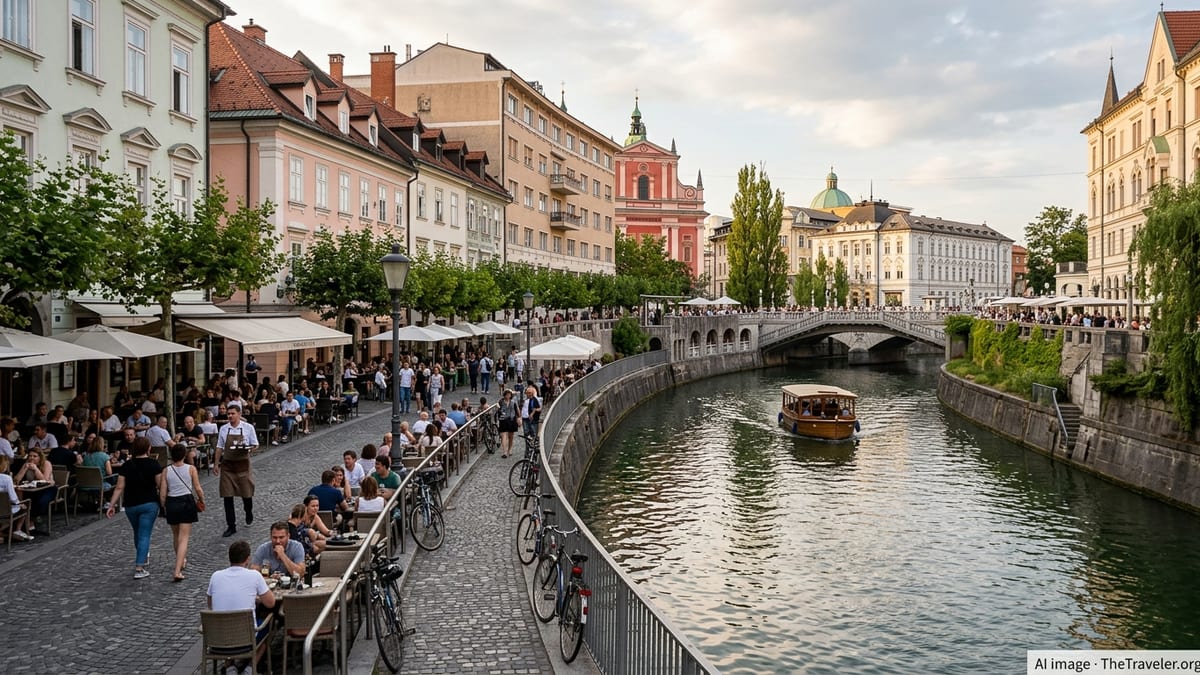
Walking out for the first evening, I expected to do one lap of the old town and feel “done.” Instead, the riverside promenade was buzzing. Cafes and wine bars spilled out onto terraces, heat lamps kept locals chatting outside in the cool evening, and street musicians played under softly lit bridges. It was not packed in the way Venice or Prague can feel in peak season; it was simply alive. I remember thinking: this is far from a one-night stand of a city.
A River City That Lives Outdoors
Most European cities with a river will tell you that the water is their heart, but Ljubljana actually behaves that way. The Ljubljanica is not especially wide or grand, yet its curves define daily life. On my first morning, I grabbed a cappuccino from a small café opposite the Triple Bridge and watched the city wake up: vendors wheeling crates toward the central market, office workers cutting across the square, and couples strolling dogs along the embankment.
The Central Market itself was an unexpected highlight. Under the colonnades designed by Jože Plečnik, I wandered between stalls of late-summer peaches, wheels of Tolminc cheese, jars of honey, and baskets of wild mushrooms. Unlike some markets that feel curated mainly for visitors, this one clearly served locals first; pensioners argued about prices, chefs loaded crates into vans, and teenagers picked up snacks between classes. I bought a handful of cherries and a still-warm burek from a nearby bakery counter and realized that breakfast for under five euros was still possible in a European capital.
Later that afternoon, I took one of the small wooden boats that cruise the river. The tour itself is gentle and almost meditative: low bridges gliding overhead, willows grazing the water, pastel facades reflected in slow ripples. What stayed with me wasn’t just the scenery, but how people used the space. Couples sat with their feet dangling over the edge, students studied on benches, and families shared gelato on the steps. The river wasn’t just a photo backdrop. It was a living room.
Food That Quietly Overdelivers
I did not arrive in Ljubljana expecting to be impressed by the food. In my mind, Slovenian cuisine was a vague mix of Central European staples: lots of meat, heavy sauces, maybe a few dumplings. That stereotype vanished after my first proper meal. At a mid-range bistro just off the main square, I ordered a plate of buckwheat štruklji with roasted vegetables and a glass of local white wine. The bill came in noticeably lower than what I would have paid in neighboring Italy or Austria, but the flavors held their own.
Over the week, I ate my way through the city without once needing to consult a chain restaurant. One night I tried jota, a tangy bean and sauerkraut stew that tasted like it had been made for cold mountain evenings, even though I was eating it on a mild autumn night by the river. Another evening, I had freshwater trout with crisp skin and lemony potatoes at a restaurant where the server chatted matter-of-factly about which valley the fish had come from. It was not “foodie theater,” just a quiet confidence that good ingredients speak for themselves.
What surprised me most was how accessible good meals were. A generous burger with proper toppings in a popular café cost roughly what I might pay for a fast-food combo back home, and a glass of decent Slovenian wine was often just a couple of euros. Even grabbing pastries and coffee for breakfast rarely broke the five-euro mark. Ljubljana felt like a place where quality had not yet learned how to charge full “capital city prices.”
Culture That Feels Bigger Than the City’s Size
On paper, Ljubljana’s population would place it firmly in the “small city” category. In reality, its cultural life felt closer to what I associate with mid-sized capitals. I arrived with vague intentions of visiting the castle and maybe a museum. I left wondering how I had run out of evenings so quickly.
One night, drawn by a poster plastered near the river, I ended up at an open-air concert in Križanke, a former monastery courtyard transformed into a summer stage. The atmosphere was both relaxed and refined: teenagers sat shoulder to shoulder with older couples, tourists shared benches with locals, and the music floated over terracotta rooftops into the warm night air. Earlier in the day, I had seen workers setting up for performances in Kongresni trg, another reminder that festivals and events here are more a rhythm than an exception.
During the day, I ducked into galleries that would not feel out of place in much larger cities. The National Gallery offered a compact but thoughtful look at Slovenian art, and a contemporary space in Metelkova showcased installations that were anything but provincial. Even in small venues, I noticed flyers for film festivals, queer cultural events, and neighborhood art weeks. The message was clear: Ljubljana might be small, but it refused to be culturally quiet.
Day Trips That Kept Pulling Me Out of Town
Before arriving, I had penciled in one day trip, maybe two. By the end of the week, I had taken three, each one a reminder that Ljubljana is less an isolated destination and more a perfect base camp. Trains and buses fanned out from the central station in neat lines, and almost every local I spoke with had a suggestion: “Go to Bled, of course, but don’t forget Bohinj if you like hiking,” or “If you have a car, you can reach the Soča Valley and be back for dinner.”
I started with the classic: Lake Bled. Even with its postcard crowds and higher prices, it was hard to begrudge the attention once I saw the island church and the castle perched on a cliff. The next day, I followed local advice and went farther afield to Lake Bohinj, where the crowds thinned, and the mountains seemed to fold right into the water. A straightforward bus ride returned me to Ljubljana in time for a late meal by the river, city shoes back on after a day in hiking boots.
Another day, I headed south toward the Postojna Cave and Predjama Castle, two more popular but undeniably impressive outings that were easy to reach by public transport and organized tours. Each time, I noticed the same pattern: big landscapes and historical sites during the day, then back to a compact, walkable capital where I could cross the center in ten minutes and still find an open café with decent cake.
A City That Is Green in Practice, Not Just in Slogans
Many cities talk about being green. Ljubljana has quietly built that identity into its everyday routines. I knew, in theory, that it had been recognized for its environmental efforts, but I only really understood what that meant once I was there. The car-free old town surprised me first. Delivery vans and occasional taxis passed through at certain hours, but for most of the day I walked streets where the only traffic came from bicycles and the occasional electric shuttle.
The result was subtle but powerful: conversations at outdoor tables did not have to compete with engines, children played in squares without parents nervously scanning for cars, and the air felt remarkably clean for a city center. Even late at night, I felt comfortable walking home along quiet lanes, guided more by the glow of café lights than by headlights.
Beyond the center, I discovered how close nature really is. One afternoon I followed a local recommendation and walked a section of the Trail of Remembrance and Comradeship, a green path that traces the route of a former World War II barbed-wire fence around the city. In other places, such a history might be marked by a plaque and forgotten. In Ljubljana, it had become a recreational loop: joggers, cyclists, parents with strollers, all moving along a tree-lined path that turns a difficult memory into a daily habit of fresh air.
Unexpected Ease for a First-Time Visitor
What I underestimated most was how easy Ljubljana would be to navigate. I had expected some language barriers, maybe a cumbersome transit system, or the need to pay mostly in cash. Instead, almost everyone I interacted with switched into fluent English without blinking, from bus drivers to market vendors. Contactless payments worked nearly everywhere, including tiny cafes and kiosks. For a traveler used to juggling different currencies and paper tickets across Europe, this ease felt almost uncanny.
The bus network across the city was straightforward, but I rarely used it because so much was accessible on foot. My longest regular “commute” was the ten-minute uphill walk to Ljubljana Castle, which rewarded me with views over red roofs and church spires to the mountains beyond. Even when I did manage to get slightly lost in the more residential neighborhoods, I never felt far from the center; within a few blocks, I would reconnect with a familiar square or bridge.
Prices were another pleasant surprise. While not a rock-bottom bargain, Ljubljana offered solid value for what it delivered: museum tickets that did not punish curiosity, coffee prices that invited lingering, and decent accommodation that did not demand luxury-level budgets. Coming from larger Western European cities where every hour seems to carry a surcharge, I found myself slowing down simply because I could afford to.
The Takeaway
By the end of the week, the version of Ljubljana I had carried in my head before arriving felt almost embarrassing. I had pictured a pleasant but forgettable small capital, good for checking off a castle and a riverfront photo before moving on. What I found instead was a city with a remarkably high quality of everyday life, one where locals actually use their public spaces, culture feels woven into the weekly calendar, and nature waits just beyond the tram lines.
Ljubljana is not the sort of place that overwhelms you with headline sights. Its charm accumulates in quieter ways: the barista who remembers your order by day three, the couple dancing to a busker’s violin at dusk, the way the castle lights up softly above the old town as the last boats glide along the river. It is a city that works beautifully for a week, especially if you give yourself permission to treat it not as a layover but as a base, a place to settle in between lakes and mountains.
If anything, Ljubljana taught me to be suspicious of phrases like “you only need a day there.” Sometimes, those statements say more about our rushed itineraries than about the cities themselves. I left already imagining a return, not for the big-ticket sights, but for more of those unhurried mornings by the river, another circuit along the green trails, and the simple pleasure of a small capital that quietly outperforms its reputation.
FAQ
Q1. Is one week in Ljubljana too long?
For many travelers, a week is ideal. You can explore the compact center thoroughly, enjoy day trips to places like Lake Bled and Lake Bohinj, and still have time to simply linger in cafes without rushing.
Q2. Is Ljubljana expensive compared to other European capitals?
Ljubljana is generally more affordable than many Western European capitals. Coffee, casual meals, and public transport are reasonably priced, while accommodation varies but often offers good value for money.
Q3. Do I need a car to explore Ljubljana and nearby attractions?
You do not need a car for the city itself, which is highly walkable and has a straightforward bus network. For day trips, public buses and organized tours cover popular spots, though a car can be helpful for more remote alpine valleys.
Q4. Is Ljubljana a good base for visiting Lake Bled?
Yes. Regular buses connect Ljubljana to Lake Bled, making it easy to visit as a day trip. Many visitors choose to stay in the capital and visit Bled, Bohinj, or caves and castles without changing hotels.
Q5. How easy is it to get around Ljubljana without speaking Slovenian?
It is very easy. English is widely spoken in hotels, restaurants, museums, and on tours. Signs and menus frequently include English, and most younger locals are comfortable switching languages.
Q6. Is Ljubljana safe for solo travelers?
Ljubljana feels notably safe, including in the car-free old town and along the river in the evening. As in any city, basic precautions are wise, but most visitors report feeling comfortable walking after dark.
Q7. What is the best time of year to spend a week in Ljubljana?
Late spring and early autumn offer mild weather, outdoor cafe culture, and fewer peak-season crowds. Summer brings festivals and lively evenings, while winter can be charming with markets and lights.
Q8. Can I pay by card in most places?
Yes. Contactless and card payments are widely accepted in Ljubljana, from supermarkets and restaurants to many smaller cafes. It is still useful to carry a small amount of cash for occasional smaller vendors.
Q9. Is Ljubljana suitable for remote work during a longer stay?
It can work well. The city has reliable internet, quiet cafes, and a relaxed pace. Many accommodations offer good Wi-Fi, and the compact center makes it easy to balance work with short walks and cultural breaks.
Q10. How many day trips can I realistically do in a week?
In a week, two or three day trips are comfortable without feeling rushed. Popular choices include Lake Bled, Lake Bohinj, and the combination of Postojna Cave and Predjama Castle, all reachable within a day from Ljubljana.