


By the time my train pulled into Roma Termini, I was already a little resentful of the city I had not yet seen. Rome, in my mind, was a place of lines and selfie sticks, a postcard backdrop that had surrendered long ago to tour groups, influencer shoots, and gelato that cost twice what it should. I had even considered cutting it from my itinerary, trading it for a quieter hill town. The only reason I didn’t was a nonrefundable hotel room and a nagging feeling that skipping the Italian capital would be like claiming to have read a book after stopping at chapter one.
Arriving With Low Expectations
That first afternoon in Rome did nothing to soften my impression. Outside the Colosseum, tour leaders waved colored flags like air-traffic controllers trying to land another bus full of visitors. The line to enter the amphitheater snaked past vendors selling plastic gladiator helmets and selfie sticks, and a bottle of water near the entrance cost roughly double what I had paid in Florence earlier that week. At the Trevi Fountain, I shuffled along with hundreds of others, wedged between souvenir stands and people angling for the same three square inches of marble for their photo.
Yet even through the crowds, the city’s beauty leaked through the cracks. Sunlight caught on the travertine stones of the Colosseum, giving them a soft, honeyed glow. In Piazza Navona, I caught glimpses of Bernini’s Fountain of the Four Rivers between umbrellas and selfie rigs. But Rome in daylight felt like a museum on its busiest weekend: objectively impressive, practically exhausting. By early evening, I had decided that the city was exactly what I had feared, a place you visited because you felt you had to, not because you wanted to.
It was only after dinner, when the heat began to loosen its grip and I stepped back out onto the cobblestones, that Rome made its counterargument.
The Moment Rome Switched the Lights On
My hotel was a small place a few blocks from Via Cavour, within walking distance of the Forum. Just after 9 p.m., I followed a side street that spilled gently downhill, the sky turning from cobalt to indigo. The chatter of the daytime crowds had softened to a low murmur. A scooter buzzed past, then another, but the sidewalks were suddenly spacious. The souvenir stands had their shutters down; in their place, doorways glowed with the warm light of trattorias and wine bars.
At the edge of the Roman Forum, I stopped. What had been a sea of tour groups earlier was now almost empty. Spotlights washed over broken columns and temple foundations, etching sharp shadows and revealing details I had barely noticed in the glare of the afternoon sun. The Arch of Titus, which had been a backdrop for countless group photos, now looked improbably delicate, its carved figures standing out in sharp relief.
A handful of other people lingered along the railing: a couple sharing a paper cone of gelato, a man with a camera on a tripod, a local walking his dog. No one rushed. I walked the length of Via dei Fori Imperiali slowly, past illuminated ruins that, for the first time that day, felt like part of a living city instead of a movie set. Night did what no crowd control barrier could: it gave the place back a sense of proportion.
Seeing the “Tourist Traps” After Dark
The next night, I decided to test a theory. If the Forum could transform after sunset, what about the spots most frequently dismissed as “tourist traps” in Rome travel forums: the Trevi Fountain, the Spanish Steps, Piazza Navona. These are the places that see constant foot traffic by day and fill every list of “overrated attractions,” often with the same complaints: too crowded, too commercial, too expensive.
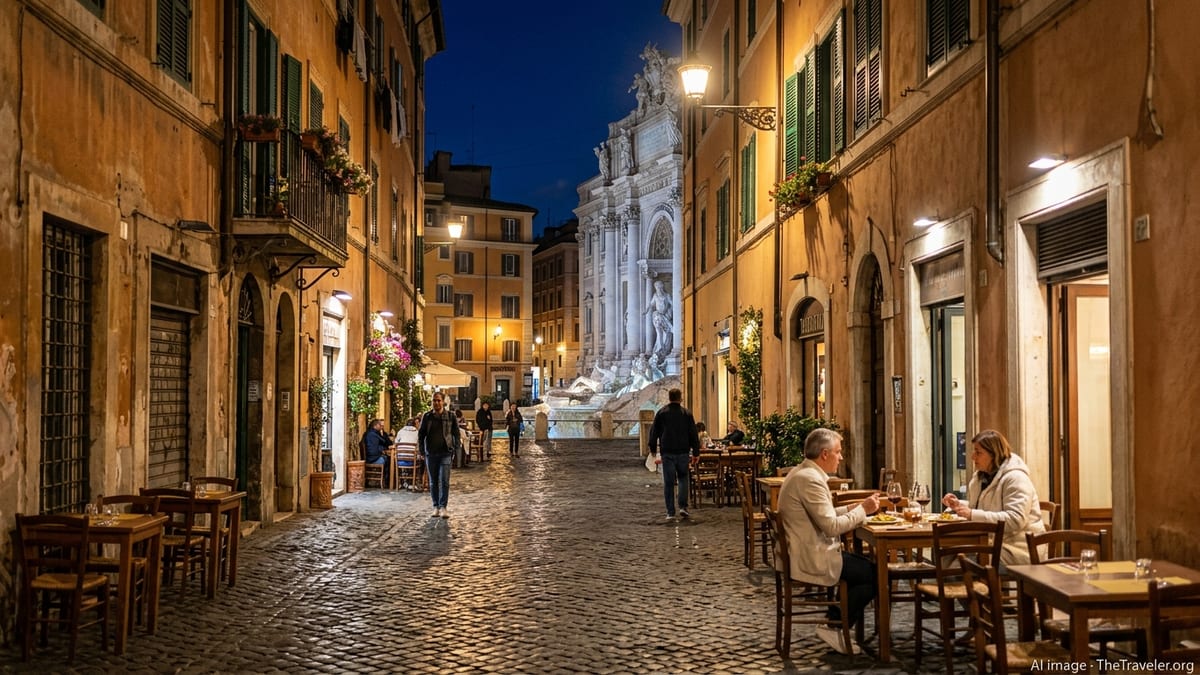
I set out around 10:30 p.m., a time when most day-trippers have boarded their buses back to the coast and cruise groups have disappeared. At Trevi, I braced for chaos. Instead, I found a crowd, yes, but a softer, less frantic version of the daytime crush. Streetlights and carefully placed spotlights bathed the marble facade in a cool glow. The water looked more blue than green, sparkling against the stone. There were still people tossing coins and taking photos, but without the midday heat and the competition for elbow room, the whole scene felt almost tender. A violinist played on the edge of the square; his open case filled slowly with coins from people lingering rather than pushing through.
From there I walked to the Spanish Steps. Earlier in the day, police officers had paced the staircase, reminding people through loudspeakers that sitting on the steps is no longer allowed, a rule introduced to protect the monument from wear. At night, the enforcement relaxed into a kind of mutual understanding. People stood or leaned quietly, looking down toward Via dei Condotti, where the high-end boutiques had gone dark, and up toward the illuminated church of Trinità dei Monti. Overpriced takeaway Aperol Spritz still cost what they did at noon, but now they came with a view that felt earned rather than incidental.
My last stop was Piazza Navona. The painters and caricature artists had packed up. The restaurant terraces were still full, but the thrumming daytime energy had mellowed to a late-night hum. The fountains glowed under the square’s lamps, their sculptures throwing long, elegant shadows across the cobblestones. It was objectively the same piazza. Yet at midnight, surrounded by Italian spoken at neighboring tables and the occasional clink of glasses, it felt less like a stage built for visitors and more like a communal living room that I happened to be passing through.
Why Some Cities Belong To The Night
Rome is hardly the only city that feels different after dark, but it may be one of the best arguments for traveling on a slightly shifted schedule. In an era when overtourism is a constant conversation and crowds are a given in major destinations, more travelers are seeking ways to experience familiar cities differently. Nighttime has quietly become that alternative. Tourism researchers have even begun using the term “noctourism” to describe experiences designed specifically for the hours after sunset, from guided evening walks to late-opening museum programs.
Practically speaking, night gives you back what mass tourism takes away first: space, temperature, and time to linger. In Rome on a hot June afternoon, temperatures often push into the high 80s Fahrenheit, and the area around the Vatican Museums or the Colosseum can feel like the security line at a major airport. At 10 p.m., the same streets are several degrees cooler, the noise lower, and the pace slower. A table that required a reservation at 7 might be available for a casual glass of wine and a plate of cacio e pepe at 10:30.
Other famously “too touristy” cities reveal the same split personality. In Paris, the Trocadéro platform facing the Eiffel Tower is a jostling mess by day, but around midnight the crowds thin, leaving clusters of friends with picnic leftovers as the tower sparkles on the hour. In Bangkok, Khao San Road’s chaotic energy is omnipresent, yet a short walk away, the Chao Phraya Riverfront at night becomes a different city of softly lit temples and quiet ferries sliding across the water. Seeing these places after dark is less about chasing nightlife and more about finding the version of the city that locals recognize when the day-trippers leave.
How Night Changed My Daily Rhythm in Rome
Once I realized how much calmer Rome felt after sunset, I shifted my entire routine. Mornings became my time for indoor sights that required tickets and booking: the Vatican Museums’ early entry hours, the Galleria Borghese’s timed visits. Afternoons, when the sun was at its sharpest and the lines at their longest, turned into a loose combination of naps, slow lunches, and neighborhood wandering in less trafficked areas like Testaccio or parts of Trastevere away from the riverfront.
The real sightseeing started in the evening. I booked an after-dark Colosseum tour that allowed a small group to walk across the arena floor and stand above the underground chambers, lit dramatically but not theatrically. Without the harsh midday light and the roar of thousands of visitors, the amphitheater felt less like a checkmark on a bucket list and more like a structure that had survived almost 2,000 years of human noise and neglect. Inside, our guide spoke in a normal voice. We could hear our footsteps.
On another night, I simply followed the sound of conversation. Rome has countless piazzas, and after 9 p.m. many of them act as informal neighborhood gathering spots. In Campo de’ Fiori, the morning market stalls gave way to outdoor tables and standing-room-only wine bars, while in smaller squares in the Monti district, I found groups of students sitting on fountain rims or church steps, eating slices of pizza al taglio from nearby bakeries that stayed open late. None of it was spectacular in the way of major landmarks, but all of it felt like the city living at its own pace, unbothered by how it looked on a postcard.
Staying Safe and Sane After Dark
There is a reason travel advisories still urge caution about wandering unfamiliar cities late at night. Even destinations considered broadly safe can have neighborhoods where it is better to take a taxi than to walk, especially after midnight. In Rome, central tourist areas like the historic center, Trastevere’s main streets, and the Vatican vicinity generally remain active and well-lit well into the evening, but peripheral train stations and some outlying districts can feel less comfortable after dark. Common sense applies: stay on main streets, keep valuables out of sight, and trust your instincts if a street or underpass feels too quiet.
I made a few simple adjustments. I saved the longest nighttime walks for routes I had already taken during the day, so the turns felt familiar. I noted which bus lines and tram routes still operated reliably after 11 p.m., and I allowed for the occasional taxi when I had pushed my wandering to the edge of the last metro departure. I carried only what I needed: a bit of cash, a card, my phone with a local SIM, and a photocopy of my passport locked away in my hotel safe.
Most of all, I learned to read the city’s body language. A street filled with families finishing dinner on a terrace at 10:30 p.m. felt different than a nearly empty alley lined with shuttered storefronts at the same hour. The first invited a slow stroll; the second called for a brisk, direct walk to a better-lit avenue. Traveling at night is not inherently riskier than moving through a crowded market at noon, but it requires a sharper attention to context. Rome rewarded that attentiveness with quiet, luminous scenes I would have never seen if I had retreated to my room right after dinner.
Letting Go of the “Too Touristy” Label
By the time I left Rome, I had become wary of the phrase “too touristy” in my own planning. The label often says as much about our expectations as it does about the place itself. A city like Rome, which receives millions of visitors each year, will never offer the kind of solitude you might find in a remote village in Basilicata or a small town in Umbria. Yet assuming that crowds erase authenticity overlooks something crucial: locals still live here. They simply adapt their routines around the same forces that frustrate visitors.
In Rome, that adaptation is visible in how residents use time. Office workers and shop owners pour into bars for aperitivo in the early evening, then reclaim piazzas and riverfront paths after the tour groups have gone. Families push strollers along cobbled lanes at 10 p.m. in August, when the temperature has finally dipped. Students sit on the Ponte Sisto bridge at midnight, guitars across their laps, the dome of St. Peter’s shining in the distance. Tourist traffic may dominate the midday hours, but it never fully defines the 24-hour life of the city.
Seeing Rome at night gave me a framework I have since carried to other destinations with similar reputations: Dubrovnik’s old town once the cruise ships depart, Kyoto’s Gion district after the day’s kimono photo shoots wind down, even New York’s Times Square just before dawn when the billboards glow and the sidewalks, for a brief window, belong mostly to street cleaners and early commuters. These hours do not erase the reality of crowds, high prices, or commercialism. They simply reveal that even in the most visited cities, there are still pockets of time that belong more to the place than to its postcards.
The Takeaway
On my last night in Rome, I walked back to the Trevi Fountain around 1 a.m. The crowd had thinned to a few dozen people. A group of friends took turns tossing coins over their shoulders, laughing when someone missed the water entirely and clattered against the stone rim. A hotel worker in a dark suit sat on a bench finishing a takeaway slice of pizza. A street cleaner guided a small machine along the edge of the piazza, its soft whir the loudest sound in the square.
I realized, standing there, that Rome had not changed over the course of my visit. The city was still everything the guidebooks promised and warned about: crowded in peak season, occasionally overpriced, constantly photographed. What had changed was the hours I chose to meet it. By stepping out after dark, I had discovered a Rome that did not need me to validate it, a Rome that went on living whether I admired it or not.
If you find yourself tempted to skip a “too touristy” city, consider staying. Keep your mornings for the must-see sights, surrender your afternoons to shade and slower streets, and then, when the air cools and the lights come on, go back out. Walk the same piazzas you disliked at noon. Sit by the same fountain. Stand before the same monument. You may discover, as I did, that some places are not meant to be judged in daylight alone.
FAQ
Q1. Is Rome safe to explore at night for solo travelers?
Rome’s central neighborhoods, including the historic center and Trastevere’s main streets, are generally considered safe at night if you stick to well-lit, busy areas and use normal urban precautions.
Q2. What time do crowds usually thin out at major sights like Trevi Fountain?
Crowds begin to thin noticeably after about 10 p.m., with the quietest times typically between midnight and 2 a.m., especially outside peak summer weekends.
Q3. Are restaurants in Rome open late enough to combine dinner with nighttime sightseeing?
Many trattorias and wine bars in central Rome serve dinner until around 11 p.m., and some stay open even later, making it easy to eat and then stroll afterward.
Q4. Do I need to book special “night tours” to see Rome after dark?
No, you can enjoy most piazzas, fountains, and viewpoints on your own, though guided after-hours tours of places like the Colosseum or the Vatican offer extra context and quieter access.
Q5. How should I adjust my daily schedule if I want to experience Rome at night?
Plan key indoor sights for early morning, rest or explore quieter neighborhoods in the afternoon, then reserve evenings and late nights for walking the main historic areas.
Q6. Is public transportation reliable late at night in Rome?
Metro lines close around midnight, but night buses and taxis operate later; it is wise to check current schedules and be prepared to use a taxi for very late returns.
Q7. What should I wear for nighttime walks around the city?
Comfortable shoes for cobblestones, a light layer for cooler temperatures, and a small crossbody bag or money belt to keep valuables close are usually sufficient.
Q8. Are famous “touristy” spots really worth visiting after dark?
Yes, landmarks like Trevi Fountain, the Spanish Steps, and Piazza Navona feel noticeably calmer and more atmospheric at night compared with peak daytime hours.
Q9. Can I take good photos of Rome’s landmarks at night without special equipment?
Modern smartphones handle low light reasonably well if you brace your hands or lean against a railing; a small travel tripod can improve results but is not essential.
Q10. How many nights should I plan in Rome to experience both day and night properly?
Spending at least three nights allows time for key sights, slower neighborhood wandering, and several long evening walks to see the city’s character after dark.