

When I set out to cross Austria by train, bus, and the occasional lake ferry, I expected the postcard classics: grand imperial cities, baroque churches, and snow-dusted peaks. I found those, of course, but what stayed with me long after the tickets and hotel receipts were gone were quieter scenes: a misty Danube at dawn, an almost-silent alpine village, a medieval clock tower chiming over red-tiled roofs. These are the places that settled into my memory and, in their own ways, defined Austria for me.
Hallstatt and the Silent Mornings on the Lake
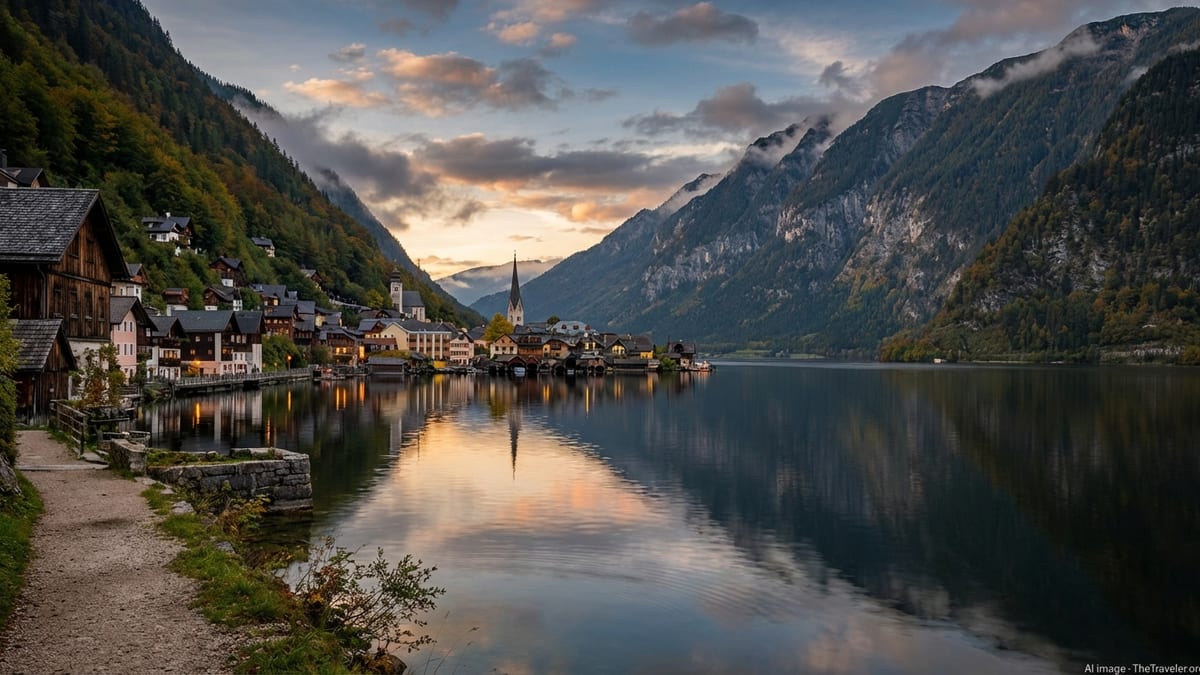
By the time I reached Hallstatt, I had already seen my share of lakes and mountains, yet nothing prepared me for the way this small village presses itself between sheer rock and deep water. The houses seem to cling to the slope, their wooden balconies draped with flowers that double their color in the reflection of Hallstätter See. In the first pale light of morning, when the water is glassy and the village is nearly empty, it feels less like a destination and more like a secret you were not meant to find.
Hallstatt has long been a symbol of Alpine Austria, with a history rooted in salt mining that reaches back thousands of years. Today, the salt mines and the skywalk platform above the village draw crowds, and in peak season day-trippers fill the narrow lanes. Recently, major renovation work has closed the main salt mine complex, cable car, and skywalk facilities, so visiting now means focusing more on the village itself, the lakeside paths, and the forested trails above rather than on headline attractions. In some ways, this pause in infrastructure has returned Hallstatt to something closer to its original rhythm.
The most enduring memory for me is not of any one landmark, but of the changing moods of the lake. Morning mist lifts slowly from the water, revealing the first row of houses; by midday, ferries trace white lines across the surface; in the evening, light drains from the surrounding Dachstein massif while windows begin to glow amber. When I walked the quieter path toward neighboring Obertraun, each turn offered another postcard view back toward the village, and yet the further I went, the more Hallstatt felt like a place to be quietly observed from a distance rather than conquered as a checklist stop.
If you go, give Hallstatt more than a rushed day trip. Stay overnight if possible, venture out as day visitors leave, and let the rhythm of the lake decide your pace. You may find that your most vivid memory is not a photo from an overlook, but a moment on a wooden bench by the shore, listening to the soft knock of boat hulls against the dock.
Graz and the Warm Glow of a Living Old Town
Graz, Austria’s second-largest city, does not shout for attention in the way Vienna often does, and that is precisely why it lingers in my mind. Its historic center is a tightly woven tapestry of Renaissance courtyards, Baroque facades, and steep, red-tiled roofs, all watched over by the proud silhouette of the clock tower on Schlossberg hill. The entire old town is protected as a World Heritage site, yet it feels lived-in rather than preserved behind glass.
What surprised me most about Graz was the blend of the old and the unapologetically modern. A short walk from narrow medieval lanes brings you to the blue, bulbous form of the Kunsthaus, a contemporary art museum nicknamed the Friendly Alien. Nearby, the Mur river is crossed by a sculptural island that functions as both pedestrian bridge and café. It would be easy for this kind of design to feel like spectacle, but in Graz it simply feels like another layer in a city that has never stopped evolving.
I spent an afternoon climbing up to the Schlossberg, first by the steep stone steps and then via shady paths that curl around the hill. From the top, the view was pure storybook: rows of terracotta roofs broken only by church towers and the distant line of green Styrian hills. Down below, the markets were packing up for the day, stalls that had been heaped with fruit and flowers turning into bare wooden tables once more. The city felt both intimate and unexpectedly vast from that vantage point.
In the evenings, Graz reveals a different kind of charm. Students spill out of bars and cafés, the courtyards of townhouses glow softly, and the air fills with the clink of glasses and the low murmur of conversations in German, Styrian dialect, and multiple other languages. With Styria known as the Green Heart of Austria, local menus lean heavily on regional products such as pumpkin seed oil, seasonal vegetables, and wines from the nearby hills. Sharing a simple plate of bread, cheese, and oil at a courtyard restaurant, I understood why many travelers quietly name Graz as the Austrian city they could most easily imagine living in.
Wachau Valley and the Danube in Slow Motion
Some landscapes demand to be seen at high speed, from the window of a train cutting through mountains. The Wachau Valley is not one of them. This 36-kilometer stretch of the Danube between Melk and Krems reveals itself best when you move slowly, by riverboat, bicycle, or on foot through terraced vineyards that seem to slide down toward the water. Here, sunlight reflects off the river, off pale stone monasteries, and off vine leaves that turn from bright green to burnished gold as autumn advances.
On my first morning in the Wachau, I woke to a low fog, the kind that erases details but sharpens outlines. Church towers emerged like ships’ masts from the mist, and the voice of the river traffic carried long before the boats themselves came into view. By midday, the fog had burned off and the valley unveiled its textures: stone drywalls holding the terraces in place, rows of vines stitched across hillsides, and apricot orchards tucked into every available fold of land.
Cycling along the Danube path, I stopped often. In one village, a wine tavern had opened its doors, offering tasting glasses of local white wine and small plates of cold cuts. In another, a short climb led to castle ruins overlooking the valley, the kind of vantage point that once meant strategic control but now simply provides a quiet place to sit and watch the current. Every few kilometers, a different village church or town square anchored the view, each similar enough to feel familiar yet distinct in its own details.
The Wachau is not a wilderness; it is a cultivated, shaped landscape, and that human imprint is part of its beauty. What I remember most is the sense of scale: standing above the river on a vineyard path, the valley felt immense, yet a single farmhouse or chapel brought it back down to human size. As evening fell and the last light caught the surface of the Danube, the entire valley seemed to move more slowly, as if matching its pace to the current.
Innsbruck and the Meeting Point of City and Summit
Innsbruck, set in the Inn Valley and encircled by steep mountain walls, felt to me like the point in Austria where city life and alpine wilderness come closest to shaking hands. The old town is compact and ornate, its arcaded streets lined with pastel facades and the famous Golden Roof glittering over a small square. Yet everywhere you look, your eyes are pulled upward to serrated ridgelines that seem to hover impossibly close above the rooftops.
One morning, I stepped out of a bakery with a still-warm pastry and, on impulse, followed signs for the Nordkette cable railway. Only a short ride later, I found myself stepping out into thin, bright air at a mountain station high above the city. Below, the Inn river twisted through the valley like a green ribbon, and the neat grid of streets in the new town shrank to a child’s model. It was not the most remote alpine view I saw in Austria, but it was the most startling in its proximity to a functioning, modern city.
Back at street level, Innsbruck’s character shifts with the light. In the soft glow of late afternoon, the house fronts along the river become a row of painted boxes, their colors mirrored in the water as trams slide past. Students and office workers share café tables, tourists listen to buskers in the old town, and hiking boots are as common as dress shoes. It is the kind of place where you can spend the morning on a high-altitude trail and the evening in a concert hall, without ever feeling like you have changed destinations.
What stayed with me from Innsbruck was a particular moment: standing on a bridge over the Inn, snow still visible on the peaks though the streets had warmed to spring, I watched the river tumble past, fast and opaque. Behind the houses, the mountains caught the last light, turning first pale gold and then almost purple. The city seemed to exist in a permanent dialogue with its surroundings, each reminding you of the other every time you looked up or down.
Vorarlberg’s Quiet Corners and the Edge of Austria
Far to the west, where Austria leans toward Switzerland and Liechtenstein, the province of Vorarlberg feels subtly different from the rest of the country. The mountains are no less dramatic here, but the tourism narrative is quieter, the crowds thinner, and the architecture often a striking blend of traditional alpine forms and sharp-edged contemporary wood design. It was in these valleys that I sensed how much room Austria still has for unhurried discovery.
I based myself for several days in a small town that sat at the meeting point of rivers and ridges. Wooden houses with deep balconies stood beside modern buildings with clean lines and large windows, all seeming to share the same soft gray and natural timber palette. The air smelled faintly of cut wood and wet stone. Trails began almost at the edge of town, leading to lakes and high pastures that attracted mainly local families and dedicated hikers rather than bucket-list seekers.
On one hike, I reached a plateau above a turquoise mountain lake. The water was so clear that stones on the lakebed seemed close enough to touch, and yet, dipping my hand into the shallows, I felt the sharp, glacial cold. There were no loud viewpoints, no queues for photos, only a handful of people scattered along the shore reading, picnicking, or simply looking. It was a reminder that Austria’s reputation for spectacular scenery is not confined to its most famous resorts.
Evenings in Vorarlberg were some of the quietest of my trip. Villages settled early, with a few lights glowing in windows and the sound of cowbells drifting down from unseen slopes. The sky darkened quickly behind the ridges, and I often found myself walking back along nearly empty streets, the crunch of my own footsteps the loudest sound. Those nights, framed by mountains and muted by distance from the main tourist routes, continue to shape how I think about alpine Europe: not just as a place of dramatic peaks, but as a network of small communities living in close, steady relationship with the land.
Lower Austria’s Gentle Hills and the Places Between
Beyond the glamour of Vienna and the drama of the high Alps, Lower Austria unfolds in a series of gentler scenes that I recall with almost unexpected fondness. Here, broad river plains give way to rolling hills, forests deepen into protected parks, and towns seem to grow not from a single landmark but from the slow accumulation of houses, churches, and farmsteads. It is a region that rewards travelers who are willing to slow down and pay attention to the spaces between better-known sights.
On one autumn trip through this part of the country, I stayed in a small town straddling a clear river, framed by wooded slopes. In the early morning, mist would hang low over the water, and the first sunbeams would catch the fading leaves, turning the valley into a brief theatrical scene before the light flattened into day. A walk from the center took me past modest farmhouses, orchards, and a succession of roadside shrines that marked the passing of generations as much as of travelers.
Lower Austria is also where I first understood the depth of Austria’s relationship with its forests and fields. Local guides spoke of regional trails that connected wine villages, castle ruins, and viewing points, often with simple picnic benches overlooking an entire valley. There were no dramatic cable cars or famous ridges here, but there was a sense that the landscape belonged to those who walked it regularly, rather than those who saw it once from behind a camera lens.
Looking back, my strongest memory of Lower Austria is of standing on a low hill at dusk, watching the last light run along the curve of the land. Villages lit up one by one, not in a blaze but in a gradual, almost shy way. Somewhere a church bell rang the hour, its sound carried by the wind. It was an unremarkable scene by the standards of glossy travel brochures, yet it has remained with me as one of the purest expressions of everyday Austria.
The Takeaway
Traversing Austria from the lakes of the Salzkammergut to the vineyards along the Danube and the quiet valleys of the west, I came to understand the country not just as a montage of famous views, but as a patchwork of lived-in landscapes. Hallstatt’s mirrored facades on still water, Graz’s warm courtyards and hilltop clock tower, the Wachau’s slow river geometry, Innsbruck’s constant conversation with its surrounding peaks, Vorarlberg’s understated alpine spaces, and Lower Austria’s soft, lingering light all offered different ways of seeing the same nation.
If there is a lesson in these lingering memories, it is that Austria rewards those who travel a little slower and stay a little longer. The country’s most powerful impressions were rarely tied to a single attraction or a dramatic reveal, but to the cumulative effect of small details: the taste of local wine in a family tavern, the echo of a church bell across water, the feeling of cold air at a mountain overlook only minutes from city streets. These are the experiences that cannot be fully captured in photographs, but that stay with you long after your journey has ended.
When you plan your own trip, leave room in your itinerary for detours and for places that may not headline travel guides. Wander side streets, linger in lesser-known valleys, and allow yourself to be surprised by a view you did not expect. Austria, I found, is at its most memorable not when you chase its icons, but when you let it unfold at its own, unhurried pace.
FAQ
Q1. When is the best time of year to travel across Austria?
The most rewarding periods are generally late spring and early autumn, when temperatures are moderate, hiking trails are accessible, and major destinations are less crowded than in peak summer.
Q2. How many days do I need for a cross-country trip through Austria?
With careful planning you can see a good mix of cities, lakes, and alpine areas in 10 to 14 days, though adding extra time allows for slower travel and more spontaneous stops.
Q3. Is it easy to get around Austria without renting a car?
Austria’s public transport network is efficient, with frequent trains and regional buses connecting even smaller towns, so it is entirely possible to travel comfortably without driving.
Q4. Are places like Hallstatt and the Wachau Valley overcrowded?
Popular spots can feel very busy in high season and midday, but staying overnight, visiting early or late in the day, and exploring side paths can restore a sense of calm.
Q5. How expensive is it to travel in Austria compared to neighboring countries?
Austria sits in the mid-to-upper price range for Central Europe, but costs can be managed by using public transport, choosing guesthouses, and eating at local taverns instead of only in tourist centers.
Q6. Do I need to speak German to travel comfortably in Austria?
Basic German phrases are appreciated, especially in rural areas, but many people in tourism, hospitality, and transport speak at least some English, making travel manageable for non-German speakers.
Q7. What should I pack for a trip that includes both cities and mountains?
Pack layers, sturdy walking shoes, a light rain jacket, and a small daypack so you can adjust easily to shifting conditions between urban streets and higher-altitude trails.
Q8. Are there any current travel considerations for visiting Austrian alpine regions?
Weather in the mountains can change quickly, so it is wise to check local forecasts and trail information shortly before hikes and to be flexible with plans if conditions deteriorate.
Q9. How can I experience Austria beyond the main tourist sights?
Consider basing yourself in smaller towns, visiting regional markets, joining local festivals when possible, and leaving unstructured time for simply walking, sitting in cafés, and exploring nearby paths.
Q10. Is Austria a good destination for solo travelers?
Austria is generally safe, well-organized, and welcoming, offering a mix of sociable hostel environments, quiet guesthouses, and accessible nature that suits both social and introspective styles of solo travel.