

I thought I knew California. I had flown into its big cities, skimmed its coasts on business trips, and reposted other people’s golden-hour photos from its national parks. But it was not until I drove the length of the state, from the Mexican border to the high Sierra and back along the Pacific, that I realized how much of California exists in the quiet spaces between postcard views. What surprised me most on this journey was not the spectacle of its famous landmarks, but the way this enormous place keeps reinventing itself in the face of crowds, climate pressure and its own mythology.
The First Shock: How Vast California Really Is
On a map, California looks long but manageable, a single block on the western edge of the country. From the driver’s seat, it feels almost continental. I started before dawn in San Diego, rolling past palm trees still wrapped in sleep, confident that I could be closeted in a small Sierra Nevada cabin by late afternoon. I had underestimated everything: the distances, the traffic, the scale of the Central Valley and the irresistible temptation to stop every hour and simply look around.
It is easy to think of California as a patchwork of familiar names: San Diego, Los Angeles, Big Sur, San Francisco, Yosemite. In reality, those cities and parks are dots on a canvas of agricultural fields, arid hills and small towns whose names never appear in travel brochures. Somewhere north of Los Angeles, when the coastal fog gave way to a hard, clear inland light, the sheer width of the valley stunned me. It is one thing to read that California feeds much of the United States, another to drive for hours between orchards, vineyards and fields without ever quite leaving them behind.
This vastness creates its own sense of time. The usual metrics of distance mean less when every detour adds an hour and every scenic pause becomes an improvised stopover. I canceled one planned side trip in the first 24 hours and learned that a realistic California itinerary lets go of the urge to see everything. The state is not designed to be “done” in a single journey. Accepting that truth early changed the tone of the trip from a checklist to a long, curious conversation.
What surprised me most was how quickly the scale becomes addictive. After a few days, three hours between stops felt normal. I began to understand why Californians casually suggest weekend plans that would count as whole vacations elsewhere. In a place this large, driving is not a chore. It is the price of admission.
Rewriting the Myth of the California Coast
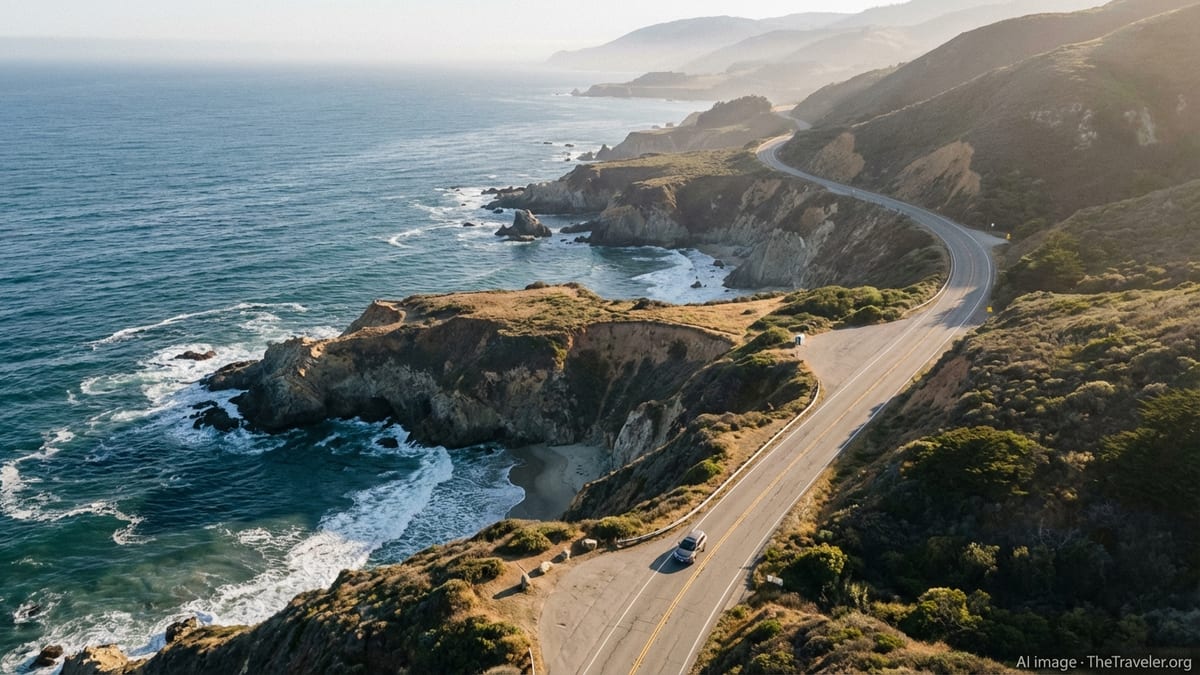
I had grown up on the classic Pacific Coast Highway fantasy: a convertible hugging cliffs above turquoise water, endless sunshine, and a road that seems to glide effortlessly along the edge of the continent. The reality I met was more complicated, and in many ways more interesting. Recovery work from recent wildfires and storms had left sections of the famous coastal route temporarily narrowed or controlled, and there were long stretches where I shared the lane with construction trucks instead of fellow road trippers.
Instead of ruining the experience, those interruptions reshaped it. Waiting at a flagger-controlled section near Malibu, I stepped out of the car and listened. The Pacific was still there, its low roar just beyond a row of orange cones, unbothered by human plans. On other stretches, where the road climbed high and the guardrails dropped away, the coast felt less like a leisurely scenic drive and more like a narrow, fragile thread holding communities together. It was not the frictionless highway of car commercials, but a working road that had to be constantly repaired to survive the same forces that made it beautiful.
Further north, past Santa Barbara and San Luis Obispo, the views grew more dramatic and the surprises more subtle. The light changed first, softening as the coast curved and the marine layer thickened. Small beach towns felt alternately timeless and precarious, with hand-painted motel signs standing a block or two from fresh erosion repairs. Conversations at coffee counters were not about the weather in the abstract, but about the latest winter storm, the last evacuation warning, the new schedule for a reopened stretch of highway.
This living, working coastline was far from the static dream I had expected. It was a place of constant adjustment, where surfers checked both the swell and the wildfire forecast, and innkeepers could tell you as much about road closures as about sunset viewpoints. The surprise was not that California’s coast is beautiful. It was that its beauty now comes framed by an awareness of how quickly wind, water and fire can rearrange the edges of the state.
Yosemite and the New Reality of Crowds
Like many travelers, I had imagined Yosemite as a kind of cathedral: grand, hushed, and perhaps even a little solemn. I did not expect my first impression to be shaped by the logic of reservations and timed entries. In recent years the park has experimented with different systems to manage growing visitor numbers and traffic congestion, adjusting rules by season, time of day and even day of the week. By the time I arrived, the details had shifted again, but the underlying reality remained: Yosemite is wrestling, in real time, with how to welcome millions of people without being overwhelmed by them.
That tug-of-war is most visible in Yosemite Valley, where famous viewpoints now coexist with real-time traffic management, busy parking lots and a steady stream of first-time visitors trying to capture everything before the light changes. Rangers speak calmly about capacity and peak hours. Electronic signs suggest alternate hiking areas when popular trailheads are full. The message is gentle but clear: this is no longer a place you can simply show up at midday on a summer weekend and expect to have to yourself.
Yet even amid the crowds, the park’s power asserts itself in unexpected ways. I walked a short distance from a busy bus stop and, within minutes, found myself almost alone on a side path where the only sounds were the river and the muffled echo of distant voices bouncing off granite walls. It struck me that the new systems, for all their complexity, are attempts to preserve those pockets of quiet. They acknowledge that what people come seeking in Yosemite is not just a photograph, but the feeling of standing in a truly large, truly wild landscape.
The surprise for me was twofold. First, that planning for Yosemite now requires the same level of attention you might give to an international flight, with date windows, peak hours and backup options if your preferred entry slot is unavailable. Second, that the effort is worth it. When the sun set behind El Capitan and the valley shifted from gold to deep blue, the logistics faded into the background. I was left with a simpler realization: in a world of rising demand for limited wild space, careful planning is not the enemy of wonder. It is increasingly the gateway to it.
Fire, Drought and a Landscape on Edge
Before this trip, wildfires were a season in California in my mind, a late-summer headline. On the road, they felt more like a constant possibility, as much a part of the landscape as the eucalyptus trees lining the highways. In gas stations and diners I heard people compare recent fire seasons in careful, almost clinical tones: which valleys had burned, which highways had been closed, which towns had come uncomfortably close. Roadside signs pointed the way to fire information stations with the same neutrality they used to mark visitor centers.
Scars from previous fires appeared unexpectedly along the route. Hillsides that might have once blended into a uniform green now showed mosaics of regrowth and blackened trunks, evidence of past burn perimeters that only revealed themselves in the right light. In certain regions, particularly along stretches of the interior and near some mountain communities, the smell of dry vegetation felt sharper than it had on earlier trips to the West. It was a quiet but insistent reminder that the lush California of tourism campaigns is only one version of the state. There is also a California that waits each summer to see how intense the heat and wind will become.
Recent years have brought cycles of extreme heat, variable snowpack and shifting rainfall patterns, leaving reservoirs and forests alternately flooded and parched. Many locals I spoke with had learned to live in a kind of seasonal vigilance. They could describe which weeks of the year usually brought smoke, how quickly a road might be closed if a fire started in a certain canyon, or how to read the color of the sky on high-risk days. For travelers, this means flexibility is no longer optional. The itinerary that looks perfect in spring can change overnight if a fire sparks near a key junction or if smoke drifts into a popular hiking area.
The surprise was not simply that California is vulnerable to fire and drought. It was seeing how deeply that vulnerability has been woven into everyday decisions: when to travel, where to live, which routes to take home. For visitors, the responsible response is practical rather than fearful. It means checking conditions frequently, respecting closures and understanding that sometimes the most sustainable choice is to turn around or skip a stop rather than push a fragile landscape past its limits.
Beyond the Postcards: Small Towns and the Central Valley
Between the big-ticket destinations of the coast and the mountains lies the Central Valley, a region many travelers cross quickly and remember vaguely as flat and hot. Spending more time there changed the shape of my understanding. The valley is where California’s nickname as the nation’s fruit and vegetable basket takes on literal form. Miles of orchards blurred past the windshield: almonds, pistachios, citrus, grapes. Freight trucks queued at processing plants. Farmworkers moved in the thin shade of treelines, their day measured not by scenic overlooks but by harvest schedules and temperature forecasts.
Stopping in towns along Highway 99 and smaller parallel routes, I found a different California story, one defined less by leisure and more by labor. Diners opened before sunrise to serve workers headed to the fields. Supermarket bulletin boards advertised seasonal jobs in three languages. At a family-run roadside stand, the owner talked about how unpredictable water allocations and increasingly erratic weather patterns had turned long-range planning into a gamble. What made the conversation memorable was its matter-of-fact tone. These were not abstract discussions about climate trends, but calculations about next year’s crops and this year’s payroll.
Travel writing often moves quickly past these inland communities, using them as a backdrop between more photogenic stops. On this trip, they became the emotional center of the journey. It is in places like Fresno, Bakersfield and countless smaller towns that the grand narratives about California’s prosperity either come true or fall apart. The fresh fruit in a coastal hotel’s breakfast buffet, the wine poured at a San Francisco restaurant, the almonds in a snack bag purchased at an airport all originate in landscapes and lives that many visitors never see.
What surprised me most about the Central Valley was its quiet resilience. There are no sweeping vistas to distract from the realities of water scarcity, economic pressure and heat. Instead there is an unromantic determination to keep going, to adapt one season at a time. For a traveler accustomed to associating California with spectacle, this grounded persistence was its own sort of revelation.
Cities in Transition: San Diego, Los Angeles and San Francisco
California’s major cities are often treated as separate destinations, disconnected from the rural landscapes that surround them. On this trip they felt more like mirrors, each reflecting a different response to the same set of pressures: housing costs, climate risk, shifting work patterns and changing tourism habits. Moving between them in a single journey revealed both their differences and their shared challenges.
San Diego, at the southern end of the journey, still leans heavily on its image of easygoing coastal life, but even its laid-back neighborhoods show signs of transition. Waterfront areas balance military infrastructure, cruise ship terminals and public parks in increasingly tight spaces. New development competes for limited coastal frontage, while inland areas grow denser as people look for slightly more affordable places to live. Tourism remains a major economic engine, yet locals talk as much about infrastructure, wildfire risk in surrounding foothills and cross-border dynamics as they do about beaches.
Los Angeles surprised me by feeling both more spread out and more interconnected than in past visits. The city’s long-standing car culture is evolving, with new light rail lines, bus-only lanes and efforts to make at least some neighborhoods more walkable. At the same time, traffic remains a powerful organizing force, dictating everything from work schedules to social lives. For a traveler, the city can feel like a test of patience and planning, but it also rewards curiosity. Neighborhoods just a few miles apart can differ dramatically in character, cuisine and rhythm, reflecting the city’s long history of immigration and reinvention.
Farther north, San Francisco sits on its familiar hills, but the atmosphere has shifted in recent years. Remote work altered downtown patterns, while shifting tech fortunes and a complicated housing market have left some storefronts vacant and others buzzing with new energy. The city’s compact size makes it easy for visitors to move between waterfront views, historic districts and residential streets, but also highlights the contrasts between prosperity and struggle. The surprise, for me, was how much the city felt caught between nostalgia for a pre-pandemic past and cautious experiments with what might come next.
Traveling Responsibly in a Crowded, Fragile State
By the halfway point of the trip, a question kept surfacing: what does it mean to visit California responsibly now. This is a state that depends heavily on tourism, yet also grapples with packed national parks, delicate coastal cliffs and communities living with the constant tension of fire, drought and high housing costs. The answer, I came to feel, is not to stay away, but to show up with a different mindset.
Practical steps matter. Booking national park visits and urban stays well in advance reduces stress on local systems scrambling to handle last-minute surges. Checking fire conditions, road closures and air quality reports before driving into rural or mountain areas is no longer a nice extra, but a basic safety measure. Traveling in shoulder seasons, considering weekday visits to especially popular parks and choosing lesser-known trails can help spread out the human footprint across both time and space.
Equally important is where we spend money and attention. Small towns on the edges of parks, agricultural communities along the valley, and independent businesses in expensive cities all feel the swings of visitor demand acutely. Steering at least part of a travel budget toward local accommodations, family-run restaurants and community-based tours strengthens the networks that make longer journeys possible. Listening to local advice about what areas are under strain, which trails need a rest, and how to navigate busy periods turns travel from a one-sided experience into more of a conversation.
The surprise was realizing how much satisfaction comes from treating California less as a backdrop for personal adventure and more as a shared space to be cared for. The scenery is still spectacular, but the memories that linger longest are often the small interactions: a ranger explaining why a trail is temporarily closed for restoration, a cafe owner pointing travelers toward a lesser-known viewpoint, a farm stand worker describing how late the rains arrived this year. These moments make the responsibility feel less like a burden and more like an invitation to belong, however briefly, to the places we pass through.
The Takeaway
When I set out to drive across California, I expected variety. I anticipated shifting landscapes, changes in climate, and the visual drama that has filled countless travel documentaries and social media feeds. What I did not expect was how much the trip would challenge my assumptions about what travel in a famous destination should feel like. California today is not a static dreamscape but a living, contested, carefully managed place where beauty and vulnerability sit side by side.
The surprises took many forms. Distance turned out to be a character in its own right, stretching days and plans. Iconic routes revealed themselves as fragile infrastructure kept open by constant work. National parks showed how much orchestration is now required to offer even a few hours of quiet awe to millions of visitors a year. Small towns and inland valleys demanded to be seen not as empty spaces between highlights, but as the working heart of the state.
Most of all, the journey made clear that the old fantasy of carefree, unplanned wandering through California belongs to another era. The new reality asks for research, flexibility and a willingness to adapt in response to climate, crowds and community needs. Far from diminishing the experience, that awareness deepens it. To travel across California now is to witness a state in the middle of profound change and to accept a modest role in shaping what kind of place it will be for future travelers.
I finished the trip tired, with a film of dust on the car and a camera roll full of both sweeping views and unspectacular roadside notes. Yet I also felt something rarer: a renewed respect for how complex and fragile even the most iconic destinations have become. California is still astonishing. It is just no longer the simple dream I had imagined. It is, in many ways, more interesting than that.
FAQ
Q1. How much time do I really need for a road trip across California?
For a meaningful trip that includes the coast, a national park and at least one major city, two weeks is a comfortable minimum. With less time, it is better to focus on one region rather than trying to cover the entire state.
Q2. When is the best season to travel across California?
Spring and fall generally offer milder temperatures, fewer crowds in many areas and better driving conditions. Summer can be spectacular on the coast and in the mountains but is typically busier, hotter inland and more prone to wildfire smoke.
Q3. Do I need reservations for national parks like Yosemite?
Reservation policies change from year to year, especially in popular parks. In recent seasons, Yosemite and other major parks have used some form of timed entry or peak-hours reservations. It is important to check official park information and secure required permits or entry slots well in advance.
Q4. How concerned should I be about wildfires when planning my trip?
Wildfire risk is now a regular consideration, particularly from late spring through fall. Travelers should monitor current conditions, follow local guidance, be prepared for possible road closures and have flexible backup plans if smoke or fire affects a region.
Q5. Is it safe to drive the Pacific Coast Highway today?
The Pacific Coast Highway is generally safe but can be narrow, winding and vulnerable to closures from landslides, storms or fire recovery work. Before you set out, review current road advisories and be prepared for slow sections, temporary traffic controls and weather-related changes.
Q6. How can I travel more responsibly in California’s crowded destinations?
Travelers can help by visiting in shoulder seasons or on weekdays, respecting closures, staying on marked trails, supporting local businesses, conserving water and energy and following Leave No Trace principles. Thoughtful planning reduces strain on popular areas and nearby communities.
Q7. Do I need a car, or can I rely on public transport?
In major cities like San Francisco, Los Angeles and San Diego, public transit and rideshares can be effective. However, for exploring national parks, small towns and rural regions, having a car remains the most practical option due to limited transit coverage.
Q8. How expensive is a cross-California trip compared with other U.S. states?
California can be more expensive than many parts of the United States, especially in coastal cities and gateway towns near national parks. Costs can be managed by mixing lodging types, traveling outside peak holidays and seeking local, off-the-beaten-path dining options.
Q9. What should I pack for such varied climates?
Packing layers is essential. Temperatures can shift quickly between the coast, inland valleys and higher elevations. A light jacket, sun protection, comfortable walking shoes and a reusable water bottle are useful almost everywhere.
Q10. Is California still worth visiting despite crowds and climate challenges?
Yes. The state’s landscapes, cultural diversity and range of experiences remain remarkable. Visiting with realistic expectations, flexible plans and a sense of shared responsibility can make the journey rewarding while also supporting the places and people that make it possible.